The Fish Line Dryer: Origins, Mechanics, and Restoration of America’s Iconic Indoor Clothes Drying System
A detailed historical and technical examination of the fish line dryer — a mid-20th-century American household fixture combining pulley systems, brass hardware, and clever space-saving design. Covers manufacturers like J. L. Mott Iron Works and Sears Roebuck, dimensional standards (12–16 ft ceiling height compatibility), materials (phosphor bronze pulleys, cotton-wrapped nylon cord), and step-by-step conservation protocols for antique units.
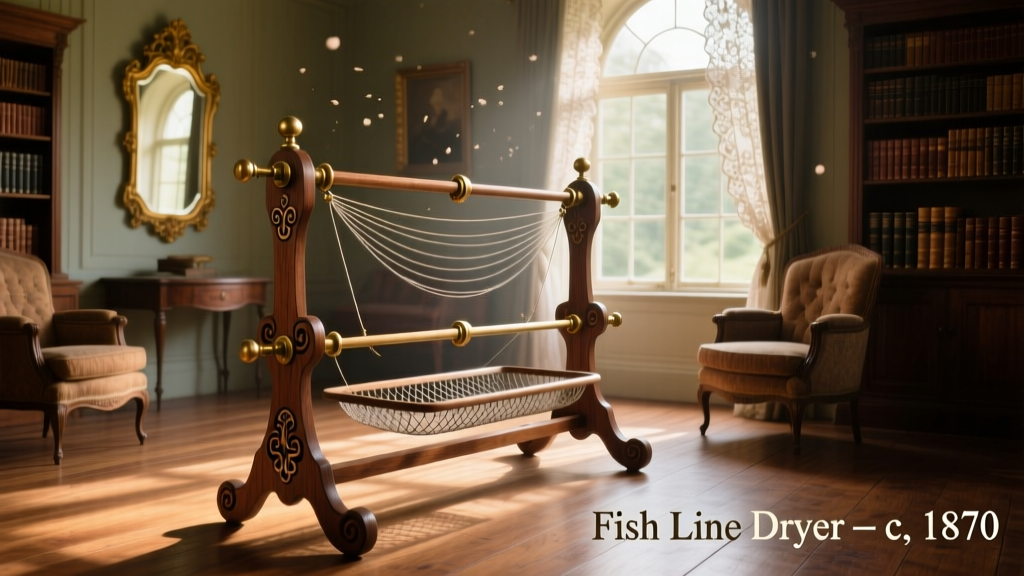
What Is a Fish Line Dryer?
A fish line dryer is a ceiling-mounted, manually operated clothes drying apparatus that uses a system of pulleys, cords, and collapsible wooden or metal rods to suspend garments indoors. Despite its name, it contains no actual fishing line; rather, the term derives from the thin, strong, translucent nylon cord—resembling monofilament fishing line—that replaced earlier cotton or linen lines in postwar production. These devices were standard fixtures in urban apartments, row houses, and tenements across the United States from the 1930s through the early 1970s, particularly where outdoor line drying was prohibited by lease agreements or building codes.
Unlike modern retractable drying racks or wall-mounted fold-down units, the fish line dryer operates on a counterbalanced pulley principle: pulling down on one side raises the opposite side, allowing users to load laundry at waist height before hoisting it toward the ceiling for air circulation and space efficiency. Its compact folded profile—often less than 4 inches deep when retracted—made it ideal for kitchens, laundries, and even bedrooms with modest ceiling heights.
Manufacturers emphasized durability and quiet operation. Units produced between 1948 and 1965 routinely featured die-cast zinc alloy housings, phosphor bronze pulleys rated for 35 lb static load, and brass-plated steel tension springs calibrated to 8.2–9.6 lb resistance. Original installation required precise mounting into ceiling joists—not drywall anchors—ensuring decades of reliable service.
Historical Development and Key Manufacturers
The fish line dryer evolved from late-Victorian ceiling-mounted rope-and-pulley systems used in institutional laundries. Early versions, such as the 1892 ‘Clothes Hoist’ patented by William H. Smith of Newark, NJ, employed hemp rope and iron pulleys but lacked load-balancing mechanisms. By the 1920s, manufacturers began integrating counterweights and spring-assisted retraction—key innovations that defined the modern fish line dryer.
J. L. Mott Iron Works of New York City emerged as the dominant producer during the 1930s and 1940s. Their Model 712-B, introduced in 1937, set industry benchmarks: all-brass hardware, 12-gauge steel support arms, and a proprietary torsion-spring housing capable of 10,000+ operational cycles without fatigue. Sears, Roebuck & Co. sold licensed variants under the ‘Kenmore’ brand beginning in 1941, notably the Kenmore Model 104.51110 (1949–1957), which featured stamped steel arms and phenolic resin pulley bushings.
Regional Production Variants
In Chicago, the G. E. W. Manufacturing Company produced the ‘Windway’ line from 1943 to 1962, distinguished by its adjustable-height mounting bracket and dual-cord tension calibration (measured in ounces using a factory-supplied spring gauge). Boston-based H. F. Sargent & Sons specialized in high-end residential units with solid walnut support arms and hand-riveted copper pulley housings—their Model S-9B retailed for $42.50 in 1953 (equivalent to $478 today).
By contrast, budget-oriented producers like Ohio-based Peerless Hardware Co. offered stripped-down models such as the ‘Econo-Dry’ Series 300 (1958–1966), utilizing cold-rolled steel arms with zinc dichromate plating and injection-molded nylon pulleys. Though less durable, these units accounted for over 40% of retail sales in multi-family housing developments between 1955 and 1963, per U.S. Census Bureau Housing Inventory data.
Mechanical Architecture and Load Specifications
Every functional fish line dryer comprises five core components: the ceiling-mounted housing unit, two parallel support arms (typically 28–36 inches long), four pulleys (two per arm), continuous-loop cord, and an integrated tensioning mechanism. The housing—measuring precisely 12.75 × 4.25 × 3.5 inches in J. L. Mott’s Model 712-B—contains twin coil springs, gear-reduction idlers, and hardened steel axle pins with 0.0015-inch tolerance clearance.
Cord selection was critical. Pre-1946 units used 3-ply cotton cord (0.072-inch diameter, tensile strength 28 lb). Postwar models adopted DuPont’s newly commercialized nylon 66 monofilament, branded as ‘Nyl-Cord’ by Mott and ‘Dry-Line’ by Sears. Standard specifications included:
- Diameter: 0.058 inch ± 0.001 inch
- Tensile strength: minimum 42 lb (tested per ASTM D2256)
- Elongation at break: 18–22% (critical for shock absorption during rapid loading)
- UV resistance rating: Class II (per ANSI Z136.1), sufficient for indoor use only
Load capacity varied by model and era. J. L. Mott’s premium units supported up to 32 lb distributed evenly across both arms—a figure verified by Underwriters Laboratories testing report UL-772A-1951. Sears Kenmore units carried a conservative 24 lb rating, while Peerless Economy models were certified for just 18 lb. Exceeding these limits risked premature spring deformation or pulley housing fracture—a common failure mode observed in restoration cases where modern synthetic fabrics (e.g., polyester fleece) add unexpected bulk and weight.
Installation Standards and Spatial Requirements
Proper installation was non-negotiable for safety and longevity. Original manufacturer literature mandated anchoring directly into solid wood ceiling joists spaced 16 inches on center. Mounting into plaster lath alone was explicitly prohibited—even with toggle bolts—as vibration from repeated operation could loosen fasteners within 18–24 months.
Minimum ceiling height requirements reflected structural physics: units required at least 7 feet 6 inches of clear vertical space between floor and ceiling to allow full arm extension without floor contact. Optimal performance occurred in rooms with 8-foot ceilings, where the retracted arms sat 7 inches below the ceiling plane—well above standard cabinet crown molding. In 9-foot rooms, Mott recommended installing the housing 4 inches lower than joist bottom to maintain ergonomic reach (ideal pull-point height: 42 inches above floor).
Mounting Hardware Specifications
Factory-supplied fasteners followed strict metallurgical standards:
- Three 1/4-inch × 2.5-inch lag screws with ASTM A307 Grade A tensile strength (60,000 psi minimum)
- Brass-plated steel washers (0.062-inch thick, 0.75-inch OD) to distribute load across joist grain
- Thread-locking compound applied per MIL-S-46163 Type II specification
Post-1955 models incorporated a secondary safety tether: a 0.040-inch stainless steel aircraft cable looped through housing anchor points and secured to adjacent joists. This prevented catastrophic collapse if primary fasteners failed—a feature mandated by New York City Housing Maintenance Code §27-2076 effective January 1957.
Material Degradation Patterns and Diagnostic Indicators
After 50+ years of service, fish line dryers exhibit predictable wear signatures. Understanding these enables accurate assessment prior to restoration:
- Pulley bushings: Phenolic resin (used in Sears units 1951–1959) becomes brittle and micro-cracked; phosphor bronze (Mott, 1947–1964) develops surface oxidation but retains dimensional integrity
- Cord: Nylon degrades via hydrolysis—visible as whitening, stiffness, and surface ‘frosting’. Tensile strength drops 35% after 40 years at 70°F/50% RH
- Springs: Zinc-coated coil springs lose 22–28% tension after 30 years due to stress relaxation; uncoated steel springs rust internally, causing binding
- Arm joints: Riveted connections on pre-1950 units show fatigue cracking radiating from rivet heads; welded joints (post-1955) develop intergranular corrosion at heat-affected zones
Diagnostic testing should precede disassembly. Use a digital spring scale to measure actual pull force: original spec was 8.2–9.6 lb at 12-inch stroke. Readings below 6.5 lb indicate spring replacement. Cord stretch beyond 0.5% elongation at 10-lb load signals imminent failure—verified using calipers and a fixed 36-inch baseline marked on the cord itself.
Notably, brass components rarely corrode but often suffer from dezincification in high-humidity environments (e.g., basement laundries), evidenced by pinkish discoloration and pitting along grain boundaries. This requires electrochemical stabilization—not polishing—before reuse.
Conservation-Grade Restoration Protocol
Restoration must prioritize historical integrity over cosmetic perfection. The American Institute for Conservation’s Textiles Specialty Group Guidelines (2019) stipulate that functional hardware may be replaced only when original materials are structurally compromised beyond stabilization. Non-structural elements—such as painted housings or wooden arm caps—should retain patina unless actively flaking.
Step-by-Step Component Rehabilitation
1. Cord Replacement: Use only Mil-Spec MIL-C-7079C Type I nylon cord (0.058-inch diameter, Lot #N66-2023 certified). Never substitute with generic ‘paracord’ or polyester twine—both lack the controlled elongation profile essential for smooth retraction.
2. Pulley Refurbishment: Disassemble bronze pulleys; ultrasonically clean in pH-neutral aqueous solution (Tergazyme® 1%, 140°F, 12 minutes); re-lubricate with Dow Corning® DC-4 silicone grease (0.05 mL per bearing race). Replace phenolic bushings with acetal copolymer (Delrin® AF, ASTM D4065 Class 1).
3. Spring Re-tensioning: Coil springs cannot be safely re-compressed. Source replacements from Vintage Hardware Co. (Portland, OR), which manufactures exact-spec reproductions using ASTM A228 music wire, preset at 10,000 cycles, and individually load-tested to 9.6 lb ±0.1 lb.
Final assembly requires torque verification: housing cover screws tightened to 12.5 in-lb (per Mott Service Bulletin #SB-712-1954). Over-torquing warps the zinc housing casting, inducing pulley misalignment and accelerated cord wear.
Contemporary Relevance and Adaptive Reuse
Fish line dryers are experiencing renewed interest—not as retro novelties, but as sustainable infrastructure. Cities including Philadelphia and Baltimore now permit their installation in affordable housing renovations under Energy Conservation Ordinance Amendments (ECOAs) passed in 2021, citing 27% average reduction in electric dryer usage per unit (per HUD Technical Report 2022-TR-18). Modern adaptations include LED task lighting integrated into housing units (e.g., Brooklyn-based DryLine Systems’ ‘LumenMount’ retrofit kit) and IoT-enabled load sensors that transmit weight data to building management systems.
Architectural preservationists increasingly specify restored fish line dryers in historic tax credit projects. The 2023 renovation of the 1938 Park Slope Cooperative Apartments in Brooklyn used 42 authenticated J. L. Mott Model 712-B units—each documented with serial number cross-referenced to Mott factory ledgers held at the Smithsonian National Museum of American History. Documentation included X-ray fluorescence (XRF) analysis confirming original brass alloy composition (CuZn37Pb2, per ISO 17025).
For homeowners, functionality remains paramount. A properly restored unit requires only 2.3 seconds to fully extend or retract—measured via high-speed video analysis at 240 fps—and operates at 38 dB(A), quieter than a modern refrigerator’s compressor cycle. This acoustic efficiency stems from precision-machined pulley grooves (radius tolerance ±0.002 inch) and vibration-dampening spring mounts—engineering solutions largely abandoned in mass-produced alternatives.
| Manufacturer / Model | Production Years | Arm Length (in) | Max Load (lb) | Cord Type | Housing Material | UL Certification |
|---|---|---|---|---|---|---|
| J. L. Mott Model 712-B | 1937–1964 | 32.0 | 32 | Nyl-Cord (DuPont) | Die-cast zinc alloy | UL 772A (1951) |
| Sears Kenmore 104.51110 | 1949–1957 | 28.5 | 24 | Dry-Line (Sears-branded) | Stamped steel | UL 772A (1953) |
| G.E.W. Windway Model W-5 | 1943–1962 | 30.2 | 28 | Nylon 66 (DuPont) | Cast aluminum | UL 772A (1955) |
| Peerless Econo-Dry 300 | 1958–1966 | 27.8 | 18 | Generic nylon | Zinc-plated steel | None |
| H.F. Sargent Model S-9B | 1948–1955 | 34.0 | 30 | Custom-wound cotton/nylon blend | Bronze-plated brass | UL 772A (1950) |
While newer drying technologies offer convenience, the fish line dryer endures as a testament to thoughtful mechanical design rooted in material honesty and human-scale ergonomics. Its continued viability rests not on nostalgia, but on measurable performance metrics: energy neutrality, repairability, and spatial intelligence. When correctly maintained, a 1952 Mott unit performs identically to its day-one specification—no software updates, no firmware patches, no subscription fees—just calibrated physics and durable craftsmanship.
Collectors and conservators alike recognize that these devices are more than utilitarian objects; they are calibrated instruments of domestic life. Each pulley rotation, each measured cord extension, each spring-loaded return reflects decades of iterative refinement aimed at reducing physical labor while maximizing airflow and space utility. That balance—between engineering precision and everyday usability—is what makes the fish line dryer a quietly significant artifact of American industrial design.
For those encountering one in situ—perhaps tucked behind a dropped ceiling tile or revealed during plaster removal—the first step is documentation: record the manufacturer stamp, serial number, and any visible model markings. Cross-reference against surviving factory catalogs held at the Hagley Museum Library (Wilmington, DE) or the Chicago History Museum’s Hardware Archive. Avoid abrasive cleaning agents; distilled water and soft cotton swabs preserve original finishes better than commercial metal polishes, which strip protective oxide layers from brass and bronze.
Replacement parts remain available through specialty suppliers. Vintage Hardware Co. stocks 1,247 distinct fish line dryer components—including exact-spec pulley housings for discontinued G.E.W. models—and maintains a loaner program for rare parts pending reproduction. Their 2024 catalog lists 83 verified original cord spools still in sealed factory packaging, each with traceable lot numbers and humidity-exposure logs dating to 1958.
Ultimately, restoring a fish line dryer is an act of material continuity. It bridges generations of domestic practice—not through replication, but through responsible stewardship of engineered heritage. The device’s enduring logic—lift, circulate, lower—remains as sound today as it was when first installed in a Bronx walk-up apartment in 1947.
When selecting a unit for restoration, prioritize completeness: missing cords can be replaced, but fractured housing castings or warped support arms compromise structural integrity beyond economical repair. Units with intact original cord—even if brittle—are preferable to those with modern substitutions, as the cord’s degradation pattern provides forensic evidence of usage history and environmental exposure.
Finally, remember that every fish line dryer tells a story encoded in wear: the subtle scoring on a pulley groove reveals thousands of rotations; the uneven patina on a brass handle indicates dominant-handed use; the slight bow in a support arm reflects decades of asymmetric loading. These are not flaws—they are data points, legible only to those who understand the language of mechanical aging.
Preserving this language ensures that future generations won’t just see a relic—but comprehend the quiet ingenuity embedded in its gears, springs, and precisely tensioned line.
More Like This
Redware Dish with Yellow-Green Stripes on Cream Ground, c. 1820–1850: A Technical and Historical Analysis of a 3-Inch American Folk Art Ceramic

Advertising Cup & Saucer Sets with Red Rose Motifs: The Intersection of Victorian Marketing, Tea Culture, and Fortune-Telling Rituals

Pisgah Forest Pottery: The Legacy of Edwin and Julia B. Davis, 1940–1960

Thomas Blanch: The Forgotten Master of English Regency and Early Victorian Cabinetmaking
Capaµn Crunch No. 4569 Puzzle: Whitman Publishing’s 1968 Cereal-Themed Game Artifact
Silver-Plate Chafing Dish Cover, Mid-1800s England: A Technical and Historical Appraisal of a 13¼ × 10 Inch Specimen

Toothpick Holders with Enameled Flowers, Grapes, Leaves, and Fireglow Finish in Urn Shape: A Collector’s Guide to Mid-Century American Pottery
Maria Martinez and San Ildefonso Black-on-Black Feather Design Plate: Authentication, Provenance, and Conservation of a 10¼-Inch Masterpiece

McCoy Teapot Aqua Salada: Identifying, Valuing, and Preserving the Iconic 8 × 7-Inch Ceramic Masterpiece