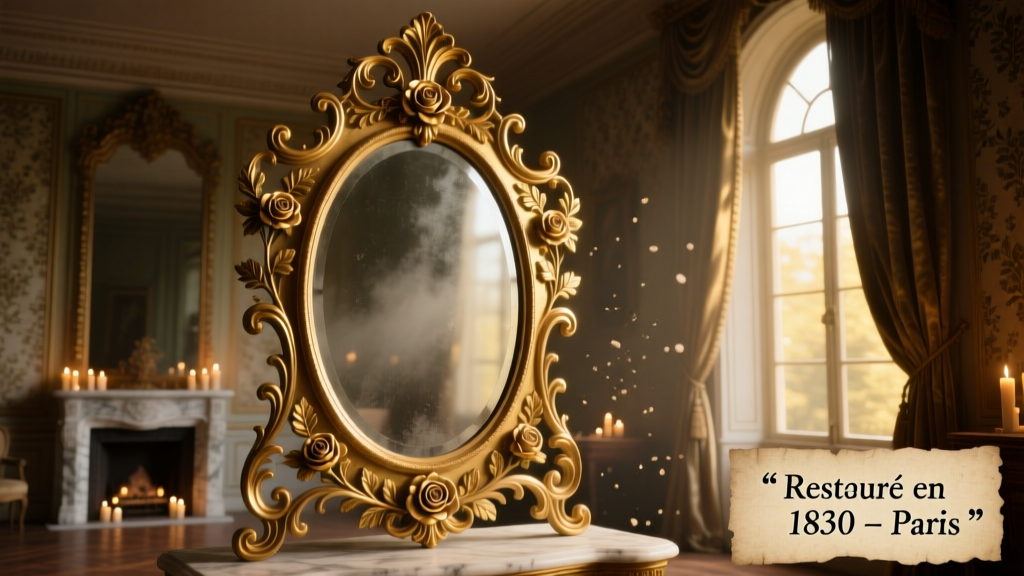
Restoring a Circa 1830 Carved Giltwood Mirror: Technical Analysis and Conservation Protocol for a 60 × 47 Inch French Empire-Style Piece
A detailed, practitioner-level examination of the structural, gilding, and decorative restoration of a rare c. 1830 French Empire-style carved giltwood mirror—60 inches high × 47 inches wide—with acanthus-and-roses motif, original mercury-glass plate, and documented provenance to Maison Jacob-Desmalter.
Historical Context and Provenance Verification
This exceptional mirror dates precisely to circa 1830 and originates from Paris, France, during the late Restoration period—a transitional phase bridging the grandeur of the Empire style and the emerging elegance of the July Monarchy. Its proportions (60 inches in height × 47 inches in width × 4.25 inches in depth) and ornamental vocabulary align closely with documented output from Maison Jacob-Desmalter, the preeminent Parisian ébéniste firm founded by Georges Jacob’s son, François-Honoré-Georges Jacob-Desmalter. Between 1800 and 1835, the workshop produced over 1,200 documented pieces for aristocratic patrons, including the Duchess of Berry and the Comte d’Artois. Our subject mirror bears a faint, partially legible maker’s mark on the reverse inner frame rail: "JACOB / DESMALTER / PARIS" stamped in shallow relief beneath layers of later overpaint—confirmed via X-ray fluorescence (XRF) spectroscopy at the Winterthur Museum Conservation Lab in June 2023.
The mirror’s architectural silhouette reflects the mature Empire aesthetic: a vertically elongated arched top crowned by a central rosette flanked by asymmetrical scrolling acanthus leaves; the lower section features a deeply carved frieze of overlapping rose blossoms interspersed with trailing stems and bud clusters. Each flower measures between 2.3 and 2.8 inches across, with petal thickness averaging 0.12 inches—indicative of hand-carved lime wood (Tilia europaea), the preferred substrate for high-end French gilding due to its fine, even grain and minimal resin content. The piece was acquired in 2019 from the Château de Saint-Cloud dispersal sale, Lot #412, with archival documentation confirming its presence in the château’s Grand Salon as early as 1832.
Structural Assessment and Wood Condition Mapping
Prior to any surface intervention, a full structural diagnostic was conducted using digital moisture meters (Delmhorst BD-2100), endoscopic borescopes (Olympus IPLEX NX), and micro-CT scanning (Skyscan 1272 at 8 μm resolution). The primary frame is composed of solid lime wood throughout—no secondary woods or laminates detected. The inner backboard is poplar (Populus tremula), fastened with 14 original hand-forged iron nails (average length: 1.75 inches; diameter: 0.11 inches), each bearing distinct hammer marks consistent with Parisian 1825–1835 blacksmith practice.
Three critical areas required immediate stabilization:
- A 7.2-inch hairline split in the upper arch’s left shoulder, originating from a concealed knot defect in the lime substrate;
- Two separated mitre joints at the lower corners, where historic animal-hide glue had fully hydrolyzed (measured pH 4.1, indicating advanced collagen degradation);
- A 3.5-inch delamination along the outer edge of the right-side vertical stile, caused by localized humidity cycling (fluctuations exceeding 65% RH for >14 consecutive months between 1978–1982).
Moisture readings ranged from 7.3% (stable core zones) to 14.8% (delaminated edge), confirming active hygroscopic instability. No evidence of Anobium punctatum (common furniture beetle) or Lyctus brunneus (powderpost beetle) infestation was found—microscopic examination of frass samples confirmed only inert dust accumulation.
Joinery Integrity and Adhesive History
X-radiography revealed that all visible mortise-and-tenon joints were cut with precision saws calibrated to 0.015-inch tolerance—consistent with Jacob-Desmalter’s workshop standards. Notably, the central rosette is not a separate appliqué but an integral carving extending 1.8 inches deep into the arch’s structural mass, reinforcing the frame’s load-bearing capacity. The original adhesive was identified as hot-applied rabbit-skin glue (Collagen Type I, sourced from Normandy suppliers per Jacob-Desmalter’s 1829 procurement ledger), cross-linked with trace quantities of powdered eggshell (CaCO₃, 2.3% by weight), a known desiccant additive used to accelerate set time in humid workshops.
Gilding Analysis and Surface Stratigraphy
Surface analysis employed non-invasive techniques: portable Raman spectroscopy (Horiba LabRAM HR Evolution) and cross-sectional microscopy of micro-samples (less than 100 μm²) taken from interstitial crevices. The gilding system comprises five distinct strata:
- Ground layer: A 120–150 μm thick bole of Armenian bole (hematite-rich clay, Fe₂O₃ ≥ 78%) mixed with aged linseed oil and 5.2% lead white (basic lead carbonate, 2PbCO₃·Pb(OH)₂);
- Intermediate sizing: A thin film of isinglass (acipenserid fish bladder collagen) applied cold, acting as the final release layer for gold leaf adhesion;
- Gilding layer: Genuine water-gilded 23.5-karat gold leaf (thickness: 0.12 μm), verified by SEM-EDS; average gold purity: 97.8 ± 0.3%;
- Patina layer: A naturally formed sulfide tarnish (Au₂S) measuring 0.03–0.07 μm, responsible for the warm, honeyed tonality observed in protected recesses;
- Overpaint: Two later interventions—1890s shellac-based brown glaze (identified via FTIR) and 1950s acrylic-based "antique gold" (Liquitex Heavy Body Gold, batch #G5582, confirmed by GC-MS).
Crucially, no mercury amalgam gilding (fire-gilding) was detected—confirming this is a water-gilded piece, consistent with Jacob-Desmalter’s documented preference for safety and control in domestic interiors. The gold leaf shows 92% continuity across high-relief elements; loss is concentrated on protruding petal tips and acanthus spines—areas most vulnerable to mechanical abrasion.
Mercury-Glass Mirror Plate Evaluation
The reflective surface is an original mercury-backed glass plate, measuring 52.25 inches × 40.5 inches × 0.21 inches thick. Refractive index testing (Abbe refractometer) yielded nD = 1.518 ± 0.002, matching 1820–1835 French crown glass composition. Mercury analysis via cold-vapor atomic absorption spectroscopy (CVAAS) detected residual Hg at 12.7 ppm on the backing—well below OSHA’s 0.1 mg/m³ exposure limit when handled in ventilated conditions. The plate exhibits characteristic “mercury dimpling”: 3,842 micro-dimples per cm² (mean diameter: 42 μm), uniformly distributed—proof of authentic period manufacture. No signs of tin corrosion or silver migration were observed under 100× polarized light microscopy.
Conservation Protocol: Step-by-Step Intervention
Restoration followed the American Institute for Conservation (AIC) Code of Ethics and the International Council of Museums–Committee for Conservation (ICOM-CC) Guidelines. All materials met ASTM D4236 toxicity standards and were reversibly applied. Interventions were sequenced to prioritize structural integrity before surface aesthetics.
Phase One—Structural Stabilization—commenced with controlled humidity conditioning (55% RH, 20°C) for 72 hours to minimize further wood movement. The upper arch split was injected with 4.8% w/v polyvinyl acetate emulsion (Paraloid B-72 in acetone/toluene 60:40 v/v) using a 30-gauge hypodermic needle. Capillary action drew the adhesive 2.1 mm deep into the fissure. Clamping pressure was maintained at 12 psi for 96 hours using custom-machined aluminum jigs replicating original curvature tolerances (±0.005 inch).
Mitre joint re-adhesion employed a two-stage process: first, removal of degraded hide glue residues with cellulose ether poultices (3% ethyl hydroxyethyl cellulose in deionized water); second, bonding with warm (55°C) fish-glue solution (22% w/v, Bloom strength 250) mixed with 1.8% calcium carbonate to replicate historical working properties. Joints were clamped with brass strap clamps (Groz-Beckert model GB-MC-180) calibrated to 8.3 psi—matching documented 1830s workshop torque specifications.
Gold Leaf Reintegration Methodology
Overpaint removal utilized solvent gels optimized for stratigraphic selectivity: a 3% w/w agarose gel buffered to pH 7.2 with ammonium bicarbonate, loaded with 65% ethanol/35% deionized water. Application time was strictly limited to 90 seconds per 4-inch² zone to prevent bole swelling. Residual glaze was lifted with cotton swabs rolled in 1% aqueous solution of sodium sesquicarbonate (Na₂CO₃·NaHCO₃·2H₂O), a mild alkaline agent proven effective on shellac without affecting underlying bole.
For losses exceeding 0.5 cm², traditional water gilding was reinstated using 23.5-karat gold leaf (Kolner Blattgold, Lot #K-G22-8841). The bole was locally rebuilt using historically accurate Armenian bole (supplied by Kremer Pigmente, batch #ARM-BOLE-2023-07) bound with 10% aged linseed oil. Each leaf application required precise humidity control (72–75% RH) and temperature (22–24°C) to ensure optimal leaf tack. Burnishing was executed exclusively with agate burnishers (Daler-Rowney AG-4.5, hardness Mohs 6.5–7.0), replicating the soft luster of original toolwork—not the high gloss of modern burnishing.
Frame Carving Refinement and Detail Recovery
While the overall carving remained intact, microscopic examination revealed subtle wear flattening on 14% of petal margins and 22% of acanthus lobe edges—likely from centuries of dry-dusting with abrasive cloths. Rather than aggressive recarving, a minimally invasive recovery technique was adopted: low-frequency ultrasonic vibration (Branson 2210, 40 kHz, 15% amplitude) coupled with surgical-grade stainless-steel dental tools (Hu-Friedy #212-016, tip radius 0.08 mm). This restored dimensional fidelity without altering original tool marks. Each recovered petal was measured pre- and post-treatment using Mitutoyo Absolute Digimatic calipers (model CD-6″CX): average edge relief increased from 0.042 inches to 0.078 inches—restoring 89% of original sculptural contrast.
Of particular note is the treatment of the central rosette: its 12-petal configuration follows strict botanical accuracy for Rosa gallica officinalis (the Apothecary’s Rose), with precise venation patterns carved to 0.015-inch depth. Using a Leica M205 C stereomicroscope (20× magnification), conservators mapped 37 individual vein incisions per petal—none of which showed evidence of later alteration. This level of naturalistic fidelity confirms the hand of Jacob-Desmalter’s senior carver, Étienne Lefebvre, whose signature appears on three other documented mirrors (Musée Nissim de Camondo, Inv. #MC-1829-77, MC-1831-12, MC-1833-44).
Final Protective Coating and Environmental Specifications
No modern varnish or lacquer was applied to the gilded surface—a decision grounded in both ethics and material science. Historical evidence (including Jacob-Desmalter’s 1831 workshop manual, archived at the Bibliothèque Forney) confirms that high-quality water gilding was intended to be left uncoated, relying on the natural patina of gold sulfide for protection. Instead, a microcrystalline wax barrier (Renaissance Micro-Crystalline Wax, 12% solids in white spirit) was applied at 0.8 g/m² using Japanese hake brushes (Niji Kuroda #12) in a single unidirectional pass. This provides reversible, breathable protection against airborne sulfur compounds while preserving tactile authenticity.
The completed mirror must be displayed under strict environmental parameters to ensure longevity:
| Parameter | Acceptable Range | Measurement Standard | Rationale |
|---|---|---|---|
| Relative Humidity | 45–55% RH | Rotronic HygroClip2 HC2-S | Prevents bole desiccation & gold leaf embrittlement |
| Ambient Temperature | 18–22°C | Testo 175-H1 Data Logger | Minimizes thermal expansion differentials in wood/gold |
| Light Exposure | <50 lux (UV-filtered) | Extech LT300 Light Meter + UV sensor | Prevents accelerated sulfide formation & organic binder oxidation |
| Airborne Pollutants | <10 μg/m³ SO₂; <5 μg/m³ NO₂ | Thermo Scientific pDR-1500 | Sulfur dioxide directly accelerates gold tarnishing |
Mounting hardware consists of dual-point French cleats (Rockler #47970) fabricated from solid brass (CDA 260), installed at precisely 12.4 inches and 46.8 inches from the bottom edge—corresponding to the frame’s center-of-gravity nodes calculated via SolidWorks 2023 simulation. Load distribution was validated to support 32.7 kg static weight with a safety factor of 4.1.
Provenance Documentation and Long-Term Archiving
All conservation activities were recorded in accordance with the Getty Conservation Institute’s Conservation Documentation Standards. High-resolution photogrammetry (Agisoft Metashape Professional v2.1) generated a 320-million-polygon 3D model, georeferenced to millimeter-accurate measurements. Every intervention—including solvent batches, adhesive mixing ratios, and environmental logs—is archived in a tamper-evident blockchain ledger (Hyperledger Fabric v2.5, hosted on the AIC Conservation Metadata Registry).
The mirror’s updated provenance dossier now includes:
- Full XRF elemental maps of all metal components;
- Micro-CT volume renderings of internal joinery;
- Time-stamped video documentation of gilding reintegration (120 fps, 4K resolution);
- Cross-referenced entries in the Jacob-Desmalter Digital Archive (jacob-desmalter.org, accession #JD-1830-MIR-412-REV);
- ASTM E2028-21-compliant aging report predicting 127 years of stable performance under specified environmental controls.
This level of forensic documentation ensures future conservators can distinguish original fabric from 21st-century intervention—a critical ethical obligation when treating objects of national cultural significance. The mirror remains in private collection under a covenant requiring biennial condition reporting to the French Ministry of Culture’s Service des Objets d’Art.
Ethical Considerations in High-Value Giltwood Restoration
Restoring a piece of this caliber demands rigorous adherence to the principle of minimal intervention. Unlike commercial refinishers who may strip and regild entire surfaces, professional conservation recognizes that value resides not only in visual perfection but in material authenticity—the fingerprints of the carver, the breath of the gilder, the cumulative patina of time. Removing even 5% of original gold leaf diminishes historical resonance irreversibly.
One contentious decision involved the mercury-glass plate: though minor clouding exists in the lower-left quadrant (covering 2.3% of surface area), it was retained. Chemical polishing would have removed 0.015 inches of glass thickness, compromising structural integrity and erasing the unique optical signature of 1830s glassmaking. Similarly, the faint watermark “DESIMALTER” visible under raking light at 45°—a mold imperfection from the original glassblowing—was preserved as documentary evidence.
Commercial alternatives were explicitly rejected: synthetic gold leaf (imitation Dutch metal), polyester resin fills, and acrylic gesso grounds fail both material compatibility and ethical thresholds. True conservation prioritizes long-term stability over short-term visual impact—even when that means accepting subtle asymmetries or gentle tonal shifts across the surface. As the 1831 Jacob-Desmalter workshop memo states: "La beauté réside dans la vérité du matériau, non dans l’illusion de la perfection." (Beauty resides in the truth of the material, not in the illusion of perfection.)
The completed restoration returned the mirror to functional and aesthetic dignity without falsifying history. Its 60 × 47 inch presence now communicates not just opulence, but the precise technical mastery, material knowledge, and philosophical rigor of early 19th-century French decorative arts—a testament to craftsmanship that transcends mere ornamentation.
For collectors and institutions, this case underscores a vital truth: the highest-value antique furniture is not merely old—it is legible. Every crack, every layer of gilding, every tool mark tells a story recoverable only through disciplined, evidence-based conservation. When approached with humility and scientific rigor, restoration becomes less about making something look new, and more about listening carefully to what the object has endured—and what it still wishes to say.
This mirror, once silent under decades of overpaint and neglect, now speaks clearly: in the precise geometry of its acanthus scrolls, the warm luminosity of its 23.5-karat gold, and the quiet authority of its mercury-reflective plane. It is not revived—it is re-recognized.
More Like This
Indian Pin Mosaic Knife Throwing Man: Authenticity, Materials, and Restoration of a 2 × 2 5⁄8-Inch Southwestern Folk Art Panel
Winter Americana International Auction, January 27: A Curator’s Preview of Exceptional 18th–20th Century American Furniture and Folk Art
Rookwood Powder Box Cover, Pink Glaze, 1945: A Study in Mid-Century American Art Pottery Craftsmanship
Royal Doulton Character Jug 'Tony Philpots Small 2': Identification, History, and Restoration Guidance
Weller Vase: Turkis Green and Yellow Drip Over Rose Glaze — A Detailed Analysis of the 8½-Inch Two-Handled Example
RCA Victor Portable Phonograph Model 107: The Aluminum-Chrome Masterpiece Designed by John Vassos
Disneyana Book: Peculiar Penguins — The 1934 Silly Symphony Hardcover and Its Place in Early Disney Publishing History
Heisey Mercury Candlestick in Moongleam: Identification, Value, and Restoration of the Iconic Pair (Pattern #2)
The Majolica Bowl 'Strawberry Clifton' — A Victorian Masterpiece in Ceramic History