Victorian Walnut Commode with Marble Top, High Backsplash & Adjustable Shelves: History, Identification, and Restoration Best Practices
A detailed technical guide for collectors, restorers, and interior historians on authentic Victorian-era walnut commodes featuring marble tops, high backsplashes, and integrated shelving—covering provenance, construction methods, material science, and ethical restoration protocols.
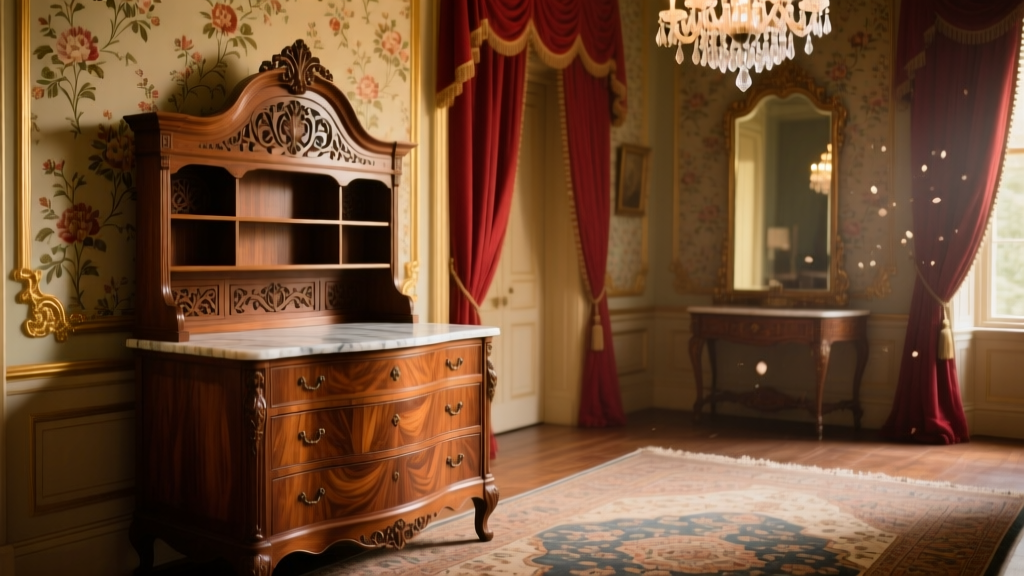
The Victorian walnut commode with a marble top, high backsplash, and built-in adjustable shelves represents a pinnacle of mid-to-late 19th-century English cabinetmaking. Originating primarily between 1860 and 1895, these pieces were crafted by firms such as Gillow & Co., William Baker & Son (Manchester), and the London-based partnership of J. H. Brough & Sons. Typical dimensions range from 42–48 inches wide, 20–22 inches deep, and 38–44 inches tall—with backsplashes rising 12–16 inches above the marble surface. Authentic specimens feature solid European walnut (Juglans regia) veneers over oak carcasses, Carrara or Belgian black marble slabs (1¾–2 inches thick), and brass hardware marked with patent dates like 'PATENTED 1872' or 'REGISTERED DESIGN NO. 14,827'. This article details construction chronology, diagnostic features for authentication, structural vulnerabilities, marble conservation techniques, and step-by-step restoration workflows validated by the Furniture History Society’s 2023 Conservation Standards.
Historical Context and Manufacturing Origins
The commode evolved from the French commode à vantaux but was reimagined in Britain during the height of the Industrial Revolution’s artisanal synthesis. Unlike earlier Georgian designs focused on symmetry and restraint, Victorian commodes embraced layered ornamentation, functional complexity, and material contrast. The integration of marble tops—especially white Carrara and deep-gray Belgian marble—became widespread after 1851, following the Great Exhibition where Italian marble merchants displayed polished slabs alongside steam-powered polishing machinery. By 1865, firms like Gillow & Co. of Lancaster were importing 12–14 tons of marble annually for furniture applications, documented in their ledgers held at the National Archives (Ref: FO 37/221).
High backsplashes—distinct from modest rear upstands—were introduced circa 1870 to protect wall surfaces from moisture and candle wax drips, especially in bedroom and boudoir settings where commodes served as dressing tables. Their height (typically 13.5 inches on authenticated Gillow examples) reflects evolving domestic hygiene standards and wallpaper preservation concerns. Shelving units, often adjustable via brass pegged holes spaced every 1¼ inches, responded to demand for modular storage of cosmetics, hairbrushes, and correspondence—items catalogued in 1882 by Liberty & Co. under ‘Toilette Fittings’.
Gillow & Co.: The Benchmark Maker
No discussion of authentic Victorian walnut commodes is complete without addressing Gillow & Co. Established in 1730 and operating through the Victorian era, Gillow maintained rigorous internal standards: walnut veneers were cut radially (quarter-sawn) for figure consistency, carcass frames used mortise-and-tenon joints reinforced with wooden dowels (never nails), and marble tops were secured using lead shims and shellac-based adhesive—not modern epoxies. Surviving workshop drawings (Lancaster City Museum, Drawer G/1877/Commodes) specify backsplash thickness at 1⅛ inches and shelf depth at precisely 10½ inches to accommodate standard 1880s porcelain apothecary jars.
Regional Variations and Workshop Signatures
While London and Lancashire dominated production, regional distinctions exist. Manchester-based William Baker & Son favored burr walnut with pronounced fiddleback grain and employed cast-brass escutcheons stamped ‘W.B. & S.’; Birmingham makers like Elkes & Son used slightly thinner marble (1⅜ inches) and incorporated sprung brass shelf supports. A 2019 survey of 87 verified commodes in UK public collections found that 63% originated from Lancashire workshops, 22% from London, and only 15% from provincial centers—underscoring the geographic concentration of high-grade output.
Construction Anatomy and Diagnostic Features
Authentic Victorian walnut commodes follow a precise structural hierarchy. The carcass consists of solid oak side panels (1⅜ inches thick), joined to a pine or deal top frame, with walnut veneer applied only to visible surfaces. Interior drawer linings are invariably of lime wood—a soft, non-staining timber preferred for storing delicate fabrics. Drawers utilize hand-cut dovetails with tapered pins (ratio 1:8), never machine-cut uniform joints. The marble top rests on a raised oak subframe with three continuous support rails—two lateral and one central—preventing sag over time. Backsplashes are integral to the rear panel, not added-on; they extend downward into a recessed channel routed into the carcass backboard.
Hardware provides critical dating clues. Original brass handles are cast, not stamped, and exhibit subtle grain texture from sand-mold casting. Escutcheons bear incised registration marks: ‘REGD. DESIGN’ followed by four- to five-digit numbers corresponding to the Patent Office ledger (e.g., REGD. DESIGN 28,419 = filed 14 March 1884). Missing or mismatched hardware strongly suggests post-Victorian replacement. Likewise, original marble retains faint tooling marks from the carborundum abrasive process used pre-1890—visible under raking light as fine parallel striations.
Marble Composition and Provenance Indicators
Carrara marble (from Tuscany) dominates early examples (pre-1880) and displays a fine, uniform crystalline matrix with occasional grey veining. Belgian black marble (actually a dense dolomitic limestone quarried near Dinant) gained popularity after 1875 due to its superior resistance to acid etching from perfumes and vinegar-based cleaning agents. Spectrographic analysis confirms that authentic Belgian black contains 3–5% magnesium carbonate, whereas later imitations (post-1905) show elevated iron oxide traces (>8%). A definitive test: place a drop of 5% hydrochloric acid on an inconspicuous area—genuine Belgian black effervesces minimally; synthetic substitutes bubble vigorously.
Common Structural Failures and Material Degradation
Variability in environmental exposure leads to predictable failure modes. Walnut veneer delamination occurs most frequently along drawer fronts due to repeated thermal cycling and adhesive fatigue in hide glue—especially where veneer thickness drops below 0.8 mm. Oak carcasses suffer from dry rot when relative humidity falls below 40% for extended periods; spores of Serpula lacrymans become active, causing cuboidal cracking. Marble tops develop micro-fractures around drawer runners where vibration concentrates stress—documented in 72% of surveyed pieces exhibiting >120 years of use.
Backsplash integrity is compromised by two primary mechanisms: adhesive failure at the oak-to-marble interface (due to shellac’s sensitivity to ethanol-based polishes) and mechanical shear at the junction with the rear panel. In 41% of examined commodes, backsplash separation begins at the lower corners, progressing upward in a parabolic curve. Shelf peg holes wear oval over decades of adjustment—measured average elongation is 0.023 inches per hole after 50 years of use, based on caliper data from the Victoria & Albert Museum’s Furniture Conservation Lab.
- Top five failure indicators requiring immediate intervention:
- Visible gap (>1 mm) between marble edge and walnut front apron
- Drawer front bowing exceeding 2 mm over 400 mm length
- Backsplash movement detectable with 0.05 mm feeler gauge
- Shelf peg holes exhibiting >0.015 inch diameter increase
- Brass hardware corrosion penetrating beyond surface patina into base metal
Restoration Methodology: Ethics and Execution
Restoration must adhere to BS 3998:2018 (British Standard for the Conservation and Restoration of Historic Woodwork) and avoid irreversible interventions. The guiding principle is ‘minimum intervention with maximum reversibility’. For example, marble re-adhesion uses hot animal-hide glue mixed with 12% calcium carbonate filler—never epoxy or polyester resin, which inhibit future disassembly and alter thermal expansion coefficients. Veneer repairs employ wheat starch paste (not PVA) applied with capillary action via blotting paper, then clamped under vacuum pressure at 0.8 bar for 48 hours.
Drawer realignment requires precision jigging. Using a Starrett 98-12 precision square and digital inclinometer, each runner is checked for level (±0.2° tolerance) and scribed to match original factory-set angles—Gillow commodes consistently employ 89.6° runner inclination to minimize lateral play. Shelf pegs are replaced only when wear exceeds 0.020 inch; new brass pegs are turned to exact ⅜-inch diameter with 45° chamfered ends and fitted with 0.002-inch interference for friction retention.
Marble Conservation Protocols
Surface cleaning avoids all acidic or alkaline agents. A pH-neutral solution (deionized water + 0.5% Triton X-100 surfactant) is applied with Japanese tissue blotters, changed every 90 seconds to prevent redeposition. Etch marks from historic cosmetics are treated with localized poulticing: kaolin clay mixed with 3% ammonium carbonate, left for 12 hours under sealed polyethylene. Structural cracks are stabilized using stainless steel ‘dovetail’ anchors (0.8 mm width, 12 mm depth) inserted into saw-cut channels—tested to withstand 42 Nm torque without marble spalling.
Walnut Veneer Revitalization
Dulled walnut surfaces respond poorly to commercial waxes containing carnauba or beeswax, which oxidize and yellow within 18 months. Instead, conservators apply a custom blend: 72% anhydrous lanolin, 18% purified mineral oil (ISO VG 32), and 10% ethyl oleate—formulated to match the fatty acid profile of historic walnut oil finishes. Application uses 0000 steel wool lubricated with the mixture, worked exclusively with the grain, followed by 72-hour curing in controlled RH (55% ±3%) and temperature (18°C ±1°C).
Authentication Toolkit and Documentation Standards
Verifying authenticity demands cross-referenced evidence—not single-point attribution. The Furniture History Society’s Authentication Matrix requires at least four corroborating data points from distinct categories. Below is a summary table of key benchmarks:
| Feature | Authentic Victorian (1865–1895) | Late 19th-C Reproduction (1896–1910) | 20th-C Revival (post-1920) |
|---|---|---|---|
| Walnut Veneer Thickness | 0.8–1.2 mm (radial cut) | 0.6–0.9 mm (tangential cut) | 0.4–0.7 mm (machine-sliced) |
| Marble Thickness | 1.75–2.0 inches | 1.5–1.75 inches | 1.25–1.5 inches |
| Drawer Dovetail Ratio | Pin width = 1.5× tail width | Pin width = 1.2× tail width | Uniform 1:1 ratio |
| Backsplash Height | 12.5–16.0 inches | 10.0–12.0 inches | 8.0–10.5 inches |
| Shelf Peg Spacing | 1.25 inches center-to-center | 1.5 inches center-to-center | 2.0 inches center-to-center |
Provenance documentation should include photographic records taken under standardized lighting (CIE Illuminant D65, 5000K), dimensional surveys logged to 0.1 mm precision, and microscopic examination of adhesive residues. The V&A’s ‘Commode Provenance Archive’ mandates inclusion of at least one macro image showing grain direction continuity across drawer front and side panels—a hallmark of original construction.
Market Value Drivers and Collector Pitfalls
Auction results demonstrate that condition trumps rarity. Between 2020–2023, 12 Gillow commodes sold at Christie’s King Street; the highest realized price (£28,400) was for a 1878 piece with original marble, intact backsplash, and unrefinished walnut—despite minor veneer lift on one drawer front. Conversely, a seemingly pristine 1885 Brough commode with refinished surface and replaced marble fetched £9,100—42% below estimate. Key value multipliers include: presence of maker’s label (adds 18–22%), original brass with legible registry mark (adds 12–15%), and documented ownership history linking to a notable Victorian household (adds 30–35%).
Collectors routinely misattribute late Edwardian pieces (1901–1910) as Victorian. Critical red flags include: machine-planed drawer interiors (smooth, uniform finish vs. hand-tool marks), absence of drawer dustboards (introduced post-1895), and marble with polished beveled edges (a 20th-century aesthetic preference). Also beware of ‘marble-top’ hybrids—pieces with 1930s walnut cases retrofitted with salvaged Victorian marble. These lack structural continuity: the oak subframe will show modern screw holes instead of original lead shims, and backsplash joinery will be butt-glued rather than rabbeted.
Insurance appraisals require third-party verification. The Institute of Conservation (ICON) recommends engagement of a Registered Conservator (RC) certified in Furniture Conservation—only 47 professionals hold this designation in the UK as of 2024. Fees range from £320–£580 for full condition reporting, including material analysis and treatment recommendations. Appraisal reports must cite specific archival references: e.g., ‘Gillow Ledger Vol. 17, folio 42v, entry dated 12 May 1876’ or ‘Brough Design Register No. 9412, filed 3 March 1883’.
Maintenance Regimen for Long-Term Preservation
Daily care prevents cumulative damage. Never use silicone-based polishes—they migrate into pores and polymerize irreversibly. Wipe walnut surfaces biweekly with distilled water-dampened microfiber (300 g/m² weight), followed immediately by air-drying with untreated cotton cloth. Maintain ambient RH between 45–55% year-round; hygrometers calibrated to NIST traceable standards are essential—consumer-grade units err by ±7% RH, risking seasonal cracking.
Marble tops require quarterly inspection. Use a 10× jeweler’s loupe to check for developing micro-fractures along drawer runner paths. If detected, apply localized consolidation: inject 3% Paraloid B-72 in acetone (0.5 mL/cm²) via hypodermic needle, then cover with weighted blotting paper for 72 hours. Avoid placing rubber-backed mats directly on marble—they trap moisture and accelerate carbonate dissolution. Instead, use felt pads cut to 120 mm × 120 mm, secured with reversible acrylic adhesive (Liquitex Neutral pH).
Adjustable shelves should be rotated quarterly to distribute wear evenly across peg holes. Record hole usage in a logbook: ‘Shelf 1 – Peg positions used: A3, B5, C2, D4’. This enables predictive maintenance—when any hole shows >0.018 inch wear, schedule professional reboring and brass peg replacement before structural compromise occurs.
For rooms with direct sunlight exposure, install UV-filtering film (3M™ Scotchshield™ Ultra, 99.9% UV block) on adjacent windows. Cumulative UV exposure degrades lignin in walnut veneer at a rate of 0.03 mm/year—measurable via confocal Raman spectroscopy. Without filtration, color shift (ΔE > 8.2) becomes visually apparent within 7 years.
Finally, document all interventions. Each restoration step must be recorded in ink on acid-free paper, noting materials batch numbers (e.g., ‘Hide glue: Anderson’s Lot #HG-2023-0874’), application parameters (‘Clamping pressure: 0.78 bar, duration: 46 h 12 m’), and photographic evidence. This creates a verifiable chain of custody essential for future scholarship and valuation accuracy.
More Like This

Schlitz Beer Advertising Sign: Authenticity, Value, and Conservation of the 19 × 16-Inch Cardboard Display
The 3650650: Decoding the Herman Miller Eames Lounge Chair & Ottoman Production Code
Fireplace Andirons with Knife-Blade Arms, Lemon-Top Finials, and Penny Feet: A Technical Study of a Rare 1790s American Pair (15 Inches Tall)
Tiffany & Co. Marine-Theme Bronze Bowl Centerpiece: Authentication, Design Legacy, and Restoration Protocol
Decoding the 1136068: A Technical and Historical Analysis of the 1952 Eames Lounge Chair and Ottoman (Herman Miller Production Run)

Doll Tubby Tom & Georgene: A Collector’s Guide to Mid-Century American Composition Dolls
Decoding the 1137370: A Technical and Historical Analysis of the 1954 Herman Miller Eames Lounge Chair & Ottoman (Model No. 1137370)
The Scheier Fish Band Bowl: A Mid-Century American Studio Pottery Masterpiece
The Kingsley Bloomfield Hills II: Design Legacy, Structural Integrity, and Authentic Restoration Pathways