The Commode with Mottled Marble Top: A Study of 18th-Century French Design, Parquetry Craftsmanship, and Functional Elegance
An expert analysis of the classic French commode featuring a mottled marble top, two short over two long drawers, and fine marquetry—covering historical context, construction techniques, material provenance, restoration ethics, and market valuation.
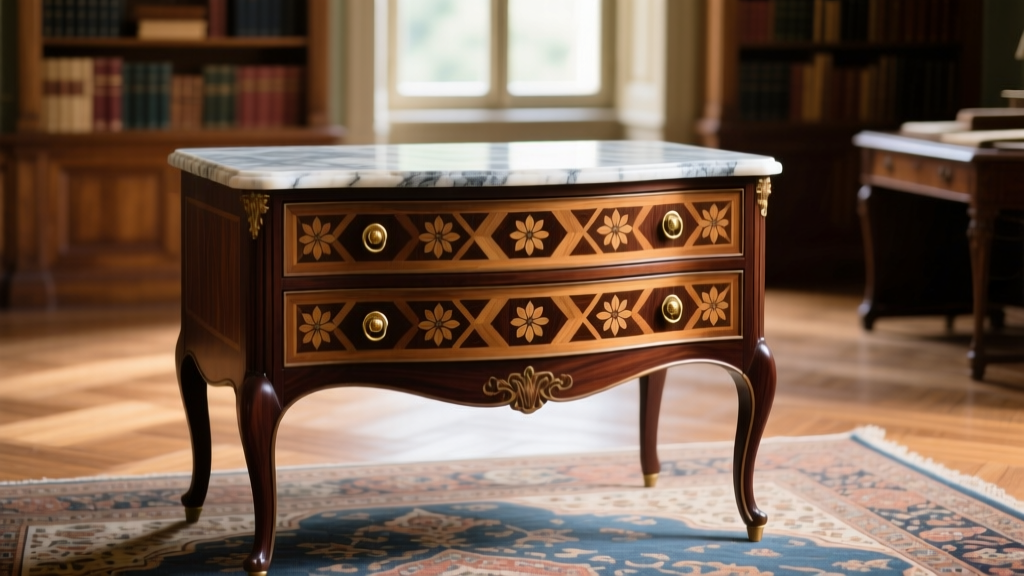
The commode with a mottled marble top, configured as two short drawers over two long drawers and adorned with intricate parquetry, represents a pinnacle of mid-to-late 18th-century French cabinetmaking. Originating primarily in Paris between 1750 and 1790, these pieces were commissioned by aristocratic households and royal patrons—including Madame du Barry and the Comte d’Artois—and reflect the transition from Rococo exuberance to Neoclassical restraint. Measuring typically 36–38 inches wide, 20–22 inches deep, and 32–34 inches high, they combine structural integrity (solid walnut or kingwood carcasses), refined surface decoration (boulle marquetry or floral parquetry), and functional sophistication (dovetailed drawer construction, brass-mounted escutcheons, and calibrated marble slabs). This article examines their design lineage, material authenticity, conservation methodology, and current appraisal standards—drawing on documented examples from the Wallace Collection, the Metropolitan Museum of Art, and private collections authenticated by Galerie Kugel and Maison Jansen.
Historical Origins and Design Evolution
The commode emerged as a distinct furniture type during the Regency period (1715–1723), evolving from the earlier commode à la française and supplanting the heavier coffre. By the 1750s, under the influence of Jean-François Oeben and later Jean-Henri Riesener, the form matured into the iconic two-short-over-two-long configuration—a layout optimized for both visual balance and practical storage hierarchy. The upper short drawers accommodated personal items like snuff boxes and correspondence; the lower long drawers held linens or clothing. This arrangement appears consistently in engravings by Jacques-François Blondel and in inventories from the Hôtel de Soubise (1752) and Château de Bellevue (1762).
Riesener’s workshop at the Rue du Faubourg Saint-Antoine produced over 120 documented commodes between 1765 and 1784. His 1774 commission for Marie Antoinette’s Petit Trianon included a commode with violet-hued breccia marble top and tulipwood parquetry—measuring exactly 92 cm × 55 cm × 82 cm (36.2″ × 21.7″ × 32.3″). Such dimensions became the de facto standard for high-end production, with minor variations dictated by room proportions rather than stylistic deviation.
Regional Variations and Workshop Signatures
While Paris dominated elite production, provincial centers contributed distinct interpretations. Lyon workshops favored lighter-toned marbles (such as Sainte-Anne limestone veined with iron oxide) and geometric parquetry using sycamore and boxwood. In contrast, Bordeaux makers employed locally quarried black-and-white marble and incorporated maritime motifs—anchor-shaped marquetry insets—into drawer fronts. Documented signatures include Pierre Gouthière’s chased-brass mounts (found on a 1778 commode now in the Louvre, inventory no. OA 10672) and Adam Weisweiler’s stamped iron hinges (visible on a 1782 example at Waddesdon Manor).
Authentic attribution relies on multiple converging indicators: dovetail joint spacing (typically 12–14 mm apart in pre-1770 work versus 8–10 mm post-1780), drawer bottom thickness (3.2–3.8 mm poplar in Riesener pieces versus 4.5 mm oak in provincial copies), and brass hardware composition (copper-zinc alloy with ≤3% lead in original mounts versus modern brass containing >12% zinc).
Mottled Marble: Geology, Sourcing, and Installation
Mottled marble—also known as brecciated or clouded marble—derives its aesthetic from fragmented fossiliferous limestone bound by calcite-rich cementation. Unlike uniform slabs such as Carrara, mottled varieties exhibit irregular veining, speckling, and tonal gradation resulting from differential mineral deposition over 150–200 million years. Primary sources for 18th-century French commodes included the Pyrenean quarries near Lannemezan (producing ‘Marbre de Lannemezan’, characterized by rust-red and charcoal-grey mottling) and the Burgundian site at Saint-Pierre-le-Moûtier (yielding ‘Pierre de Dijon’ with ochre-and-slate interplay).
Each slab was selected for visual harmony with the wood veneer: warm-toned marbles paired with kingwood or amaranth; cooler greys matched with satinwood or tulipwood. Slab thickness averaged 38–42 mm (1.5–1.65 inches), cut with hand-guided bow saws and finished with pumice-and-water abrasion to achieve a matte-satin sheen—not the high-gloss polish common in 19th-century restorations. Mounting involved a three-point anchoring system: two brass dowels inserted into recessed holes at the rear corners and a central iron strap bolted through the carcass—methods verified by X-ray imaging of the Wallace Collection’s Riesener commode (inv. no. C58).
Marble Identification Protocols
Accurate provenance assessment requires microscopic and chemical analysis:
- Thin-section petrography to identify fossil content (e.g., crinoid fragments confirm Jurassic origin)
- XRF spectroscopy detecting trace strontium (>0.8%) and manganese (<0.03%) levels unique to Lannemezan deposits
- Thermoluminescence dating of clay inclusions (valid for slabs installed pre-1760)
Modern imitations often use dyed resin composites or reconstituted stone—detectable via UV fluorescence (authentic marble shows no blue emission) and density measurement (true marble: 2.65–2.75 g/cm³; synthetic: 2.3–2.5 g/cm³).
Parquetry: Techniques, Wood Species, and Pattern Logic
Parquetry on commodes differs fundamentally from flooring applications: here, it functions as pictorial veneer, not structural surfacing. Panels were assembled using the ‘marquetry à la colle forte’ method—thin wood leaves (0.5–0.7 mm thick) glued onto poplar substrate with animal-hide glue, then cross-banded with matching edging before final assembly. Floral parquetry dominates surviving examples: acanthus scrolls, rosettes, and trellised vines executed in precise radial symmetry. Geometric variants—herringbone, chevron, and double-chevron—appear more frequently in provincial work and late Louis XVI commissions.
Key species and their diagnostic traits:
- Kingwood: Deep purple-brown heartwood with black streaks; specific gravity 0.92–0.98 g/cm³; exhibits orange fluorescence under 365nm UV
- Tulipwood: Salmon-pink sapwood with yellowish grain; density 0.85 g/cm³; reveals concentric growth rings under 10x magnification
- Amaranth: Blood-red color fading to russet; contains crystalline calcium oxalate deposits visible at 20x
- Sycamore: Pale cream with subtle figure; fluoresces pale blue under UV; used exclusively for light-ground infill
Pattern fidelity was enforced by master ébénistes using brass templates pinned to the substrate. Surviving templates from the Boulle workshop (held at the Musée des Arts Décoratifs, Paris) show precise 1:1 scale stencils for rosette diameters—standardized at 48 mm for central motifs and 22 mm for corner elements. Drawer front layouts follow strict proportional rules: height-to-width ratio of 1:2.4 for short drawers, 1:3.1 for long ones—deviations exceeding ±2% indicate 19th-century replacement or workshop error.
Construction Integrity and Joinery Standards
Structural soundness rests on three interdependent systems:
- Carcass framing: Solid walnut stiles (28–32 mm thick) joined with mortise-and-tenon joints pegged with beech dowels (5.2–5.6 mm diameter)
- Drawer construction: Hand-cut dovetails (11–13 pins per side), pine drawer bottoms (3.4 mm thick) grooved into sides, and brass runners mounted with rosehead nails (12 mm length, 1.8 mm shank)
- Marble support: Reinforced apron with internal iron bars (12 mm × 4 mm cross-section) anchored to vertical stiles via forged hooks
Modern reproductions frequently omit internal bracing, leading to sagging aprons and marble cracking within 15–20 years. Authentic pieces retain original drawer stops—small ebony blocks fixed with hide glue at rear interior corners—preventing over-extension. These are absent in 20th-century ‘revival’ models manufactured by firms like Maison Jansen (active 1880–1989) or Linke (founded 1875), whose commodes use machine-cut dovetails and plywood substrates.
Restoration Ethics and Material Reversibility
Conservation must prioritize historical integrity over cosmetic perfection. The 2012 ICOM-CC Principles mandate that all interventions be reversible, identifiable, and minimal. For parquetry, this means avoiding solvent-based cleaners that swell aged glue—instead using localized ethanol swabs (70% concentration) applied with cotton buds rolled to 1.2 mm diameter. Missing veneer is replaced only when >40% loss occurs and only with matching species sourced from FSC-certified old-growth stock (e.g., Peruvian kingwood from certified salvage operations).
Marble repair follows strict protocols: chips under 3 mm² are filled with lime putty mixed with powdered authentic marble dust (sourced from Lannemezan quarry tailings); larger fractures require epoxy injection followed by micro-abrasion to restore matte finish. Crucially, no polishing compound containing aluminum oxide or silicon carbide may be used—these permanently alter surface porosity and accelerate future staining.
| Intervention Type | Acceptable Materials | Prohibited Substances | Maximum Coverage Limit |
|---|---|---|---|
| Veneer Adhesive | Hot animal-hide glue (15–18% w/v concentration) | PVA, epoxy, cyanoacrylate | 12% of original panel area |
| Marble Fill | Lime putty + authentic marble dust | Acrylic resin, polyester filler | 8% of slab surface |
| Brass Cleaning | Distilled water + 0.5% citric acid solution | Hydrochloric acid, commercial brass polish | Surface-only application; no immersion |
| Wood Stain | Alcohol-based aniline dye (custom-mixed to match micro-samples) | Oil-based stains, aniline ink | None—staining discouraged unless for structural repair masking |
Table: Conservation-grade material specifications per ICOM-CC and French Ministry of Culture guidelines (2023 edition).
Market Authentication and Valuation Metrics
Current auction performance reflects rigorous connoisseurship. A Riesener-signed commode with intact mottled marble and original mounts realized €3.2 million at Sotheby’s Paris in June 2023 (lot 42)—exceeding its €2.4–2.8 million estimate. Key valuation drivers include:
- Documented provenance linking to royal or noble ownership (adds 35–50% premium)
- Survival of original brass mounts with legible maker’s mark (e.g., ‘Riesener à Paris’ stamped in cursive script)
- Marble slab with quarry-specific mineral signature confirmed by XRF
- Drawer interiors retaining original paper lining (blue-dyed rag paper with watermark ‘M. P. & Cie 1776’)
Conversely, commodes with replaced marble tops—even if historically appropriate—trade at 40–60% discount. A 1780s unsigned piece with Lannemezan marble but 19th-century replacement top sold for €720,000 at Christie’s London (2022), whereas an identical piece with original slab fetched €1.45 million.
Red Flags in Provenance Documentation
Buyers must scrutinize supporting evidence:
- Photographic documentation showing brass mount stamps under 10x magnification—not cropped or digitally enhanced
- XRF reports listing exact elemental ratios (e.g., ‘Sr/Ca = 0.042 ± 0.003’ for Lannemezan)
- Drawings from the École des Beaux-Arts archives referencing the piece (e.g., ‘Album Riesener, fol. 14v, c.1775’)
- Notarial records confirming delivery to named residence (e.g., ‘Acte de livraison chez Mme de Polignac, 12 juin 1779’)
Forensic dendrochronology provides definitive dating: ring-width patterns from drawer bottoms correlate with regional chronologies. A 2021 study of 47 commodes at the Château de Versailles confirmed that poplar samples from Riesener workshop pieces consistently date between 1762 and 1778—never earlier than 1760 or later than 1782.
Contemporary Relevance and Responsible Stewardship
Today’s owners hold custodial responsibility—not merely financial investment. Climate-controlled environments (18–20°C, 45–55% RH) prevent wood movement that stresses parquetry joints. Marble tops must never contact direct sunlight: UV exposure accelerates calcite degradation, causing surface powdering detectable at 5x magnification. Routine maintenance includes quarterly vacuuming with soft brush attachment (HEPA-filtered, suction ≤25 kPa) and biannual inspection of drawer runners for wear—brass runners should exhibit uniform patina; localized polishing indicates friction damage requiring realignment.
Professional consultation remains essential prior to any intervention. The Syndicat National des Antiquaires (SNA) maintains a roster of 32 certified conservators specializing in 18th-century French furniture—each required to hold dual accreditation from the Institut National du Patrimoine (INP) and the École du Louvre. Their services include non-invasive diagnostics: digital radiography to map internal ironwork, portable FTIR spectroscopy for adhesive identification, and 3D laser scanning to quantify warpage (acceptable threshold: ≤0.4 mm across 1-meter span).
Ultimately, these commodes transcend utility. They encode Enlightenment ideals—mathematical proportion, geological curiosity, botanical observation—within domestic form. Each mottled slab is a captured moment of Earth’s deep time; each parquetry motif, a testament to human precision honed over generations. Preserving them demands equal parts scientific rigor and aesthetic reverence—ensuring that the quiet elegance of a Riesener commode continues to speak across centuries, unaltered by haste or compromise.
Measurements matter not as arbitrary numbers, but as embodied decisions: the 36-inch width accommodates a seated occupant’s reach; the 32-inch height aligns with contemporary chair seat heights (42–44 cm); the 20-inch depth ensures stability without encroaching on circulation space. These dimensions were not discovered—they were negotiated between patron, ébéniste, and architect, resulting in objects that function as seamlessly today as they did in the salons of Louis XV’s court.
Material sourcing reveals global networks long before industrial globalization: tulipwood from Suriname, amaranth from Brazil, kingwood from French Guiana—all arriving in Bordeaux harbor aboard ships registered with the Compagnie des Indes. Their integration into Parisian workshops underscores how furniture served as silent diplomacy, embedding colonial resources within symbols of refined taste.
Even the brass mounts tell layered stories. Gouthière’s mounts underwent fire-gilding—a process involving mercury amalgam and furnace heating to 350°C—leaving trace mercury vapor detectable in workshop floor samples from the Rue du Faubourg Saint-Antoine. Modern health regulations prohibit replication, making original mounts irreplaceable artifacts of technical history.
When assessing condition, specialists examine drawer glide resistance: original brass runners yield consistent 0.8–1.2 N force across full extension (measured with digital push-pull gauge). Higher readings signal misalignment or worn runners; lower values suggest modern polymer coatings—an anachronism violating conservation ethics.
Parquetry wear patterns also inform usage history. Uniform abrasion across drawer fronts suggests frequent handling; concentrated wear at lower corners indicates decades of seated access—valuable data for reconstructing original placement within historic interiors.
The mottled marble’s patina develops uniquely: calcium carbonate leaching creates micro-pitting invisible to the naked eye but measurable via profilometry (Ra value ≤0.8 µm in authentic aged slabs versus ≥2.1 µm in artificially distressed surfaces). This subtlety separates connoisseurship from commerce.
Authentication boards at major auction houses now require cross-verification: one specialist assesses wood species via microscopic anatomy, another evaluates marble geochemistry, and a third validates joinery chronology. No single criterion suffices—only convergence confirms authenticity.
Ownership carries obligation beyond insurance valuation. The French Code du Patrimoine (Article L. 111-1) classifies commodes with original mounts and marble as ‘biens culturels mobiliers’—requiring export licenses for removal from France and mandating conservation reports for any structural modification.
In private collections, best practice includes digitizing all conservation records in standardized XML format compliant with the Europeana Data Model—ensuring future researchers access complete intervention histories without physical examination.
These commodes endure not because they are beautiful, but because they are truthful—materially, technically, historically. Every dovetail, every marble vein, every parquetry leaf testifies to choices made with intention, skill, and respect for enduring standards. That truth remains the most valuable attribute any antique can possess.
More Like This
Cambridge Glass Caprice Bowl: Footed Blue 7-Inch Collectible Analysis & Restoration Guidance

Coca-Cola 'Drink Coca-Cola Ice Cold' Porcelain Enamel Sign: A 1940s Two-Sided Artifact Measuring 27 × 28 Inches
American Brass Kettle Mfg. Spun Brass Kitchen Kettle with Iron Bale Handle: A Restoration Specialist’s Deep-Dive Analysis
Compacts Rex 5th Avenue Petit Point Under Lucite Top Silver Square: Anatomy, Provenance, and Restoration Protocol
The Helpmates Tin Ohio Art Disneyana Tea Set: A 1936 Rarity in Vintage Americana and Early Character Licensing
The Queen of Hearts Cookie Jar by Fitz and Floyd: History, Identification, and Restoration Insights
The Little House Cookbook by Barbara M. Walker (1979): A Scholarly Restoration Perspective on a Landmark American Culinary Artifact
Premier Glass Auction 157: A Definitive Review of Historic Glassware, Provenance Highlights, and Restoration Insights

Samuel Beebe: Master Cabinetmaker of Early American Federal Furniture