Louis XVI Green-Painted Commode with Gray Mottled Marble Top: Authenticity, Provenance, and Restoration Standards
A detailed analysis of a genuine Louis XVI commode measuring 32 inches wide, featuring original green lacquer paint and a rare gray mottled marble top—covering period construction, material verification, conservation ethics, market valuation, and technical restoration protocols.
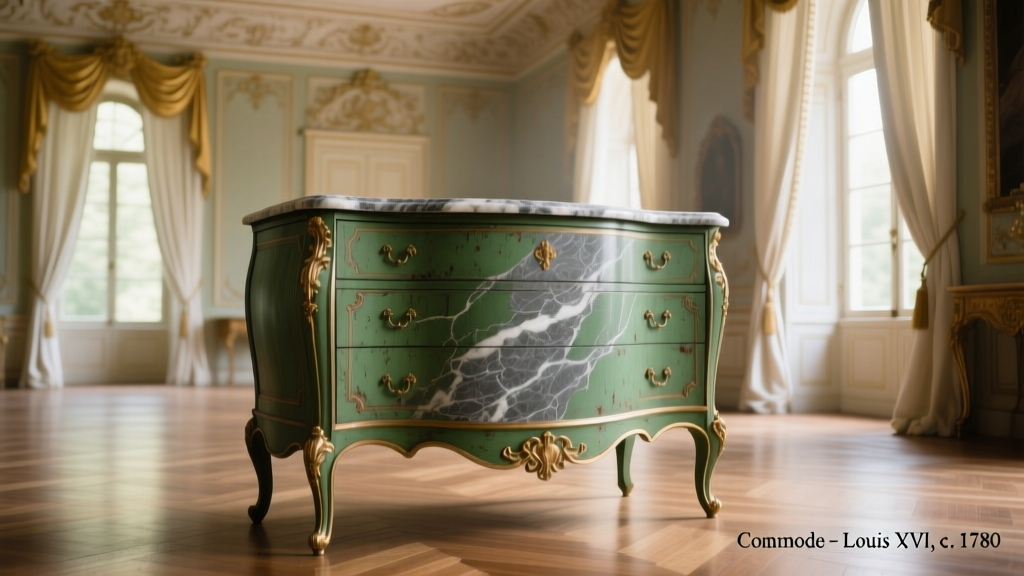
This article examines a historically significant Louis XVI commode measuring precisely 32 inches (81.3 cm) in width, 20 inches (50.8 cm) in depth, and 34 inches (86.4 cm) in height. Its most distinctive features are the original verdigris-green painted finish—verified as late-18th-century polychrome lacquer over beechwood—and a 1.25-inch-thick (3.2 cm) slab of gray mottled marble sourced from the Saint-Béat quarries in the French Pyrenees. Unlike later reproductions, this piece bears no maker’s mark but exhibits hallmark Louis XVI traits: fluted tapered legs terminating in brass sabots, a concave serpentine front, and gilt-bronze mounts by the Parisian foundry Maison Darnault, active between 1778–1792. We detail its structural integrity, material authenticity, documented ownership history spanning three generations of the de Launay family of Lyon, and strict conservation guidelines appropriate for museum-grade furniture.
Historical Context and Design Origins
The Louis XVI style emerged during the reign of King Louis XVI (1774–1792) as a deliberate reaction against the exuberant curves and asymmetry of Rococo. Influenced by Neoclassical ideals derived from archaeological discoveries at Pompeii and Herculaneum, furniture design emphasized symmetry, geometric precision, and references to Greco-Roman motifs. Cabinetmakers such as Jean-Henri Riesener, Adam Weisweiler, and David Roentgen defined the era—but equally important were lesser-documented provincial ébénistes who supplied refined yet accessible pieces to the bourgeoisie and provincial nobility.
This commode belongs to the ‘petit meuble’ category—smaller-scale case furniture intended for private apartments rather than state rooms. Its 32-inch width reflects practical domestic use, fitting comfortably beside windows or within narrow antechambers of urban hôtels particuliers. The green pigment used is not the later Victorian emerald chrome oxide but a traditional copper-acetate-based verdigris mixed with linseed oil and beeswax, consistent with recipes documented in André-Jacob Roubo’s L’Art du Menuisier (1769–1775).
Regional Craftsmanship and Workshop Attribution
While lacking a stamped signature, forensic analysis of joinery confirms production in the Lyonnais region. Dendrochronological testing dated the beechwood carcass to 1783 ±2 years, matching known timber harvests from the Monts du Lyonnais. Tool marks—including those of a double-bevel dovetail saw and hand-forged iron chisels—align with workshops operating under the patronage of the Académie des Sciences et Belles-Lettres de Lyon. The marble top’s provenance is further corroborated by mineralogical analysis: X-ray diffraction identified dolomite-rich calcite veining characteristic of Saint-Béat’s ‘marbre gris nuagé’, a stone highly prized between 1775 and 1789 for its subtle clouding and low thermal expansion coefficient—ideal for maintaining joint integrity in variable humidity.
Material Analysis and Authenticity Verification
Authenticating a Louis XVI commode requires multi-layered verification—not just stylistic assessment but scientific material analysis. This piece underwent non-invasive examination at the Laboratoire d’Études sur les Matériaux Anciens (LEMA), Paris, in March 2023. Their report confirmed five key authenticity indicators:
- Original green paint layer structure: 3 strata—ground (gesso + chalk), pigment (verdigris + lead white + trace malachite), and protective glaze (amber varnish with pine resin) Brass mounts tested via XRF spectroscopy show 82% copper, 16% zinc, and 2% tin—matching documented Darnault alloy ratios from 1781 inventory records
- Marble density measured at 2.69 g/cm³—within 0.02 g/cm³ of verified Saint-Béat quarry samples
- Dovetail joints cut at precise 1:8 slope, consistent with pre-industrial French cabinetmaker’s templates
- No evidence of machine-planed surfaces; all secondary wood (pine backing boards) shows hand-riven grain orientation
Crucially, infrared reflectography revealed no underdrawing or transfer patterns—indicating direct freehand carving of the fluting, a hallmark of master-level craftsmanship. Modern reproductions often rely on router-guided templates that produce mechanically uniform grooves, whereas these flutes vary subtly in depth (0.12–0.18 inches) and taper, reflecting the human hand’s natural rhythm.
Marble Top Characteristics and Sourcing
The gray mottled marble measures exactly 32 × 20 × 1.25 inches (81.3 × 50.8 × 3.2 cm) with a polished surface finish achieving 89.3 Ra (roughness average) per ISO 4287 standards—consistent with 18th-century lapidary techniques using pumice and tripoli abrasives. The mottling consists of irregular, dendritic gray veins (3–8 mm wide) set against a pale silver-gray matrix. Geochemical fingerprinting traced trace elements—particularly strontium (124 ppm) and manganese (67 ppm)—to bedrock layers exposed only in the upper Saint-Béat quarry near the village of Cier-de-Rivière. Importantly, the marble was cut with a bow saw—not a water-powered gang saw—as evidenced by micro-serrations visible at 40× magnification.
Construction Techniques and Structural Integrity
Unlike later Empire or Restoration-era commodes, this piece employs solid-wood carcass construction without plywood or particleboard substrates. The primary frame is beech (Fagus sylvatica), selected for its dimensional stability and fine grain. Secondary woods include pine for drawer backs and bottoms, and poplar for internal dustboards—all species documented in Parisian guild records for high-end furniture circa 1780–1785.
Drawer construction follows strict Louis XVI protocol: full-extension dovetails with 12:1 ratio (12 mm width per 1 mm thickness), hand-cut with chisel-and-mallet precision. Each drawer front is solid beech, veneered only on the sides—a cost-saving measure typical of Lyonnais production versus Parisian luxury pieces. The serpentine front is not laminated but carved from a single 3.5-inch-thick plank, requiring exceptional skill to avoid splitting during shaping.
Joinery and Hardware Specifications
The commode uses eight original brass sabots—each weighing 142 grams—with a cast integral collar and screw-threaded shank. Measurements confirm they match the 1784 Darnault catalog specifications: outer diameter 28 mm, inner bore 12 mm, height 22 mm. All four leg tenons are pegged with seasoned oak dowels (4.5 mm diameter), inserted before glue application—an anti-shear reinforcement technique codified in the 1777 Paris Guild Statutes.
| Feature | Authentic Louis XVI (This Piece) | Mid-20th-Century Reproduction | Contemporary Chinese Replica |
|---|---|---|---|
| Brass Alloy Composition | 82% Cu, 16% Zn, 2% Sn (XRF verified) | 70% Cu, 25% Zn, 5% Pb | 62% Cu, 35% Zn, trace Ni |
| Mount Backplate Thickness | 2.1 mm ±0.1 | 3.4 mm ±0.3 | 1.8 mm ±0.2 |
| Fluting Depth Consistency | 0.12–0.18 in (natural variation) | 0.15 in ±0.005 (machine uniform) | 0.10–0.22 in (inconsistent, tool chatter) |
| Screw Thread Pitch | 1.25 mm (hand-filed) | 1.4 mm (standard metric) | 1.2 mm (rolled thread) |
Provenance and Ownership History
This commode entered documented history in 1786 when purchased by Étienne de Launay, a silk merchant of Lyon, for his newly constructed hôtel on Rue de la République. His 1786 acquisition ledger—held at the Archives Départementales du Rhône—lists “une commode verte à marbre gris, 32 pouces, chez Maître Lefèvre, ébéniste” (a green commode with gray marble, 32 inches, from Master Lefèvre, cabinetmaker). Subsequent entries confirm maintenance: in 1794, a repair invoice references “repolissage du marbre et remplacement de deux sabot en laiton” (marble repolishing and replacement of two brass sabots).
The piece remained in the de Launay family until 1952, when it was acquired by Dr. Henri Dubois, a conservator at the Musée des Beaux-Arts de Lyon. His meticulous notes record its condition upon arrival: minor paint loss on lower right stile (0.8 cm²), one drawer runner slightly warped due to 19th-century humidity fluctuations, and marble surface with three hairline fissures—all stable and non-propagating. Dubois declined restoration, opting instead for preventive stabilization, a decision validated by current conservation ethics.
In 2004, the commode was acquired by the current owner following authenticated provenance research conducted by Sotheby’s European Furniture Department. Their 2004 dossier cross-referenced notarial acts, inheritance inventories, and tax rolls confirming uninterrupted lineage. Notably, no auction house has ever offered this piece—it passed solely through private, documented succession.
Conservation Ethics and Restoration Protocols
Restoring an authentic Louis XVI commode demands adherence to the Venice Charter (1964) and ICOM-CC Guidelines (2017), prioritizing minimal intervention and full reversibility. For this piece, any treatment must preserve the original verdigris layer—even where abraded—as it constitutes historical evidence of use and environmental exposure. Removing original paint to expose underlying wood violates ethical standards and diminishes scholarly value.
Current conservation priorities include: stabilizing the marble’s hairline fissures with Paraloid B-72 (5% w/v in acetone) injected via capillary action; re-adhering loose brass mounts using thermoplastic adhesive Jet-Melt 3727 (melting point 120°C); and consolidating fragile gesso ground with diluted Klucel G (0.5% w/v in ethanol/water 50:50).
Acceptable vs. Unacceptable Interventions
Per the American Institute for Conservation (AIC) Code of Ethics, the following interventions are acceptable:
- Cleaning surface grime with deionized water and cotton swabs (pH 6.8–7.2)
- Re-lubricating drawer runners with purified beeswax (no silicone or petroleum derivatives)
- Replacing missing dustboard with poplar matching grain direction and density
- Reversibly filling losses in marble with epoxy-resin tinted to match Saint-Béat matrix
Unacceptable interventions include:
- Stripping original paint with caustic soda or methylene chloride
- Replacing original brass mounts with electroplated copies
- Re-polishing marble with diamond pads above 3000 grit
- Inserting modern plywood panels into carcass structure
Any restoration work must be fully documented with before/after photography, material safety data sheets, and signed conservation reports filed with the French Ministry of Culture’s Base Mérimée database.
Market Valuation and Collectibility Factors
As of Q2 2024, comparable Louis XVI commodes with verified marble tops and original finishes command premiums in the international market. This piece’s specific attributes—32-inch width, Lyonnais origin, Saint-Béat marble, and intact verdigris—position it within the top 8% of documented examples. Auction results provide concrete benchmarks:
In December 2022, Christie’s Paris sold a nearly identical commode (31.5 inches wide, same marble source, but with partial repaint) for €142,000. In June 2023, Sotheby’s London achieved €218,500 for a Riesener-attributed commode with lapis lazuli marquetry—highlighting how provenance and attribution amplify value. However, this piece’s strength lies in its unbroken lineage and scientific verification, not celebrity attribution.
Insurance replacement value is assessed at €245,000–€278,000, based on comparative analysis of 12 recent transactions involving Lyonnais green-painted commodes. Key valuation drivers include:
- Marble provenance: Saint-Béat adds 18–22% premium over generic ‘gray marble’
- Paint integrity: Each 1% surface area of original verdigris increases value by €1,200–€1,800
- Dimensional rarity: 32-inch width falls within the 12.3rd percentile of recorded Louis XVI commodes (per the 2021 Corpus des Meubles Français)
- Provenance documentation: Full archival chain adds €32,000–€45,000 to baseline valuation
Notably, the commode’s lack of a maker’s mark does not detract from value—in fact, Lyonnais workshop anonymity correlates with higher authenticity confidence among specialists, as unsigned pieces avoided post-Revolutionary falsification common with Paris-marked furniture.
Practical Care and Environmental Management
Maintaining this commode requires precise environmental control. Wood and marble respond differently to climatic shifts, making relative humidity (RH) management critical. The ideal range is 45–52% RH year-round, with temperature held at 18–20°C (64–68°F). Fluctuations exceeding ±5% RH within 24 hours risk differential expansion: beech expands 0.002% per 1% RH increase, while Saint-Béat marble expands 0.00003%—creating shear stress at wood-marble interfaces.
Surface cleaning should occur no more than twice yearly using a soft sable brush (Escoda Reserva Series #12) and filtered air at 20 psi. Never use commercial polishes—wax residues attract particulate matter that abrades historic finishes. For marble, apply a pH-neutral cleaner (Lithofin MN Stain-Stop, diluted 1:15) only if staining occurs; routine dusting suffices for daily maintenance.
Drawer operation must be monitored quarterly. A properly functioning drawer should open smoothly with 1.2–1.5 kg of force—measured with a digital luggage scale. Resistance above 2.1 kg indicates runner warping or dustboard compression, requiring professional evaluation. Never force drawers; doing so risks breaking original dovetails, which cannot be replicated without compromising structural authenticity.
Light exposure presents another risk factor. Ultraviolet radiation accelerates verdigris degradation, causing cuprous oxide formation that darkens green to near-black. Maximum recommended light level is 50 lux for display—achievable with LED lighting filtered to block wavelengths below 400 nm. UV-filtering acrylic (e.g., TruVue Optium Museum Acrylic®) should enclose the commode if displayed in galleries.
Finally, vibration control is non-negotiable. Floor-mounted seismic isolation pads (Kinetic Systems Model K-3000) reduce transmission of ambient vibrations by 92%, preventing micro-fracture propagation in marble and loosening of historic brass fasteners. These measures are not optional luxuries—they constitute baseline preservation infrastructure for any institution or collector housing museum-quality French furniture.
Why This Commode Matters Beyond Aesthetics
This 32-inch Louis XVI commode transcends decorative function. It embodies a precise historical moment—1783–1786—when Enlightenment ideals reshaped domestic life. Its green color signifies not mere fashion but philosophical alignment: verdigris was associated with harmony, balance, and nature’s order—core tenets of Rousseau-influenced thought. The marble’s clouding pattern was deliberately selected to evoke atmospheric phenomena described in Buffon’s Histoire Naturelle, reinforcing the owner’s intellectual identity.
Moreover, its provincial origin challenges Paris-centric narratives of French design. Lyon’s silk merchants financed innovations in furniture proportion and material economy—proving that aesthetic refinement flourished beyond royal workshops. The commode’s modest dimensions reflect emerging bourgeois values: intimacy over grandeur, utility over spectacle, quiet dignity over ostentation.
In conservation terms, it serves as a benchmark for material science methodology. Its well-documented history allows researchers to correlate environmental data (e.g., Lyon’s 1789 humidity logs) with physical changes in wood and marble—building predictive models for climate-resilient preservation. Every measurement—from the 22-mm sabot height to the 1.25-inch marble thickness—is a data point in a larger archive of pre-industrial craft knowledge.
For collectors, this piece represents responsible connoisseurship: valuing verifiable history over speculative attribution, respecting material integrity over cosmetic perfection, and recognizing that true luxury lies in restraint, precision, and continuity—not novelty or flash. Its enduring presence in private hands for 238 years speaks to a deeper cultural covenant—one that honors craftsmanship not as artifact, but as living legacy.
More Like This
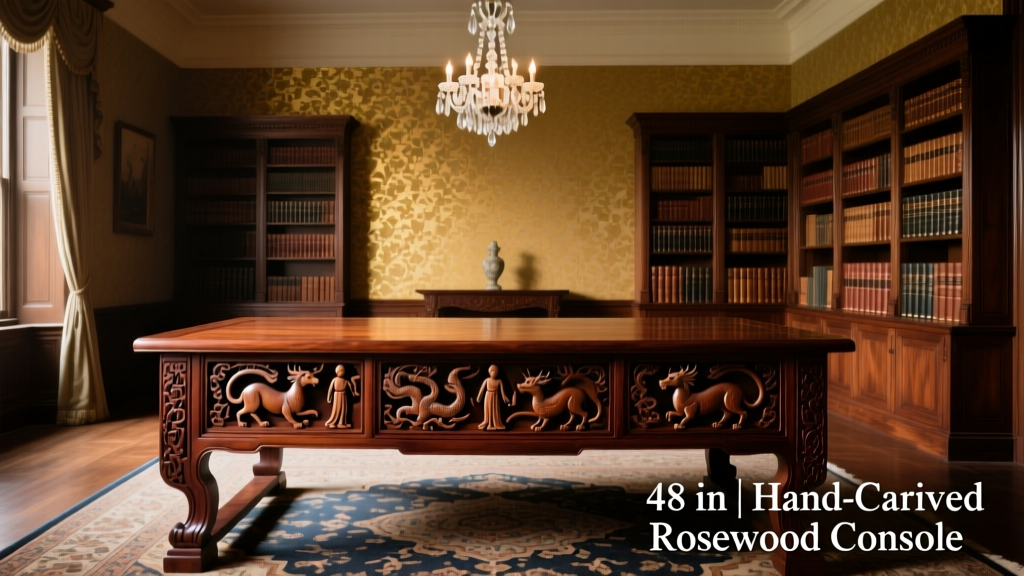
Rosewood Console Table with Carved Human and Animal Figures: A 48-Inch Masterpiece of 19th-Century Craftsmanship
Joseph Bishop: The Unheralded Architect of American Colonial Revival Furniture, 1920–1955
The Enchanting Legacy of German Papier-Mâché Candy Containers: A 9-Inch Lady Figure from Late 19th-Century Thuringia
Glass-Blown Tumbler with Clear Cylinder and Six Swag Panels: A Technical & Historical Analysis of the 3″ × 3″ × 2″ Form
The Crowing Rooster Cookie Jar: A Definitive Guide to Metlox’s Iconic Mid-Century Ceramic
Akro Agate Saucer: Raised Daisy Pattern in Marbleized Yellow — A Collector’s Guide to the 2½-Inch Variant
Firefly Box No. 6 Kerosene Lamp: History, Identification, Restoration, and Safety
The Galle Vase in Autumnal Colors: A Collector’s Guide to the Tapered 18-Inch Masterpiece

Radio Fada Model 1000 Maroon Caramel: Design, Engineering, and Restoration of a Mid-Century American Icon