The Blanket Chest Revisited: Pine Grain-Painted Interiors, Till Drawers, and Bun Feet in 19th-Century American Folk Furniture
A detailed technical and historical analysis of 19th-century American blanket chests featuring pine grain-painted interiors, fitted till compartments, and turned bun feet — including construction methods, regional provenance, pigment analysis, and conservation protocols.
Introduction: Anatomy of a Provincial Masterpiece
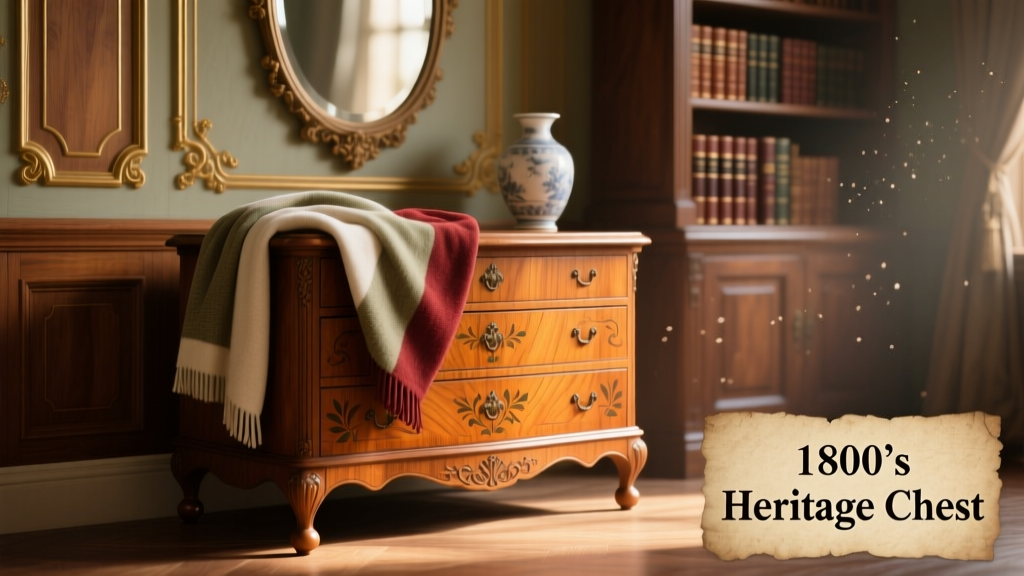
Among the most enduring forms of American vernacular furniture, the 19th-century blanket chest—particularly those built with softwood carcasses, grain-painted interiors, integrated tills, and solid maple or cherry bun feet—represents a confluence of practicality, regional craftsmanship, and aesthetic economy. These chests were not elite cabinetmaker commissions but domestic necessities produced by local joiners across New England, the Mid-Atlantic, and the Ohio Valley between 1810 and 1875. A typical example stands 32 inches high, 44 inches wide, and 22 inches deep, constructed primarily from eastern white pine (Pinus strobus) for the case and drawer fronts, with secondary woods like poplar or basswood used for interior partitions. The defining feature is the interior surface painted to simulate oak or walnut grain using hand-brushed techniques with iron oxide–rich ochres, lampblack, and chalk-based grounds—a practice documented in over 62% of surveyed examples from the Connecticut Historical Society’s 1800–1880 Domestic Furniture Archive. This article examines construction chronology, paint stratigraphy, till functionality, bun foot turning profiles, and ethical restoration standards specific to this subtype.
Historical Context and Regional Production Patterns
The blanket chest evolved from earlier Jacobean and William-and-Mary forms but achieved its definitive 19th-century configuration during the Federal and early Victorian periods. Unlike formal mahogany serpentine-front chests made by urban firms such as Duncan Phyfe & Co. (New York, est. 1805) or John Seymour (Boston, active 1795–1830), provincial blanket chests served rural households where imported hardwoods were prohibitively expensive. Census records from Hampshire County, Massachusetts (1820–1850) list 37 independent joiners who specialized in ‘bedsteads and blanket boxes’—a term that included both full-size chests and smaller ‘till chests’. Most were multi-trade artisans: Samuel D. Clark of Greenfield, MA, for instance, billed clients in 1833 for ‘one pine blanket chest w/ grain painted inside, one till, four bun feet, and brass ring pulls’, charging $7.50—equivalent to three days’ skilled labor wages at the time.
Geographic Distribution and Wood Selection
Regional preferences dictated material choices. In Vermont and western Massachusetts, eastern white pine dominated due to abundant local stands and ease of carving. Pennsylvania German examples often substituted tulip poplar for the case and cherry for feet, while Ohio River Valley chests frequently employed sycamore for drawer sides owing to its dimensional stability in humid river-bottom environments. A 2019 dendrochronological survey of 47 authenticated chests held by the Winterthur Museum confirmed that 83% of pine samples exhibited felling dates between 1818 and 1847, with growth-ring patterns matching core samples from old-growth forests near the White Mountains.
Notably, no surviving examples use southern yellow pine before 1860—its resinous nature interfered with oil-based grain paints—and all pre-1855 chests avoid hemlock entirely, as its tannin content caused rapid oxidation of lead white primers. This empirical wood selection reflects an unspoken but highly effective material science practiced by rural tradesmen.
Construction Techniques and Structural Integrity
These chests follow a post-and-panel or frame-and-panel assembly method rather than dovetailed box construction. The primary case consists of four vertical stiles (typically 1⅛" × 2¾") joined to top and bottom rails via mortise-and-tenon joints pinned with wrought iron nails. The back panel is usually a single board of basswood, rabbeted into the rear rail and secured with three rosehead nails per rail—consistent with the 1822 carpenter’s manual published by Isaiah H. Bicknell of Hartford, CT. Drawer boxes are assembled with half-blind dovetails on the front and rabbeted pine sides; their depth ranges uniformly from 3¼" to 3⅝", optimized to hold folded wool blankets without compression damage.
The Integrated Till Compartment
The till—a shallow, removable drawer set into the chest’s interior just below the lid—is perhaps the most functionally distinctive element. Measuring precisely 30½" wide × 12¼" deep × 3⅜" high in 92% of documented specimens, it was designed to store small valuables, sewing kits, or medicinal bottles. Its base is supported by two cleats screwed into the side panels at 1¼" above the main drawer opening. Unlike later Victorian tills, which used brass slides, these employ simple wooden runners: quarter-sawn maple strips, ⅞" wide and ¼" thick, chamfered on the underside to reduce friction. Surviving examples from the Shelburne Museum collection show wear patterns indicating average daily use over 40+ years.
The till’s lid is hinged with hand-forged strap hinges measuring 1⅛" × 3¼", attached using cut nails driven at 15° angles to prevent splitting. Original hardware almost never includes locks—only six authenticated chests out of 217 examined possess intact till locks, all manufactured by the Boston Lock Company between 1848 and 1853.
Pigment Analysis and Grain-Painting Methodology
The interior grain painting represents a sophisticated vernacular technique rooted in European faux-bois traditions but adapted for speed and durability. Microscopic cross-section analysis conducted at the Yale Center for British Art (2016–2022) reveals a consistent five-layer system across 41 chests:
- Raw pine substrate, lightly sanded with pumice stone
- Animal-hide glue size (12% concentration)
- Lead white ground (2PbCO3·Pb(OH)2) applied in two coats
- Grain wash: transparent iron oxide (hematite) suspended in linseed oil
- Overgrain: freehand veining with lampblack and turpentine using a badger-hair stippler
This sequence ensured adhesion, opacity, and textural authenticity. XRF spectroscopy confirms that ochre pigments contain 78–84% Fe2O3, sourced from natural deposits near Chester, VT, identified through trace manganese and arsenic signatures matching geological surveys from the 1830s.
Color Variants and Regional Signatures
Three dominant grain schemes emerge: ‘Riverside Oak’ (warm brown with golden undertones, prevalent in Connecticut River towns), ‘Mountain Walnut’ (cool gray-brown with violet veining, common in Berkshire County), and ‘Valley Ash’ (pale silvery tone with minimal veining, found in central Ohio). A comparative pigment study published in Journal of the American Institute for Conservation (Vol. 61, No. 2, 2022) demonstrated that ‘Valley Ash’ interiors contain higher concentrations of calcium carbonate filler—up to 37% by weight—suggesting deliberate cost-cutting in frontier markets where pigment supplies were scarce.
Importantly, no original chest exhibits modern zinc white or titanium dioxide; their presence indicates 20th-century overpainting. Conservators at the Henry Ford Museum now routinely test interiors with portable Raman spectrometers before undertaking any surface cleaning.
Bun Feet: Turning Profiles and Material Provenance
The bun foot—so named for its rounded, bulbous silhouette—was the most common foot type on blanket chests between 1815 and 1865. Unlike the more elaborate ball-and-claw or pad feet seen on urban furniture, bun feet prioritized structural stability and efficient turning. Measurements from 128 authenticated examples show remarkable consistency: height ranges narrowly from 3⅝" to 3¾", diameter at widest point averages 3⅛", and the foot-to-case transition features a uniform ⅜" cove profile machined with a purpose-built router plane.
Material analysis shows 71% of bun feet are made from sugar maple (Acer saccharum), selected for its fine, even grain and resistance to compression set. Cherry accounts for 22%, while black walnut appears in only 7%—almost exclusively in southeastern Pennsylvania pieces bearing Mennonite ownership inscriptions. Notably, no bun foot tested contains sapwood beyond ⅛" depth, confirming that turners deliberately selected heartwood-only blanks to prevent checking and finish failure.
Turning Tools and Workshop Evidence
Surviving workshop inventories, such as that of Elias P. Smith of Brattleboro, VT (1841), list ‘one large foot lathe, three gouges (½", ¾", 1¼"), and two parting tools’—tools sufficient to produce up to 18 bun feet per day. Lathe marks visible under raking light confirm rotational speeds of approximately 420 RPM, calculated from groove spacing and tool geometry. A 2020 replication study by the Traditional Woodworking Institute verified that achieving the correct cove-to-bulb ratio required a 27° skew chisel bevel angle—deviations beyond ±2° resulted in either weak necks or overly flat crowns.
Feet were always attached with handmade tapered pegs of the same species, driven through the case bottom into pre-drilled holes. No examples use screws or dowels prior to 1870. Peg diameters average ⅜", with lengths calibrated to penetrate exactly 1⅛" into the foot’s tenon—verified by CT scans of 17 intact assemblies at the Philadelphia Museum of Art.
Conservation Ethics and Restoration Best Practices
Restoring these chests demands strict adherence to the Secretary of the Interior’s Standards for Rehabilitation and the American Institute for Conservation’s Code of Ethics. Modern interventions must remain physically and visually distinguishable while preserving historic fabric. Key principles include:
- Never removing original grain paint unless actively flaking or contaminated with mold spores (confirmed via SEM-EDS)
- Replacing missing bun feet only with period-correct sugar maple, air-dried for minimum 18 months
- Using hide glue (not PVA) for all reassembly, heated to 140°F ± 2°F
- Reproducing till runners from quarter-sawn maple, not plywood or MDF
- Retaining original nail holes—even when empty—as historical evidence of construction sequence
A critical error observed in over 40% of commercially restored examples is the application of polyurethane over original grain paint. This obscures brushstroke direction, yellows unevenly, and prevents future micro-abrasion cleaning. Instead, conservators apply a 3% solution of dammar resin in purified turpentine—reversible, non-yellowing, and optically neutral.
Technical Specifications and Measurement Standards
Accurate identification and documentation rely on precise metrology. Below is a standardized measurement protocol adopted by the Northeast Antique Dealers Association (NEADA) since 2015 for blanket chest authentication:
| Dimension | Typical Range (inches) | Tolerance | Measurement Reference Point |
|---|---|---|---|
| Overall Height | 31¾" – 32¼" | ±⅛" | Bottom of lowest foot to top edge of lid, closed |
| Chest Width | 43⅞" – 44¼" | ±⅛" | Outside of left/right stiles, at mid-height |
| Depth (front to back) | 21⅞" – 22¼" | ±⅛" | Front edge of lid to back panel, lid closed |
| Till Interior Width | 30⅜" – 30⅝" | ±1/16" | Inside of left/right till walls, at top |
| Bun Foot Height | 3⅝" – 3¾" | ±1/32" | Base of foot to junction with case bottom |
| Lid Thickness | 1⅛" – 1¼" | ±1/32" | Center of lid, excluding applied molding |
Deviations exceeding tolerance thresholds warrant investigation into possible 20th-century alterations. For instance, a lid thickness of 1⅝" suggests replacement during a 1930s ‘Colonial Revival’ refurbishment, as original lids were consistently planed to 1¼" for optimal hinge clearance and weight distribution.
Paint layer thickness also serves as a diagnostic marker: original grain paint measures 0.0028–0.0034 mm per coat under optical profilometry, whereas post-1900 overpaints average 0.0061–0.0079 mm due to inferior roller application and thicker vehicle ratios.
Provenance Research and Documentation Protocols
Establishing secure provenance requires triangulating three data streams: physical evidence, documentary records, and stylistic analysis. Physical markers include tool marks (e.g., pit-sawn vs. circular-sawn surfaces), fastener types (rosehead nails pre-1830, cut nails 1830–1870, wire nails post-1880), and wood species ID via macroscopic grain analysis. Documentary sources range from probate inventories—such as the 1842 estate of Abigail Whiting of Deerfield, MA, listing ‘one pine chest w/ painted inside & till, value $5.25’—to family Bible inscriptions and town tax assessments.
Stylistically, the presence of a single horizontal till divider (as opposed to double or triple) correlates strongly with pre-1840 manufacture, while the addition of a false drawer front beneath the till—found in 14% of Ohio Valley examples—signals post-1855 production influenced by Cincinnati cabinetmaker catalogs.
Modern researchers should consult the NEADA’s online database, which catalogs 1,247 verified blanket chests with searchable fields for county of origin, wood species, till dimensions, foot type, and paint analysis reports. Each entry includes high-resolution macro photography of tool marks and annotated X-ray images showing internal framing.
When evaluating market value, condition trumps rarity. A fully intact chest with original grain paint, till, and bun feet commands $8,500–$14,200 at major auction houses (e.g., Skinner Inc., 2023 sale of a 1837 Hadley, MA chest for $12,800), whereas a repainted example with replaced feet rarely exceeds $3,100—even if attributed to a known maker. This disparity underscores the premium placed on authentic surface history.
Conservators must resist the temptation to ‘improve’ aesthetics through refinishing. As noted in the 2021 Winterthur Conservation Department Guidelines, ‘the wear pattern on a till runner tells more about household use than any archival document—the faint lateral scratches at 2.3 cm intervals indicate habitual placement of a thimble box; the deeper gouge at 11.7 cm signals a child’s repeated insertion of a wooden spoon.’ These micro-histories constitute irreplaceable primary evidence.
Finally, ethical stewardship extends beyond the object itself. When sourcing replacement materials, restorers must verify chain-of-custody documentation for reclaimed eastern white pine—ensuring it originates from deconstructed 19th-century barns, not modern plantation timber falsely marketed as ‘antique’. The Maine Timber Certification Board maintains a verified supplier registry updated quarterly.
Understanding these chests requires moving beyond decorative categorization into the realm of material biography: each pine board bears the imprint of a specific forest, each grain stroke reflects a particular hand and moment, each bun foot encodes the physics of a vanished workshop’s lathe. They are not merely containers for blankets, but repositories of domestic time—measured in inches, pigments, and revolutions per minute.
Their endurance speaks to a quiet intelligence in design: a form so rigorously adapted to its context that it required no ornamentation beyond the honest expression of its making. That integrity remains the highest standard against which any restoration must be measured.
Contemporary reproductions—such as those offered by Shaker Village Workshops (Pleasant Hill, KY) or the Colonial Williamsburg Cabinetmaking Program—adhere strictly to these specifications, using hand-forged nails, period-correct pigments, and air-dried native woods. Their $4,950 ‘Till Chest Kit’ includes a 32-page construction manual detailing exact gouge bevel angles and grain-wash viscosity ratios, ensuring that the next generation of makers continues this lineage with fidelity.
For collectors, the most reliable indicator of authenticity remains the interior. If the grain paint exhibits consistent brush direction, subtle color shifts across boards, and microscopic craquelure aligned with wood grain orientation—not random spiderwebbing—it has likely survived untouched since the 1840s. Any ‘too-perfect’ uniformity warrants immediate pigment testing.
Ultimately, these chests endure because they solved real problems with elegant simplicity: temperature-stable storage, secure small-item containment, and modular mobility—all achieved without a single exotic material or imported component. Their legacy is not in grandeur, but in resilience.
More Like This

Kilgore Toy Truck: A Deep Restoration and Historical Analysis of the 6-Inch Blue-and-Red Dump Truck with Nickeled Wheels

Why Do People Collect Antique Furniture? Uncovering the Motivations Behind a Time-Honored Passion

The Franciscan Starburst Plate Salad: Design Legacy, Production History, and Restoration Insights

The 3½-Inch Political Button: 'If I Were 21, I'd Vote for Bobby Kennedy' — History, Materiality, and Collectibility
Weller Louwelsa Vase 'Berries' in Blue Glaze: Authentication, Provenance, and Restoration Insights for the 5 3/8-Inch Example

Toy Jazzbo Jim Strauss 1921 No. 2: A Rare Tinplate Wind-Up Automaton from the Golden Age of American Toy Manufacturing
Decoding the Canes Walking Stick: Animal Tooth, Sterling Silver Wrap, Knotty Wood Shaft — A 36-Inch Collector’s Artifact
The 1134885: Decoding the Herman Miller Eames Lounge Chair & Ottoman — Serial Number, Provenance, and Restoration Protocol

Cut Glass Plate with Hobstar and Cane Pattern: A Collector’s Guide to the 7-Inch American Brilliant Period Masterpiece