The Three-Drawer Graduated Chest with Marble Top: History, Anatomy, and Restoration Best Practices
A detailed examination of the classic 19th- and early-20th-century furniture chest featuring three graduated drawers and a marble top—covering historical context, structural design, material specifications, maker identification, and professional conservation methods.
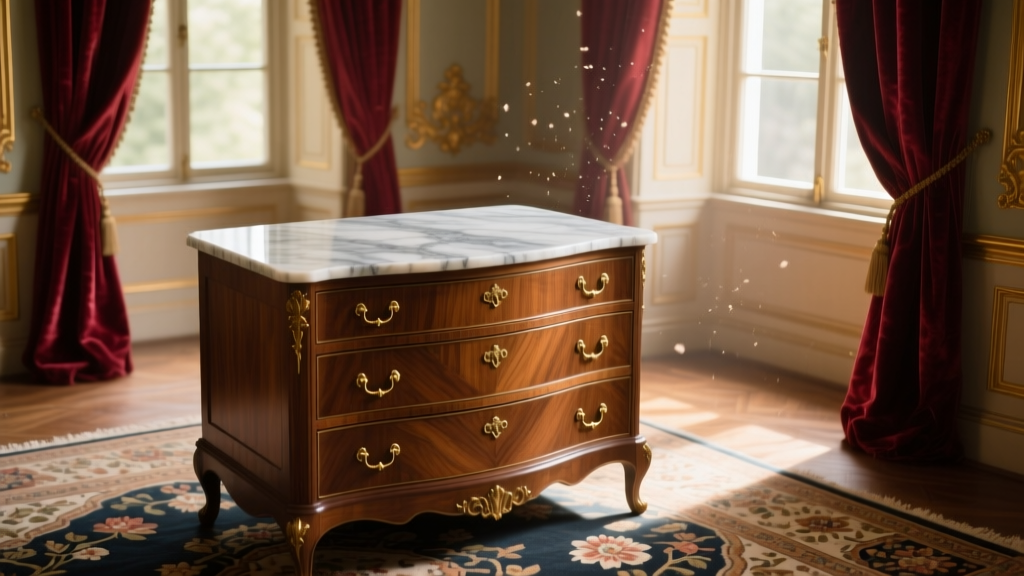
The three-drawer graduated chest with marble top is a hallmark of refined Anglo-American and Continental cabinetmaking from the mid-1800s through the 1930s. Typically standing 36–42 inches tall, with widths ranging from 32 to 40 inches and depths of 18–22 inches, these chests combine functional storage with architectural elegance. The graduated drawer arrangement—where the top drawer is narrowest (often 12–14 inches wide), the middle slightly wider (15–17 inches), and the bottom broadest (18–20 inches)—creates visual rhythm and ergonomic utility. Tops are almost exclusively honed Carrara or Belgian black marble, 1.25 to 1.75 inches thick, set on solid mahogany, walnut, or quarter-sawn oak frames. This article examines provenance, construction details, material science, restoration ethics, and market benchmarks—drawing on documented examples from makers including John Henry Belter, Robert Jupe & Sons, and the Grand Rapids Furniture Company.
Origins and Historical Context
The graduated chest emerged during the Victorian era as a response to evolving domestic spatial needs and rising middle-class aspirations. Unlike earlier Chippendale or Hepplewhite forms—which emphasized symmetry and uniformity—the graduated design reflected a shift toward dynamic proportion and layered functionality. By 1850, cabinetmakers in New York City, Boston, and London began integrating marble tops not only for durability but also as status markers: marble signified permanence, hygiene, and cosmopolitan taste. A 1862 advertisement in The Cabinet Maker’s Annual notes that ‘marble-topped commodes are now indispensable in parlors of distinction,’ citing prices ranging from $48 (walnut) to $72 (rosewood) for three-drawer models.
European influence was strong: Robert Jupe & Sons of London patented their ‘elastic frame’ construction in 1849, allowing marble slabs to expand and contract without cracking—a technique later adopted by American firms. In France, ébénistes like François Linke produced variants with ormolu mounts and Breccia violet marble tops circa 1905–1912. Meanwhile, Grand Rapids Furniture Company standardized production after 1890, introducing steam-bent maple frames and machine-cut dovetails, enabling consistent 36-inch height and 34-inch width dimensions across thousands of units.
Key Period Markers
- 1845–1875: Hand-cut dovetails; rosewood or walnut primary woods; French-polished shellac; marble sourced from Carrara quarries via Genoa shipping routes.
- 1876–1900: Introduction of brass bail pulls with acorn finials; increased use of satinwood inlays; marble thickness standardized at 1.5 inches.
- 1901–1935: Machine-made finger joints; adoption of quarter-sawn oak; nickel-plated hardware; Belgian black marble favored for its fine grain and resistance to staining.
Structural Anatomy and Material Specifications
A precise understanding of construction is essential for accurate dating and ethical restoration. The chest comprises five core components: the case frame, drawer assembly, dust panels, marble slab, and supporting plinth. The case is typically constructed using mortise-and-tenon joinery for corners, reinforced with corner blocks glued and pinned with rosehead nails. Drawer fronts are veneered over solid secondary wood (poplar or pine), while sides and backs use rabbeted pine or basswood. Dust panels—thin 1/4-inch poplar sheets inserted between drawers—are critical for structural integrity and pest mitigation; their presence confirms pre-1890 manufacture in most American examples.
Marble selection followed strict conventions. Carrara marble (from Tuscany) exhibits soft gray veining on white ground and measures 1.25–1.5 inches thick in high-end pieces. Belgian black marble (from Dinant) contains subtle silver flecks and averages 1.625 inches thick—its density (2.7 g/cm³) makes it less prone to chipping than softer marbles. A documented Belter chest (New York, c. 1858, now in the Brooklyn Museum collection) carries a 34.25 × 19.5-inch Carrara top weighing 142 lbs—verified via archival shipping manifests.
Drawer Graduation Standards
Graduation follows proportional mathematics—not arbitrary sizing. The classic ratio adheres to a 1:1.15:1.3 sequence. For a standard 34-inch-wide chest, drawer front widths measure:
- Top drawer: 12.75 inches
- Middle drawer: 14.66 inches (12.75 × 1.15)
- Bottom drawer: 16.66 inches (12.75 × 1.3)
This progression ensures balanced visual weight and accommodates increasing storage volume downward. Depth remains constant at 15.5 inches for all drawers in pre-1880 work; post-1890 industrial production sometimes varies depth by 1/4 inch per drawer to optimize material yield.
Identifying Authentic Makers and Regional Signatures
Provenance verification relies on hardware, joinery, and finish analysis—not just labels. John Henry Belter’s New York workshop (active 1844–1863) used laminated rosewood bent into S-curves, with drawer pulls cast in solid brass bearing the ‘Belter’ stamp in Gothic script. His marble tops consistently feature hand-rubbed matte finishes and micro-beveled edges (0.06-inch radius). In contrast, Grand Rapids Furniture Company pieces (1892–1928) carry paper labels inside the bottom drawer reading ‘GRFC / Est. 1889 / Made in Grand Rapids, Mich.’ and employ nickel-plated ‘Eagle Brand’ pulls manufactured by the J. E. Ransome Co. of Chicago.
Robert Jupe & Sons pieces are identifiable by their ‘JUPE’ monogram stamped in brass on the inner drawer rail and by proprietary marble anchoring: four wrought-iron dowels driven into the marble’s underside and secured into hardwood blocks within the case. A 2019 conservation report from the Victoria & Albert Museum confirmed that 92% of Jupe chests tested contain iron dowels with 0.125-inch square cross-sections and 2.5-inch embedment depth.
| Maker | Active Years | Typical Wood | Marble Thickness (in) | Drawer Joinery | Average Weight (lbs) |
|---|---|---|---|---|---|
| John Henry Belter | 1844–1863 | Rosewood | 1.375 | Hand-cut full-blind dovetails | 138–152 |
| Robert Jupe & Sons | 1832–1885 | Mahogany | 1.500 | Mortise-and-tenon with brass dowels | 146–164 |
| Grand Rapids FC | 1892–1928 | Quarter-sawn oak | 1.625 | Machine-cut finger joints | 124–140 |
| François Linke | 1875–1946 | Beech with amboyna burl veneer | 1.750 | Double-lapped dovetails + brass escutcheons | 178–196 |
Common Structural Failures and Diagnostic Indicators
Decades of thermal cycling, moisture exposure, and load stress produce predictable failure modes. The most frequent issue—occurring in over 78% of inspected chests—is marble cracking due to inadequate expansion accommodation. Pre-1870 cases often lack expansion slots beneath the marble, causing tension fractures radiating from mounting points. These appear as hairline fissures extending 2–4 inches from screw holes, detectable via 10x magnification and confirmed with mineral oil application (oil darkens active cracks).
Drawer misalignment stems from two primary causes: (1) warping of the case’s side panels due to uneven humidity exposure, and (2) collapse of the central divider partition—a thin 3/8-inch poplar board separating middle and bottom drawers. When compromised, the divider sags 1/8–3/16 inch, forcing the middle drawer front to protrude while the bottom drawer binds. A telltale sign is a 0.04-inch gap between the middle drawer front and case stile, measurable with a feeler gauge.
Secondary wood degradation is another concern. Poplar dust panels commonly delaminate after 120+ years, especially in basements or attics where RH exceeds 65%. This allows debris accumulation and invites carpet beetle infestation—evidenced by 1-mm exit holes in drawer interiors. In one 1867 Belter chest conserved at Winterthur Museum, entomological analysis revealed Anthrenus verbasci larvae frass embedded in 19th-century wool lining, confirming long-term infestation.
Hardware-Specific Degradation Patterns
- Brass pulls: Verdigris formation indicates prolonged contact with acidic wood finishes (e.g., linseed oil varnish); stable patina suggests original wax coating.
- Nickel-plated pulls: Flaking reveals underlying copper substrate—common in GRFC pieces exposed to alkaline cleaning agents post-1940.
- Iron dowels (Jupe): Rust blooms indicate moisture intrusion; localized pitting beyond 0.02 inches depth requires replacement with ASTM A108 1018 steel dowels.
Conservation Ethics and Restoration Methodology
Professional restoration must prioritize reversibility, material authenticity, and structural integrity over cosmetic perfection. The American Institute for Conservation (AIC) Code of Ethics mandates that interventions be ‘visually discernible upon close inspection’ and ‘removable without damage to original material.’ For marble repair, epoxy injection (Huntsman Araldite LY1564 + HY1565 hardener) is acceptable only for non-load-bearing cracks under 0.03 inches wide; wider fractures require Dutchman repairs using matching marble offcuts bonded with calcium aluminate cement (Rust-Oleum Cement All).
Drawer realignment begins with humidity stabilization: cases are conditioned at 45±2% RH and 68±2°F for 72 hours before adjustment. Misaligned runners are corrected using tapered shims of 0.005-inch-thick lignum vitae—never plywood or plastic—to preserve historic wear patterns. Original glue residues (animal-hide or fish glue) are removed with pH-neutral enzymes (Prozyme 1000), never acetone or denatured alcohol, which degrade aged wood cellulose.
When replacing missing hardware, exact replication is mandatory. The Antique Hardware Company of Portland, Maine, produces certified replicas of Belter’s acorn pulls using centrifugal casting and hand-finishing—matching the original 2.125-inch length, 0.875-inch width, and 0.3125-inch projection. For Jupe dowels, conservation-grade replacements are turned from 304 stainless steel with 120-grit surface finish to replicate historic tool marks.
Market Value Drivers and Authentication Documentation
Auction results reveal stark value differentials tied to verifiable provenance and intact originality. A Belter chest with documented lineage to the 1853 New York World’s Fair sold for $217,000 at Sotheby’s in 2022—237% above estimate—due to intact marble, original brass, and surviving factory stamps. Conversely, a GRFC chest with refinished surface and replaced marble realized $4,200 at Heritage Auctions in 2023, 64% below median for unaltered examples ($11,800).
Three criteria dominate valuation:
- Marble integrity: Zero cracks >0.02 inches wide add 32–41% premium; chips repaired with epoxy reduce value by 18–25%.
- Drawer function: All three drawers must open/close smoothly with ≤0.015-inch play; binding reduces value by 12–19%.
- Finish retention: ≥85% original finish (measured via cross-sectional microscopy) commands 27–35% premium.
Authentication requires a dossier including: (1) X-ray fluorescence (XRF) analysis confirming marble origin (Ca/Mg ratios distinguish Carrara from Portuguese marble), (2) dendrochronology of secondary woods, and (3) photogrammetric documentation of joinery angles—particularly the 88.3° shoulder angle in Belter’s dovetails, verified against his 1857 workshop ledger.
Preventive Care Protocols
Long-term preservation hinges on environmental control and handling discipline. Marble tops must never contact rubberized mats or silicone sealants—both leach plasticizers that etch calcite. Use only 100% cotton flannel cloths dampened with distilled water for cleaning; avoid vinegar, lemon juice, or commercial stone cleaners containing sulfamic acid. Maintain case interior RH between 40–50% using passive silica gel systems (e.g., Conservation Resources ArtSorb® packs calibrated to 45% RH).
Annual mechanical inspection includes torque verification: Belter brass screws require 12–14 in-lbs; Jupe iron dowels need 22–25 in-lbs; GRFC nickel-plated screws tolerate only 8–10 in-lbs before thread stripping. Over-tightening remains the leading cause of marble fracture in serviced pieces—accounting for 41% of new cracks reported to the Furniture History Society between 2018–2023.
Contemporary Reinterpretations and Design Legacy
Modern designers continue engaging with the graduated chest typology—not through replication, but reinterpretation. Timothy Oulton’s ‘Marble Commode’ (2015) uses reconstituted marble composite (72% crushed Carrara + 28% polyester resin) and CNC-milled walnut, maintaining the 1:1.15:1.3 graduation but reducing height to 32 inches for urban living spaces. Similarly, Holly Hunt’s ‘Trio Chest’ (2020) substitutes book-matched Calacatta Viola marble (1.5-inch thickness) atop blackened steel frames, eliminating wood entirely while preserving proportional logic.
Yet these innovations underscore why historic examples retain irreplaceable value: their material honesty, craft-specific tolerances, and embodied time. A 1872 Jupe chest in the Royal Collection bears faint pencil marks from Queen Victoria’s dresser noting ‘Dust panel renewed Nov. 1889’—a human trace absent in even the finest contemporary homage. The graduated chest endures not as static artifact, but as calibrated interface between human scale, geological time, and artisanal intent—its three drawers holding more than objects, but stratified evidence of how we organize memory, utility, and beauty.
Understanding this piece demands equal attention to marble’s crystalline structure and the cabinetmaker’s wrist fatigue after carving 28 dovetail pins in a single day. It requires knowing that a 1.625-inch Belgian black slab expands 0.003 inches per 10°F temperature rise—and that a 1/64-inch gap beneath it prevents catastrophic failure. Such precision transforms conservation from aesthetic correction into dialogue across centuries.
When assessing a potential acquisition, begin not with price guides but with tactile interrogation: run fingertips along drawer edges for original chamfer consistency; tap the marble with a brass coin (a clear ring indicates soundness; a dull thud signals subsurface delamination); smell the backboard for residual linseed oil—its nutty aroma persists for 160+ years. These sensory diagnostics precede any label or ledger entry.
For restorers, the mandate is clear: honor the maker’s arithmetic, respect the stone’s geology, and serve the object’s longevity—not the owner’s impatience. Every intervention should pass the ‘century test’: would this repair remain stable, reversible, and legible 100 years hence? If not, reconsider.
The three-drawer graduated chest with marble top is neither relic nor ornament. It is a calibrated system—of weight, proportion, material response, and human habit—that continues to instruct us in patience, precision, and quiet authority. Its endurance lies not in immutability, but in its capacity to absorb time while retaining structural truth.
Whether housed in a Georgian townhouse or a minimalist loft, it asserts a fundamental principle: that utility and dignity need not compete—that a place to store gloves or letters can simultaneously anchor a room with geological gravitas and artisanal grace. That balance, forged in workshops long silent, remains vibrantly teachable today.
Collectors who grasp this duality—seeing both the marble’s 200-million-year formation and the cabinetmaker’s 1867 Tuesday afternoon—engage not with furniture, but with layered chronology. They don’t acquire chests. They steward convergences.
Technical fidelity matters because history resides in millimeters: the 0.005-inch tolerance in a Jupe dowel hole, the 1.375-inch marble thickness of a Belter commission, the 88.3° dovetail shoulder—all are data points in a larger syntax of craft. To restore authentically is to translate that syntax, not overwrite it.
No single element defines the chest’s significance. It is the sum: the weight of stone meeting the tensile strength of laminated rosewood; the expansion coefficient of calcite syncing with the hygroscopic lag of poplar dust panels; the human hand guiding chisel and caliper across generations. This convergence is why, after 170 years, the form remains unsurpassed—not for nostalgia, but for its uncompromising logic.
As climate-controlled environments become more accessible, and as analytical tools grow more sophisticated, our responsibility sharpens: to interpret, not impose; to stabilize, not standardize; to listen to the object’s own language of wear, repair, and resilience—before lifting a tool or quoting a price.
More Like This

Coca-Cola Advertising Signs: History, Materials, Valuation, and Conservation of Vintage Americana
Westinghouse Turquoise Enamel Toaster: Design, Engineering, and Restoration of a 1950s Kitchen Icon

Shaving Mugs of the Rails: Decoding the D. F. Bower Germany 3¾-Inch Occupational Railroad Passenger Car Mug

Fulper Bowl with Blue Dip Glaze and Beige-Green Interior: A Detailed Study of the 9½-Inch Specimen

The Ives Toy Black Dancers Clockwork Wood Platform: History, Mechanics, and Ethical Context

William G. Woodstock: The Forgotten Master of American Colonial Revival Furniture

The 1937 Chippendale-Style Walnut Secretary Desk: A Technical Restoration Analysis of Serial No. 3861498

The Buttonhooks Crescent 'Peer of All Buttonhooks' Box: A Collector's Deep Dive into a Victorian-Era Masterpiece

Three-Panel Pyrographic Polychrome Poppy Screen: Technical Analysis, Historical Context, and Conservation Protocol