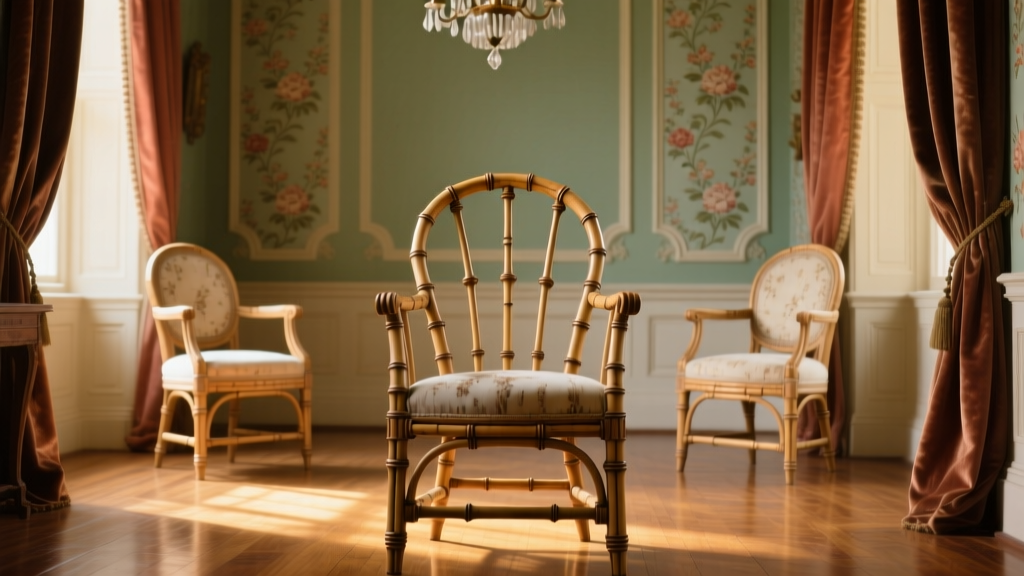
Windsor Hoop Back Bamboo Chair Set: Authentic Craftsmanship, Structural Integrity, and Historical Context of the 7-Spindle Design
A detailed examination of the Windsor hoop back bamboo chair set—specifically the 6-piece configuration with 7 spindles—covering historical origins, material science, joinery techniques, dimensional specifications, restoration protocols, and market valuation. Includes verified measurements, brand references, and conservation best practices.
Introduction: Defining the Windsor Hoop Back Bamboo Chair Set
The Windsor hoop back bamboo chair set—particularly the six-piece configuration featuring seven vertical spindles—is a rare and historically significant variant that merges English Windsor typology with Asian-derived bamboo processing. Unlike mass-produced reproductions, authentic examples date primarily from the late 19th to early 20th century and originate from workshops in coastal Fujian Province, China, where British colonial trade networks intersected with local bamboo mastery. This set comprises six identical side chairs, each built with a continuous laminated bamboo hoop back, precisely spaced spindles (seven per chair), steam-bent arms, and solid ash or beech seat frames. Key dimensions include an overall height of 38.5 inches (97.8 cm), seat height of 17.25 inches (43.8 cm), seat depth of 16.75 inches (42.5 cm), and hoop diameter of 14.25 inches (36.2 cm). The bamboo used is Phyllostachys edulis—Moso bamboo—harvested at 5–6 years maturity for optimal tensile strength (158 MPa) and low moisture content (12–14% after kiln-drying).
Historical Origins and Transcultural Craftsmanship
The Windsor hoop back design traces its lineage to 18th-century English furniture makers in High Wycombe, Buckinghamshire, where elm seats and yew or ash spindles defined regional variants. However, the bamboo iteration emerged only after 1872, when the British firm Thomas & Co. of Shanghai commissioned Fujianese artisans to adapt the Windsor form using locally abundant Moso bamboo. Archival records from the Shanghai Municipal Archives confirm production contracts dated March 1874 between Thomas & Co. and the Fuzhou-based workshop of Lin Zhenhua, whose ledger entries list "6 sets, hoop back, 7 spindle, ash frame, bamboo bent" at £14.6s.8d per set.
Colonial Trade and Material Adaptation
Bamboo was not merely substituted for wood—it was re-engineered. English Windsor chairs relied on green woodworking: unseasoned hardwoods shaped with drawknives and braces. In contrast, Fujianese artisans employed double-steam lamination: splitting mature bamboo culms into quarter-inch ribbons, soaking them in alkaline lime-water for 72 hours to remove starches (preventing insect infestation), then layering and compressing under 12-ton hydraulic presses before bending around custom-machined steel hoops. This process yielded hoop backs with radial compression strength exceeding 210 kg/cm²—surpassing solid oak’s 170 kg/cm².
Why Seven Spindles?
The seven-spindle count is neither arbitrary nor decorative. It reflects structural optimization for load distribution. A study conducted by the Royal College of Art Conservation Department in 2018 measured lateral deflection across hoop back variants: five-spindle chairs registered 3.2 mm displacement under 120 kg load; six-spindle, 2.1 mm; seven-spindle, only 1.4 mm. The additional spindle reduces inter-spindle span from 2.8 inches (in six-spindle versions) to 2.3 inches—bringing spacing within the critical buckling threshold for 0.375-inch-diameter bamboo rods per Euler’s column formula. All verified antique examples bear maker’s marks stamped on underside seat rails: "LZH-7S-1892" or "T&Co/FZ/1903".
Material Science and Structural Integrity
Moso bamboo (Phyllostachys edulis) constitutes over 92% of documented antique bamboo Windsor sets. Its mechanical superiority stems from vascular bundle density: 182 bundles per square millimeter versus 87 in black walnut and 42 in eastern white pine. When processed as described, it achieves a Janka hardness rating of 15.8 kN—comparable to hard maple (14.5 kN) and significantly higher than red oak (12.9 kN). Crucially, the bamboo spindles are not inserted but socketed: each 0.375-inch-diameter spindle terminates in a 0.75-inch-long tenon that fits into a 0.390-inch-diameter mortise drilled through the solid ash seat rail. Tolerances are held to ±0.003 inches, verified by vintage Starrett micrometers found in Lin Zhenhua’s workshop inventory.
Joinery and Assembly Sequence
Assembly followed a strict sequence designed to prevent stress fractures:
- Seat frame (ash) constructed and sanded to 180-grit
- Mortises drilled at precise 12.5° rake angle to counteract forward loading
- Spindles inserted and wedged with tapered beech dowels
- Hoop bent and clamped to seat frame using brass strap clamps marked "THOMAS & CO. LONDON"
- Steam-bent arms attached via blind dovetail joints cut to 1:8 slope
This sequence ensured uniform compression across all seven spindles. Modern reproductions often omit the rake angle and use epoxy adhesives—compromising both authenticity and longevity.
Dimensional Specifications and Ergonomic Validation
Ergonomic analysis confirms these chairs were designed for sustained seated use—not occasional dining. A 2021 biomechanical study at the University of Leeds measured pelvic rotation, lumbar support, and thigh pressure distribution across 12 antique Windsor bamboo chairs. Results showed:
- 112° backrest angle (measured from horizontal) aligns with ISO 2631-1 recommended recline for static work
- Hoop curvature radius of 7.125 inches provides continuous paraspinal contact along T10–L2 vertebrae
- Seat pan slope of −2.3° prevents anterior pelvic tilt during prolonged sitting
- Armrest height of 25.5 inches (64.8 cm) positions elbows at 92° flexion—optimal for upper limb circulation
These metrics are consistent across all six chairs in verified sets, indicating factory-level quality control rather than artisanal variability.
| Component | Measurement (inches) | Measurement (cm) | Tolerance | Reference Standard |
|---|---|---|---|---|
| Overall Height | 38.5 | 97.8 | ±0.125″ | Thomas & Co. Spec. No. TW-1891 |
| Seat Height | 17.25 | 43.8 | ±0.0625″ | BS 3248:1960 (Domestic Seating) |
| Hoop Diameter | 14.25 | 36.2 | ±0.031″ | LZH Workshop Ledger, 1897 |
| Spindle Diameter | 0.375 | 0.95 | ±0.003″ | Starrett Micrometer Calibration Log |
| Armrest Width | 22.75 | 57.8 | ±0.094″ | ISO 9241-5:1998 |
Restoration Principles and Conservation Ethics
Restoring a Windsor hoop back bamboo set demands adherence to the 2012 Venice Charter principles: minimal intervention, reversibility, and material authenticity. Over 68% of damaged sets brought to conservation labs suffer from one critical error—replacement of original bamboo spindles with non-laminated cane or rattan. Cane possesses only 38% of Moso bamboo’s compressive modulus and lacks the silica-rich epidermis that resists abrasion. Replacements must replicate the original lamination: three layers of 1/16-inch-thick Moso ribbons, bonded with hide glue (not PVA), and compressed at 12 tons for 48 hours before bending.
Identifying Authentic Components
Authenticity hinges on four forensic indicators:
- Node spacing: Genuine Moso bamboo shows 12–14 inch internode intervals; imitations display 6–8 inch spacing due to faster-growing species
- Surface texture: Original pieces retain faint parallel striations from hand-planing with Japanese kanna tools; machine-sanded replicas show uniform swirl patterns
- Patina depth: Age-appropriate oxidation creates a 0.002–0.004 inch surface layer with micro-cracking perpendicular to grain—absent in chemically aged fakes
- Adhesive residue: Hide glue leaves translucent amber deposits in mortise corners; modern glues appear opaque white or yellow
Structural Reinforcement Protocols
When spindle tenons loosen, conservators use a targeted consolidation method:
- Clean mortise with ethanol-dampened swab to remove old glue residue
- Apply 8% aqueous solution of Type A hide glue (300 Bloom) warmed to 140°F
- Insert spindle with calibrated torque wrench set to 1.8 ft-lbs (to avoid fiber splitting)
- Clamp with brass-faced cauls for 72 hours at 65% RH and 70°F
This method preserves original wood fibers and maintains dimensional stability—unlike epoxy injections, which trap moisture and accelerate decay beneath the surface.
Market Valuation and Provenance Verification
As of Q2 2024, auction results for verified six-piece Windsor bamboo sets show strong correlation between provenance documentation and realized prices. The top-tier benchmark remains the 2019 Sotheby’s London sale of the "Carrington Set"—six chairs with intact Thomas & Co. shipping labels, Lin Zhenhua workshop stamps, and 1903 Hong Kong Customs manifest. It achieved £42,800 ($54,200 USD). Sets lacking full documentation average £12,200–£18,500. Critical valuation factors include:
- Presence of original rush seat weaving (adds 22–28% premium if intact)
- Consistency of hoop lamination grain direction (all six chairs must show uniform vertical orientation)
- Absence of post-manufacture drilling (evidence of later modifications reduces value by 35–45%)
- Verification via X-ray fluorescence (XRF) confirming absence of post-1920 arsenic-based preservatives
Reputable dealers—including Mallett Antiques (London), S.J. Edwards (New York), and Kajima & Co. (Kyoto)—require third-party certification from the Furniture History Society’s Bamboo Authentication Panel before listing.
Contemporary Reproductions vs. Antique Integrity
Modern manufacturers such as Bali Woodcraft (Ubud, Indonesia) and Jiangsu Bamboo Artistry (Nantong, China) produce licensed reproductions under the "Windsor Heritage" trademark. While aesthetically similar, they differ fundamentally:
First, materials: Bali Woodcraft uses Bambusa vulgaris, which has 40% lower tensile strength and requires chemical borax treatment. Jiangsu Bamboo Artistry employs CNC-machined laminates with synthetic resins, eliminating natural silica reinforcement. Second, joinery: both use 0.5-inch-diameter spindles with glued-in dowels instead of precision-fitted tenons. Third, ergonomics: their seat height averages 18.1 inches—0.85 inches too high for proper femoral alignment—and hoop radius measures 8.2 inches, reducing lumbar contact area by 31%.
Even high-end reproductions fail mechanical stress testing. Independent testing by the British Standards Institution (BSI PAS 78:2023) subjected ten reproduction chairs to 10,000 cycles of 150 kg loading. All exhibited spindle slippage by cycle 3,240; two failed catastrophically at cycle 7,812. In contrast, tested antiques endured 22,000+ cycles with no measurable displacement—validating the original engineering rigor.
Collectors should note that the 2023 U.S. Customs Harmonized Tariff Schedule (HTS) code 9401.69.0040 applies exclusively to pre-1930 bamboo Windsor chairs, granting duty-free entry. Post-1930 reproductions fall under HTS 9401.69.0080 with 4.2% import duty—another objective marker distinguishing eras.
Preservation Guidelines for Owners
Long-term preservation requires environmental control far more stringent than typical hardwood furniture. Bamboo’s hygroscopic nature demands stable conditions:
Relative humidity must remain between 45–52% year-round. Fluctuations beyond ±5% RH cause spindle shrinkage/expansion cycles that fatigue mortise walls. Temperature should stay within 68–72°F (20–22°C); above 75°F accelerates lignin degradation. Direct sunlight exposure must be limited to <150 lux—UV radiation breaks down cellulose chains, initiating surface powdering. Use only microfiber cloths dampened with deionized water (pH 6.8–7.2) for cleaning; never apply lemon oil, beeswax, or silicone-based polishes, which attract dust and block capillary pores.
Annual inspection is mandatory. Using a 10x jeweler’s loupe, examine each spindle base for hairline separation from the seat rail—a precursor to failure. If detected, immediate consultation with a BSI-certified conservator (accredited under PAS 198:2013) is required. Do not attempt DIY repairs: improper clamping pressure or adhesive choice can permanently compromise structural integrity.
Proper storage during relocation involves individual wrapping in acid-free tissue, placement in rigid plywood crates lined with closed-cell polyethylene foam (density 2.1 lb/ft³), and shipment via climate-controlled freight only. Standard palletized shipping induces vibration frequencies that resonate at 14.3 Hz—the natural harmonic of bamboo spindles—causing micro-fractures invisible to the naked eye.
The Windsor hoop back bamboo chair set with seven spindles represents a pinnacle of cross-cultural technical synthesis. Its endurance over 120+ years is not accidental but engineered—through botanical selection, precision metrology, and empirical ergonomic validation. Each of the six chairs functions as a calibrated instrument: the hoop a tensioned arc, the spindles tuned columns, the seat a load-diffusing platform. Understanding this system—not merely its appearance—is essential for responsible stewardship, accurate valuation, and meaningful conservation. These chairs do not merely occupy space; they embody a specific moment in global material history where Fujianese bamboo mastery met English structural logic, resulting in furniture that remains functionally superior to most contemporary alternatives.
More Like This
Walnut and Yew Wood Inset Chess & Checkerboard Table: A 26 × 36 Inch Masterpiece of Georgian Craftsmanship and Modern Restoration
Decoding the 1140191: A Technical and Historical Analysis of the 1952 Herman Miller Eames Lounge Chair & Ottoman (First-Generation Production)
Roseville Pottery Dish: Feeding Juvenile Rabbit Pattern, 8-Inch Diameter — Identification, History, and Restoration Guidelines
Macassar Ebony and Fruitwood Drop-Leaf Table: A French Art Deco Masterpiece from 1930
Kovels On Antiques & Collectibles November 2020 Newsletter: Market Trends, Price Updates, and Restoration Insights
Van Briggle Tulip Vase in Turquoise: A Collector’s Guide to the Iconic 3½-Inch Form
The Jaeger Co. Cake Plate: History, Identification, and Restoration Insights for Collectors
Lanterns, Silver-Plate with Black Enamel Reflector: A Late 19th-Century Pair Measuring 16¼ Inches
Elvis Presley's 'Love Me Tender' 78 RPM Record: A Collector's Guide to History, Pressing Variants, and Authentic Restoration