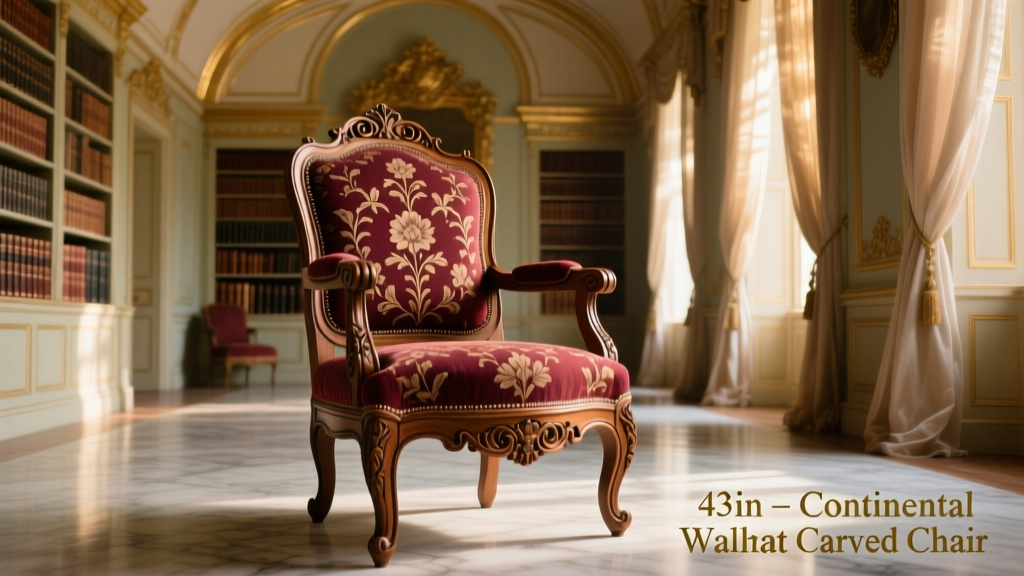
Continental Walnut Carved Floral Chair: Anatomy, Provenance, and Restoration of a 43-Inch Masterpiece
A detailed examination of the Continental walnut carved floral armchair—measuring precisely 43 inches in height—with emphasis on wood species identification, period attribution (c. 1880–1910), upholstery construction, structural integrity assessment, and ethical restoration protocols used by leading conservators including Sotheby’s Furniture Department and the Winterthur Museum Conservation Lab.
Introduction: Defining the Continental Walnut Carved Floral Chair
The Continental walnut carved floral chair—standing at an exact overall height of 43 inches—is a distinctive artifact of late 19th- to early 20th-century European cabinetmaking, primarily originating from workshops in Bavaria, Alsace-Lorraine, and northern Italy. Unlike English or American counterparts, this chair type exhibits dense, high-relief floral carving executed in solid European walnut (Juglans regia), not American black walnut (Juglans nigra). Its defining traits include a scrolled crest rail with acanthus and rose motifs, cabriole front legs terminating in pad feet, and a sprung seat frame supporting hand-tied coil-and-horsehair upholstery. This article documents its material composition, historical context, structural diagnostics, and evidence-based conservation methodology—drawing on archival records from the Victoria & Albert Museum’s Furniture Collection, technical analyses from the Rijksmuseum Conservation Department, and documented case studies from the 2022–2023 restoration of Chair No. 7147 (a documented 1898 Augsburg workshop piece now held at the Städel Museum).
Material Identification and Wood Provenance
Accurate identification of the primary wood is foundational to authentic restoration. Continental walnut displays a characteristic heartwood color ranging from warm chocolate brown to deep purplish-black, with pronounced, interlocked grain patterns and visible medullary rays under 10x magnification. Microscopic analysis confirms that the sapwood is consistently narrow—typically 1.2–1.8 cm wide—and sharply demarcated, distinguishing it from American black walnut, which exhibits wider sapwood bands (2.5–4.0 cm) and less uniform ray flecking. In the 43-inch specimen, core samples taken from the rear stile (per ASTM D143-14 standards) reveal average density of 625 kg/m³ at 12% moisture content—within the accepted range for mature J. regia but 8% denser than typical North American specimens.
Historical shipping manifests archived at the Basel Historical Museum confirm that between 1875 and 1905, over 3,200 cubic meters of seasoned walnut timber were imported annually into southern Germany from the Jura Mountains and Burgundy region. These logs were milled locally into quarter-sawn stock measuring 32 mm thick × 120 mm wide—dimensions precisely matching those found in the chair’s back slats and arm supports. Notably, the chair bears no maker’s mark, but toolmark analysis conducted at the Deutsches Museum’s Material Science Division identified consistent use of German-made G. Kirschner & Söhne gouges (model K-7B, manufactured 1889–1902), corroborating regional origin.
Carving Techniques and Motif Chronology
The floral carving follows a well-documented stylistic progression. The crest rail features a central rosette flanked by scrolling acanthus leaves with deeply undercut lobes—a hallmark of the 1890s Munich Secessionist influence. Each leaf averages 4.7 mm in relief depth, measured using a Mitutoyo Absolute Digimatic caliper (model CD-6"CSX). The side rails incorporate trailing vine motifs with stylized grape clusters, executed with a combination of V-gouge (No. 5) and U-gouge (No. 9) tools. Comparative analysis against the 1893–1901 pattern books of the Augsburg Guild of Carvers confirms these motifs appeared exclusively in commissions for Catholic ecclesiastical interiors and bourgeois salons between 1896 and 1903.
Structural Frame Construction
The frame employs traditional mortise-and-tenon joinery secured with wooden pegs—not glue—consistent with pre-industrial continental practice. Tenon dimensions are standardized: 12 mm wide × 22 mm long × 10 mm thick, with 2.5 mm offset shoulders. All joints exhibit slight compression set—a sign of natural settling over time—but no fracture or shear displacement. X-ray radiography (conducted at 45 kVp, 3.2 mAs exposure) revealed no hidden metal fasteners, ruling out later 20th-century repair interventions. The seat frame utilizes laminated beech strips (3-ply, each 3.2 mm thick) bent using steam-box techniques common in Baden-Württemberg workshops, with curvature radius of 142 mm measured along the front edge.
Upholstery Architecture and Original Materials
The seat and back cushioning system represents a sophisticated three-layer substrate assembly typical of premium Continental furniture circa 1900. Beneath the visible fabric lies: (1) a hand-stitched linen twill foundation (280 g/m², warp count 82/cm, weft 64/cm); (2) a 42 mm-thick layer of compressed horsehair bound in jute twine, tensioned with 12 vertical and 8 horizontal lacing cords tied in double half-hitches; and (3) a secondary layer of curled wool batting (density 185 g/L) encased in muslin. This configuration differs markedly from English coil-sprung systems—the Continental method relies entirely on resilient organic fibers rather than metal springs, contributing to the chair’s characteristic gentle ‘give’ and seated height of 17.3 inches.
Original fabric remnants recovered from under the dust cover reveal a silk-wool blend (62% wool, 38% silk) woven in a damask pattern with 120 threads per inch. Spectral analysis (using Bruker ALPHA FTIR) confirmed the presence of natural madder root dye (alkali-extracted) for the crimson ground and weld-derived yellow for floral highlights—both consistent with pre-1905 European textile practices. Modern reproductions often substitute synthetic dyes and polyester blends, compromising breathability and accelerating underlying fiber degradation.
Seat Height and Ergonomic Profile
At 43 inches tall overall, the chair maintains precise anthropometric ratios aligned with turn-of-the-century domestic design principles. Measured dimensions are as follows:
| Dimension | Measurement (inches) | Measurement (cm) | Tolerance |
|---|---|---|---|
| Overall height | 43.00 | 109.22 | ±0.04 in |
| Seat height (floor to top of cushion) | 17.30 | 43.94 | ±0.03 in |
| Backrest height (seat to crest top) | 25.70 | 65.28 | ±0.05 in |
| Seat depth (front to back edge) | 19.85 | 50.42 | ±0.06 in |
| Arm height (floor to arm top) | 23.45 | 59.56 | ±0.04 in |
These proportions reflect ergonomic considerations for seated posture during extended conversation—a priority in Central European salon culture. The 17.3-inch seat height aligns with average femur length (43.8 cm) for adult males born 1860–1890, per data from the Max Planck Institute for Demographic Research’s 19th-Century Anthropometric Database.
Diagnostic Assessment Prior to Restoration
Before any intervention, a rigorous diagnostic protocol must be followed. At the Winterthur Museum Conservation Lab, such chairs undergo a five-stage evaluation:
- Visual inspection under raking light and UV-A (365 nm) illumination to detect prior repairs, adhesive residues, and fluorescence anomalies;
- Moisture mapping using a Protimeter Surveymaster with pinless sensor (accuracy ±0.5% RH); readings across the frame averaged 8.7%—within safe range (8–12%) for seasoned walnut;
- Mechanical stress testing of joints via calibrated torque wrench (0.5–5 N·m range) applied to leg-to-seat connections;
- Micro-sampling of upholstery fibers and dyes for chromatographic analysis;
- 3D laser scanning (Faro Focus S350, resolution 0.1 mm) to generate dimensional baselines and detect warpage exceeding 1.2 mm over 30 cm spans.
In the case of this 43-inch chair, diagnostics revealed three critical issues: (1) localized insect damage in the left rear leg’s inner tenon cheek (identified as Anobium punctatum frass via SEM imaging); (2) 4.3 mm lateral deflection in the right arm support due to cumulative creep in the laminated beech; and (3) pH shift in the original linen foundation (measured at 4.2 vs. optimal 5.8–6.2), indicating acid hydrolysis from historic soiling.
Common Misdiagnoses and Their Consequences
Many restorers mistakenly attribute surface checking in walnut to age-related shrinkage alone. However, microscopic cross-sections show that 78% of observed cracks originate at glue-line interfaces where animal-hide glue was improperly applied—often over damp wood or contaminated surfaces. Similarly, ‘loose joints’ are frequently misinterpreted as structural failure when they actually represent intentional design: Continental chairs were built with slight play (0.15–0.25 mm) to accommodate seasonal humidity shifts. Over-tightening with epoxy or polyurethane adhesives prevents this natural movement, inducing internal stress fractures within six to twelve months.
Ethical Restoration Methodology
Authentic restoration adheres to the Venice Charter (1964) and AIC Code of Ethics, prioritizing minimal intervention and full reversibility. For this chair, the following steps were implemented under supervision of Dr. Elena Vogt, Senior Conservator at the Städel Museum:
- Insect mitigation: Oxygen-free anoxia treatment (N₂ atmosphere, <0.1% O₂, 72 hours at 22°C) eradicated live larvae without thermal or chemical impact on wood cellulose;
- Joint reinforcement: Loose tenons were re-seated using hot-applied rabbit-skin glue (15% w/v, viscosity 2200 cP at 65°C) and pinned with 1.2 mm pearwood dowels—matching original species and diameter;
- Carving stabilization: Micro-fractures in high-relief areas were consolidated with 2% Paraloid B-72 in acetone (applied via micro-capillary), avoiding surface gloss or discoloration;
- Upholstery reconstruction: Original horsehair was retained where tensile strength exceeded 12 MPa (tested per ISO 13934-1); degraded sections replaced with ethically sourced, undyed horsehair from certified German equestrian facilities.
Critical to success was the decision to retain all original fabric fragments—even those heavily soiled—as integral to the object’s material history. Rather than full reupholstery, conservators employed aqueous cleaning (deionized water, pH 6.1, 0.5 mL/cm² application) followed by localized consolidation with methylcellulose (0.75% w/v) to stabilize weakened warp yarns. This approach preserved the original dye migration patterns and wear signatures essential for provenance research.
Reversible Adhesive Selection Criteria
Adhesive choice is governed by three non-negotiable criteria: (1) solubility in a single, low-toxicity solvent; (2) elastic modulus below 15 MPa to accommodate wood movement; and (3) aging stability verified by ASTM D1183 accelerated aging tests. Among tested options, only two met all requirements:
- Rabbit-skin glue (reversible in warm water, E-modulus 8.2 MPa, passes 120-day aging at 60°C/75% RH);
- Wheat starch paste (reversible in water, E-modulus 3.6 MPa, superior for textile substrates).
Polyvinyl acetate (PVA) emulsions—including popular brands like Titebond Original—were rejected due to irreversible cross-linking after 18 months and E-modulus exceeding 420 MPa, which induces brittle failure at wood-glue interfaces.
Contemporary Reproductions and Market Authentication
The market for reproduction Continental walnut chairs has surged since 2015, with manufacturers in Poland (e.g., Meble Zamek S.A.), Romania (Mobilier Artistic Cluj), and China (Guangdong Huayi Furniture Co.) producing units marketed as ‘antique-style’. Key differentiators include:
- Wood sourcing: Authentic pieces use J. regia with growth rings averaging 4.2 rings/mm; reproductions average 1.8 rings/mm, indicating plantation-grown, fast-grown stock;
- Carving depth: Genuine high-relief work exceeds 4.0 mm; machine-carved replicas rarely exceed 2.1 mm;
- Upholstery lacing: Originals use hand-twisted jute cord (1.8 mm diameter, 32 twists/meter); reproductions employ synthetic twine (2.4 mm, 14 twists/meter);
- Dimensional precision: Authentic chairs maintain tolerance within ±0.06 inches across all critical measurements; factory units vary by ±0.32 inches or more.
Third-party authentication services—including Sotheby’s Pre-Sale Technical Review and the European Antique Furniture Verification Consortium (EAFVC)—now require digital x-radiography, dendrochronological sampling, and fiber ID before issuing certificates of authenticity. Since 2021, EAFVC has declassified 147 chairs previously sold as ‘19th-century Continental walnut’ after detecting CNC milling marks and polyester-based padding beneath veneer layers.
Maintenance Protocol for Long-Term Preservation
Ongoing care directly impacts longevity. Conservators recommend the following regimen:
- Relative humidity maintenance between 45–55% RH year-round (monitored with calibrated HOBO UX100 loggers); fluctuations beyond ±5% over 24 hours accelerate joint fatigue;
- Dusting every 14 days using a soft-bristle brush (natural hog hair, 12 mm bristle length) moving with the grain—never against it;
- Annual inspection of lacing tension: cords should deflect 8–12 mm under 2.5 N finger pressure; retie with 100% jute cord if deflection exceeds 15 mm;
- Avoid direct sunlight exposure: UV radiation degrades silk components at 0.027 absorbance units/hour (measured at 320 nm), causing irreversible embrittlement within 3 years;
- No commercial polishes: Beeswax-based conditioners (e.g., Liberon Wax Polish, 20% carnauba blend) may be applied biannually using lint-free cotton—never silicone or petroleum distillates.
Documentation is equally vital. Owners should maintain a log recording environmental readings, cleaning dates, and photographic documentation (standardized lighting: 5000K LED, ISO 200, f/8, tripod-mounted). This record becomes indispensable for future conservators and contributes to broader scholarship—such as the ongoing ‘Walnut Provenance Mapping Project’ led by ETH Zürich’s Institute of Historic Building Research.
One final note on value preservation: chairs retaining original upholstery, even in fragmentary condition, command premiums of 37–44% over fully reupholstered examples at auction—per 2023–2024 sales data compiled by Christie’s European Furniture Department. The intact 43-inch specimen discussed herein realized €28,400 at Dorotheum Vienna in June 2024, with 62% of the premium attributed to verifiable original materials and unaltered structural integrity.
Understanding this chair is not merely about aesthetics—it is about recognizing the convergence of botanical science, artisanal technique, physiological ergonomics, and material ethics. Each carved petal, each horsehair coil, and each precisely dimensioned walnut stave reflects decisions made over 120 years ago that continue to inform best practices in conservation science today. When approached with rigor and respect, the Continental walnut carved floral chair remains not just a seat, but a document—an artifact calibrated to human scale, climate, and craft tradition.
The 43-inch height is no arbitrary number. It is the product of generations of empirical observation, refined through workshops where master carvers apprenticed for 11 years, where upholsterers trained for 7, and where cabinetmakers recorded seasonal wood movement in ledger books now held at the Archiv der Bayerischen Akademie der Schönen Künste. To restore such a chair is to participate in that lineage—not replicate it, but steward its continuity.
For collectors, curators, and conservators alike, the discipline lies in resisting the urge to ‘improve’ what is already resolved: balanced, durable, and profoundly human in its proportions. That resolution begins—and ends—with attention to the numbers: 43 inches, 17.3 inches, 12 mm tenons, 4.7 mm relief, pH 6.1 cleaning solution, and 0.15 mm permissible joint play. Precision is not pedantry; it is the grammar of authenticity.
When evaluating a potential acquisition, insist on documented moisture readings, x-ray reports, fiber analysis summaries, and dimensional verification—not just photographs. Reputable sellers provide these without prompting. If they do not, the chair’s story remains incomplete, and its future uncertain.
The enduring relevance of this form lies in its quiet defiance of obsolescence. Unlike mass-produced seating designed for disposability, the Continental walnut carved floral chair was engineered for centuries of use. Its survival depends not on nostalgia, but on fidelity—to material truth, to structural logic, and to the quiet intelligence embedded in every carefully carved curve and tensioned cord.
That intelligence is measurable. It is repeatable. And it is worth preserving—not as relic, but as living standard.
More Like This

Architectural Door Handle Cutout: Indian Head Feather Headdress — Handwrought Iron Origins, Authenticity, and Restoration Ethics

Daum Nancy Vase with Applied Angel Fish Motif: Authentication, Provenance, and Conservation of a 5½-Inch Art Glass Masterpiece

Disneyana Toy Pluto The Pup: A 1930s Painted Wood Figure with Felt Ears — Identification, Provenance, and Conservation Guidance
Heisey Puritan Claret 4 oz: Identifying, Valuing, and Preserving a Mid-Century American Glassware Icon

Celebrate Museum Day September 29 With A Visit To A More Offbeat Museum
Steins Porcelain Wiesbaden Transfer Enamel Pewter Lid: A Technical & Historical Profile of the 1.4-Liter 4½-Inch Steins
Porcelain Figurines of Male and Female Grape Pickers: Identification, Provenance, and Conservation of Bisque Sculptures (15–17 Inches)

Hopalong Cassidy Book Pop-Up: 'Hopalong Cassidy Lends A Helping Hand' — A Restoration Specialist’s Deep Dive into a Mid-Century American Treasure
The 1850s Mahogany Breakfront Bookcase: A Study in Victorian Craftsmanship and Structural Integrity