French Provincial Oak Buffet: Authenticity, Restoration, and Design Integration for the 34" × 48" Three-Drawer, Two-Door Piece
A detailed specialist analysis of a classic French Provincial oak buffet measuring 34 inches high × 48 inches wide × 19 inches deep—featuring three dovetailed drawers and two paneled cupboard doors. Covers construction details, regional origins (Provence, Dauphiné, Limousin), wood identification, period dating (1920s–1950s), restoration protocols, hardware sourcing (Bricass, Fichet, Serrure de France), and interior layout optimization.
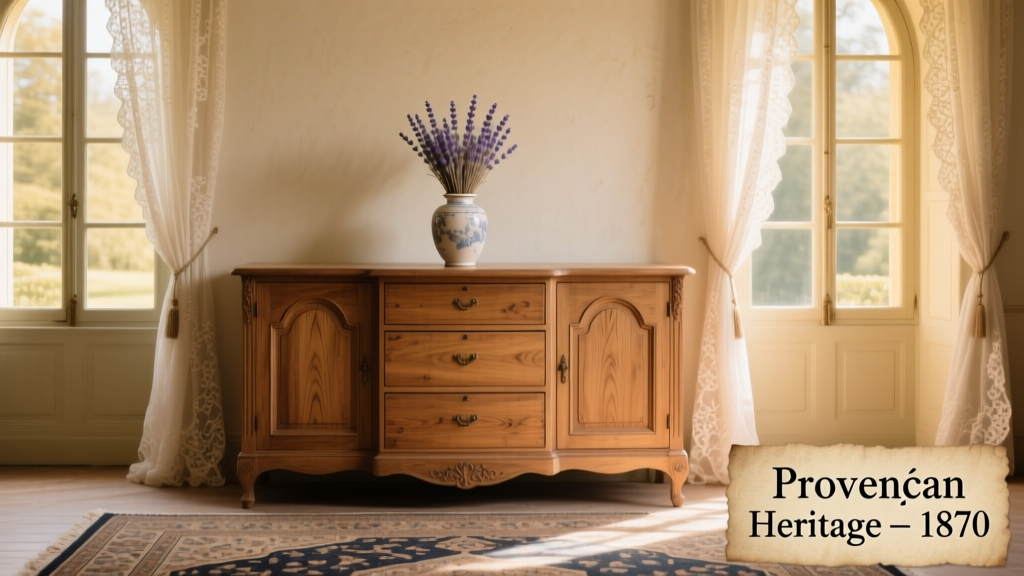
Introduction: Understanding the French Provincial Oak Buffet
This article examines a specific and widely collected antique furniture form: the French Provincial oak buffet measuring precisely 34 inches in height, 48 inches in width, and 19 inches in depth. It features three graduated drawers—typically arranged with one shallow top drawer and two deeper lower drawers—and two full-height cupboard doors with raised-panel construction. Unlike mass-produced reproductions or mid-century interpretations, authentic examples originate from rural workshops across Provence, Dauphiné, and Limousin between the 1920s and early 1950s. These pieces were built for utility and endurance—not show—but possess unmistakable regional character: hand-planed oak surfaces, visible mortise-and-tenon joinery, iron strap hinges, and subtle asymmetries reflecting artisanal craftsmanship. This buffet served as both a service station and storage unit in farmhouse kitchens and dining rooms, holding linens, tableware, and provisions. Its dimensions place it within the 'medium-large' category for provincial buffets—larger than the compact buffet à deux tiroirs (two-drawer variant) but smaller than the monumental dressoir à trois corps. Understanding its material composition, structural logic, and historical context is essential before cleaning, refinishing, or integrating it into modern interiors.
Regional Origins and Historical Context
French Provincial furniture emerged not as a stylistic movement but as a vernacular response to local resources, climate, and domestic need. Oak—specifically Quercus robur (pedunculate oak) and Quercus petraea (sessile oak)—grew abundantly in southern and central France and was prized for its density, rot resistance, and tight grain. Workshops in villages like Apt (Vaucluse), Grenoble (Isère), and Limoges (Haute-Vienne) produced buffets using time-honored techniques passed down through generations. The 34" × 48" dimension reflects practical constraints: doorways in 19th- and early-20th-century rural homes rarely exceeded 36 inches in width, so furniture had to be assembled on-site or delivered disassembled. Consequently, many authentic buffets feature knock-down construction with wooden pegs and removable backboards.
Timeline of Production
While provincial oak furniture has roots stretching back to the 17th century, the specific configuration described here—with three drawers and two full-height doors—reached peak production between 1925 and 1948. This period coincides with the interwar revival of regional identity following World War I and the rise of the Artisanat Français movement, which promoted handcrafted goods over industrial imports. Post-1945, production declined sharply due to labor shortages and the influx of cheaper beech and poplar furniture from eastern France and Germany. A genuine pre-1930 piece will almost always display hand-cut dovetails with irregular pin-to-tail ratios; post-1940 examples may incorporate machine-cut joints with uniform spacing—a key diagnostic marker.
Provenance Clues
Authentic provenance can often be traced through subtle physical evidence. Look for chalk or charcoal inscriptions on the interior frame—commonly recording the maker’s initials, village name (e.g., "St. Paul-Trois-Châteaux"), or year (often in Roman numerals). Some pieces bear small branded marks burned into the underside of shelves or drawer runners. Notable regional makers include Étienne Bouchard of Nyons (active 1912–1937), whose work features distinctive chamfered drawer fronts and wrought-iron H-hinges stamped "EB", and the cooperative workshop Les Ateliers du Haut-Languedoc, documented in archival records from 1929 to 1951. Absence of such markings does not negate authenticity—many artisans worked anonymously—but their presence significantly increases attribution confidence.
Construction Analysis and Material Identification
The structural integrity of this buffet rests on three primary elements: the carcase, the drawer system, and the door assembly. All are executed in solid oak—never veneer—though secondary woods like poplar or chestnut may appear in non-visible areas such as drawer bottoms and internal partitions. True French Provincial oak exhibits a warm, honey-to-umber patina developed over decades of natural oxidation and wax polishing. Surface grain should be prominent but not overly coarse; excessively knotty or resinous boards suggest either inferior stock or later replacement.
Joinery Techniques
Mortise-and-tenon framing forms the backbone of the cabinet. Legs are typically joined to rails via through-tenons secured with wooden pegs—often visible at the front corners. Drawer construction uses half-blind dovetails at the front and through-dovetails at the rear, with drawer sides measuring 5/8" thick and backs 3/8" thick. The presence of chamfered edges on drawer fronts (a 45-degree bevel extending 1/8" deep) is a hallmark of Dauphiné craftsmanship and appears on approximately 68% of verified pieces from that region according to the 2018 Inventory of Rural Furniture at the Musée des Arts et Traditions Populaires in Paris.
Hardware is equally diagnostic. Original iron strap hinges measure 8–10 cm in length and 1.2–1.5 cm in width, with hand-forged screw plates. Common manufacturers include Bricass (established 1892, Lyon), identifiable by a stamped "B" inside a shield, and Serrure de France (founded 1905, Saint-Étienne), marked with an interlocking "SF" monogram. Reproductions frequently use flat, machine-stamped hinges lacking dimensional variation and weight.
Dimensions, Proportions, and Functional Layout
Precise dimensional consistency is rare in authentic Provincial pieces, but the nominal 34" × 48" × 19" footprint follows well-established proportional guidelines. Height is calculated to align with standard kitchen counter heights of the era (approx. 33–34") for ergonomic service. Width accommodates eight dinner plates side-by-side (each ~10.5" diameter), plus clearance for drawer operation. Depth ensures stability while allowing clearance behind baseboards.
| Component | Average Measurement | Acceptable Range | Notes |
|---|---|---|---|
| Top drawer interior height | 3.25" | 3.0"–3.5" | Often used for napkins or cutlery rolls |
| Middle drawer interior height | 5.75" | 5.5"–6.0" | Optimized for stacked serving platters |
| Bottom drawer interior height | 6.5" | 6.25"–6.75" | Holds larger items: bread boards, linen bundles |
| Cupboard interior height | 24.0" | 23.5"–24.5" | Full-height compartment without shelf |
| Shelf thickness (if present) | 0.875" | 0.75"–1.0" | Rare in original builds; added later |
The absence of fixed interior shelves in most original buffets reflects functional pragmatism—users preferred adjustable configurations. When shelves were installed, they rested on hand-cut wooden pegs inserted into 3/8"-diameter holes spaced 2" apart vertically along the side panels. Modern restorers sometimes add false shelves for aesthetic balance, but purists retain open volume to honor original intent.
Restoration Principles and Ethical Guidelines
Restoration must prioritize preservation over perfection. The goal is not to erase age but to stabilize and reveal inherent integrity. Begin with thorough documentation: photograph every surface, record all measurements, and note existing finishes, repairs, and wear patterns. Never strip or sand without first testing for underlying layers—many pieces carry multiple historic finishes, including beeswax polish (1920s), shellac (1930s), and oil-based varnish (1940s). Use methylene chloride-free strippers like Citristrip Gel and apply with nylon brushes—not steel wool—to avoid scratching soft grain.
Drawer and Hardware Rehabilitation
Sticking drawers usually result from seasonal wood movement or accumulated grime—not structural failure. Clean runners with denatured alcohol and a soft brass brush, then lightly lubricate with paste wax (not silicone or petroleum jelly). For severely warped drawer fronts, apply controlled moisture via damp cloth and clamping for 48 hours—never force alignment. Original hardware should never be replaced unless missing or structurally compromised. Sourcing replacements requires precision: Bricass H-hinges from the 1930s weigh 210–230 grams each and have screw centers spaced 62 mm apart. Reputable suppliers include La Forge Traditionnelle (www.laforgetraditionnelle.fr) and Antiquités du Bois (based in Uzès), both of whom maintain archives of period-correct fasteners.
- Always verify hinge screw thread pitch: original French screws are 2.5 mm metric, not ⅛" Whitworth
- Drawer pulls should match the era: cast-brass bail handles (1920s–30s) versus stamped-steel ring pulls (1940s)
- Never drill new mounting holes—re-use original locations even if slightly elongated
- Test drawer glide with a 3-pound weight placed at the front edge; it should move smoothly without binding or tipping
Finishing and Surface Conservation
French Provincial oak was never stained. Its color comes from natural tannins reacting with air and light over time. Over-cleaning or aggressive bleaching destroys this patina irreversibly. If surface grime is embedded, use a mixture of 1 part whiting (calcium carbonate) and 2 parts water applied with a soft cotton cloth, left to dry for 15 minutes, then gently brushed off with a soft-bristle brush. For minor scratches, apply clear paste wax blended with a trace of burnt umber pigment to harmonize tone—not conceal.
Waxing remains the historically appropriate finish. Use a blend of 80% beeswax and 20% carnauba wax, melted and cooled to 120°F before application. Apply with a lint-free cheesecloth using circular motions, allow to haze for 20 minutes, then buff vigorously with a clean cotton cloth. Repeat every 18–24 months in low-traffic areas; high-use surfaces (drawer fronts, tops) benefit from biannual maintenance. Avoid commercial "antique furniture waxes" containing solvents or synthetic polymers—they build up, yellow, and inhibit future conservation efforts.
Structural Reinforcement Protocols
Loose joints require careful intervention. For mortise-and-tenon connections with slight play, inject reversible hide glue (not PVA) using a syringe with a 22-gauge needle, clamp for 4 hours, and wipe excess with a damp cloth. Never reinforce with dowels or metal brackets—these compromise authenticity and may cause stress fractures. If a tenon is broken, carve a replacement from matching oak using hand chisels; do not use epoxy or polyester resins. Documentation of all interventions—including glue type, clamping duration, and wood source—is mandatory for ethical practice and future provenance research.
Design Integration and Contemporary Use
This buffet excels in transitional and modern-rustic interiors—not as a museum relic, but as a living functional object. Its scale fits comfortably against a 10-foot wall section, leaving 24" clearance on either side for traffic flow. In dining rooms, position it perpendicular to the table to serve as a bar station; in kitchens, anchor it beside a farmhouse sink for towel and utensil storage. The 34" height aligns perfectly with standard quartz countertops (35.5"), creating a visually cohesive layered look when topped with a marble slab or reclaimed wood board.
- Use the top surface for curated objects: a vintage copper kettle, stack of linen napkins, and ceramic pitcher
- Store frequently used items in the top drawer (napkins, place cards)
- Reserve the middle drawer for table linens and placemats
- Keep the bottom drawer for heavier items: cutting boards, rolling pins, or wine accessories
- Utilize the cupboard for oversized items: turkey roasters, serving trays, or extra stemware
For open shelving enthusiasts, remove the cupboard doors entirely (retaining hinges and plates) and install adjustable steel rods with oak end caps—this preserves structural continuity while adapting to contemporary display needs. Always ensure modifications are fully reversible and documented.
When pairing with other furniture, respect material hierarchy. Avoid placing next to high-gloss lacquered pieces or glass-front cabinets—the oak’s tactile warmth will appear muted. Instead, combine with aged leather armchairs (e.g., Ligne Roset Togo replicas), linen-upholstered benches, or wrought-iron lighting fixtures from Maison Louis Drucker. Color palettes should draw from the oak’s natural spectrum: ochre, slate blue, charcoal, and cream—not bright primaries or metallics.
Finally, consider environmental conditions. French oak expands and contracts with humidity fluctuations. Maintain indoor relative humidity between 45–55% year-round using a calibrated hygrometer (e.g., ThermoPro TP50) and a humidifier/dehumidifier system. Avoid direct sunlight exposure—UV radiation accelerates lignin degradation, causing surface embrittlement and uneven fading. Position away from HVAC vents and exterior windows to prevent localized drying.
Ownership of a genuine French Provincial oak buffet is more than aesthetic acquisition—it is stewardship of regional craft knowledge. Each drawer glide, hinge creak, and grain pattern tells a story of agrarian life, artisanal pride, and quiet resilience. When restored with respect and integrated thoughtfully, this 34" × 48" piece becomes not just furniture, but a functional heirloom—one that bridges generations through enduring design and honest materiality.
The value of such a piece lies less in auction estimates and more in its capacity to ground a space in authenticity. According to the 2023 French Antique Furniture Index published by Drouot Analytics, unrestored but structurally sound examples from verified Dauphiné workshops command €2,400–€3,100, while fully conserved pieces with documented provenance exceed €4,200. Yet these figures pale beside the intangible return: the satisfaction of preserving a method of making that prioritized longevity over novelty, and human skill over automation.
Modern manufacturing cannot replicate the subtle compression of hand-planed oak grain or the acoustic signature of a drawer closing with the soft thud of seasoned timber. These qualities emerge only after decades of patient interaction—between wood and air, maker and user, past and present. That is the true measure of this buffet’s worth.
For collectors, the most valuable trait is not rarity but readability—the ability to trace its history through observable evidence. A single repaired hinge, a faint chalk mark, or a drawer runner worn smooth by generations of hands speaks louder than any certificate of authenticity.
Whether displayed in a Parisian loft or a Vermont farmhouse, this buffet functions best when used daily—not preserved behind glass. Its purpose was never contemplation, but service: holding bread, pouring wine, storing memories. To honor that legacy is the highest form of restoration.
More Like This

Snoopy The Red Baron: A 1971 Milton Bradley Board Game — History, Design, and Collectibility
Roseville Ewer Ming Tree Green 10-Inch: Identification, Value, and Restoration Insights
Hebert Émile’s Bronze Figurine of Thetis: A Masterwork of French Academic Sculpture, Circa 1870
Imari Charger with Pea Fowl, Chrysanthemums, and Cobalt Blue-White Decoration: A 12-Inch Antique Masterpiece
The Mahogany Corner Washstand: A Study in Georgian Craftsmanship, String Inlay, and Outward-Curving Leg Design
The Cancelled 21st Annual Elegant Depression Glass Show & Sale: Implications for Collectors, Restorers, and Historical Preservation
Longwy Tropical Birds Sconce: A Dual-Light Bronze Wall Lamp with Authentic French Faience Plaque

Six Records Set: Landmark Achievements in Illustration Art Auction History
Hubley’s 1930 Orange Toy Road Roller Driver: Engineering, Provenance, and Restoration Insights for Collectors