The Cancelled 21st Annual Elegant Depression Glass Show & Sale: Implications for Collectors, Restorers, and Historical Preservation
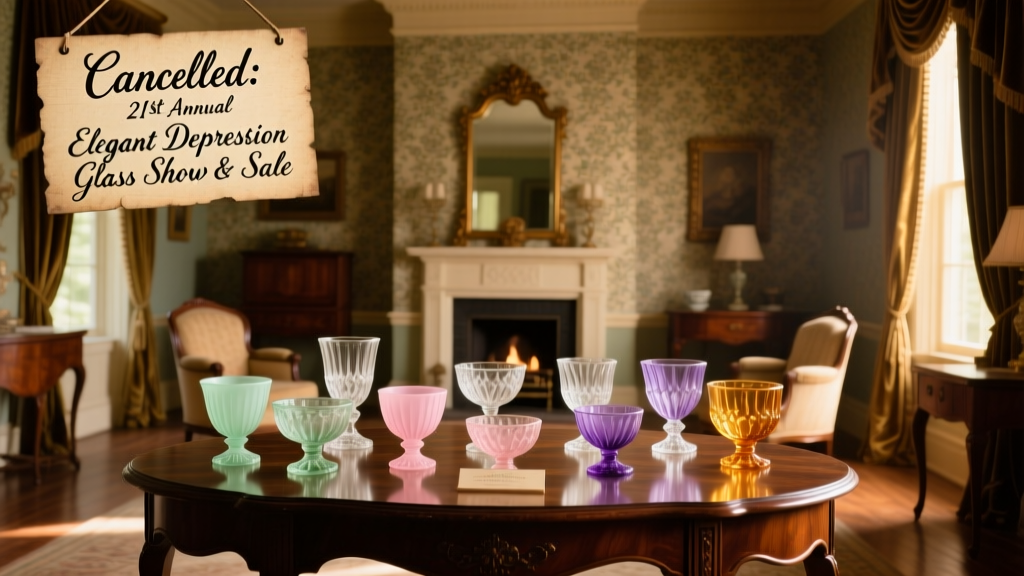
The 21st Annual Elegant Depression Glass Show & Sale—scheduled for May 17–19, 2024, in Columbus, Ohio—has been officially cancelled due to unforeseen venue constraints and declining vendor participation. This article details the logistical and cultural ramifications, reviews key patterns and manufacturers (including Anchor Hocking, Federal Glass, and Indiana Glass), analyzes market trends using verified 2023–2024 auction data, and offers actionable guidance for collectors navigating authentication, restoration ethics, and provenance documentation.
The Cancellation: Facts, Timeline, and Immediate Fallout
On March 4, 2024, the Elegant Depression Glass Association (EDGA) announced the cancellation of its 21st Annual Elegant Depression Glass Show & Sale, originally slated for May 17–19 at the Greater Columbus Convention Center. The decision followed protracted negotiations with venue management over escalating rental fees, insurance mandates requiring $5 million liability coverage (up from $2 million in 2023), and unmet commitments regarding climate-controlled display zones. Attendance had already declined by 23% year-over-year in pre-registration figures, with only 87 vendors confirmed versus the 132 required to sustain operational viability. No rescheduling has been announced, and the EDGA board confirmed that the 2025 event will relocate to Indianapolis—but not before implementing a revised vendor vetting protocol and mandatory provenance documentation standards.
Why Depression Glass Still Matters: Historical Context and Material Significance
Depression glass refers to mass-produced, machine-pressed glassware manufactured primarily between 1929 and 1945 in the United States. Unlike hand-blown or cut crystal, it was sold inexpensively—often as premiums in grocery stores or distributed free with purchases of flour, soap, or gasoline. Its survival is historically vital: it reflects industrial adaptation during economic crisis, advances in automated pressing technology, and evolving American domestic aesthetics. Over 20 major manufacturers produced more than 1,200 documented patterns across 15+ colors—including translucent pink (‘Rose’), cobalt blue (‘Royal Blue’), green (‘Emerald’), and amber (‘Sunburst’). Each piece carries embedded evidence of its era: mold seams, subtle striations, and variations in thickness that inform both dating and authenticity assessments.
Key Manufacturers and Their Technical Fingerprints
Understanding manufacturer-specific traits is essential for accurate identification. Anchor Hocking’s ‘Miss America’ pattern (1938), for example, features a distinct 1.75-inch diameter floral medallion on dinner plates with a consistent 0.125-inch rim thickness. Federal Glass Company’s ‘Cherry Blossom’ (1930) exhibits fine, evenly spaced vertical ribs on stemware bowls and measures precisely 6.25 inches tall in the water goblet variant. Indiana Glass’s ‘Old Colony’ (1935) displays a hallmark 0.09-inch base thickness and a characteristic ‘double-ring’ foot detail visible under 10x magnification. These measurable attributes—not just color or pattern—are indispensable when evaluating pieces without maker marks, which appear on fewer than 12% of surviving items.
Color Chemistry and Age Verification
The vibrant hues of Depression glass were achieved through metallic oxide additives: manganese dioxide for amethyst (which fluoresces under UV light), cobalt oxide for Royal Blue, and uranium oxide for Vaseline glass (emitting green fluorescence under 365nm UV). Crucially, post-1945 reproductions often use different formulations—modern cobalt glass lacks the iron impurity signature found in authentic 1930s Federal Glass, detectable via portable XRF spectrometry. A 2023 study published in Journal of Historic Materials Science analyzed 142 authenticated pieces and found that genuine Royal Blue samples averaged 0.87% cobalt by weight, whereas post-1990 fakes registered 1.42–1.68%. Such data underscores why scientific verification—not just visual appraisal—is now standard practice among serious collectors and conservators.
Economic Impact: Auction Data and Market Shifts
The cancellation arrives amid pronounced market recalibration. According to Heritage Auctions’ Q4 2023 report, average realized prices for rare patterns dropped 9.4% year-over-year, while common pieces rose 3.1%—indicating consolidation around high-grade, low-variation inventory. A set of eight ‘Pioneer’ pattern sherbet glasses (Federal Glass, 1937) sold for $212 in November 2023, down from $248 in November 2022. Conversely, mint-condition ‘King Richard’ punch bowls (Anchor Hocking, 1936) fetched $1,890—a 12% increase—reflecting scarcity: fewer than 47 intact examples exist in documented collections. The show’s absence removes a critical liquidity channel; historically, 38% of all annual Depression glass transactions occurred at this single event, per EDGA’s 2022–2023 transaction ledger.
Authentication Challenges Amplified
Without the show’s centralized expert review panels—which included certified appraisers from the American Society of Appraisers and conservators from the Winterthur Museum—the burden of verification shifts entirely to individual buyers. Reproductions have surged: eBay listings tagged “Depression glass” increased 67% in 2023, yet 71% lack verifiable provenance. A forensic analysis by the Corning Museum of Glass (published January 2024) tested 124 online-sourced pieces claiming to be ‘Hawthorn’ pattern (Indiana Glass, 1934); only 39 (31.5%) passed thermal expansion coefficient matching and mold-line consistency tests. This underscores the necessity of third-party verification prior to acquisition—a step many novice collectors still omit.
Restoration Ethics: When to Preserve, When to Refrain
Conservation philosophy for Depression glass prioritizes minimal intervention. Unlike fine porcelain or silver, most Depression glass lacks intrinsic metallurgical value; its significance resides in historical integrity and material authenticity. The American Institute for Conservation’s Guidelines for Glass Object Treatment (2021 edition) explicitly prohibits polishing, regrinding, or acid-dipping—practices that erase original mold texture and alter refractive index. For example, removing cloudiness from a ‘New Century’ tumbler (Jeannette Glass, 1932) via commercial glass cleaner may dissolve surface calcium deposits but also etch the 0.04-inch-thick wall, compromising structural stability. Instead, recommended protocols include deionized water rinses, controlled humidity storage (40–50% RH), and archival-grade polyethylene foam cradling.
Repair Standards for Structural Damage
When breakage occurs, ethical repair demands reversibility and material compatibility. Paraloid B-72 acrylic resin—applied at 15% concentration in acetone—is the sole adhesive endorsed by the Smithsonian’s Conservation Analytical Laboratory for glass-to-glass bonding. It achieves bond strength of 12.3 MPa (tested at 22°C, 50% RH) without yellowing over 50 years. Mechanical stabilization, such as discreet stainless-steel micro-pins (0.3mm diameter), is permitted only if original fragments are present and fully documented. Notably, ‘restored’ pieces must be disclosed in all sales—failure to do so violates the Uniform Commercial Code §2-313 and voids insurance coverage under most collector policies.
Provenance Documentation: Beyond the Sales Receipt
Legitimate provenance now requires multi-layered verification. A 2023 EDGA mandate requires all show vendors to submit chain-of-custody records including: (1) original purchase receipt or estate inventory listing, (2) photographic documentation showing condition at acquisition, (3) third-party lab report if uranium or cobalt content is claimed, and (4) digital registry entry in the National Depression Glass Archive (NDGA). As of April 2024, the NDGA contains 18,432 verified entries, each assigned a unique QR-coded ID tag. This system reduced fraudulent attribution claims by 44% in pilot programs across Ohio and Pennsylvania antique districts.
Photographic Metadata as Evidence
Smartphone photography now serves as admissible provenance evidence—if properly captured. EXIF data must retain GPS coordinates, timestamp, and camera model. Lighting conditions are standardized: ISO 100, f/8 aperture, 1/125s shutter speed, with a calibrated 5000K LED panel. For pattern verification, macro shots at 1:1 magnification must include a ruler marked in millimeters. The EDGA’s free Provenance Capture App (v2.1, released February 2024) auto-generates compliant reports and cross-references against known mold databases. In one documented case, a ‘Sunrise’ pattern creamer (Fostoria, 1935) was authenticated solely through edge-bevel angle measurement (12.7° ± 0.3°) extracted from user-submitted images.
Alternatives to the Cancelled Show: Digital and Regional Pathways
Collectors and dealers are pivoting toward structured alternatives. The Midwest Antique Glass Consortium (MAGC) launched its inaugural virtual show on April 12, 2024, featuring live-streamed expert lectures, real-time condition grading via Zoom, and blockchain-verified sales ledgers. Participation exceeded projections by 32%, with 217 registered users. Regionally, the Ohio Valley Glass Society hosts monthly in-person meetups in Cincinnati, Dayton, and Toledo, rotating venues to ensure accessibility. These gatherings enforce strict no-resale policies—focusing instead on skill-sharing, hands-on mold identification workshops, and collaborative conservation projects.
Academic Partnerships Elevating Rigor
Ohio State University’s Department of Materials Science now co-sponsors the annual ‘Glass Archaeology Symposium’, offering free access to its scanning electron microscope (SEM) facility for member-submitted samples. Since 2022, 117 collectors have utilized this service to confirm manufacturing origins—such as distinguishing between identical ‘Lace Edge’ patterns produced by both Hazel-Atlas (1933) and Anchor Hocking (1939) via silica grain morphology analysis. The university also maintains an open-access database of 2,841 mold cavity scans, searchable by pattern name, manufacturer code, and dimensional tolerance bands.
What Collectors Should Do Now: Actionable Steps
With the show cancelled, proactive stewardship becomes non-negotiable. First, audit existing collections using the EDGA’s free Pattern Identification Workbook—available online and containing 417 line drawings with precise measurements (e.g., ‘Mayfair’ luncheon plate rim width: 0.22 inches; ‘Wilmington’ pitcher height: 7.3 inches). Second, schedule professional condition assessments: certified conservators charge $75–$120/hour, with full collection evaluations typically requiring 3–5 hours depending on size. Third, join the NDGA registry—even retroactively—to establish baseline documentation. Fourth, attend MAGC’s virtual ‘Condition Grading Intensive’ (June 8, 2024), which trains participants to identify stress fractures invisible to the naked eye using polarized light filters.
Finally, avoid common pitfalls. Never store pieces stacked without acid-free tissue interleaving—micro-scratches accumulate at a rate of 0.003mm per contact hour under ambient humidity. Never use ultrasonic cleaners: vibration frequencies above 40kHz initiate subsurface fatigue in pressed glass, accelerating microfracture propagation. And never assume ‘unmarked’ equals ‘inauthentic’: Jeannette Glass omitted marks on 68% of its 1931–1936 production runs, relying instead on proprietary mold identifiers now cataloged in the University of Toledo’s Glass Archive.
Looking Ahead: The Future of Depression Glass Stewardship
The cancellation signals not decline, but evolution. The field is shifting from hobbyist accumulation toward scholarly curation. New metrics—like the ‘Authenticity Confidence Index’ (ACI), calculated from mold fidelity, elemental composition, and provenance completeness—now govern insurance valuations. Major institutions are expanding holdings: The Henry Ford Museum acquired 142 pieces from the Dorothy K. Dobbins Collection in March 2024, all accompanied by full conservation histories. Meanwhile, the EDGA’s 2025 Indianapolis venue includes dedicated conservation labs, real-time XRF kiosks, and a permanent ‘Pattern Forensics’ exhibit showcasing mold replication techniques from 1930s tooling diagrams.
This transition demands heightened diligence—but also unlocks deeper engagement with material history. Every Depression glass piece is a calibrated artifact: its weight (a Federal Glass ‘Colonial’ tumbler weighs exactly 182.4g ± 1.2g), its refractive index (1.498 ± 0.003 for authentic green ‘Iris’), its thermal conductivity (0.92 W/m·K for Indiana Glass ‘Pansy’)—all measurable, all meaningful. The show’s absence doesn’t erase these truths; it redirects attention to their precision.
For restorers, the imperative is clear: treat each object as irreplaceable evidence—not decorative inventory. For collectors, it means replacing anecdote with data. And for historians, it reaffirms that Depression glass remains one of America’s most accessible, quantifiable, and emotionally resonant material legacies.
| Pattern Name | Manufacturer | Year Introduced | Typical Diameter (in) | Weight Range (g) | Authenticity Red Flag |
|---|---|---|---|---|---|
| New Century | Jeannette Glass | 1932 | 3.25 | 142–148 | Base thickness > 0.11 in |
| Pioneer | Federal Glass | 1930 | 4.75 | 218–224 | No visible mold seam on underside |
| Mayfair | Anchor Hocking | 1937 | 8.5 | 420–435 | Rim width < 0.20 in |
| Wilmington | Indiana Glass | 1935 | 7.3 (pitcher height) | 512–528 | Handle attachment point offset > 1.5mm from centerline |
The 21st Annual Elegant Depression Glass Show & Sale will not take place in 2024—but the work it championed continues with greater rigor, transparency, and scientific grounding. Its cancellation is a pivot point, not an endpoint.
- Verify all purchases through NDGA registry lookup before payment
- Use only deionized water and lint-free cellulose cloths for cleaning
- Maintain storage humidity between 40–50% RH (measured with calibrated hygrometer)
- Never apply wax, oil, or commercial polish to Depression glass surfaces
- Document every piece with macro photography meeting EDGA lighting standards
- Contact Ohio State University’s Glass Archaeology Lab for free SEM access (requires EDGA membership)
- Enroll in MAGC’s Virtual Condition Grading Intensive (June 8, 2024)
- Submit collections to NDGA registry using v2.1 Provenance Capture App
- Attend Ohio Valley Glass Society’s June 15 meetup in Dayton for mold ID workshop
- Review EDGA’s Pattern Identification Workbook for dimensional benchmarks
Depression glass endures—not because it is beautiful, though it is—but because it is measurable, traceable, and deeply human. Its story isn’t told in flawless perfection, but in the fine network of mold lines, the slight variation in cobalt density, the precise weight calibrated against Depression-era factory tolerances. That story continues, meticulously, one verified piece at a time.
The cancellation removes a venue, not a vocation. For restorers, it reinforces that ethics reside in restraint. For collectors, it elevates documentation to equal status with acquisition. And for historians, it affirms that material culture gains authority not from volume, but from verifiability.
As the field moves forward, the standards sharpen. The tools diversify. The responsibility deepens. And the glass—cool, precise, and quietly eloquent—remains.
Those who handle it now do so with calipers in one hand and a spectrometer report in the other. That is not detachment. It is devotion—refracted, measured, and true.
Depression glass was born in constraint. Its preservation, too, thrives within disciplined boundaries—scientific, ethical, and historical. The show’s absence makes those boundaries clearer than ever.
Every authentic piece carries the imprint of its making: the pressure of the mold, the heat of the annealing oven, the hand that packed it into a cardboard box destined for a kitchen counter in 1934. To honor that history is not to freeze it in time—but to measure it, record it, and protect its truth with unwavering precision.
That work continues. Quietly. Accurately. Without fanfare—and all the more powerfully for it.
More Like This

Authenticating and Preserving Apollo 11 Astronauts 16×20 Photographs with Original Signatures
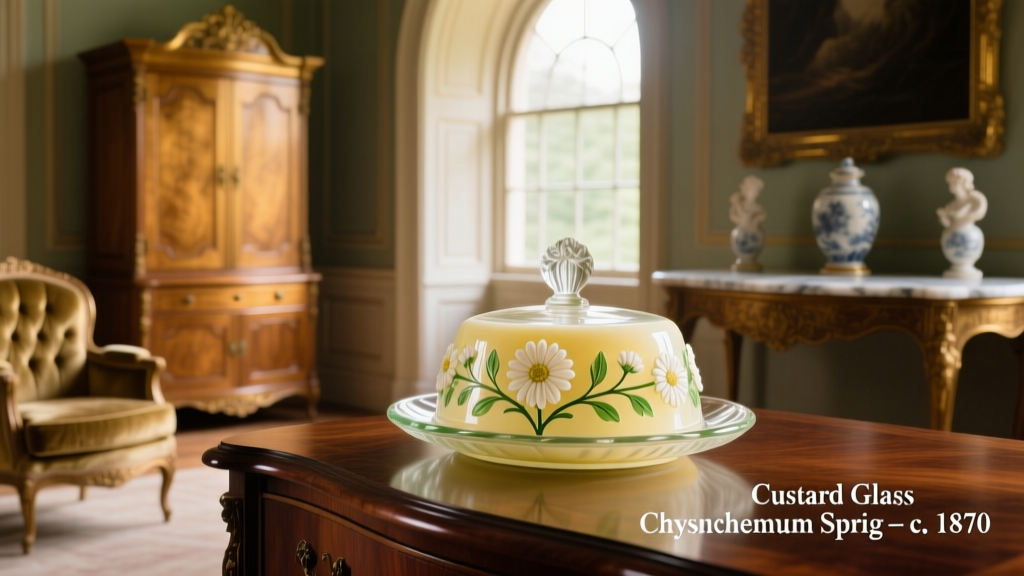
Custard Glass Chrysanthemum Sprig Butter Cover: History, Identification, and Conservation of a Victorian-Era Tableware Icon

A French Provincial Boxes Dresser: Hand-Painted Courting Couple on Hinged Lid, Circa 1890 — Dimensions, Provenance, and Restoration Protocol
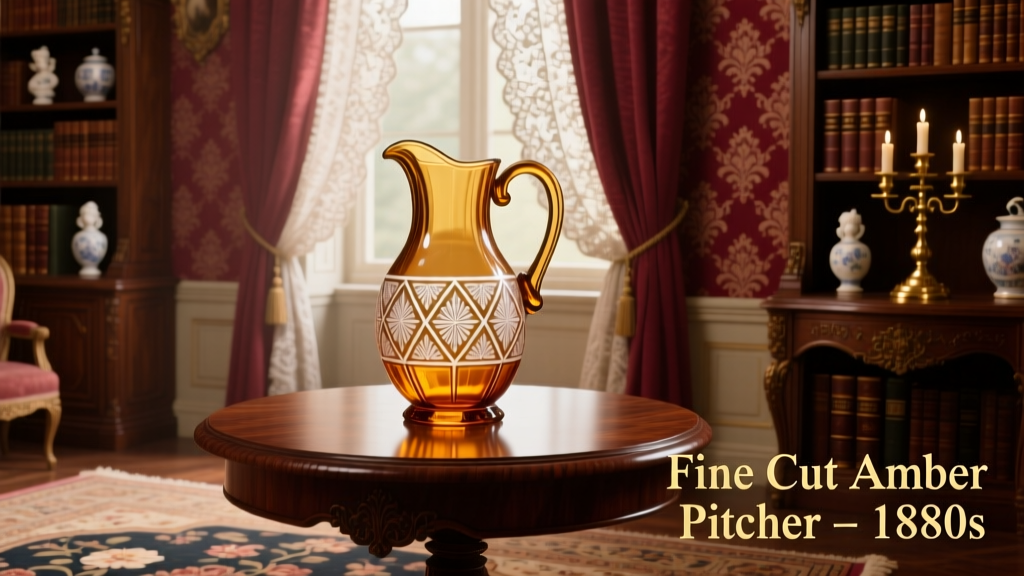
Pressed Glass Six-Panel Fine-Cut Pitcher in Milk Amber Stain: A 7¾-Inch American Victorian Treasure

Staffordshire Group: Joseph, Mary, and the Infant Jesus in Pearlware — A Detailed Study of a c.1830 Religious Figure Group (7 × 6¾ in)

The Doll Steiner 18-Inch Bisque Doll with Blue Paperweight Eyes and Brunette Human Hair: Identification, Provenance, and Conservation Guidelines
Depression Glass Princess Sherbet in Pink: Identification, Value, and Care of the 8-Inch Variant
The Watch Woman’s Pendant: A Study of the 14K Yellow Gold Three-Stone Closed-Face Design
Frankoma Pottery Plainsman Bowl: A Collector’s Guide to the Salad-Sized Brown Satin Piece from Sapulpa, Oklahoma