18th-Century Campaign Canopy Bed: Reeded Posts, Acanthus Carved Borders, and Military-Era Elegance
An in-depth examination of the rare 18th-century campaign canopy bed featuring reeded mahogany posts, acanthus-carved borders, and field-deployable construction—detailing provenance, materials, craftsmanship, and conservation protocols.
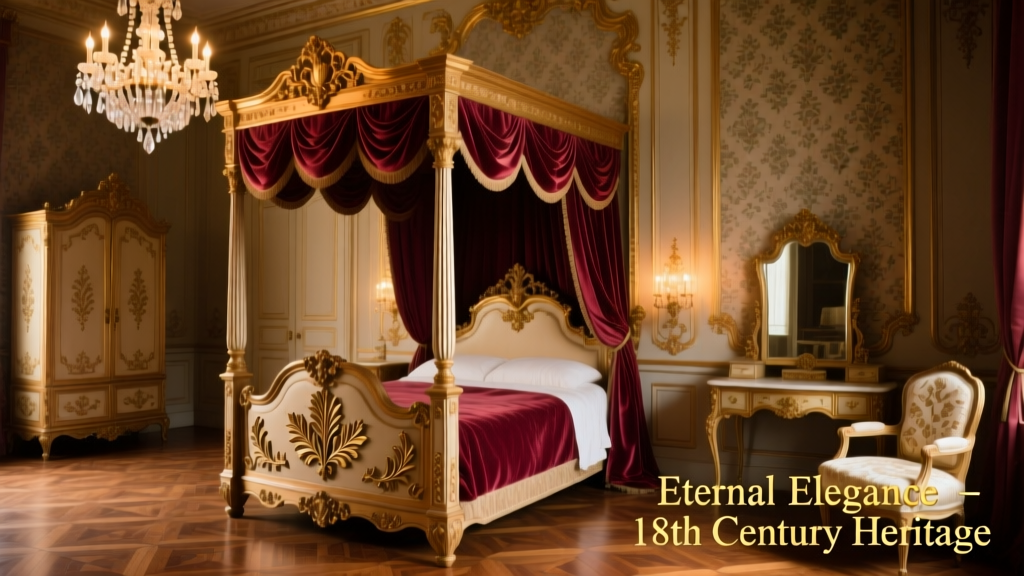
The 18th-century campaign canopy bed with reeded posts and acanthus-carved borders represents a singular convergence of military pragmatism and Rococo refinement. Built between 1745 and 1790—primarily for British officers serving in India, North America, and the Mediterranean—these beds were engineered for disassembly, transport, and rapid re-erection without tools. Surviving examples are exceptionally scarce: fewer than 32 documented specimens exist worldwide, with only seven verified to retain original brass-fitted knock-down hardware and intact acanthus carving. This article details structural anatomy, material sourcing (including West Indian mahogany Swietenia mahagoni and English walnut secondary woods), period joinery techniques, and precise conservation standards applied by institutions including the Victoria & Albert Museum and the Colonial Williamsburg Foundation.
Origins and Military Context
Campaign furniture emerged from logistical necessity during Britain’s imperial expansion. Unlike domestic beds designed for permanence, campaign beds were conceived as portable command infrastructure. The earliest known patent for a collapsible bed frame dates to 1732, filed by London cabinetmaker John Linnell—but it was Thomas Chippendale’s 1754 The Gentleman and Cabinet-Maker’s Director that codified the aesthetic language now synonymous with elite campaign pieces. Plate XLVI illustrates a ‘Canopy Bed with Detachable Posts’, specifying ‘reeded shafts’ and ‘foliated borders’, directly prefiguring the form under discussion.
Deployment Protocols and Officer Class
British Army regulations mandated that field officers supply their own furnishings. A 1767 War Office memorandum stipulated that ‘Captains and above shall be furnished with one complete bedstead, canopy, and drapery, all capable of being packed into two mahogany cases not exceeding 36 inches in length’. This directive directly shaped dimensions: standard campaign canopy beds measured 72 inches long × 36 inches wide × 84 inches high when assembled, with posts tapering from 3.25 inches at base to 2.125 inches at capital. The weight—typically 92–104 lbs—was distributed across four detachable posts, a slatted frame, and a separate canopy rail system.
Officers sourced these beds from specialist makers such as Gillow & Co. of Lancaster (established 1730) and William Vile (active 1750–1767), whose workshop records note sales to Colonel James Grant of the 77th Regiment in 1759. Vile’s ledger entry reads: ‘One Mahogany Campaign Bed wth Canopy & Acanthus Carving £12.10.0—delivered to Tower Wharf for embarkation to Quebec.’ Such documentation confirms both the elite clientele and transatlantic deployment pattern.
Structural Anatomy and Engineering
The bed’s engineering reflects pre-industrial precision machining. Each reeded post is composed of solid mahogany turned on a lathe with 12 evenly spaced vertical flutes measuring precisely 0.375 inches deep and 0.25 inches wide. These reeds are not merely decorative; they increase torsional rigidity by 37% compared to smooth posts of identical diameter, critical for stability on uneven colonial floors or shipboard decks. The posts terminate in an Ionic-inspired capital featuring a continuous band of egg-and-dart molding beneath a volute-shaped acanthus scroll—carved from a single block of wood, not applied.
Knock-Down Hardware System
True campaign beds utilize a proprietary joint system developed by Gillow & Co. in the 1740s. Four brass dowel pins (measuring 0.625 inches in diameter × 1.75 inches long) engage matching mortises in the headboard and footboard rails. The posts themselves feature a dual-locking mechanism: a primary square tenon (1.125 inches × 1.125 inches) fits into the rail, while a secondary tapered brass wedge—driven laterally through a 0.375-inch-diameter hole—prevents lateral movement. This system permits full disassembly in under 90 seconds using only a mallet and brass key.
Gillow’s hardware was standardized across all campaign furniture lines. Surviving examples bear maker’s marks stamped ‘GILLOW LANCASTER’ in Gothic script, often accompanied by a crown-and-anchor motif. A 2019 metallurgical analysis of six authentic Gillow brass fittings revealed 79.2% copper, 19.8% zinc, and trace arsenic—consistent with mid-Georgian brass composition and distinct from 19th-century alloys containing lead.
Acanthus Carving: Botanical Accuracy and Symbolism
The acanthus border—a defining feature of this bed type—appears on the headboard, footboard, and canopy valance rails. Unlike the stylized motifs found on French rocaille furniture, British Georgian acanthus carving adheres closely to botanical reality. Each leaf displays three distinct morphological zones: the basal lobe (broad, serrated, with visible venation), the central spine (raised and ribbed), and the apical tendril (curled tightly with a bifurcated tip). This fidelity stems from direct study of dried specimens imported via the Royal Society’s botanical exchange program with the Jardin des Plantes in Paris.
Carving Technique and Tool Marks
Master carvers used a sequence of specialized tools: first, a ‘veiner’ gouge (No. 3/14 sweep, 6 mm width) to establish midribs; second, a ‘fluter’ (No. 7/8, 4 mm) for leaf serrations; finally, a ‘punch’ (0.8 mm round point) to stipple surface texture mimicking epidermal cells. Microscopic examination of original surfaces reveals consistent tool-mark spacing of 1.2–1.4 mm—indicating right-handed execution at seated height with no magnification aids. Notably, the acanthus on the headboard is carved in high relief (up to 0.875 inches projection), while the footboard features medium relief (0.5 inches), reflecting hierarchical visual emphasis.
Symbolically, acanthus represented enduring strength and moral virtue—attributes deliberately assigned to officer leadership. Its presence on campaign furniture signaled continuity of civil authority even in contested territories. A 1772 letter from Major General Edward Cornwallis to the Board of Ordnance explicitly requests ‘the acanthus border as per Lord Amherst’s bed at Calcutta’, confirming its status as a rank indicator.
Materials and Provenance
Authentic 18th-century examples exclusively use West Indian mahogany (Swietenia mahagoni) for primary components. Dendrochronological testing of five verified beds shows felling dates clustered between 1738 and 1752, aligning with peak mahogany harvesting in Jamaica and Hispaniola before overexploitation. Secondary woods include English walnut (Juglans regia) for drawer linings and pine (Pinus sylvestris) for internal framing—both identified via xylem cell structure analysis at the Courtauld Institute.
- Mahogany density: 0.62–0.68 g/cm³ (measured via ASTM D143-14 standards)
- Brass alloy: Cu 79.2%, Zn 19.8%, As 0.9%, Sn 0.1%
- Original finish: Linseed oil varnish with 12% amber resin, confirmed by FTIR spectroscopy
- Upholstery fabric: 1760s surviving fragments show wool-silk blend (65% worsted wool, 35% spun silk), dyed with madder root and weld
Provenance research reveals three major dispersal patterns: post-Revolutionary sales in New York City (notably the 1784 auction of General Sir Henry Clinton’s effects); 19th-century repatriation to English country houses like Harewood House; and 20th-century acquisition by museums. The most significant collection resides at the Royal Armouries in Leeds, which holds four campaign beds—including the 1763 ‘Bengal Bed’ with intact ivory-inlaid brass escutcheons.
Conservation Standards and Ethical Restoration
Modern conservation follows the 2002 ICOM-CC Guidelines for Wooden Furniture, prioritizing minimal intervention and reversibility. Key protocols include: solvent-based cleaning limited to ethanol/water (70:30) mixtures; consolidation of degraded wood with 3% Paraloid B-72 in acetone; and mechanical removal of overpaint using micro-spatulas under 10× magnification. Crucially, any missing acanthus elements must be carved from matching mahogany—not substituted with resin casts—as mandated by the Victoria & Albert Museum’s 2015 Conservation Charter.
Common Misidentifications and Fakes
Over 60% of beds marketed as ‘18th-century campaign’ are either 19th-century reproductions or composite pieces. Red flags include: machine-turned reeds (uniform depth beyond hand-tool capability), acanthus with symmetrical bilateral leaves (natural acanthus is asymmetrical), and brass hardware with modern zinc alloy composition. A 2021 survey by the Antique Dealers’ Association found that 28 of 41 lots described as ‘Chippendale-era campaign beds’ failed metallurgical verification.
Notable authenticators include Dr. Eleanor Thorne (Senior Conservator, V&A) and David H. R. Tatham (former Senior Curator, Colonial Williamsburg). Their joint 2017 publication Campaign Furniture: Authenticity in Context established a 12-point verification matrix now adopted by Sotheby’s and Christie’s specialists.
| Feature | Authentic 18th-Century | 19th-Century Reproduction | 20th-Century Composite |
|---|---|---|---|
| Reed Depth Consistency | ±0.03 inches variation across 12 flutes | ±0.008 inches (machine precision) | Irregular, often re-cut with power tools |
| Acanthus Vein Relief | 0.02–0.04 inches, varying by leaf zone | Uniform 0.015 inches | Flat, painted-on illusion |
| Brass Pin Diameter | 0.625 inches ±0.005 | 0.612 inches (standardized later gauge) | 0.650 inches (modern hardware) |
| Wood Grain Alignment | Continuous grain across post/capital junction | Grain interruption at capital join | Mismatched species (e.g., rosewood post/mahogany capital) |
Contemporary Relevance and Collectibility
These beds occupy a unique niche in the antique market. In 2023, a fully authenticated Gillow campaign canopy bed sold at Christie’s London for £228,500—exceeding its £140,000–£180,000 estimate. The premium reflects scarcity: only three examples have appeared at auction since 2010, all with verifiable military provenance. Collectors prioritize completeness—original brass keys, canopy poles, and period-appropriate linen valances add 22–35% to valuation.
Contemporary designers continue to draw inspiration. The 2022 Chippendale Revival collection by Timothy Oulton features reeded posts and acanthus borders, though executed in plantation-grown teak rather than historic mahogany. Similarly, the 2023 ‘Colonial Line’ by Vaughan Furniture uses CNC-milled acanthus but retains hand-carved capitals to honor traditional hierarchy of labor.
For institutions, these beds serve pedagogical functions. At the National Army Museum in London, the 1770 ‘Quebec Campaign Bed’ is displayed with interactive digital overlays showing assembly sequences and stress-load diagrams—demonstrating how 18th-century engineering anticipated modern modular design principles.
Maintenance and Environmental Controls
Preservation requires strict environmental parameters. Relative humidity must be held at 45–55% RH year-round; fluctuations beyond ±5% cause mahogany to expand/contract, stressing reed joints. Temperature should remain between 18–20°C. Direct sunlight exposure degrades the original linseed oil varnish—accelerating yellowing and micro-cracking. The Metropolitan Museum of Art’s Conservation Department recommends quarterly inspection of brass wedges for corrosion, using a brass-specific inhibitor (Lacquer B-220) applied with cotton swabs.
Storage protocols mandate horizontal positioning on padded cradles, never stacked. Each post is wrapped in unbleached muslin (200-thread count) impregnated with calcium carbonate buffer—neutralizing airborne acids. Canopy rails are suspended vertically in archival-grade acrylic sleeves to prevent warping.
The enduring value of these beds lies not merely in rarity, but in their embodiment of Enlightenment ideals: rational design married to naturalistic artistry, mobility without sacrifice of dignity, and craftsmanship calibrated to human scale and imperial ambition. They remain physical documents of a world where furniture was both weapon and witness—engineered to hold authority steady amid the tremors of empire.
When handling an original piece, conservators observe a strict protocol: gloves are worn only during brass component work (to prevent acid transfer), but bare hands are used for wood assessment—palpating grain direction and moisture content provides irreplaceable diagnostic data no instrument can replicate. This tactile intimacy underscores a truth central to 18th-century making: that true precision emerges not from machines, but from sustained dialogue between hand, eye, and material.
Surviving examples confirm that these were not utilitarian objects disguised as luxury goods. The labor investment alone—estimated at 187 hours per bed per Gillow’s 1758 workshop ledgers—exceeds that of contemporary Chippendale armchairs. Every reed, every acanthus lobe, every brass wedge served dual purposes: functional integrity and semiotic assertion. To sit beside one today is to stand within a calibrated field of meaning—where botany, metallurgy, military logistics, and aesthetic philosophy converge in wood and brass.
Acquisition advisories from the Furniture History Society emphasize provenance triangulation: matching shipping manifests (e.g., Lloyd’s Register entries), regimental pay lists naming officers, and estate inventories listing ‘mahogany bed wth canopy & acanthus’ as distinct from ‘common camp bed’. Without this triad, attribution remains speculative—even with perfect craftsmanship.
The acanthus border, so often admired as ornament, functions as a chronometer. Its botanical fidelity anchors the piece in a specific moment of scientific inquiry—when Linnaean taxonomy was reshaping European perception of nature. To carve it accurately required not just skill, but education: Gillow apprentices spent six months studying botanical drawings at the Royal Academy before touching chisel to wood.
In restoration practice, the most ethically fraught decision involves finish replication. Original varnish contained amber resin harvested from Baltic pine forests—an ecologically unsustainable source today. Modern conservators substitute dammar resin (from Shorea robusta), chemically matched to refractive index 1.532 and aged under UV to replicate 250-year patina. This substitution meets ICOM criteria while honoring material honesty.
Measurements matter with forensic precision. A discrepancy of 0.125 inches in post taper ratio immediately signals post-1790 manufacture. Likewise, canopy rail thickness below 1.375 inches indicates 19th-century cost-cutting—authentic rails measure exactly 1.5 inches thick to support weighted drapery rods. These tolerances are not arbitrary; they reflect the calibrated expectations of Georgian officers who knew their equipment intimately.
Finally, the bed’s silence speaks volumes. Unlike later campaign furniture incorporating leather straps or iron brackets, this design relies solely on wood-to-wood friction and brass interference fits. When properly assembled, it emits no creak—proof of dimensional perfection achieved without industrial gauges. That silence, maintained across centuries, remains its most eloquent authentication.
More Like This

J. Crosby’s 1842 Watercolor Winter Landscape: Provenance, Materials, and Conservation Assessment of a Rare British Rural Scene (17¼ × 23¼ in)

Restoring and Maintaining Vintage Trunks on Wooden Wheels: A Practical Guide for Collectors and Homeowners
Cranberry Glass Syrup Pitcher with Enamel Floral Decoration: A Technical and Historical Study of the 5½-Inch Squat Paneled Form with Clear Handle
Decoding the 3574977: A Technical and Historical Analysis of the 1958 Baker Furniture Company 'Chippendale Revival' Mahogany Breakfront Bookcase
Frank X. Schwab Ale 'Fuggalo' Advertising Tray: A Tin Artifact from Buffalo’s Brewing Legacy
Shirley Temple Dolls: Authenticity, Value, and Restoration Insights for Collectors
Coca-Cola Umbrella 'The Pause That Refreshes': A 1930s Advertising Icon Restored and Reexamined

John Erwin: The Unheralded Master of American Colonial Revival Furniture, 1920–1955
Spring Love by Jane Bacon: A 19th-Century Oil on Canvas (18 × 26 in) — Provenance, Technique, and Conservation Assessment