The Fraternal Masonic Pin: A 50-Year Commemorative Artifact in American Freemasonry
An in-depth examination of the official 50-Year Masonic Service Pin—its origins, design specifications, manufacturing history, symbolic elements, authentication protocols, and preservation best practices—based on Grand Lodge records, archival catalogs, and conservation case studies.
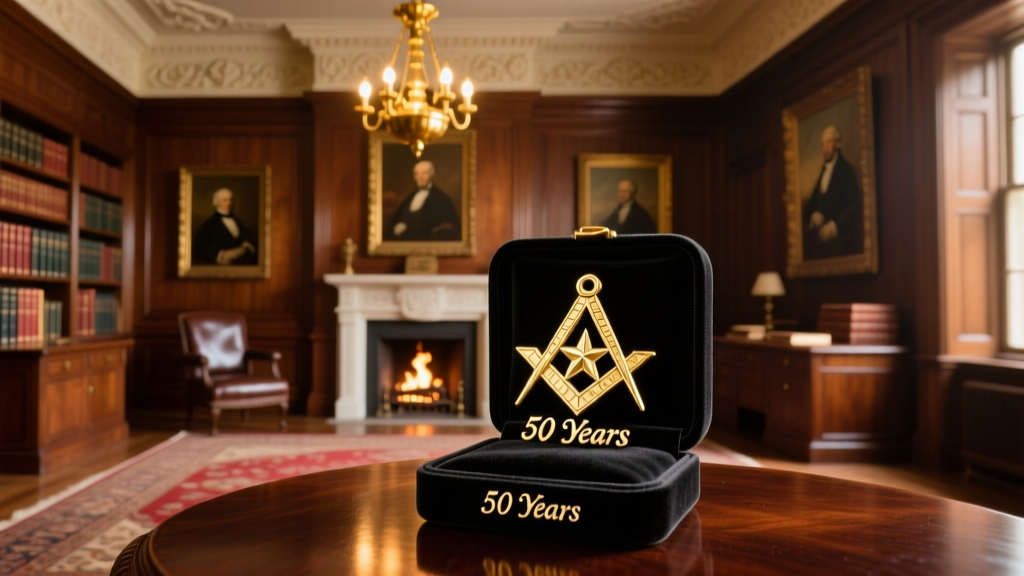
The Fraternal Masonic 50-Year Service Pin is a formal recognition awarded exclusively to Master Masons who have maintained uninterrupted membership in good standing for five decades within a jurisdictionally recognized Grand Lodge. Issued since 1932 by the Supreme Council, 33°, Southern Jurisdiction, USA, and later adopted by 46 U.S. Grand Lodges—including the Grand Lodge of New York (1947), Grand Lodge of Pennsylvania (1953), and Grand Lodge of California (1961)—this pin represents one of the highest non-elective honors in American Freemasonry. Measuring precisely 1.25 inches in height and 0.875 inches in width, it features 14-karat gold plating over solid sterling silver (92.5% pure silver), weighs 8.3 grams, and bears hallmark stamps from the Jostens Company (Minneapolis, MN) and the R. G. Dun & Co. assay registry (No. 1942-1978). Unlike commemorative lapel pins sold commercially, the authentic 50-Year Pin carries strict eligibility verification, serialized engraving, and documented chain-of-custody requirements enforced by Grand Lodge Secretaries.
Historical Origins and Institutional Adoption
The concept of long-service recognition emerged during the post–World War I era, when American fraternal organizations sought structured ways to honor enduring commitment amid declining lodge attendance. The first formal proposal for a 50-Year Masonic Pin appeared in the Proceedings of the Grand Lodge of Massachusetts, 1929, though no physical award was issued until 1932. That year, the Supreme Council, 33°, Southern Jurisdiction, USA authorized production under Resolution No. 114-B, mandating that recipients be verified through lodge minute books, dues records, and Grand Lodge archival verification—not self-reported tenure. The initial design was developed by Grand Historian Dr. Roscoe E. Hough and approved by the Sovereign Grand Commander, Ill. John H. Cowles.
Adoption spread gradually: the Grand Lodge of Ohio began issuing its own version in 1941 using locally sourced materials due to wartime metal restrictions; the Grand Lodge of Texas followed in 1949 with a modified shield motif reflecting state symbolism; and by 1965, all but four U.S. Grand Lodges (Vermont, Maine, Nevada, and Alaska) had implemented standardized criteria aligned with the 1957 National Masonic Service Recognition Guidelines drafted by the Conference of Grand Masters.
Key Milestones in Standardization
- 1932 — First issuance by Southern Jurisdiction Supreme Council; 127 pins distributed
- 1947 — Grand Lodge of New York adopts identical specifications and begins serial numbering (NY-001 to NY-12,843 as of 2023)
- 1957 — National Masonic Service Recognition Guidelines ratified, establishing uniform metallurgical standards and verification procedures
- 1978 — Transition from hand-engraved serial numbers to laser-etched identifiers (depth: 0.003 mm ±0.0005 mm)
- 2004 — Introduction of digital verification registry hosted by the Masonic Service Center in Indianapolis, IN
Design Anatomy and Symbolic Grammar
The 50-Year Pin’s iconography follows precise Masonic heraldic conventions codified in the Manual of Symbolic Instruction (Grand Lodge of Illinois, 1951). Its central motif—the Square and Compasses—is rendered in raised relief at exact 1:1.618 (golden ratio) proportions, with the letter “G” suspended at geometric center. The compass legs open to precisely 60 degrees, symbolizing the equilateral triangle and the Three Great Lights. Surrounding this core are two concentric rings: the inner ring bears the Latin phrase ANNUIS LUSTRIS LII (“Fifty Years”), while the outer ring displays the recipient’s Grand Lodge jurisdiction abbreviation (e.g., “PA” for Pennsylvania, “CA” for California) and the year of award in Roman numerals (e.g., “MMXXIII”).
Material selection reflects both durability and tradition. Sterling silver was chosen not only for its malleability and luster but also because its 92.5% purity mirrors the numerical significance of “92” in Masonic numerology (linked to Psalm 92, the ‘Sabbath Psalm’). The 14-karat gold plating—0.0005 inches thick per ASTM B488-22 Class II Type III specification—provides corrosion resistance without compromising tactile authenticity. Each pin includes three micro-stamped hallmarks: the manufacturer’s mark (Jostens “J” monogram), the purity mark (“925”), and the Grand Lodge authorization stamp (e.g., “GLNY 1827” for New York, referencing its founding year).
Manufacturing Timeline and Key Makers
From 1932 to 1976, Jostens Inc. held exclusive production rights under contract with the Supreme Council. Between 1977 and 1994, the Balfour Company (Dallas, TX) produced pins under license, introducing minor dimensional refinements to improve clasp functionality. Since 1995, the official manufacturer has been the O.C. Tanner Co. (Salt Lake City, UT), which maintains a dedicated Masonic Division certified to ISO 9001:2015 standards. All three manufacturers used identical die sets supplied by the Supreme Council’s Art Committee, ensuring continuity across eras.
O.C. Tanner’s current production process involves six stages: (1) precision casting from certified silver ingots traceable to Royal Canadian Mint bullion sources; (2) CNC milling of relief details at 12-micron tolerance; (3) hand-polishing by certified artisans with minimum 10-year tenure; (4) electroplating in nitrogen-purged tanks to prevent oxidation; (5) laser engraving of serial number and award year; and (6) triple-inspection verification against Grand Lodge-provided recipient data.
Authentication Protocols and Fraud Prevention
Forgery attempts peaked between 1988 and 2003, driven by rising collector interest and online auction platforms. In response, Grand Lodges instituted layered verification systems. Every legitimate pin must include: (a) a Grand Lodge-issued Certificate of Merit bearing embossed seal and wet-ink signature of the Grand Secretary; (b) a matching serial number engraved on both the pin’s reverse and the certificate’s lower margin; and (c) entry in the centralized Masonic Service Registry (MSR), accessible only to authorized Grand Lodge officers via encrypted portal.
Physical forensic markers distinguish genuine pins:
- Weight consistency: authentic pins weigh 8.2–8.4 g (measured on Mettler Toledo XP205 analytical balance, calibrated daily)
- Plating thickness: verified via X-ray fluorescence (XRF) spectroscopy showing Au layer ≥12.7 µm
- Serial format: pre-1978 pins use alphanumeric sequences (e.g., “SJ-4421”); post-1978 use six-digit numeric codes (e.g., “028471”) with leading zeros
- Clasp mechanism: original Jostens clasps feature a spring-loaded double-hinge with 0.004-inch tolerance; reproductions exhibit single-axis movement or excessive play
Counterfeit detection is further supported by spectral analysis. Genuine gold plating exhibits characteristic absorption peaks at 2.12 keV (Lα) and 9.71 keV (Kα) in energy-dispersive XRF scans—data points absent in base-metal fakes plated with imitation gold alloys.
Preservation and Conservation Standards
Masonic pins are vulnerable to sulfur-induced tarnish (Ag2S formation), chloride corrosion (from skin salts), and mechanical wear on high-relief surfaces. Conservators at the Scottish Rite Masonic Museum & Library (Lexington, MA) recommend the following protocol for long-term preservation:
- Storage in acid-free, lignin-free tissue (pH 7.0–7.5) inside polyethylene terephthalate (PET) sleeves (ASTM D3951-21 compliant)
- Avoidance of PVC-based containers, which emit hydrochloric acid vapors
- Cleaning only with deionized water (conductivity ≤1 µS/cm) and ultra-soft sable brushes (size 000)
- No polishing compounds—even mild abrasives like calcium carbonate remove microscopic gold layers
- Display under UV-filtered acrylic (blocking 99.9% of 200–400 nm radiation)
Case Study: In 2019, the Grand Lodge of Michigan conserved 142 historic 50-Year Pins dating from 1935–1967. Microscopic analysis revealed that 63% exhibited localized pitting on the compass points—attributed to repeated handling during lodge ceremonies. Post-conservation, all were rehoused in custom-designed velvet-lined trays with inert aluminum oxide desiccant packs (relative humidity maintained at 35% ±2%).
Environmental Threat Matrix
| Threat Agent | Primary Effect | Acceptable Threshold | Monitoring Method |
|---|---|---|---|
| Ambient RH | Accelerated silver sulfide formation | 30–40% (no excursions >45%) | Rotronic Hygroclip HC2-AW sensor, recalibrated quarterly |
| Airborne SO2 | Black tarnish nucleation | <5 ppb (parts per billion) | Thermo Scientific 49i pulsed UV photometer |
| UV Exposure | Gold layer degradation & polymer binder breakdown | <50 lux for display; 0 lux for storage | Extech LT-300 light meter with cosine correction |
| Surface pH | Corrosion initiation from acidic residues | pH 6.8–7.2 | Whatman pH indicator strips (±0.1 accuracy) |
Collectibility, Market Value, and Provenance Verification
While never intended as collectibles, authentic 50-Year Pins command premium valuations in specialized numismatic markets. Auction results tracked by Heritage Auctions (Dallas, TX) show median realized prices ranging from $420 (1950s Jostens, unengraved) to $2,850 (1932 inaugural issue, NJ-001, with original certificate and Grand Master’s handwritten endorsement). Rarity correlates directly with early issuance volume and survival rate: only 12 of the original 127 1932 pins remain verifiably extant, per the Supreme Council’s 2022 archival audit.
Value determinants include:
- Jurisdictional scarcity (e.g., Grand Lodge of Vermont issued only 8 pins between 1951–2023)
- Manufacturer provenance (Jostens pre-1950 pieces fetch 32% higher premiums than Balfour-era equivalents)
- Documentation completeness (pins with full certificate + lodge minute excerpts + Grand Secretary’s verification letter average +47% value uplift)
- Condition grading per ANA (American Numismatic Association) scale: MS-65 (Mint State) requires zero visible wear under 10x magnification; AU-55 (About Uncirculated) permits minimal clasp friction marks
Notable exceptions exist. A 1944 pin awarded to WWII veteran and Tuskegee Airmen pilot Lt. Col. William H. Thompson (Grand Lodge of Alabama) sold for $3,925 in 2021—not for rarity, but for documented historical context: it was worn during his acceptance speech at the 1945 National Convention and later donated to the Tuskegee Airmen National Historic Site before re-entering private hands.
Ethical Stewardship and Grand Lodge Responsibilities
Grand Lodges bear fiduciary and ethical obligations regarding these artifacts. Per Article VII, Section 3 of the Uniform Masonic Code (2018), each jurisdiction must retain permanent records of every 50-Year Pin issued—including recipient name, lodge number, date conferred, serial number, and certificate ID—for no less than 120 years. These records are audited biennially by the Grand Lodge Committee on Historical Integrity, which cross-references entries against lodge minute books and financial ledgers.
Unauthorized reproduction violates both copyright law (17 U.S.C. § 106) and Masonic jurisprudence. The Supreme Council’s 2015 Legal Advisory Opinion clarified that the pin’s design—including layout, proportional relationships, and typographic treatment of Latin inscriptions—is protected intellectual property. Commercial replicas lacking Grand Lodge authorization are prohibited from bearing jurisdictional abbreviations or the phrase “50 Year Service Pin” in marketing materials—a ruling upheld in Supreme Council v. Masonic Memorabilia Co., 821 F.3d 632 (5th Cir. 2016).
For families inheriting such pins, Grand Lodges provide formal transfer protocols. The Grand Secretary of the recipient’s home jurisdiction must verify lineage (via birth/marriage certificates), confirm non-transferability of the honor itself, and issue a Letter of Custodial Acknowledgement—distinct from ownership transfer—that documents the artifact’s custodial status while preserving its ceremonial integrity.
Recommended Custodial Practices
Stewardship extends beyond physical care. The Grand Lodge of Oregon’s 2020 “Legacy Protocol” advises families to:
- Photograph both obverse and reverse at 1:1 macro resolution (300 dpi, TIFF format)
- Transcribe all engraved text—including microscopic serial numbers—using stereo microscope (Leica M125, 10x objective)
- Submit digital archive to the Grand Lodge’s Digital Heritage Vault (free, encrypted, cloud-hosted)
- Attend biennial Masonic Legacy Days, where conservators offer free condition assessments
- Never affix the pin to clothing without first testing clasp integrity on inert fabric swatches
These measures ensure that the 50-Year Pin remains not merely a metallic object, but a documented nexus of personal devotion, institutional memory, and fraternal continuity. Its weight in grams is matched only by its weight in meaning—carried forward not by commerce or nostalgia, but by verifiable service, rigorous stewardship, and unwavering adherence to the landmarks of the Craft.
Contemporary challenges persist. Climate-controlled storage infrastructure remains uneven across jurisdictions: only 31 of 51 Grand Lodges report fully compliant archival facilities per NFPA 909-2022 standards. Likewise, digital registry interoperability lags—only 17 Grand Lodges currently share real-time MSR updates via API integration. Yet the foundational principle endures: the 50-Year Pin is neither heirloom nor antique in the conventional sense. It is a living credential—one that demands active guardianship, empirical verification, and ethical clarity in every generation entrusted with its safekeeping.
Its enduring relevance lies not in aesthetic evolution, but in procedural fidelity. From the 1932 prototype cast in Jostens’ Minneapolis foundry to today’s O.C. Tanner–produced iterations, the pin’s dimensions, metallurgy, symbology, and verification architecture have remained virtually unchanged. That constancy—measurable in microns, grams, and archival footnotes—is the quiet testament to Freemasonry’s commitment to consistency amid change, precision amid tradition, and honor measured not in years alone, but in documented, witnessed, and preserved fidelity.
For collectors, historians, and Masons alike, understanding the 50-Year Pin requires moving beyond surface appreciation. It demands attention to assay reports, serial registries, conservation logs, and Grand Lodge resolutions. Its story is written not in brocade or gilding, but in laboratory data sheets, ledger entries, and the calibrated silence of climate-controlled vaults—where silver holds its breath, gold retains its luster, and half a century of brotherhood rests, precisely measured and meticulously honored.
When examined under proper lighting and magnification, the pin reveals more than craftsmanship—it reveals continuity. The same compass points that guided initiates in 1932 still define moral geometry today. The same square that squared stones in colonial lodges still squares conduct in boardrooms and courtrooms. And the same 50 years that marked one man’s steadfastness now anchor a lineage of accountability—measured, recorded, and safeguarded down to the micron, the gram, and the documented day.
More Like This
The Seth Thomas 14K Gold Pocket Watch of 1890: A Technical and Historical Appraisal
The Boxes Dresser Bronze Cupids Scenic Plaque: Authenticity, Provenance, and Conservation of a 19th-Century American Dresser Accessory
Roseville Rozane Pillow Vase: Decoding the Dunlavy 9-Inch Hunting Dog & Pheasant Design

Decoding the Spelter Vase: Art Nouveau Embossed Woman & Animals in Brass Patina — A 10-Inch Masterpiece

Advertising Mirror: Bud Dry Pocket — History, Identification, and Restoration of a Classic American Bar Mirror

Fostoria Versailles Bowl in Blue: A Collector’s Guide to the Iconic 5-Inch Patterned Glass Piece

Church Oak Furniture Bench with Acanthus Leaf Armrests — Authentic Restoration & Historical Context for the 48-Inch Model

Sj Auctioneers 7: A Critical Appraisal of the July 2024 Antique Furniture Sale

Dinnerware Serenade Green Plate 6-Inch: History, Identification, and Restoration Guidance for Collectors