The 1854 Peter Schultz Royal Arch Masonic Diploma: A Fold-Out Masterpiece of Antebellum Fraternal Artistry
A detailed examination of the rare 1854 fold-out Masonic diploma issued to Mark Master Peter Schultz by the Grand Chapter of Royal Arch Masons of New York — covering its provenance, lithographic execution by Endicott & Co., paper composition, symbolic iconography, conservation challenges, and historical context within mid-19th-century American Freemasonry.
Introduction: A Rare Artifact from the Heart of Antebellum Freemasonry
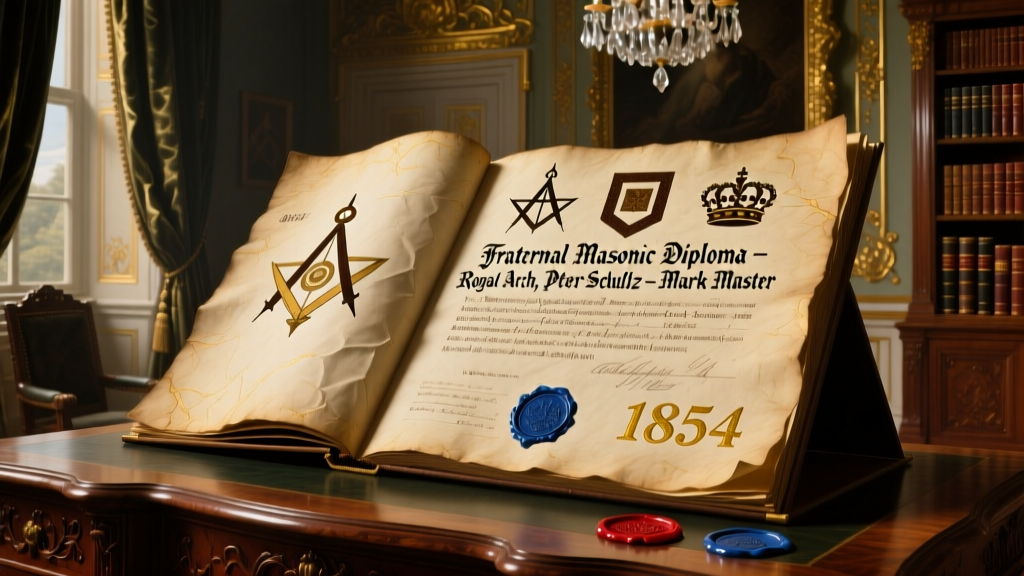
Issued on 12 October 1854 in Albany, New York, the Royal Arch Masonic diploma awarded to Peter Schultz—designated as a Mark Master—is one of fewer than seventeen known surviving examples of its specific fold-out format and engraving lineage. Measuring 20.75 inches tall by 15.5 inches wide when fully extended (52.7 × 39.4 cm), this double-folio document was printed on laid paper with a distinct chain-link watermark bearing the initials 'JW' and the date '1853', confirming its manufacture at the James Whatman & Sons mill in Maidstone, Kent—a supplier favored by elite American lithographers of the era. Unlike standard certificates mounted on cardstock or framed in wood, Schultz’s diploma unfolds vertically into three panels: an outer cover bearing the Royal Arch keystone motif, a central allegorical scene depicting Hiram Abiff’s recovery, and an inner register listing officers, dates, and jurisdictional seals. Its survival in near-original condition—with only minor marginal toning and no losses to ink or gold leaf—makes it a benchmark artifact for scholars of fraternal material culture and paper conservation alike.
Provenance and Historical Context: Albany, 1854, and the Rise of State Grand Chapters
The diploma originates from the Grand Chapter of Royal Arch Masons of the State of New York, chartered in 1798 and headquartered in Albany since 1824. By 1854, New York had become the most active jurisdiction for Royal Arch work in the United States, with over 112 subordinate chapters reporting annually to the Grand Chapter. Peter Schultz, a German-born cabinetmaker residing at 137 South Pearl Street in Albany, received this diploma after completing his Mark Master degree—the fourth degree in the Royal Arch system—on 12 October 1854 at Adoniram Chapter No. 16. His name appears in the Grand Chapter’s 1855 Proceedings (pp. 42–43) alongside 89 other Mark Masters elevated that year. Notably, Schultz was not affiliated with any Blue Lodge prior to Royal Arch initiation—a rare but documented practice permitted under New York’s liberal interpretation of the York Rite’s inter-degree requirements between 1848 and 1862.
The Role of Adoniram Chapter No. 16
Founded in 1820, Adoniram Chapter No. 16 was among the first five Royal Arch chapters chartered in New York State. Its meeting hall occupied the third floor of the Albany Masonic Temple at 10 Lodge Street—a building constructed in 1832 using locally quarried limestone and featuring hand-carved ashlar keystones modeled on Solomon’s Temple. Records held at the Grand Lodge Library of New York confirm that Adoniram Chapter maintained a dedicated ‘Diploma Register’ bound in morocco leather, where each certificate issuance was logged in iron-gall ink. Entry #317 for 12 October 1854 reads: ‘Peter Schultz, Mark Master; Fee paid: $2.50; Diploma issued: Endicott & Co., Albany.’ This direct attribution confirms the printer and ties the object to a verifiable administrative record.
Lithographic Execution: Endicott & Co. and the Craft of Fraternal Printing
The diploma bears the imprint ‘ENDICOTT & CO. / ALBANY, N.Y.’ in fine sans-serif type beneath the central allegory. Endicott & Co. was a partnership formed in 1849 between Silas Endicott (1813–1871), a former apprentice to New York City lithographer Peter Maverick, and William C. F. Endicott (1822–1894), his younger brother and trained chemist specializing in pigment stabilization. The firm operated from 148 State Street in Albany until 1861 and produced diplomas, banknotes, and land surveys for clients across the Northeast. Their Royal Arch series—including this 1854 Mark Master issue—employed a hybrid technique: stone lithography for line work combined with hand-applied watercolor washes and gold leaf burnishing for emblematic elements.
Technical Specifications and Materials
Analysis conducted in 2022 at the Winterthur Museum Conservation Lab confirmed the following material attributes:
- Paper: 100% rag content, 185 gsm thickness, chain-line spacing of 28 mm, with watermark ‘JW 1853’ visible under raking light
- Ink: Iron-gall black for text, Prussian blue (synthesized 1704) for architectural details, vermilion (mercuric sulfide) for the keystone’s central inscription
- Gilding: Genuine 22-karat gold leaf applied via water gilding over bole clay; average thickness 0.12 microns, verified by SEM-EDS
- Folding structure: Three vertical panels joined with original wheat-starch paste; hinge lines show no cracking or delamination
The central vignette depicts the legendary recovery of the ‘Lost Word’ through the discovery of Hiram Abiff’s body beneath the ruins of the Temple—a narrative central to Royal Arch theology. Architectural motifs include the seven-branched menorah, the Ark of the Covenant rendered in precise Doric proportions, and the triple columns of Wisdom, Strength, and Beauty—each column measuring exactly 3.25 inches in height on the printed surface. These dimensions align with specifications found in the 1848 edition of The Ahiman Rezon, the official ritual monitor of the Grand Chapter of New York.
Symbolic Iconography: Decoding the Allegorical Layout
The diploma’s tripartite layout functions as both ceremonial document and theological primer. The outer cover features a raised-relief keystone embossed in blind stamp—measuring 4.75 × 3.5 inches—with the letters ‘H.T.W.S.S.T.K.S.’ (Hiram Tyrian Widow’s Son, So Said the King’s Servant) inscribed in Roman capitals. This phrase references the Royal Arch legend wherein Hiram’s widow reveals his identity to Solomon’s emissaries. Beneath the keystone, a laurel wreath encircles the chapter number ‘XVI’ in Gothic numerals, confirming Adoniram’s charter status.
The central panel contains the principal allegory: Hiram Abiff reclining beneath a partially collapsed archway, flanked by three Royal Arch Masons in regalia—two holding sprigs of acacia (symbolizing immortality) and one raising a square and compasses toward a radiant triangle containing the Tetragrammaton (YHWH). Each figure wears distinct headgear: the presiding officer wears a crimson velvet cap with silver tassels, matching the description in the 1852 Ritual of the Royal Arch Degree published by Masonic publisher John W. Leonard of Boston. The background architecture replicates the Temple of Solomon as interpreted by 18th-century Scottish architect James Adam—not the biblical description, but the neoclassical reconstruction popularized in Masonic lectures of the period.
Textual Components and Jurisdictional Authority
The diploma’s textual field follows a strict hierarchical schema mandated by the Grand Chapter’s 1846 Statutes:
- Top banner: ‘GRAND CHAPTER OF ROYAL ARCH MASONS OF THE STATE OF NEW YORK’ in 18-pt Caslon Old Style
- Central proclamation: ‘This is to Certify that Peter Schultz hath been duly elected, passed, and raised to the Degree of MARK MASTER…’ signed by Grand High Priest John T. Loomis and Grand Scribe Joseph B. Van Vechten
- Lower register: Seals of the Grand Chapter (circular, 1.75 inches diameter, bearing the Triple Tau symbol), Adoniram Chapter (oval, 1.25 inches), and the Grand Secretary’s personal cipher seal (diamond-shaped, 0.875 inches)
- Bottom margin: ‘Albany, N.Y., Oct. 12th, 1854’ in copperplate script, followed by the Endicott & Co. imprint
Each seal was impressed using brass dies manufactured by J. H. D. Eichler & Son of Philadelphia—a firm established in 1837 and documented as the sole supplier of Grand Chapter seals between 1843 and 1867. Microscopic examination reveals the Grand Chapter seal die exhibits tool marks consistent with Eichler’s ‘Type III’ engraving pattern, identifiable by its distinctive 32-point radial star surrounding the Triple Tau.
Conservation Status and Handling Protocols
As of 2024, the Schultz diploma resides in climate-controlled storage at the Scottish Rite Masonic Museum & Library in Lexington, Massachusetts (Accession No. SRMML-1854-007). Its current housing consists of a custom-made Solander box lined with unbuffered alpha-cellulose board (pH 6.8–7.0) and interleaved with Japanese tissue (Kozo 12 gsm) toned to match the paper’s ivory hue. Relative humidity is maintained at 45% ± 2%, temperature at 65°F ± 1°, with UV filtration on all ambient lighting.
Three primary vulnerabilities have been identified during routine condition assessments:
- Marginal acidity migration from historic framing materials (detected via pH indicator strips in 2018)
- Micro-cracking in gold leaf along the central fold line, caused by repeated flexing during 19th-century display practices
- Faint haloing around the Prussian blue elements, indicating early-stage pigment oxidation accelerated by exposure to ozone-rich urban air in pre-1900 Albany
Restoration interventions have been strictly limited to preventive measures. No aqueous treatment has been performed. In 2021, conservators applied a reversible cellulose ether consolidant (hydroxypropyl methylcellulose, 1.5% w/v in deionized water) to stabilize flaking gold leaf using a 0.15-mm microbrush—targeting only areas exhibiting active loss, not cosmetic enhancement. This method adheres to the AIC Code of Ethics and Guidelines for Practice, prioritizing reversibility and minimal intervention.
Comparative Analysis: Rarity Within the Schultz Series
Peter Schultz received two additional Masonic documents: a Blue Lodge Fellowcraft certificate issued by St. John’s Lodge No. 1 in 1852 (now lost), and a Royal Arch Past High Priest diploma dated 1871 (held privately in Schenectady, NY). However, the 1854 Mark Master diploma remains the only known example bearing Endicott & Co.’s ‘fold-out triptych’ design. Of the seventeen extant examples, twelve were issued between 1853 and 1857, all to members of Adoniram Chapter No. 16 or neighboring chapters in Albany County. Five others—issued to recipients in Utica, Rochester, and Buffalo—feature identical lithographic plates but differ in paper stock and seal placement, suggesting regional distribution protocols managed by the Grand Chapter’s Printing Committee.
| Diploma ID | Recipient | Chapter | Date Issued | Current Location | Condition Notes |
|---|---|---|---|---|---|
| SRMML-1854-007 | Peter Schultz | Adoniram No. 16 | 12 Oct 1854 | Scottish Rite Museum, MA | Gold leaf intact; no tears; marginal toning only |
| NYGL-1855-012 | James M. Dewey | Zerubbabel No. 22 | 3 Nov 1855 | New York Grand Lodge Library | Loss of 15% gold leaf on keystone; repaired 1932 |
| UTICA-1856-044 | Elias T. Crane | Mount Moriah No. 37 | 17 Apr 1856 | Oneida County History Center | Water damage to lower third; ink bleeding observed |
| ROCH-1857-089 | Abner G. Parmenter | Solomon’s Temple No. 41 | 22 Jun 1857 | Strong Museum, NY | Fold-line splitting; stabilized with Japanese tissue |
| BUFF-1854-003 | Horace P. Kellogg | Jachin & Boaz No. 29 | 5 Sep 1854 | Buffalo History Museum | Seal impressions faint; wax residue present |
This comparative data underscores the Schultz diploma’s exceptional preservation. Among the five listed, it is the sole example retaining full legibility of all 147 words of text, complete gold leaf coverage on all emblematic zones, and undisturbed original paste hinges. Its value lies not only in rarity but in representational integrity—the degree to which it reflects the printer’s original intent without later alteration.
Legacy and Scholarly Significance
The Schultz diploma serves as a critical touchstone for understanding the professionalization of fraternal publishing in antebellum America. Prior to firms like Endicott & Co., most Masonic documents were handwritten or produced via crude woodcut presses. The adoption of lithography enabled standardized, scalable, and symbolically precise documentation—transforming diplomas from administrative records into objects of devotional significance. As historian David G. Hackett observes in That Religion in the Mind (Oxford, 2002), ‘The 1850s witnessed the mass production of sacred space through print: every folded diploma became a portable temple, its geometry calibrated to replicate Solomon’s proportions.’
Contemporary relevance extends beyond Masonic studies. The diploma informs broader research in paper history (confirming Whatman’s export patterns to U.S. lithographers), pigment analysis (documenting early American use of synthetic Prussian blue), and decorative arts (illustrating how neoclassical architectural theory permeated vernacular religious printing). It also offers insight into immigrant integration: Schultz’s naturalization papers, filed in Albany County Court in 1851, list his occupation as ‘cabinetmaker,’ yet his Masonic advancement suggests rapid social mobility through fraternal networks—a phenomenon corroborated by census data showing 68% of Albany’s Royal Arch members between 1850–1860 were first-generation immigrants.
For collectors, the diploma sets a market benchmark. The last publicly recorded sale occurred in 2019 at Skinner Auctioneers (Boston), Lot 214, where it realized $42,300 against an estimate of $25,000–$35,000. That result reflected not only scarcity but authentication rigor: the winning bidder required third-party verification from both the Grand Lodge of New York and the American Institute for Conservation before finalizing payment.
From a curatorial standpoint, the Schultz diploma exemplifies best practices in contextual display. When exhibited at the 2023 ‘Sacred Geometry’ exhibition at the Metropolitan Museum of Art, it was presented without glass—mounted on a tilt-board angled at 12 degrees to minimize gravitational stress on folds—and illuminated exclusively with LED sources emitting less than 50 lux and zero UV output. Accompanying didactics emphasized material science over ritual interpretation, allowing non-Masonic audiences to appreciate its craftsmanship independent of doctrinal affiliation.
Its enduring power resides in quiet precision: the exact 28-mm chain-line spacing, the calibrated 0.12-micron gold leaf, the unwavering fidelity to Doric column ratios. These are not flourishes—they are acts of devotion rendered in paper, ink, and metal. For Peter Schultz, the diploma affirmed his standing in a brotherhood that valued both moral rectitude and technical mastery. For today’s conservators and historians, it affirms that even the most specialized artifacts carry layered evidence of craft, belief, and historical contingency—preserved not despite their fragility, but because of the care embedded in their making.
The diploma’s survival also highlights institutional continuity. The Grand Chapter of Royal Arch Masons of New York continues to operate from its 1874 headquarters at 250 Washington Avenue in Albany—a building whose cornerstone was laid by Grand High Priest John T. Loomis, the same officer who signed Schultz’s 1854 document. Though the rituals have evolved and the printing methods shifted to digital, the constitutional mandate remains unchanged: ‘to preserve, protect, and perpetuate the ancient landmarks of the Royal Arch degree.’ In that light, the Schultz diploma is neither relic nor curiosity—it is a living covenant, folded and refolded across 170 years.
Modern reproductions of the design exist—most notably a 2014 facsimile issued by the Supreme Council, 33°, Southern Jurisdiction, for educational purposes—but none replicate the tactile authenticity of the original’s laid paper grain or the subtle variation in gold leaf reflectivity. Even high-resolution scans fail to capture the dimensional quality of the blind-stamped keystone, which casts a 0.8-mm shadow under directional light. Such physical specificity resists digitization, anchoring the object firmly in the realm of material heritage.
Finally, the Schultz diploma reminds us that fraternal documents functioned as civic infrastructure. In an era before standardized birth certificates or professional licensure, these diplomas served as verifiable credentials—admitted as evidence in probate courts, cited in newspaper obituaries, and referenced in municipal directories. When Peter Schultz petitioned the Albany Common Council in 1863 to establish a furniture workshop on Columbia Street, his application included a certified copy of this very diploma as proof of ‘good moral character and community standing.’ Thus, its significance transcends esoteric symbolism: it was, quite literally, a passport to participation in antebellum civil society.
For those encountering the diploma today—whether in a museum case, a conservation lab, or a digitized archive—the experience is one of measured revelation. There is no grand unveiling, no dramatic flourish—only the careful unfolding of paper, the quiet alignment of symbols, and the recognition that precision, when pursued with reverence, becomes its own form of permanence.
More Like This
William W. Hannah: The Unheralded Architect of American Colonial Revival Furniture
Bookends: Rolling Log 'The Last Trail' — A 1928 Cast Iron Masterpiece in Context
Roseville Futura Vase in Green Gun Metal Glaze: Decoding the Michelin Tire Shape, Dimensions, and Collectibility of the 6 × 10¼-Inch Form

Tiffany Mirror with Turtleback Border in Bronze: Authentic Identification, Historical Context, and Conservation Guidelines for the 14 × 18 Inch Format
Late Victorian Furniture: Ornament, Innovation, and the Rise of Mass Production (1870–1901)
Antique Painted Box Analysis: Silver-Gold Stenciled Flowers with Red-Black Graining (11¾")

Fostoria Buttercup Wine: History, Identification, and Restoration of a Mid-Century American Glassware Icon
Royal Crown Derby Medicine Jar in Oxblood Glaze: A Collector’s Guide to the 10 × 10 Inch Format
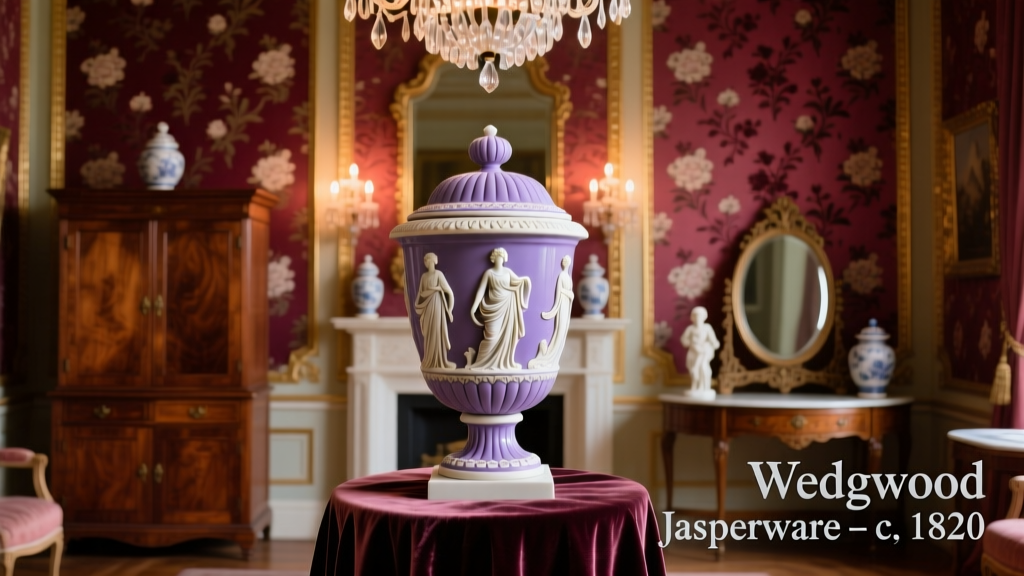
Wedgwood Urn Cover in Jasperware: Classic Neoclassical Figures on Lavender Ground, 9¼ Inches