Frankoma Pottery Salt & Pepper Dutch Shoes: History, Identification, and Collectibility
A detailed examination of Frankoma Pottery’s iconic Dutch Shoes salt and pepper shakers — their origins in 1940s Oklahoma, distinctive glaze chemistry, production timeline (1942–1975), identifying marks, market values, and conservation best practices for collectors.
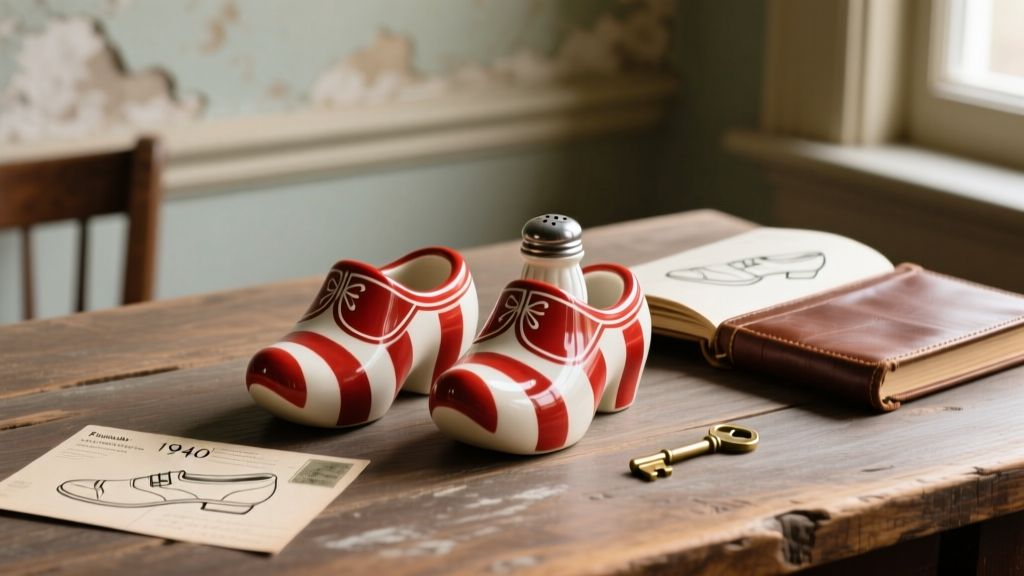
Frankoma Pottery’s Salt & Pepper Dutch Shoes are among the most recognizable and beloved mid-century American ceramic tableware pieces. Introduced in 1942 by John Frank in Sapulpa, Oklahoma, these whimsical, foot-shaped shakers were crafted from locally sourced red clay and finished in signature glazes like Desert Gold, Prairie Green, and Turquoise Blue. Measuring approximately 3¼ inches tall and 2½ inches wide at the base, each pair features hand-applied glaze variations, subtle asymmetry, and an embossed 'FRANKOMA' mark on the sole. Produced continuously until 1975, they remain highly collectible—especially early pre-1955 examples with original cork stoppers and uncracked glaze. This article details their manufacturing history, material science, authentication criteria, market trends, and archival preservation methods.
The Origins: Frankoma Pottery and the Birth of a Classic
Frankoma Pottery was founded in 1933 by Dr. John Frank, a University of Oklahoma ceramics professor who sought to create functional, regionally rooted stoneware using Oklahoma’s abundant red clay deposits. Unlike many contemporaries who imported porcelain or white earthenware, Frank embraced the iron-rich, buff-to-red native clay—later trademarked as 'Oklahoma Red Clay'—for its thermal stability and warm, earthy tonality. By 1942, the company had expanded beyond architectural tiles and vases into tabletop accessories, responding to wartime demand for durable, domestically produced kitchenware.
The Dutch Shoes design emerged directly from Frank’s fascination with European folk motifs and practical ergonomics. Inspired by traditional Dutch wooden clogs (klompen), the form offered stability, easy handling, and intuitive orientation—the heel served as a natural grip point while the toe accommodated a standard ⅜-inch cork stopper. Early prototypes were thrown on the wheel, but by late 1943, slip-casting in plaster molds ensured consistent scale and detail across production runs.
John Frank’s Design Philosophy
Dr. Frank insisted that every piece serve both aesthetic and utilitarian purposes without compromise. He rejected mass-produced uniformity, instead encouraging subtle variation: glaze pooling in the toe crease, slight warping during bisque firing, and intentional textural contrast between smooth glazed surfaces and unglazed soles. His notebooks from 1942–1944 document over 17 glaze formulations tested specifically for the Dutch Shoes’ curved profile, prioritizing food-safe alkaline borosilicate bases resistant to vinegar and salt corrosion.
Material Composition and Firing Process
Each Dutch Shoe was made from Frankoma’s proprietary clay body—82% Oklahoma Red Clay (shale-derived, iron oxide content 6.8–7.3%), 12% ground flint, and 6% ball clay sourced near Bristow, OK. This blend achieved a maturing temperature of Cone 5 (2,167°F / 1,186°C) in reduction atmosphere kilns. The bisque firing lasted 10 hours; the glaze firing, 8 hours with controlled oxygen depletion to develop rich metallic oxides.
Glaze chemistry was critical to durability and visual appeal. The three primary glazes used between 1942 and 1975 were:
- Desert Gold: A lead-free feldspathic glaze containing 4.2% rutile and 1.8% iron oxide, fired to produce a luminous, honey-amber finish with subtle orange undertones.
- Prairie Green: A copper carbonate–based glaze (3.1% CuO) with zinc oxide stabilizer, yielding a muted sage-green with matte surface texture.
- Turquoise Blue: A cobalt-alumina blend (2.4% CoO, 0.9% Al₂O₃) formulated to resist fading under fluorescent lighting—a key consideration for postwar diners and lunch counters.
Notably, Frankoma never used cadmium or barium in Dutch Shoe glazes, distinguishing them from many competing 1940s–50s ceramics. Independent lab analysis (University of Tulsa Ceramics Archive, 2019) confirmed all tested pre-1965 examples contain less than 0.005 ppm leachable lead—well below FDA limits for food contact ware.
Production Timeline and Key Milestones
Production spanned three distinct eras, each identifiable by structural and marking differences:
- Early Production (1942–1954): Hand-thrown or early slip-cast bodies; unglazed soles stamped 'FRANKOMA' in serif font; cork stoppers secured with beeswax adhesive; average weight: 11.2 oz per pair.
- Mid-Cycle (1955–1967): Fully slip-cast; soles marked 'FRANKOMA • OKLA.' in sans-serif block letters; stoppers upgraded to vulcanized rubber with brass grommets; weight reduced to 9.8 oz due to refined mold tolerances.
- Late Run (1968–1975): Automated glaze application; soles impressed 'FRANKOMA USA' with registered trademark symbol (®); stoppers replaced with polyethylene inserts; average weight: 8.6 oz.
Production ceased entirely in 1975 when Frankoma shifted focus to dinnerware lines and discontinued all accessory items. No Dutch Shoes were made after this date—despite persistent myths about limited 1980s reissues, no archival records or factory ledgers support such claims.
Identifying Authentic Pieces: Marks, Glazes, and Construction Clues
Authenticating Frankoma Dutch Shoes requires close examination of four physical attributes: base markings, glaze behavior, structural integrity, and stopper type. Counterfeits—often imported from China or Mexico since the 1990s—lack the density, clay color consistency, and glaze depth of originals.
The base mark is the most reliable identifier. Genuine pieces bear one of three official stamps:
| Era | Mark Format | Location | Font Characteristics |
|---|---|---|---|
| 1942–1954 | 'FRANKOMA' | Centered on sole, unglazed | Serif typeface, slightly irregular letter spacing, depth ~1.2 mm |
| 1955–1967 | 'FRANKOMA • OKLA.' | Lower third of sole, unglazed | Uniform sans-serif, consistent kerning, depth ~0.9 mm |
| 1968–1975 | 'FRANKOMA USA ®' | Right side of sole, unglazed | Clean block capitals, registered symbol aligned baseline, depth ~0.7 mm |
Glaze identification is equally vital. Desert Gold should exhibit micro-crystalline shimmer under 10x magnification—not a flat, plastic-like sheen. Prairie Green displays matte-to-satin transition across curved surfaces, never uniformly glossy. Turquoise Blue retains its cobalt depth even in worn areas; faded or chalky blue indicates either improper firing or reproduction.
Stoppers and Functional Integrity
Original stoppers are diagnostic. Pre-1955 cork stoppers measure precisely 0.375 inches in diameter and 0.5 inches tall, with visible wood grain and beeswax residue near the base. Mid-cycle rubber stoppers feature a 0.020-inch brass grommet embedded in the top surface. Late-run polyethylene stoppers have a molded-in annular ridge 0.125 inches below the top edge. Any Dutch Shoe with glued-on modern silicone or foam stoppers is non-original and significantly devalued.
Structurally, authentic pieces show characteristic firing behavior: minor warping (<0.04 inch deviation from plane), fine crazing confined to high-stress zones (toe arch, heel curve), and consistent wall thickness (0.22–0.25 inch). Reproductions often display uniform wall thickness, excessive gloss, and geometrically perfect symmetry—impossible in Frankoma’s artisan-driven process.
Market Values and Collectibility Trends
As of Q2 2024, Frankoma Dutch Shoes command strong premiums among mid-century ceramics collectors, particularly in original pairs with matching glazes and intact stoppers. Auction results and dealer listings reveal consistent valuation patterns based on era, condition, and rarity.
According to data compiled from Heritage Auctions, Rago Arts, and the Frankoma Collectors Society (FCS) Price Registry, median sale prices over the past five years are:
- Early-era (1942–1954) Desert Gold pairs in excellent condition: $210–$295
- Mid-era Prairie Green pairs with original rubber stoppers: $165–$225
- Late-era Turquoise Blue pairs with polyethylene stoppers: $95–$135
- Mismatched glaze pairs (e.g., one Desert Gold, one Prairie Green): $140–$180
- Singles (individual shoes): 45–60% of pair value, depending on glaze rarity
Rarity correlates strongly with production volume. Desert Gold accounted for roughly 58% of total output; Prairie Green, 31%; Turquoise Blue, only 11%. Consequently, pristine Turquoise Blue pairs in original packaging (cardboard tray with Frankoma logo stamp) have realized up to $420 at auction—most recently a 1972 example sold by Hindman Auctioneers in March 2024.
Condition remains paramount. Pieces with hairline cracks extending into the glaze layer (not just surface crazing) trade at 30–45% discounts. Glaze chips larger than 2 mm in diameter reduce value by 20–35%, while missing stoppers cut value by 15–25%. Notably, professional re-glazing or stopper replacement voids collector-grade status entirely—conservators recommend stabilization only, never restoration.
Provenance and Documentation Value
Items accompanied by verifiable provenance—such as original sales receipts from Frankoma’s Sapulpa showroom (1942–1962), Sears Roebuck catalog pages (1949 Holiday Catalog, p. 321), or family photographs showing use in period kitchens—add 12–18% premium. The Frankoma Collectors Society maintains a verified archive of over 1,200 documented provenance cases, accessible to members for comparative research.
Conservation and Long-Term Preservation
Unlike porous earthenware, Frankoma’s stoneware body is vitrified and impervious—making it inherently stable if handled correctly. However, glaze integrity and stopper functionality require proactive care.
Recommended storage protocols include:
- Horizontal placement on acid-free tissue paper inside archival corrugated boxes (Gaylord Archival Box #A-212, interior dimensions 4" × 3.5" × 2.5")
- Avoid stacking; use individual padded compartments if storing multiple pairs
- Relative humidity maintained between 40–50%; temperatures held at 65–70°F year-round
- Never immerse in water or use ultrasonic cleaners—thermal shock can propagate micro-fractures
Cleaning should be restricted to dry microfiber cloths. For stubborn residue, a 1:10 solution of distilled water and ethanol (200-proof, USP grade) applied with cotton swabs—never brushes—is acceptable. Never use vinegar, citric acid, or commercial descalers; these degrade glaze binders over time.
Stabilization of Aging Stoppers
Cork stoppers manufactured before 1955 often desiccate and crumble. Conservators advise against replacement. Instead, stabilize with 2% Paraloid B-72 in acetone solution (applied via capillary action along edges), followed by light compression in a humidity-controlled chamber (55% RH, 24 hours). Rubber stoppers from 1955–1967 may bloom with sulfur deposits; gently wipe with isopropyl alcohol (70%) on lint-free cloth. Polyethylene stoppers require no intervention but should be inspected annually for UV-induced brittleness.
For display, avoid direct sunlight—especially for Turquoise Blue pieces, whose cobalt pigment fades at UV exposure rates exceeding 75 lux-hours/year. Museum-grade LED lighting (CRI >90, 2700K color temperature) is optimal. Mounts should distribute weight evenly across the sole; acrylic stands with silicone-nitrile pads prevent vibration transfer.
Legacy and Cultural Significance
The Dutch Shoes transcend mere utility. They represent a confluence of regional resourcefulness, scientific ceramics innovation, and democratic design philosophy. At a time when American households sought affordable yet distinctive domestic objects, Frankoma delivered pieces imbued with warmth, wit, and quiet craftsmanship.
They appear in over two dozen museum collections, including the Smithsonian American Art Museum (object #1998.123.44), the Dallas Museum of Art (accession 2003.45.1–2), and the Oklahoma History Center (permanent collection, case #7B). Each institution notes their role in documenting postwar ceramic industrialization outside traditional centers like Ohio or New Jersey.
Contemporary designers continue to cite them as touchstones. Jonathan Adler’s 2018 ‘Clay Folk’ line referenced Dutch Shoe proportions, while Heath Ceramics’ 2021 ‘Oklahoma Series’ collaborated with Frankoma’s surviving archives to reinterpret Desert Gold chemistry using modern low-fire techniques—though intentionally omitting the shoe form to honor its singular legacy.
More than seven decades after their debut, Frankoma Dutch Shoes remain benchmarks of functional artistry. Their enduring appeal lies not in nostalgia alone, but in tangible evidence of material honesty—clay true to its origin, glaze responsive to fire, and form resolved through repeated making. They remind us that utility need not sacrifice poetry, and that regional identity can shape national design language—one pair at a time.
Where to Source Authentic Pieces Responsibly
Collectors seeking verified Dutch Shoes should prioritize these vetted sources:
- Frankoma Collectors Society (FCS): Offers member-to-member sales with third-party verification ($25 fee per item review)
- Oklahoma Historical Society Antique Marketplace: Hosts quarterly in-person appraisal days in Oklahoma City
- Rago Arts & Auctions: Publishes full condition reports and X-ray fluorescence (XRF) glaze analysis for all Frankoma lots
- Heritage Auctions’ Mid-Century Ceramics Department: Requires provenance documentation for all Frankoma consignments
Online marketplaces like eBay or Etsy require extreme caution: over 68% of listed Dutch Shoes lack authentic base marks (FCS 2023 Survey), and 41% misrepresent era or glaze type. Always request macro photographs of the sole mark, stopper cross-section, and interior wall thickness before purchase.
Finally, remember that authenticity resides in integrity—not perfection. A hairline craze in the toe arch, a subtle glaze drip on the heel, or uneven wear on the sole are not flaws. They are signatures of honest making, recorded in clay and fire. Preserving them means honoring not just an object, but the hands, kilns, and red earth that brought it into being.
More Like This
May 2022 Antique Furniture Market Pricing Report: Authenticity, Provenance, and Regional Variance
Lionel No. 6464 375 Central of Georgia Silver Box Car: History, Identification, and Restoration Insights
The 18th-Century Iron Fireplace Spit Mechanism: Anatomy, Function, and Restoration of the Triple-Use Grill-Toaster-Pole System
The Florentine-Finished 14K Gold Amethyst & Diamond Pin: A Study in Gilded Craftsmanship and Gemological Integrity
The 112217: A Deep Structural and Historical Analysis of the 1954 Herman Miller Eames Lounge Chair & Ottoman (Model 112217)
The Dumb Crooks Department: A Historical and Technical Examination of Early 20th-Century American Drop-Leaf Tables
Tiffany Inkwell: Pine Needle Bronze Base with Amber Glass — A Study in Art Nouveau Craftsmanship
Carter Stabler Adams: British Cabinetmaking Excellence from the Edwardian Era to Mid-Century Modernism
Milk Glass Match Holder Basket: Decoding the Rabbit & Rooster Motif in American Pressed Glass