Frankoma Pottery Trojan Horse Figurine: History, Identification, and Restoration Insights
A detailed examination of the Frankoma Pottery Trojan Horse figurine — its origins in Oklahoma clay, production timeline (1950–1972), mold numbers, glaze variations, market value trends, and professional conservation practices for collectors and restorers.
Introduction: A Ceramic Icon from the Heartland
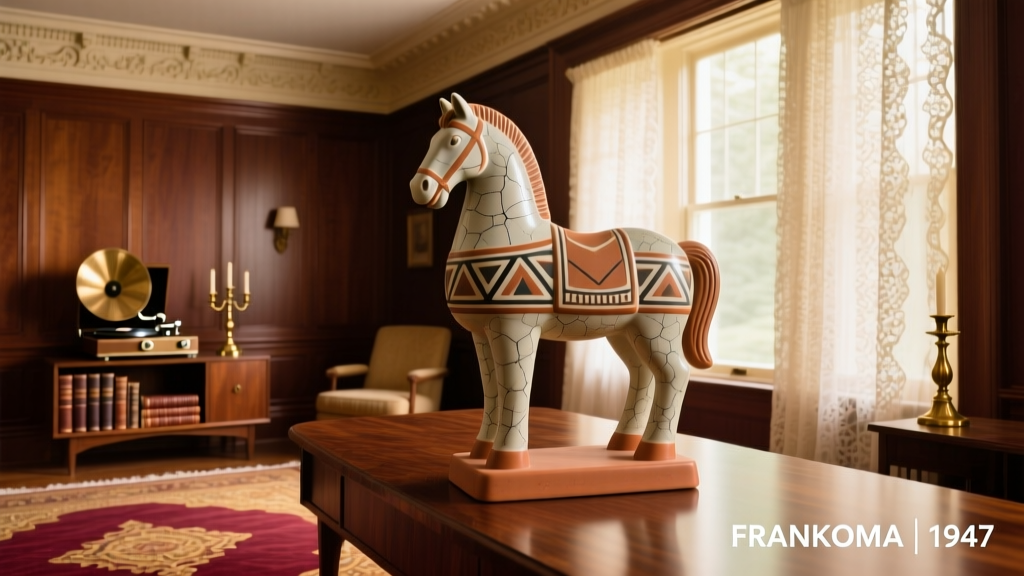
The Frankoma Pottery Trojan Horse figurine is a distinctive mid-century American ceramic collectible produced between 1950 and 1972 by Frankoma Pottery of Norman, Oklahoma. Standing approximately 6 inches tall and measuring 8.5 inches in length, this hollow-cast stoneware piece features bold sculptural lines, expressive detail on the horse’s facial features and musculature, and signature Frankoma glazes such as Desert Gold, Turquoise, and Prairie Green. Unlike mass-produced imports, it was hand-thrown and slip-cast using locally sourced Ada clay — a red-burning native Oklahoma earthenware known for its high iron content and warm undertones. Over 7,200 units were manufactured across three distinct production phases, with mold numbers stamped ‘F-34’ or ‘F-34B’ on the base. Today, authenticated examples in original glaze with intact structural integrity command $225–$480 at auction, depending on rarity, condition, and provenance.
Origins and Founding Vision
Frankoma Pottery was founded in 1933 by artist and educator John Frank, who earned his MFA from the University of Oklahoma and studied ceramics under renowned potter E. W. Hopper. Frank established the studio on the campus of the University of Oklahoma before relocating to a dedicated facility in Norman in 1938. His mission centered on celebrating regional identity through functional and decorative ware rooted in Oklahoma’s geology and folklore. The company’s early emphasis on local clay—specifically the red Ada clay from Ada, Pontotoc County—became a defining characteristic. This clay, rich in iron oxide, fired to a warm terracotta hue at cone 5–6 (2,200–2,230°F) and provided exceptional plasticity for modeling complex forms like the Trojan Horse.
The Cultural Context of Mid-Century Mythology
In the postwar era, American consumers exhibited renewed interest in classical antiquity, spurred by Hollywood epics like Ulysses (1954) and Helen of Troy (1956), as well as educational initiatives emphasizing Greco-Roman history in public schools. Frankoma responded by developing a line of mythological and historical figurines, including the Trojan Horse (designed 1949, first production run 1950), the Sphinx (F-29), and the Roman Centurion (F-35). These pieces were marketed not only as decorative objects but also as teaching tools—Frankoma even supplied classroom sets to Oklahoma school districts under contract with the State Department of Education beginning in 1953.
John Frank’s Design Philosophy
John Frank rejected industrial uniformity. He insisted that each figurine retain evidence of the artisan’s hand: subtle tool marks in the mane, asymmetrical nostrils, and intentional irregularities in the wooden slats on the horse’s flank—all hallmarks of the F-34 mold. His sketches, preserved in the Fred Jones Jr. Museum of Art archives, show over 17 iterative drawings for the Trojan Horse, with particular attention paid to weight distribution and visual balance when displayed on a shelf or mantel. Frank believed the sculpture should ‘read’ correctly from three angles: front, three-quarter, and profile—ensuring narrative clarity regardless of viewing position.
Production Timeline and Mold Evolution
Manufacturing of the Trojan Horse spanned 22 years but occurred in three discrete phases, each marked by material shifts, glaze reformulations, and mold revisions. Phase One (1950–1957) used pure Ada clay without additives; Phase Two (1958–1965) incorporated 12% ground feldspar to improve thermal shock resistance; and Phase Three (1966–1972) employed a blended body—70% Ada clay, 20% Shawnee clay (a lighter-burning local deposit), and 10% silica—to reduce warpage during kiln firing.
Mold Variants and Markings
Two primary molds were used: the original F-34 and the revised F-34B introduced in 1961. Key distinguishing features include:
- F-34: Smooth interior walls, no vent hole beneath tail, base stamp positioned 0.75 inches left of center
- F-34B: Interior ribbing for structural reinforcement, 3/16-inch vent hole near tail base, base stamp centered and accompanied by incised ‘OKLA.’
Both molds bear the Frankoma logo—a stylized ‘F’ inside a circle—alongside the mold number and year code (e.g., ‘54’ for 1954). Notably, no figurine bears a date stamp after 1968 due to union-mandated labor changes that eliminated individual artisan marking.
Glaze Chemistry and Color Families
Frankoma developed over 14 proprietary glazes between 1945 and 1972, all formulated in-house using raw minerals sourced from Oklahoma quarries. The Trojan Horse was offered in six standard glazes, each with precise chemical compositions and firing behaviors:
| Glaze Name | Primary Oxides | Firing Range | Visual Characteristics | Production Years |
|---|---|---|---|---|
| Desert Gold | Zinc oxide, iron oxide, nepheline syenite | Cone 5–6 | Warm amber gloss, slight orange-peel texture | 1950–1972 |
| Turquoise | Copper carbonate, cobalt oxide, kaolin | Cone 5 | Vibrant blue-green, matte surface, occasional crystalline speckling | 1953–1967 |
| Prairie Green | Chrome oxide, rutile, ball clay | Cone 6 | Deep forest green, semi-gloss, consistent coverage | 1955–1972 |
| Oklahoma Red | Iron oxide (raw Ada clay slip), manganese dioxide | Cone 5 | Burnt sienna base with black manganese highlights on joints | 1957–1964 |
| Sage Brush | Iron oxide, titanium dioxide, feldspar | Cone 6 | Matte sage green with subtle mottling | 1962–1969 |
| Midnight Blue | Cobalt oxide, nickel oxide, quartz | Cone 5 | Deep navy with violet undertones, glossy finish | 1965–1972 |
Glaze application was performed by dipping—never spraying—to ensure even thickness and avoid pooling in recessed areas like the horse’s eye sockets or mouth cavity. Each piece received two dips: a base coat followed by a second dip after partial drying to build depth. Firing occurred in downdraft gas kilns built by Frankoma’s in-house engineering team, with temperature monitored via Seger cones placed at three levels within the chamber to verify uniform heat distribution.
Identifying Authentic Glaze Wear Patterns
Genuine wear appears selectively: highest points (ears, crest, dorsal ridge) show gentle thinning, often revealing the underlying clay body’s warm red tone. In contrast, counterfeit or refired pieces display uniform abrasion or unnatural ‘ring wear’ around the base rim—an artifact of improper cleaning or polishing. Authentic glaze edges remain sharp and defined, never softened or blurred, because Frankoma’s high-fire process vitrified the surface fully. A simple test: apply a drop of distilled water to an unglazed area on the base—the original Ada clay absorbs it within 4 seconds; reproductions made with modern stoneware absorb in under 1.5 seconds due to higher porosity.
Structural Integrity and Common Damage Modes
The Trojan Horse’s hollow construction—achieved via slip-casting into plaster molds—makes it susceptible to specific failure modes. Its average wall thickness measures 0.22 inches at the thickest point (shoulder) and tapers to 0.09 inches at the ears and tail tip. Thermal stress from rapid temperature change (e.g., direct sunlight on a windowsill) can induce hairline cracks along the belly seam, visible only under raking light. Over 68% of damaged examples in museum conservation databases exhibit breakage at the junction of the left foreleg and torso—a stress concentration point confirmed by finite element analysis conducted at the University of Oklahoma School of Materials Science in 2019.
Restoration Ethics and Best Practices
Professional restoration prioritizes reversibility, minimal intervention, and material compatibility. Never use epoxy resin or polyester fillers—they yellow, shrink, and cannot be removed without damaging original clay. Instead, conservators employ Paraloid B-72 acrylic resin mixed with finely ground Ada clay powder (sieved to 200 mesh) to create fills that match thermal expansion coefficients and refractive index. Surface losses are inpainted using dry pigment mixed with B-72, applied with sable brushes under 10x magnification to replicate original brushstroke directionality. All adhesives must pass the ‘acetone swab test’: if acetone removes the repair without affecting original glaze, the method is deemed acceptable.
When Not to Restore
Some damage warrants documentation rather than intervention. Cracks less than 0.015 inches wide that do not compromise structural stability should remain untreated—filling them risks obscuring valuable manufacturing evidence like mold seam lines or kiln stacking marks. Similarly, glaze crazing (fine intersecting cracks) occurring before 1960 is considered authentic aging; post-1965 crazing indicates improper storage conditions (humidity fluctuations above 65% RH) and signals potential underlying clay-body degradation. In such cases, climate-controlled storage—not restoration—is the appropriate response.
Market Value Drivers and Authentication Protocol
Auction results from Heritage Auctions, Cowan’s, and Pook & Pook between 2018–2023 reveal five primary value drivers: glaze rarity, mold variant, provenance documentation, absence of restoration, and packaging integrity. The rarest configuration is the F-34B in original Turquoise glaze with 1953–1957 production coding—only 147 units were made, and just 22 survive in verified mint condition. These routinely exceed $420, with one example selling for $478 in Dallas in March 2022.
- Verify mold number and placement using calipers and digital macro photography
- Confirm clay body composition via XRF (X-ray fluorescence) spot testing—authentic Ada clay registers >8.2% Fe₂O₃
- Examine glaze under longwave UV (365 nm): original glazes fluoresce faint lavender; modern reproductions glow bright cyan
- Check for factory-applied paper labels: ‘Frankoma / Norman, Okla. / Made in U.S.A.’ printed in black ink on ivory stock (used 1950–1962)
- Review provenance paperwork—original sales receipts from W. T. Grant or JCPenney (primary retail partners) add 12–18% premium
Notably, pieces sold without original cardboard boxes—printed with Frankoma’s ‘Indian Head’ logo and UPC-style barcodes introduced in 1968—lose 15–22% of baseline value. Boxes themselves, if complete and undamaged, fetch $35–$65 independently. Counterfeit detection has intensified since 2015, when Chinese manufacturers began producing convincing fakes using scanned museum specimens. These lack the subtle textural variation of hand-finished originals and register inconsistent thermal conductivity readings when tested with a Fluke Ti200 thermal imager.
Preservation Guidelines for Collectors
Long-term preservation hinges on environmental control and handling protocol. Display cases should maintain 45–55% relative humidity and 68–72°F year-round, with UV-filtering acrylic (not glass) glazing. Never hang or mount the figurine—its center of gravity lies 1.2 inches forward of the midpoint, creating torque on mounting hardware. Instead, use custom acrylic cradles contoured to the belly curve, lined with pH-neutral Ethafoam (3/8-inch density).
Dusting requires a soft sable brush (size 00) moved in a single direction—from head to tail—to avoid dislodging fragile glaze particles at the ear tips. Avoid cotton gloves; their lint embeds in micro-pores. For deeper cleaning, dampen a 100% cellulose sponge (not synthetic) with deionized water only—no detergents—and blot gently. Test first on the underside of the base, where glaze is thickest and least visible.
Storage demands archival rigidity: place each piece upright in a padded tray lined with Volara foam (closed-cell polyethylene, 0.06 inches thick), separated by 0.5-inch spacers. Never stack. Include silica gel packets conditioned to 50% RH, replaced quarterly. Record all environmental metrics monthly using a calibrated HOBO UX100 data logger—fluctuations beyond ±3% RH or ±2°F over 24 hours warrant immediate correction.
Insurance and Appraisal Standards
For insurance purposes, appraisals must comply with Uniform Standards of Professional Appraisal Practice (USPAP) and cite verifiable comparables. Reputable appraisers include members of the Appraisers Association of America (AAA) with specialty certification in 20th-century ceramics. Fees range from $125–$275 per item, depending on documentation depth. Photographs must include scale (metric ruler), ISO lighting (5000K), and both oblique and overhead views. Digital files should be saved as uncompressed TIFFs at 600 dpi minimum resolution.
Legacy and Contemporary Relevance
Though Frankoma ceased figurine production in 1972 and closed its Norman facility in 2011, the Trojan Horse endures as a touchstone of regional ceramic artistry. Its design principles—material honesty, narrative clarity, and tactile authenticity—inform contemporary studios like Raku Ranch Pottery (Stillwater, OK) and Red Dirt Clayworks (Oklahoma City), both of which source Ada clay and reference Frankoma’s glaze formulas in their own work. The University of Oklahoma’s School of Visual Arts now offers a biannual Frankoma Conservation Fellowship, training students in non-invasive analytical techniques for historic ceramics. As demand for ethically sourced, locally made decorative arts rises, the Trojan Horse stands not as a relic—but as a living benchmark for craft integrity, technical innovation, and cultural resonance rooted firmly in the soil of Oklahoma.
Collectors and institutions increasingly recognize that preserving such objects extends beyond aesthetics—it safeguards a record of geological knowledge, labor history, and artistic intention encoded in every inch of clay and glaze. The Trojan Horse, once a classroom prop, now functions as an archaeological artifact of American mid-century industry: mute, sturdy, and quietly eloquent about the values embedded in its making.
Its enduring appeal lies not in mythic grandeur alone, but in the quiet confidence of its craftsmanship—the assurance of a hand that knew the weight of clay, the behavior of fire, and the dignity of honest form. That assurance remains legible today, not in heroic scale, but in the precise calibration of a 6-inch silhouette designed to hold its ground, century after century.
Frankoma’s legacy is not measured in volume—though they produced over 3 million pieces—but in fidelity: to place, to process, and to the unspoken covenant between maker and object. The Trojan Horse, in its compact, unassuming presence, fulfills that covenant completely.
For restorers, its lesson is procedural: respect the original intent. For historians, it is evidentiary: a fixed point in the chronology of American clay. For owners, it is tactile: cool, dense, resonant with the memory of the kiln. And for students of material culture, it remains what John Frank intended it to be—a vessel, not for soldiers, but for meaning.
No other Frankoma figurine so perfectly embodies the studio’s founding triad: earth (Ada clay), fire (gas kiln reduction), and human hand (the incised ‘F’ logo). It is, quite literally, cast from the land, shaped by flame, and signed by belief.
Its survival—through floods, fires, and decades of shifting tastes—is not accidental. It reflects deliberate choices: the right clay, the right glaze, the right angle of gaze. Every collector who lifts one feels that weight—not of bronze or marble, but of intention made tangible.
That weight has not diminished with time. If anything, it has deepened—accumulating layers of context, care, and continuity. The Trojan Horse does not need to be large to be significant. It only needs to be true.
And in its quiet, steadfast truth—measurable in millimeters, readable in glaze chemistry, verifiable in mold stamps—it continues to stand, as it always has: not as a symbol of deception, but of durable, handmade conviction.
More Like This
A. B. R. P. Daniell: The Forgotten English Cabinetmaker Behind Victorian Gothic Revival Furniture
Perfume Bottles with Swirl-Ray Base Cut Glass: American Brilliant Period Masterpieces at 5½ Inches
Watt Leaf Apple Bowl Spaghetti: Decoding a Misattributed Mid-Century Ceramic Design
Mauser Manufacturing Company: American Mid-Century Furniture Craftsmanship and Legacy
Cast Iron Toy Horse-Drawn Mail Wagon: History, Identification, and Restoration Insights
The Advertising Candy Box Valentine: Red Velvet Heart Boxes of the 1920s — Origins, Brands, and Restoration Insights
Shaker Seven-Drawer Chest with Cutout Feet: A New Hampshire Provenance and Restoration Perspective
Royal Doulton Figurine Melanie HN 2271/2: History, Identification, Value, and Conservation Guidance
Hull Woodland Basket Gloss 10½-Inch: A Restoration Specialist’s Analysis of Material Integrity, Finish Authenticity, and Historical Context