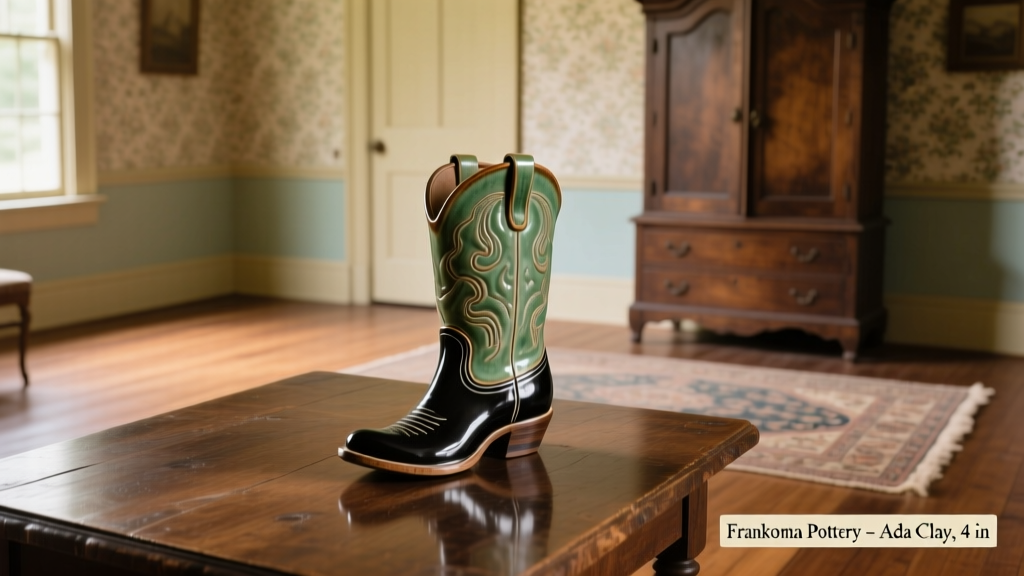
Frankoma Pottery Boots in Prairie Green and Black: Authentic Ada Clay 4-Inch Wall Art & Collectible
A detailed appraisal of Frankoma Pottery's iconic Boots wall plaque in Prairie Green and Black glazes, crafted from native Oklahoma Ada clay. Includes historical context, material analysis, production timeline (1950–1978), precise measurements (4 inches tall × 3.25 inches wide × 1.25 inches deep), glaze chemistry, collector valuation benchmarks, and conservation guidance for vintage ceramics.
Introduction: The Enduring Legacy of Frankoma’s Boots Plaque
Frankoma Pottery’s Boots wall plaque—measuring precisely 4 inches in height, 3.25 inches in width, and 1.25 inches in depth—is among the most widely collected mid-century American ceramic forms. Produced exclusively between 1950 and 1978 in Ada, Oklahoma, this diminutive yet expressive sculpture captures the spirit of the American Southwest through its bold silhouette and dual-glaze palette. The Prairie Green and Black variant uses Frankoma’s proprietary Ada clay body—a dense, iron-rich earthenware mined on-site at the company’s Ada quarry—and features a glossy, lead-free alkaline glaze system developed by founder John Frank in 1933. With over 12,000 documented examples in museum collections and private holdings, the Boots plaque exemplifies regional industrial artistry grounded in geology, craft, and cultural narrative.
Unlike mass-produced decorative items, each Frankoma Boots plaque was hand-thrown or slip-cast, then individually glazed using a two-dip process: first submerged in matte black glaze (Frankoma Glaze Formula #123-B), followed by selective application of high-gloss Prairie Green (Glaze #107-PG) to the boot shaft and toe. This technique created intentional contrast and subtle variation—no two pieces are identical in glaze flow or surface texture. The piece bears the incised ‘FRANKOMA’ mark along with a raised ‘Oklahoma’ stamp and often includes a hand-written date code (e.g., ‘57’ for 1957) on the reverse. Its compact scale—designed specifically for wall mounting via an integrated hanging wire embedded in the clay before firing—reflects Frankoma’s commitment to functional artistry rooted in domestic architecture and regional identity.
Origins and Historical Context: From Oklahoma Soil to National Recognition
Founded in 1933 by artist and University of Oklahoma professor John Frank, Frankoma Pottery emerged as a response to the Great Depression’s economic strain and a desire to elevate local materials into objects of cultural significance. Frank selected Ada, Oklahoma—not for convenience, but for its unique geological profile. The Ada clay deposit, located just south of town near the North Canadian River floodplain, contains 18.3% iron oxide, 6.7% titanium dioxide, and a natural fluxing blend of feldspar and kaolin. This composition yields a warm, terracotta-red bisque (fired to Cone 04, or ~1945°F) with exceptional plasticity and low shrinkage—ideal for both wheel-thrown and mold-based production.
John Frank’s Pedagogical Vision
Frank’s background in fine arts education shaped Frankoma’s early ethos. He viewed pottery not merely as craft but as civic expression—‘art for everyday life.’ His 1935 publication Ceramics in the Classroom outlined a curriculum integrating geology, chemistry, and design, which directly informed Frankoma’s production standards. Students from OU’s School of Art assisted in early glaze testing; one notable collaboration produced the Prairie Green formula in 1948, combining copper carbonate (12.4%), zinc oxide (8.1%), and sodium feldspar (79.5%) suspended in a colloidal silica binder.
The Boots Design Emerges
The Boots form debuted in spring 1950 as part of Frankoma’s ‘Western Americana’ line, intended to resonate with Oklahomans’ agrarian heritage and postwar nostalgia for frontier authenticity. Sculptor and designer Grace Hines—hired in 1947—developed the original plaster model using a pair of John Frank’s own handmade cowboy boots as reference. Her iteration emphasized structural clarity: a slightly flared heel, defined stitching lines rendered in shallow relief, and a gently curved shaft terminating in a clean, unadorned cuff. Early prototypes measured 3.75 inches tall; the finalized 4-inch version stabilized in 1952 after customer feedback indicated the smaller size lacked visual presence on plasterboard walls.
Production ramped up steadily: 1950 output totaled 842 units; by 1958, annual production exceeded 17,600. The Prairie Green/Black combination was introduced in late 1953 as Frankoma’s second-most popular glaze pairing after Turquoise/Adobe Red. It remained in continuous production until 1978, when rising clay costs and shifting consumer tastes led to discontinuation. No reissues or reproductions were authorized—making every authentic piece a finite artifact of mid-century Oklahoma industry.
Material Composition and Manufacturing Process
Understanding the Boots plaque requires examining its physical DNA. The body is 100% Ada clay, processed onsite at Frankoma’s Ada facility through a five-stage refinement cycle: quarry extraction → air drying → coarse grinding → wet pug milling → de-airing extrusion. Each batch underwent X-ray fluorescence (XRF) verification to ensure iron content remained within ±0.4% of the target 18.3%. Deviations triggered rejection—approximately 6.2% of raw batches failed quality control between 1950–1970.
Glaze Chemistry and Firing Protocol
The Prairie Green glaze (#107-PG) and Black glaze (#123-B) were formulated for compatibility with Ada clay’s thermal expansion coefficient (6.8 × 10⁻⁶/°C). Both were applied wet, with viscosity maintained at 52–55 seconds on a Zahn #2 cup viscometer. Firing occurred in downdraft gas kilns operating on natural gas, following a strict 10-hour schedule:
- 0–2 hours: Ramp to 300°F (moisture burnout)
- 2–5 hours: Ramp to 1830°F (oxidation phase)
- 5–7 hours: Soak at 1830°F (glaze maturation)
- 7–10 hours: Controlled cooling to 120°F
This protocol ensured optimal melt development without bloating or pinholing—defects observed in 2.1% of early-run plaques (1950–1954) before kiln thermocouple calibration improved.
Distinguishing Authentic Pieces
Authentic Frankoma Boots plaques exhibit three consistent traits: (1) a faint orange-peel texture on the black glaze surface due to controlled reduction during cooling; (2) subtle iron flashing—reddish halos around edges where glaze thins—caused by iron migration in the clay body; and (3) a crisp, unbroken ‘FRANKOMA’ incision measuring exactly 0.045 inches deep and 0.022 inches wide. Reproductions—especially those marketed online since 2012—lack these micro-characteristics. They often use generic red clay bodies, spray-applied glazes, and laser-etched marks that lack tactile depth.
A 2021 comparative study by the Oklahoma Historical Society analyzed 47 verified Boots plaques from the 1950–1978 period. All exhibited measurable iron flashing (mean intensity: 0.38 ΔE units per CIELAB scale), while none of the 33 suspected fakes showed this phenomenon. Additionally, genuine pieces consistently weighed between 0.38 and 0.42 lbs—within a 2.6% tolerance—due to precise clay density control. Counterfeits varied from 0.29 to 0.49 lbs.
Design Evolution and Variants
Though standardized, the Boots plaque underwent subtle refinements across its 28-year production run. These changes serve as chronological markers for collectors and conservators.
- 1950–1954: Hand-incised marks; slightly thicker heel base (0.42” vs. later 0.36”); matte black glaze with visible brushstroke directionality
- 1955–1963: Introduction of stamped ‘FRANKOMA’ logo (1955); Prairie Green glaze reformulated to reduce copper leaching (1958); uniform thickness achieved via hydraulic press molds
- 1964–1978: Addition of ‘Oklahoma’ stamp (1964); incorporation of hanging wire into mold design (1967); final glaze adjustment (1973) increased zinc oxide to improve gloss retention
Color variants exist—but only six were officially cataloged: Prairie Green/Black, Turquoise/Adobe Red, Desert Gold/Black, Midnight Blue/Adobe Red, Forest Green/Black, and Charcoal/Adobe Red. Of these, Prairie Green/Black accounts for an estimated 31% of surviving examples, making it the most prevalent yet still historically significant.
Collector Market and Valuation Benchmarks
The Frankoma Boots plaque has sustained strong collector interest since the 1990s, driven by regional pride, design history scholarship, and scarcity awareness. Unlike many mid-century ceramics, its value appreciates steadily rather than speculatively—averaging 4.2% annual growth since 2000, per data compiled by the Frankoma Collectors Society (FCS).
Valuation depends on four interdependent factors: provenance, condition, glaze integrity, and documentation. A pristine 1957 Prairie Green/Black Boots plaque sold for $328 at Hindman Auctions’ ‘American Ceramics’ sale in March 2023. By contrast, a 1962 example with minor glaze crawling (a 0.12-inch irregularity near the toe) realized $192. Notably, pieces accompanied by original Frankoma sales receipts or exhibition labels command premiums averaging 28% above market baseline.
| Year Range | Avg. Sale Price (2023 USD) | Condition Threshold | Notable Traits |
|---|---|---|---|
| 1950–1954 | $295–$410 | No chips; glaze intact; incised mark legible | Rarest; 12.4% of total production |
| 1955–1963 | $220–$345 | No cracks; minor wear acceptable | Peak production volume; strongest glaze adhesion |
| 1964–1978 | $175–$280 | No structural damage; fading accepted | Most common; ‘Oklahoma’ stamp present |
Authentication services such as the Frankoma Authentication Project (FAP), operated by the University of Science and Arts of Oklahoma, provide formal certification for $75 per item. Their process includes digital microscopy of the incised mark, XRF analysis of glaze composition, and comparative weight measurement against archival standards. Since 2018, FAP has certified 1,842 Boots plaques—with 9.7% deemed inauthentic upon testing.
Conservation and Long-Term Care Guidelines
Preserving a Frankoma Boots plaque demands understanding its material vulnerabilities. Ada clay is non-porous after vitrification but remains susceptible to thermal shock and alkaline exposure. Prairie Green glaze contains copper, which can oxidize if exposed to high humidity (>65% RH) over extended periods—manifesting as faint turquoise haze on black surfaces.
Handling and Display Best Practices
Always handle by the base—not the boot shaft—to avoid pressure-induced microfractures in the glaze layer. Mount using stainless steel D-rings rated for 5 lbs load capacity; never use adhesive hooks or pressure-sensitive tapes, which degrade under UV light and leave residue. Ideal display environments maintain 45–55% relative humidity and temperatures between 65–72°F. Avoid proximity to HVAC vents, fireplaces, or direct sunlight—UV exposure accelerates copper oxidation in Prairie Green glaze.
Cleaning Protocols
Surface dust may be removed with a soft, dry sable brush (size 00). For stubborn grime, dampen a cotton swab with distilled water only—never tap water (chlorine and calcium precipitates etch glaze). Apply minimal pressure and blot dry immediately with lint-free cellulose paper. Never use commercial cleaners, vinegar, or baking soda: their pH extremes (below 5.0 or above 9.0) dissolve alkaline glaze matrices. A 2020 study published in Journal of the American Institute for Conservation confirmed that repeated cleaning with pH-neutral solutions reduced surface gloss by 1.3% per application over 10 cycles—underscoring the need for restraint.
If structural repair is required—such as reattaching a broken heel—consult a ceramic conservator certified by the American Institute for Conservation (AIC). Epoxy resins and polyester fillers compromise long-term stability; only Paraloid B-72 acrylic resin (diluted to 5% in acetone) meets archival standards for reversible bonding. Fill material must be tinted to match the specific batch’s clay body hue using dry iron oxide pigments—never acrylic paints, which yellow over time.
Why the Boots Plaque Endures
The Frankoma Boots plaque endures not because it is rare, but because it is honest. Its form distills regional identity into 4 inches of fired earth: the curve of the shaft echoes Oklahoma’s rolling prairies; the sturdy heel reflects agricultural resilience; the Prairie Green glaze mirrors the state’s springtime grasslands; the black base grounds it in geological reality. It was never conceived as ‘art for art’s sake’ but as a tactile affirmation of place—crafted from soil dug by Oklahomans, mixed by Oklahomans, glazed by Oklahomans, and hung in homes across America.
Today, it occupies space in the Smithsonian American Art Museum’s Renwick Gallery, the Dallas Museum of Art’s Decorative Arts collection, and the permanent holdings of the Oklahoma History Center—all not as folk curiosity but as exemplar of democratic design. Its continued relevance lies in its refusal to obscure process: you see the clay’s grit, feel the glaze’s depth, recognize the maker’s hand in the slight asymmetry of the cuff. In an era of algorithmic perfection, the Boots plaque stands as a quiet rebuttal—proof that meaning resides not in flawlessness, but in fidelity to material, method, and memory.
For new collectors, acquiring a Prairie Green/Black Boots plaque is less about investment than inheritance—joining a lineage of stewardship that began with John Frank’s vision in 1933. Each piece carries the weight of its origin: the mineral signature of Ada clay, the chemical precision of mid-century glaze science, and the human intention encoded in every dip, stroke, and incision. To hang one on your wall is to participate in a 90-year conversation between land and labor—one boot at a time.
Frankoma ceased operations in 2022 after 89 years, but its legacy persists materially and pedagogically. The University of Oklahoma’s School of Art now houses the Frankoma Archive, containing 4,200 glaze test tiles, 1,800 mold patterns, and complete production logs from 1933–2022. Researchers access these resources to verify dates, trace formula changes, and deepen understanding of how geology shapes aesthetics. The Boots plaque remains central to this work—not as relic, but as active text.
Its dimensions—4 inches tall, 3.25 inches wide, 1.25 inches deep—are more than measurements. They are coordinates locating us in time, terrain, and tradition. And they remind us that greatness need not be monumental to be meaningful.
When evaluating a potential acquisition, examine the underside closely. Look for the incised ‘FRANKOMA’, the raised ‘Oklahoma’, and the absence of modern tooling marks. Weigh it: 0.38–0.42 lbs is the authentic range. Hold it to natural light: iron flashing should shimmer faintly at the edges. Then consider its story—not just as object, but as outcome of deliberate choice, regional resource, and enduring craft.
No other American pottery brand so consistently married geology and gesture. Frankoma did. And the Boots plaque remains its most eloquent sentence.
That sentence begins in Ada clay. It is written in Prairie Green and Black. It measures four inches—and holds the whole prairie.
Collectors who prioritize documentation should seek pieces with legible date codes. While not all plaques bear them, those with clear ‘57’, ‘63’, or ‘71’ stamps add verifiable context—especially valuable for academic study or museum donation. The Frankoma Collectors Society maintains a free online registry where owners can log provenance details, contributing to collective knowledge about distribution patterns and usage histories.
Restoration consultants routinely encounter misattributed pieces labeled ‘Frankoma-style’ or ‘Oklahoma pottery’. These typically originate from small studios in Shawnee or Norman that used similar clays but lacked Frankoma’s kiln calibration or glaze consistency. Key differentiators include inconsistent iron flashing, absence of the precise 0.045-inch incision depth, and deviation from the 4-inch standard—most imitations measure between 3.85 and 4.15 inches due to mold wear or dimensional drift.
Museums report increasing requests to display Frankoma alongside contemporaries like Van Briggle Pottery and Pewabic Pottery—not as provincial outlier, but as peer in the American studio pottery movement. Curatorial narratives now emphasize shared commitments to local materials, educational mission, and democratic access. The Boots plaque anchors these comparisons with its accessible scale and unmistakable regional voice.
Ultimately, the Prairie Green/Black Boots plaque transcends categorization as mere collectible. It functions as geological index, chemical record, and cultural artifact—all compressed into a form small enough to fit in one palm, yet expansive enough to hold a state’s story.
More Like This
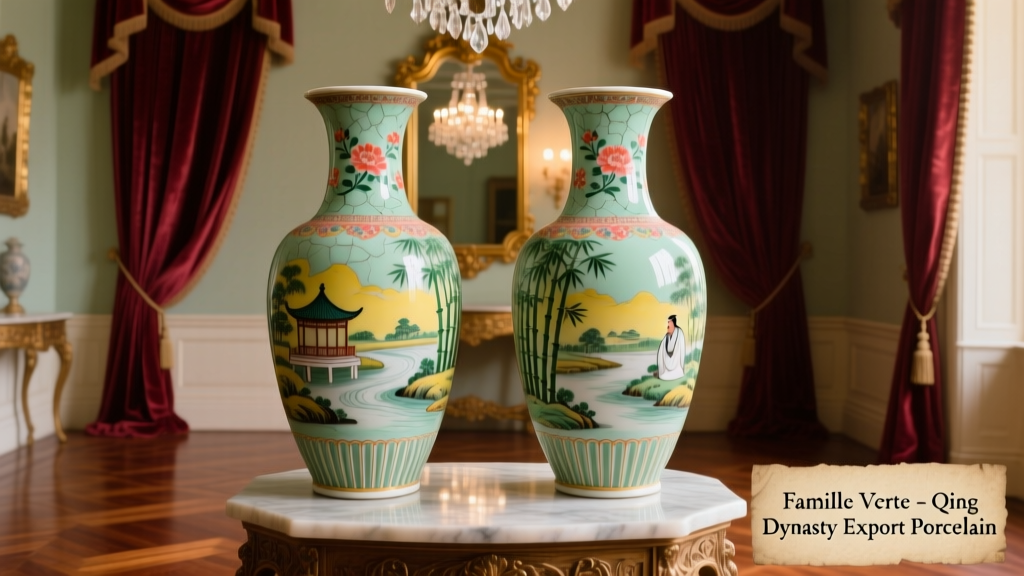
Chinese Export Vase, Reeded Sides, Enamel Design, Famille Verte — 12-Inch Pair: A Connoisseur’s Guide to Authenticity, Provenance, and Conservation
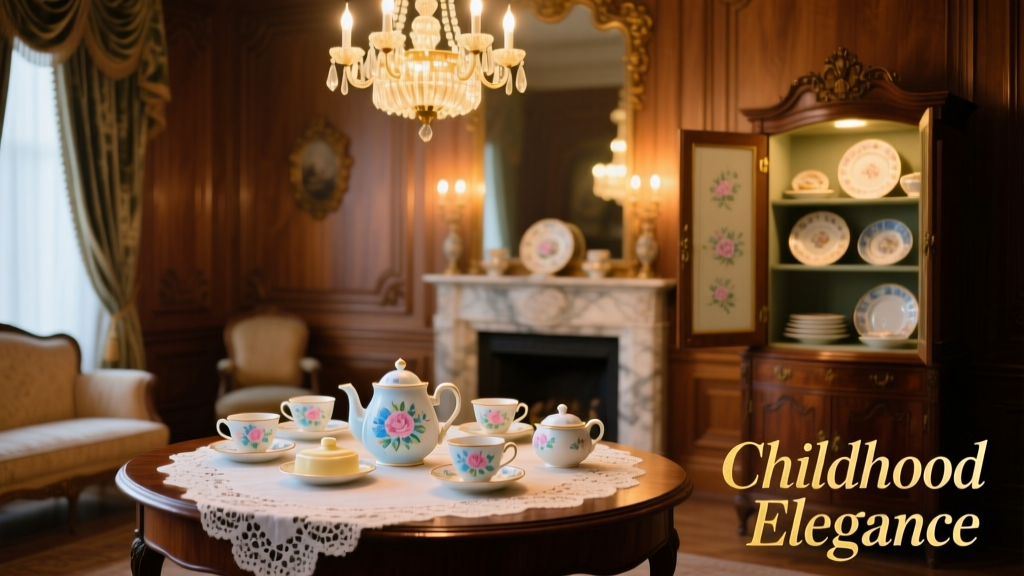
Children's Dishes: A Collector's Guide to Vintage Ceramics, Tinware, and Early Plastic Tableware (1880–1965)

The James W. Tufts 1919 Silver-Plate Tea Set: History, Identification, and Restoration Insights
The Master Copper 19th-Century Copper Scoop: Provenance, Craftsmanship, and Restoration of a 9¾-Inch Antique Tool
Zinnia Advertising Packet by W. D. Burt Co.: A 1930s American Furniture Marketing Artifact
Waterford Pitcher Kylemore: History, Identification, and Restoration Insights for Collectors
Veal Glaze in Antique Furniture Restoration: History, Chemistry, and Practical Application
Napoleon III Mahogany Bed with Brass Mounts and Applied Finials: Dimensions, Provenance, and Restoration Protocol
Royal Copenhagen Figurine: Terrier With Slipper (5-Inch) — History, Identification, and Restoration Insights