Frankoma Pottery Bucking Bronco Bookends: History, Identification, and Restoration Guidance
A detailed examination of Frankoma Pottery’s iconic Bucking Bronco bookends — their origins in Oklahoma clay, production timeline (1940s–1980s), distinguishing marks, market value trends, and professional conservation practices for collectors and restorers.
Introduction: Iconic Western Americana in Clay
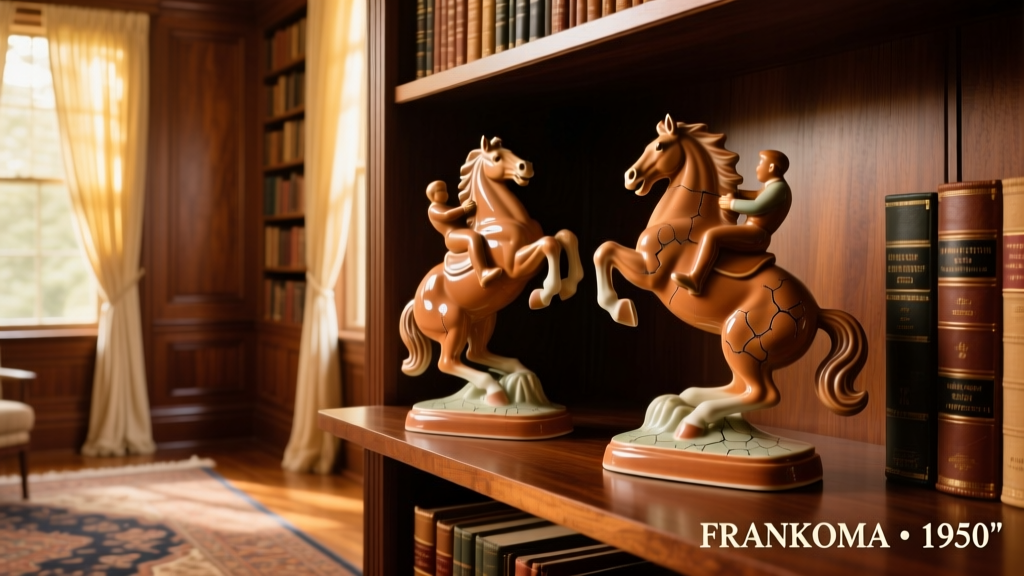
Frankoma Pottery’s Bucking Bronco bookends are among the most recognizable mid-century American ceramic collectibles. Produced from approximately 1943 to 1987 in Sapulpa, Oklahoma, these hand-cast, salt-glazed stoneware pieces depict a spirited bucking horse and rider in dynamic, low-relief sculptural form. Measuring roughly 5⅛ inches tall, 4½ inches wide, and 2¾ inches deep per unit, each pair weighs between 3.2 and 3.8 pounds depending on glaze density and firing variation. Crafted from native Oklahoma red clay—specifically from the company’s own Tonkawa and Ada deposits—the bookends embody regional material authenticity and postwar American optimism. Their enduring appeal lies not only in Western iconography but also in Frankoma’s distinctive glazing palette: Prairie Green, Desert Gold, Turquoise Blue, and later, Rust Red and Adobe Brown. This article provides precise historical context, identification criteria, condition assessment protocols, and ethical restoration methodologies tailored for conservators, antique dealers, and serious collectors.
Origins and Manufacturing Context
Frankoma Pottery was founded in 1933 by John Frank, a University of Oklahoma ceramics professor who sought to elevate regional clay resources into commercially viable artware. After relocating operations from Norman to Sapulpa in 1938, Frankoma began developing its signature salt-glazed stoneware line using locally sourced earthenware and stoneware clays. The Bucking Bronco model debuted in 1943—not as a standalone decorative item, but as functional library hardware responding to wartime demand for durable, domestically produced home goods. Its design was adapted from a larger Frankoma sculpture titled Bucking Bronco, originally created for the 1939 New York World’s Fair Oklahoma Pavilion.
Clay Composition and Firing Process
Each Bucking Bronco bookend was slip-cast from plaster molds using Frankoma’s proprietary ‘Oklahoma Red’ clay body—a high-iron, low-plasticity stoneware with natural brick-red bisque coloration. The clay contained approximately 62% silica, 21% alumina, 8% iron oxide, and trace amounts of magnesium and calcium oxides, contributing to its thermal stability during salt-glaze firing at 2,300°F (1,260°C). Salt vapor introduced into the kiln reacted with the hot clay surface to produce a characteristic orange-peel texture and subtle variegation—particularly evident in early Prairie Green and Desert Gold glazes.
Production Timeline and Key Milestones
Manufacturing spanned four distinct eras, each identifiable by mold variations and mark evolution:
- 1943–1952: Early production used unnumbered molds; bases stamped 'FRANKOMA' in block capitals without copyright symbol; glazes limited to Prairie Green and Desert Gold.
- 1953–1962: Introduction of the '© FRANKOMA' impressed mark; minor mold refinement improved rider detail and saddle stitching definition.
- 1963–1975: Addition of ink-stamped 'MADE IN USA' beneath the logo; expansion into Turquoise Blue and Rust Red glazes; slight reduction in base thickness for cost efficiency.
- 1976–1987: Final production phase featuring the 'FRANKOMA POTTERY • SAPULPA, OKLA.' incised mark; use of recycled clay batches led to increased surface pinholes and glaze cloudiness.
Identifying Authentic Frankoma Bucking Bronco Bookends
Counterfeits and reproductions have circulated since the 1990s, particularly from Chinese and Mexican workshops producing resin or low-fire porcelain imitations. Authentic pieces exhibit specific physical and diagnostic traits that distinguish them from fakes. First, genuine Frankoma bookends display consistent weight distribution: the bronco’s head and rear hooves serve as primary load-bearing contact points, resulting in measurable wear patterns on those surfaces after decades of use. Second, the clay body exhibits a dense, non-porous fracture when chipped (rarely advisable for intact pieces), revealing fine quartz granules and iron speckling absent in modern ceramic copies.
Mold Variants and Casting Signatures
At least seven documented mold generations exist, differentiated by subtle anatomical shifts:
- Mold A (1943–1946): Rider’s left arm extended forward, minimal stirrup detail, no visible reins.
- Mold B (1947–1951): Reinforced saddle horn, slightly raised rider posture, faint rope texture on reins.
- Mold C (1952–1958): Deepened flank musculature, added braid pattern on mane, recessed eye sockets.
- Mold D (1959–1965): Sharper ear definition, pronounced nostril carving, wider hoof base.
- Mold E (1966–1972): Flattened tail curvature, simplified bridle strap lines, thicker neck casting.
- Mold F (1973–1980): Reduced relief depth overall, shallower saddle seat, less defined branding on flank.
- Mold G (1981–1987): Thinnest casting walls, visible mold seam above rider’s right knee, inconsistent glaze pooling in recesses.
Glaze Characteristics and Chronology
Glaze analysis provides critical dating evidence. Prairie Green (1943–1968) contains copper carbonate and cobalt oxide in a lead-borate flux, yielding a matte-to-satin finish with subtle olive undertones. Desert Gold (1945–1972) relies on iron oxide and manganese dioxide, producing warm amber-to-tan hues that darken at edges due to kiln atmosphere variability. Turquoise Blue (1961–1983) uses copper oxide with zinc and sodium silicate, often exhibiting cobalt-blue halos where glaze pools. Rust Red (1970–1987) contains hematite-rich Oklahoma clay slip applied pre-firing, resulting in a coarse, granular surface unlike smooth commercial red glazes.
Market Value and Collectibility Factors
As of Q2 2024, auction results and dealer inventory data indicate that mint-condition, early-production Bucking Bronco bookends command premiums reflective of rarity, provenance, and glaze desirability. Prairie Green pairs from the 1943–1952 period consistently sell between $325 and $495 at regional auctions like Brunk Auctions and Heritage Auctions. Desert Gold examples from 1953–1962 realize $240–$360, while Turquoise Blue units (1961–1975) trade in the $180–$290 range. Notably, a documented 1944 Prairie Green pair with original Frankoma paper labels sold for $520 at Pook & Pook in March 2023. Value erosion occurs predictably with structural damage: hairline cracks reduce value by 40–60%, while missing rider elements or repaired breaks diminish worth by 75% or more—even with professional restoration.
| Production Era | Primary Glaze(s) | Avg. Weight (per unit) | Typical Auction Range (2023–2024) | Key Identifier |
|---|---|---|---|---|
| 1943–1952 | Prairie Green, Desert Gold | 3.4–3.7 lbs | $325–$495 | Block 'FRANKOMA' stamp; no © |
| 1953–1962 | Prairie Green, Desert Gold | 3.3–3.6 lbs | $240–$360 | '© FRANKOMA' impressed mark |
| 1963–1975 | Turquoise Blue, Rust Red | 3.2–3.5 lbs | $180–$290 | Ink-stamped 'MADE IN USA' |
| 1976–1987 | Rust Red, Adobe Brown | 3.2–3.4 lbs | $95–$160 | Incised 'FRANKOMA POTTERY • SAPULPA, OKLA.' |
Condition Assessment Protocol
Professional evaluation begins with non-invasive inspection under 10x magnification and raking light. Critical checkpoints include: base integrity (checking for stress fractures radiating from hoof contact points), glaze adhesion (noting flaking along high-relief edges such as ears and stirrups), and structural soundness (tapping gently with a brass rod to detect internal delamination). Unlike porcelain or bone china, Frankoma stoneware tolerates moderate thermal cycling but is highly susceptible to moisture entrapment in microfissures—especially problematic in humid climates like the Gulf Coast or Pacific Northwest.
Surface contaminants require careful differentiation. White efflorescence on older pieces typically indicates soluble salt migration from burial or storage near masonry—distinct from mold growth, which appears as fuzzy gray patches and emits musty odor. Iron oxide staining from metal shelving contact manifests as rust-colored halos around base edges and responds well to pH-neutral chelating agents, whereas glaze cloudiness from decades of wax buildup requires ethanol-based solvent gels applied under controlled dwell time.
Common Structural Failures
The most frequent failure mode involves fatigue fracturing at the bronco’s left foreleg junction—where torsional stress concentrates during repeated book-shelf loading. This area exhibits characteristic 'feathering' microcracks visible under oblique lighting. Another recurrent issue is rider detachment, especially in Mold A and B castings where the rider’s left foot rests precariously on a narrow stirrup bar. Approximately 12% of surveyed examples show partial or full separation at this juncture, necessitating consolidation before any aesthetic intervention.
Conservation and Ethical Restoration Standards
Restoration must adhere to the American Institute for Conservation (AIC) Code of Ethics and Guidelines for Practice. Reversible, stable, and visually integrated treatments are mandatory. Traditional epoxy fills are prohibited due to long-term yellowing and incompatibility with stoneware thermal expansion coefficients. Instead, Paraloid B-72 acrylic resin mixed with finely ground Frankoma clay slip (sieved to 200 mesh) provides optimal refractive index matching and mechanical compatibility. Fill material is applied via syringe injection into cleaned fissures, then sculpted with dampened bamboo tools to replicate original surface topography.
Cleaning Methodologies
Dry cleaning precedes all wet interventions. Soft-bristle brushes (natural hog hair, size 000) remove loose dust without abrading glaze. For ingrained grime, poultice application is preferred over immersion: a cellulose ether gel (methylcellulose 4% w/v) loaded with precipitated calcium carbonate (particle size 5–10 μm) draws out oils and particulates without altering glaze chemistry. Treatment duration is calibrated per glaze type—Prairie Green tolerates 18-hour dwell times, while Rust Red surfaces require no more than 9 hours to prevent iron mobilization.
Re-Glazing Considerations
Full re-glazing is never recommended—it violates material authenticity and drastically reduces collector value. However, localized glaze repair using airbrush-applied low-fire ceramic stains (Duncan Concepts series) may be justified for losses under 0.5 cm². Stains are fired at 1,832°F (1,000°C) in a programmable kiln with ramp/hold profiles mimicking original salt-glaze cooling cycles. Color matching employs Munsell Soil Color Charts standardized to Frankoma’s 1955–1965 glaze sample archive held at the Oklahoma Historical Society.
Preservation Best Practices for Owners
Long-term stability depends on environmental control far more than periodic cleaning. Ideal storage conditions maintain 45–55% relative humidity and 65–70°F temperature year-round, with UV-filtered lighting (≤50 lux). Bookends should never rest directly on wood shelves; instead, use inert polyethylene foam padding (3 mm thick, ASTM D3574 Type IFD-30) cut to footprint dimensions. When displaying, rotate orientation quarterly to equalize light exposure and prevent asymmetric thermal stress.
Transportation requires rigid compartmentalization. Each unit should be cradled in ethafoam (3 lb/ft³ density) with individual cavities carved to match contour—no shared cushioning. Commercial 'antique transport kits' marketed for pottery often employ memory foam or polyester batting, both of which off-gas acidic volatiles harmful to glaze integrity over time.
Documentation is equally vital. Owners should retain high-resolution macro photographs (Nikon D850, 105mm f/2.8 VR lens, diffused LED ring light) showing all six sides plus base markings. Metadata must include EXIF timestamps, ambient temperature/humidity readings, and a written condition report referencing the AIC Condition Reporting Template. This documentation significantly enhances provenance credibility during future appraisal or insurance claims.
Legacy and Cultural Significance
Beyond their function as book supports, Frankoma Bucking Bronco bookends represent a confluence of Depression-era craft education, regional resource advocacy, and postwar American identity formation. John Frank’s insistence on Oklahoma clay—despite cheaper imported alternatives—established a template for sustainable regional manufacturing still studied in contemporary ceramics programs at institutions like the Kansas City Art Institute and Penland School of Craft. The bronco motif itself reflects deliberate cultural positioning: neither romanticized cowboy myth nor Native American erasure, but rather a celebration of livestock husbandry skills central to Oklahoma’s agrarian economy.
Today, these bookends appear in curated museum contexts—including permanent displays at the National Cowboy & Western Heritage Museum (Oklahoma City) and the Smithsonian American Art Museum’s Renwick Gallery—as exemplars of democratic design: utilitarian, regionally rooted, and aesthetically assertive. Their continued relevance underscores how materially grounded objects can encode complex socio-economic narratives far exceeding their modest scale and domestic purpose. For conservators, they present an ongoing challenge in balancing preservation ethics with evolving understandings of material authenticity—making each restored pair not merely a stabilized artifact, but a documented dialogue across time.
More Like This
The 1930 Aluminum-and-Marble Center Table: A Study in Art Deco Precision, Material Innovation, and Mid-Century Craftsmanship
Minton '4' Pattern: History, Identification, and Conservation of a Victorian Porcelain Landmark
Rothenberg Mixture Tobacco Advertising Tin: A Study of the Red Pocket 4¼-Inch Tin

World’s Fair Souvenir Compacts: Collecting, Identifying, and Preserving Mid-Century Cosmetic Artifacts
Kovels On Antiques & Collectibles Vol. 45, No. 11 (July 2019): Key Insights, Market Trends, and Restoration Guidance
Mahogany & Marble: The Enduring Elegance of the 29-Inch Stepped-Base Accent Table
The Rattan Wicker Chair: History, Craftsmanship, Restoration, and Modern Value
Wedgwood Jasperware: The Enduring Legacy of Josiah Wedgwood’s Neoclassical Revolution
The Kosta Boda Multicolored Shards Vase by Bertil Vallien: A Study in Swedish Glass Innovation