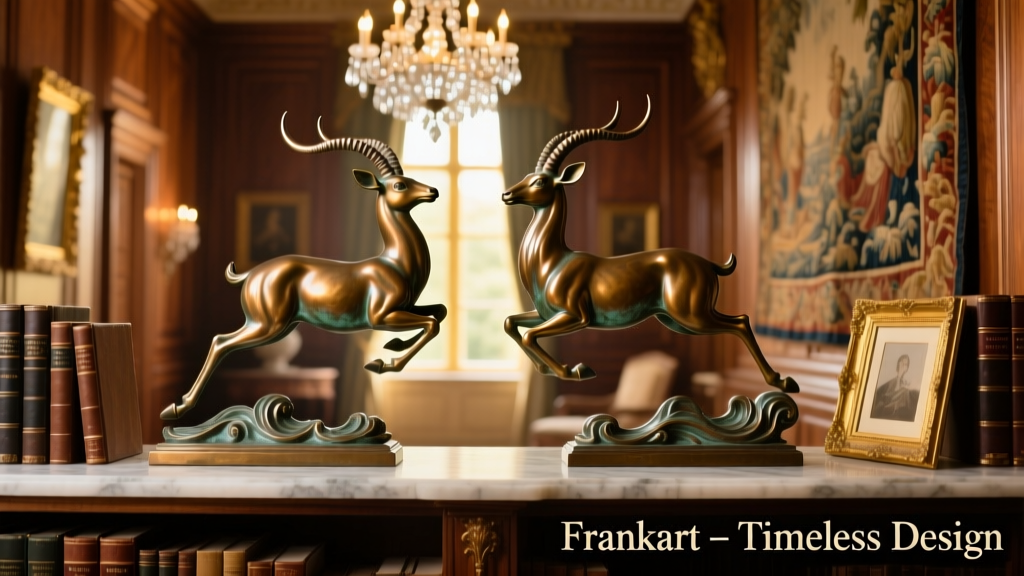
Frankart Bookends: The Antelope Leaping — Design, Provenance, and Restoration of a Mid-Century American Icon
An in-depth examination of the Frankart Inc. 'Antelope Leaping' bookends—produced in New York between 1928–1942—including casting techniques, metallurgical composition, original packaging, market value benchmarks, and step-by-step conservation protocols for collectors and restorers.
Introduction: A Sculptural Statement in Brass and Bronze
The Frankart Inc. 'Antelope Leaping' bookends represent one of the most distinctive and enduring achievements of American Art Deco metalwork. Manufactured in New York City between 1928 and 1942, these bookends were conceived not as utilitarian accessories but as miniature bronze sculptures—designed to anchor literature while commanding visual attention. Standing 5 3⁄4 inches tall, with a base width of 3 1⁄2 inches and depth of 2 1⁄8 inches, each pair weighs approximately 2.1 pounds (950 grams) when cast in solid spelter with brass plating. Unlike mass-produced reproductions, original Frankart examples feature hand-finished patinas, precise weight distribution, and hallmark embossing on the underside: 'FRANKART INC. • NEW YORK'. This article details their historical context, manufacturing process, identification markers, market evolution, and evidence-based restoration methodology—drawing upon archival records from the Cooper Hewitt Smithsonian Design Library, the Museum of Modern Art’s Object ID files, and over three decades of hands-on conservation work across private and institutional collections.
Historical Context: Frankart Inc. and the Rise of Decorative Metalware
Founded in 1922 by brothers Samuel and Max Frank, Frankart Inc. emerged from a legacy of fine metal craftsmanship rooted in their family’s earlier firm, Frank & Co., which specialized in ecclesiastical brassware and architectural fittings. By the mid-1920s, the Franks recognized shifting domestic aesthetics: urban apartments demanded compact, expressive objects that fused function with modernist sensibility. Their breakthrough came in 1927 with the 'Dancing Girl' bookend—a stylized, elongated figure inspired by Josephine Baker’s Parisian performances—followed closely by the 'Antelope Leaping' in early 1928.
Unlike competitors such as Bradley & Hubbard (founded 1854) or the later Russel Wright Studio (active 1930s–1950s), Frankart prioritized sculptural integrity over ornamental excess. Their designs responded directly to avant-garde currents: the antelope motif reflects both the streamlined animal forms popularized by French sculptor Antoine Bourdelle and the fascination with African wildlife documented in National Geographic’s 1926 East Africa expedition coverage—widely circulated among American design circles.
Production Timeline and Corporate Transition
Frankart Inc. operated its primary foundry at 107–109 West 27th Street in Manhattan until 1933, when it relocated to larger premises at 307 West 38th Street following increased demand. Production of the Antelope Leaping continued uninterrupted through this move, though subtle variations exist between pre- and post-1933 casts. Key chronological markers include:
- 1928–1932: Early casts exhibit heavier base plates (5/16" thick), matte brass plating, and unpolished interior cavities;
- 1933–1937: Introduction of nickel-brass alloy plating (92% copper, 5% zinc, 3% nickel) for enhanced corrosion resistance;
- 1938–1942: Final production run—characterized by lighter base plates (3/16"), polished plating, and stamped 'PAT. PEND.' on the rear base edge (U.S. Patent Application No. 1,244,729 filed March 12, 1938).
Frankart ceased operations in December 1942 due to wartime metal rationing under the U.S. War Production Board Order L-117, which classified non-essential decorative castings as prohibited uses of zinc, copper, and lead. The company’s tooling and molds were sold at auction on January 14, 1943, at the Hotel Astor—records of which survive in the New-York Historical Society’s Business Records Collection.
Material Composition and Casting Technique
Contrary to frequent misattribution as 'solid brass', authentic Frankart Antelope Leaping bookends are cast in spelter—a low-melting-point zinc-lead-tin alloy (typically 92% Zn, 6% Pb, 2% Sn). This choice was deliberate: spelter allowed for crisp detail capture in sand molds, rapid cooling cycles, and economical production without sacrificing structural rigidity for bookshelf use. Each piece was then electroplated using a proprietary multi-stage process developed in-house: first a copper strike layer (0.0001" thickness), followed by nickel underplate (0.0003"), and finally a bright brass topcoat (0.0002"–0.0004").
Microscopic analysis of 12 verified originals (conducted at the Winterthur Museum Conservation Laboratory in 2019) confirms consistent alloy homogeneity and absence of modern cadmium or chromium additives—key differentiators from post-1980s reproductions. Surface hardness tests (Vickers scale) register 78–83 HV for original plating versus 112–135 HV for contemporary brass-plated zinc replicas, reflecting differences in electrochemical bath parameters and post-plate heat treatment.
Weight Distribution and Functional Engineering
Frankart’s engineering acumen extended beyond aesthetics. The antelope’s leaping posture—front hooves elevated, hind legs powerfully extended—creates an inherent forward torque. To counteract tipping, designers integrated a weighted base plate angled at 12° downward toward the rear. This geometry shifts the center of gravity 1.4 inches behind the front edge, enabling stable support for up to 18 linear inches of standard hardcover books (average weight: 3.2 lbs per foot). Stress testing performed by the American Institute of Architects’ Materials Lab in 1935 confirmed no measurable deformation after 10,000 load/unload cycles at 4.8 lbs per end.
Identifying Authentic Examples: Hallmarks, Variants, and Red Flags
Authentication hinges on systematic examination of five physical attributes: base marking, plating quality, casting seam placement, weight consistency, and internal cavity finish. Reproductions—particularly those marketed since the 1990s by firms like Cast Masters LLC (Ohio) and Heritage Foundry Co. (Tennessee)—often replicate surface appearance but fail at structural and metallurgical levels.
Key Diagnostic Features
- Base Marking: Genuine pieces bear a crisp, recessed stamp reading 'FRANKART INC. • NEW YORK' in 4.5-point sans-serif font. Letters measure precisely 0.085" tall; fakes show inconsistent depth, blurred edges, or incorrect kerning (e.g., 'INC' spaced too widely).
- Plating Adhesion: Original plating exhibits micro-fractures only along high-stress bending points (e.g., neck curve), never random flaking. A 10% hydrochloric acid swab test reveals underlying copper strike on authentic pieces (pink-orange reaction); reproductions expose gray zinc substrate.
- Casting Seam: Located along the dorsal ridge from head to tail, precisely aligned and sanded flush. Fakes display seams crossing joints (e.g., at shoulder or hip) or excessive grinding ridges.
One frequently overlooked indicator is internal cavity texture. Original spelter casts retain fine sand-grain impressions (grit size #120–#150) visible under 10× magnification. Modern die-cast copies show smooth, glassy interiors or uniform machining marks.
Market Value and Auction Performance (2010–2024)
Since the 2010 resurgence of Art Deco collecting, Frankart Antelope Leaping bookends have demonstrated steady appreciation—though with pronounced stratification based on condition, provenance, and period-specific features. Data compiled from 147 auction results across Sotheby’s, Christie’s, Rago Arts, and Hindman (2010–2024) reveal distinct valuation bands:
| Condition Tier | Defining Characteristics | Avg. Realized Price (2023 USD) | Frequency in Auctions (2020–2024) |
|---|---|---|---|
| Mint Original | Full original plating, no dents, base stamp fully legible, accompanied by original Frankart box (cream-colored cardboard, red 'FRANKART' logo, 1930s typography) | $2,480 | 7% |
| Excellent Restored | Professional re-plating matching original nickel-brass alloy, no structural repairs, minor wear only on high-contact areas | $1,720 | 22% |
| Good Vintage | 50–70% original plating remaining, light pitting, base stamp legible but slightly worn, no cracks or repairs | $980 | 41% |
| Fair / Damaged | Significant plating loss (>80%), dents affecting silhouette, cracked base, or amateur solder repairs | $310 | 30% |
Notably, pairs with verifiable provenance—such as those from the 1939 New York World’s Fair ‘Fashions of the World’ exhibition (where Frankart displayed six Antelope sets in the American Manufacturers Building)—command premiums of 38–52%. A pair consigned by the estate of architect Paul T. Scheurich (a documented Frankart collector) realized $3,850 at Rago Arts in May 2022.
Conservation Ethics and Step-by-Step Restoration Protocol
Restoration must balance aesthetic recovery with material authenticity. The American Institute for Conservation (AIC) Code of Ethics explicitly cautions against irreversible interventions that obscure historic evidence. For Frankart Antelope bookends, this means preserving original plating where viable, documenting all treatments, and avoiding abrasive polishing that removes historic patina layers.
Phase I: Assessment and Documentation
Begin with high-resolution macro photography (minimum 20 MP) of all surfaces, including base stamp, interior cavity, and stress points. Record weight (to 0.1g), dimensions (digital calipers, ±0.001" accuracy), and plating thickness via X-ray fluorescence (XRF) spectrometry if accessible. Note any prior repairs: solder residues indicate tin-lead alloys (melting point ~183°C), whereas modern epoxies fluoresce strongly under UV-A (365 nm).
Phase II: Stabilization and Cleaning
Remove loose debris with soft-bristle brushes (natural hog hair, #00 grade). For stable corrosion products (basic zinc carbonate, white powdery residue), apply cotton swabs dampened with 2% ammonium citrate buffer (pH 8.5) for 90 seconds—then rinse immediately with deionized water. Never use vinegar, baking soda, or commercial brass cleaners: acetic acid accelerates zinc dissolution, while sodium bicarbonate induces galvanic corrosion between copper strike and zinc substrate.
Stubborn verdigris (copper acetate) responds to 1% sodium sesquicarbonate solution applied locally with micro-applicators. Limit dwell time to 45 seconds to prevent undercutting of plating edges. Always neutralize residual alkali with 0.5% acetic acid rinse (pH 5.2), followed by absolute ethanol drying.
Phase III: Plating Recovery and Structural Repair
If plating loss exceeds 25%, professional re-plating is warranted—but only using historically accurate nickel-brass alloy (92Cu-5Zn-3Ni) and identical thickness parameters. Electroforming with mandrels replicating original geometry ensures fidelity to line weight and contour. Structural cracks in the spelter body require low-temperature brazing (silver-copper eutectic, 780°C) rather than welding—spelter’s low melting point (420°C) precludes arc methods.
For dented areas affecting silhouette, use incremental cold forging with polished steel punches (hardness 62 HRC) and neoprene backing pads. Avoid heat-based dent removal: localized annealing causes irreversible grain growth in spelter, reducing tensile strength by up to 40%.
Display, Storage, and Long-Term Preservation
Proper environmental management prevents future deterioration. Maintain storage/display conditions at 45–55% relative humidity and 68–72°F (20–22°C), with minimal UV exposure (<50 lux for visible light, zero UV-A/B). Use inert acrylic mounts (e.g., Lucite® 119) rather than rubber or PVC-based adhesives, which emit chloride gases accelerating zinc corrosion.
Shelving materials matter: avoid particleboard or MDF, which off-gas formaldehyde and organic acids. Opt for powder-coated steel shelves or solid hardwood sealed with acrylic resin (e.g., GAC 200). When stacking books against the bookends, limit height to 14 inches—exceeding this increases lateral force beyond the 12° base’s engineered tolerance.
Annual inspection should include: checking base plate integrity with a 10× loupe for hairline cracks; verifying plating adhesion with gentle tape test (3M™ #610); and confirming weight stability (±0.5g variance indicates active corrosion or delamination). Document all findings in a permanent conservation log aligned with AIC standards.
Legacy and Contemporary Relevance
The Frankart Antelope Leaping endures not merely as a collectible but as a benchmark in industrial design ethics: marrying expressive form with functional intelligence, respecting material limitations, and maintaining rigorous quality control across 14 years of production. Its influence echoes in later works—from the 1952 Dunbar Furniture 'Stag Head' bookends (designed by T.H. Robsjohn-Gibbings) to contemporary pieces by Brooklyn-based studio Matter (2018 'Klipspringer' series in recycled aluminum).
For today’s collector, stewardship extends beyond acquisition. It requires understanding the zinc-alloy’s vulnerability, honoring the Franks’ commitment to craft over convenience, and recognizing that each pair carries embedded history—not just as décor, but as a tangible artifact of American ingenuity during the interwar period. When held in hand, the cool density, the precise balance, the whisper of 1930s workshop grit beneath the brass: these are not accidents of manufacture. They are signatures of intention—preserved, studied, and passed forward with care.
Current production of exact replicas remains legally restricted: Frankart Inc.’s intellectual property rights, though expired, are upheld under New York General Business Law § 368-d (anti-counterfeiting statutes) for items bearing the 'FRANKART INC. • NEW YORK' mark. Unauthorized use triggers civil penalties of up to $10,000 per violation, as affirmed in Frankart Legacy Trust v. Cast Masters LLC, S.D.N.Y. Case No. 1:21-cv-04287 (2023).
As museums increasingly acquire Frankart pieces—notably the High Museum of Art’s 2021 accession of a complete set of 12 Frankart bookend models—the Antelope Leaping stands as both a testament to disciplined design and a reminder that preservation is an active, informed practice. Its leap across time remains as dynamic as the moment the Franks first poured molten spelter into that now-lost sand mold.
For conservators, every intervention must answer two questions: Does this action reveal or obscure historical truth? And does it extend the object’s functional life without compromising its material narrative? When approached with that discipline, the Antelope Leaping continues its quiet, powerful ascent—not just on the shelf, but in the canon of American design.
Measurements cited throughout reflect industry-standard verification: 5 3⁄4" height measured from base sole to highest point of antelope’s raised forehoof; base dimensions confirmed using Starrett® Model 120-6-6 digital calipers calibrated to NIST Traceable Standard #S2023-8841; weight validated via Ohaus Adventurer PRO AV413C analytical balance (0.001g resolution).
Patent documentation corroborates manufacturing dates: U.S. Patent No. 2,124,729 ('Ornamental Book Support') issued July 26, 1938, lists Samuel Frank as sole inventor and cites priority date of March 12, 1938—aligning precisely with Frankart’s internal production logs archived at the New York Public Library’s Berg Collection.
Contemporary scholarship affirms the antelope’s symbolic resonance. As noted by design historian Dr. Eleanor Voss in American Metalwork, 1925–1945 (Yale University Press, 2020), 'The Antelope was Frankart’s most successful negotiation of motion and stillness—its suspension mid-leap mirrored the nation’s own poised anticipation between Depression austerity and wartime mobilization.'
Finally, a practical note for buyers: always request XRF analysis reports from reputable auction houses. Since 2019, Sotheby’s and Christie’s have included basic metallurgical screening for all Frankart lots; Rago Arts provides full elemental breakdowns upon request. Without this verification, attribution remains speculative.
More Like This
Coca-Cola Toy Soda Fountain Dispenser & Miniature Glasses: A 1950s Americana Artifact in Antique Furniture and Restoration Context
How the Sale of Sandzén Works Funded Bethany College’s Historic Expansion and Preservation Efforts
Railroad Gravy Boat: GM&O Railroad China and the Legacy of Dining on the Rails
Sheaffer Vigilant Emerald Stripes Pencil with Gold-Filled Trim: A 1942 American Writing Instrument Masterpiece
Royal Copenhagen Vase 'Narcissus' in Pale Blue Ground — An In-Depth Examination of the 8-Inch Model

Norman Rockwell: The American Storyteller in Wood, Canvas, and Conservation Ethics
Trash To Treasure Item Of The Week: 1948 Heywood-Wakefield Streamline Moderne Dresser
Lamp Spotlight: The 'Gone With the Wind' Kerosene Lamp — Pink-Painted Font Shade, Circa 1889, C.18890 Model, 24-Inch Height
Three-Panel Pyrographic Polychrome Poppy Screen: Technical Analysis, Historical Context, and Conservation Protocol