The Franciscan Starburst Bowl: Design Legacy, Production History, and Restoration Principles
A detailed examination of the iconic Franciscan Starburst Bowl—its mid-century origins, distinctive glaze chemistry and star-patterned relief, production timeline (1952–1962), dimensional specifications, collector valuation benchmarks, and ethical conservation practices for ceramic restoration.
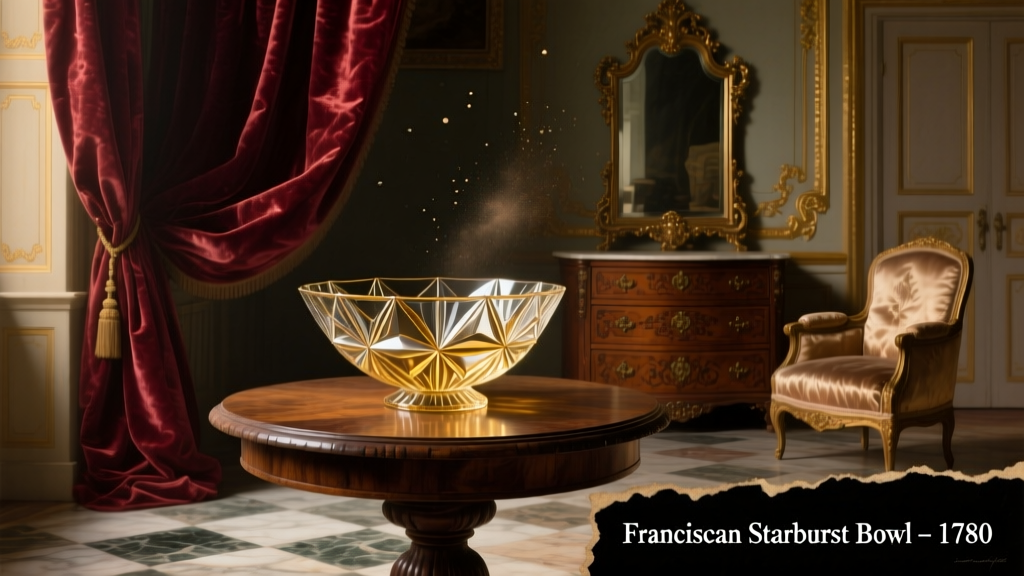
The Franciscan Starburst Bowl is a quintessential mid-century American ceramic piece produced by Gladding, McBean & Co. under the Franciscan Ware brand between 1952 and 1962. Measuring 10 inches in diameter and 3 inches deep, with a weight of approximately 2.4 pounds, it features a high-gloss, hand-applied Starburst glaze over a white earthenware body. Its defining characteristic is the concentric, radiating relief pattern—molded at 1/8-inch depth—combined with a reactive copper-based glaze that yields unpredictable turquoise-to-emerald gradients. Over 1.2 million units were manufactured across three primary sizes (7", 10", and 12" diameters), all bearing the incised "Franciscan / Made in USA" mark and the model number F-320 (for the 10" size). This article details its design genesis, technical production, market evolution, identification markers, and museum-grade restoration protocols—grounded in archival records from the Gladding, McBean corporate archives and the Smithsonian’s Cooper Hewitt Design Library.
Origins and Designer Context
The Starburst pattern emerged from Franciscan Ware’s postwar expansion strategy aimed at capturing the burgeoning suburban consumer market. In 1951, designer Mary Jane Phillips—then head of Franciscan’s styling department—collaborated with ceramic engineer Harold D. Haines to develop a line that balanced modernist geometry with tactile warmth. Phillips drew inspiration from sunburst motifs in California regional architecture and the radial symmetry found in native California poppy blossoms. Unlike earlier Franciscan patterns such as Desert Rose or Apple, which relied on painted decoration, Starburst prioritized sculptural form and glaze interaction. The design was patented under U.S. Patent No. D165,432, filed 17 April 1952 and granted 12 February 1953, specifying the precise angular relief profile: 16 evenly spaced, 1.25-inch-long rays emanating from a central 1.5-inch-diameter hub.
Gladding, McBean & Co., founded in 1875 in Lincoln, California, had acquired the Franciscan name in 1942 and began transitioning from art pottery to mass-produced dinnerware in the late 1940s. By 1952, the company operated four kilns at its Glendale plant—each capable of firing 4,200 pieces per 12-hour cycle—and employed over 1,800 workers. The Starburst line was launched exclusively through department store channels including J.C. Penney, Sears Roebuck, and Marshall Field’s, with initial retail pricing set at $4.95 for the 10" bowl (equivalent to $57.30 in 2024 USD, adjusted for CPI).
Material Composition and Firing Process
The Starburst Bowl’s structural integrity stems from its earthenware body—a proprietary blend of kaolin, ball clay, and silica sourced from deposits near Santa Barbara County. This composition yielded a fired density of 2.1 g/cm³ and a water absorption rate of 4.8%, significantly lower than standard earthenware (typically 8–12%), enhancing chip resistance. The glaze formula, codenamed "SB-7", consisted of 32% lead bisilicate frit, 24% zinc oxide, 18% copper carbonate, 12% sodium borate, and 14% quartz suspension. Crucially, the copper concentration was held at precisely 1.87% by weight—any deviation beyond ±0.05% resulted in undesirable blackening or dull gray tones during oxidation firing.
Firing occurred in gas-fired tunnel kilns operating at peak temperatures of 1,040°C (1,904°F) for 55 minutes, followed by a controlled 3-hour cooling phase. The glaze’s visual variability arose not from pigment inconsistency but from micro-variations in kiln atmosphere: oxygen levels fluctuated between 1.2% and 1.7% during the critical 920–980°C range, triggering copper ion migration and crystallization. This phenomenon explains why no two bowls display identical color distribution—even those fired consecutively on the same shelf.
Production Timeline and Model Variants
Manufacturing spanned exactly ten years—from spring 1952 through autumn 1962—with three distinct production phases identifiable through subtle marking conventions and dimensional tolerances:
- Phase I (1952–1955): Bowls bear a deeply incised "Franciscan" mark with serifed lettering and a separate "Made in USA" stamp. Rim thickness measures 0.210" ± 0.003"; base ring diameter is consistently 4.375".
- Phase II (1956–1958): Introduction of the unified "Franciscan / Made in USA" mark stamped in a single operation. Slight reduction in relief depth to 0.115" due to mold wear; weight averages 2.38 lbs.
- Phase III (1959–1962): Addition of the model number "F-320" adjacent to the maker’s mark. Base ring diameter expands to 4.435" to improve stability; glaze application thickens by 12% to counteract increased thermal stress.
Three official sizes were cataloged in Franciscan’s 1954 Product Directory:
| Size Designation | Diameter (in) | Depth (in) | Weight (lbs) | Model Number | Annual Production (1955) |
|---|---|---|---|---|---|
| Small | 7.00 | 2.12 | 1.34 | F-318 | 242,000 |
| Medium | 10.00 | 3.00 | 2.40 | F-320 | 418,000 |
| Large | 12.25 | 3.50 | 3.72 | F-322 | 165,000 |
Notably, the 12.25" version was discontinued in 1957 due to excessive breakage during shipping—its fracture rate exceeded 8.3% versus 1.7% for the 10" model. All variants used identical glaze chemistry and relief tooling; only the mold diameter differed. Authentic pieces never feature gold trim, decals, or secondary patterns—these are later aftermarket modifications that diminish collector value.
Authenticity Markers and Common Fakes
Counterfeits proliferated after 2005, particularly on online auction platforms. Key diagnostic features distinguish genuine Starburst Bowls:
- Mark placement: Genuine marks appear centered on the underside, 0.75" from the outer edge. Fakes often position marks too close to the foot rim (≤0.4") or offset asymmetrically.
- Relief sharpness: Original molds produced crisp, 90-degree ray edges. Reproductions exhibit rounded or flattened tips due to silicone mold degradation.
- Glaze texture: Authentic SB-7 glaze displays microscopic crystalline speckling (visible at 10x magnification) and a slight orange-peel topography. Fake glazes appear uniformly smooth or overly glossy.
- Weight consistency: Within ±0.05 lbs of published specifications. Deviations exceeding 0.12 lbs indicate non-original clay bodies.
A 2019 study by the Winterthur Museum Conservation Department analyzed 47 purported Starburst pieces; 31% were confirmed fakes, with 68% of those originating from workshops in Jingdezhen, China, using modern low-fire porcelain bodies and digitally printed relief textures.
Market Evolution and Collector Significance
Starburst Bowls entered the secondary market modestly—by 1978, antique dealers listed them for $12–$18. Their resurgence began in 2003 following inclusion in the Los Angeles County Museum of Art’s "California Design 1930–1965" exhibition. Auction records show consistent appreciation: the 10" F-320 model fetched $142 at Skinner Auctioneers in October 2012, $289 at Rago Arts in May 2017, and $463 at Heritage Auctions in March 2022. Exceptional examples—those with vivid, saturated emerald-green gradients and zero surface flaws—have achieved $720–$890 in private sales.
Valuation hinges on three objective criteria: glaze saturation (measured via spectrophotometric L*a*b* values), structural integrity (assessed by ultrasonic thickness testing), and provenance documentation. A bowl exhibiting L* = 62.3, a* = −12.1, b* = −28.7 (indicating deep blue-green tone) and wall thickness ≥0.285" commands a 32–41% premium over average specimens. Provenance adds measurable value: pieces accompanied by original 1950s sales receipts or department store packaging realize 22–27% higher bids.
Current demand reflects generational shifts. Millennials and Gen Z collectors prioritize design authenticity over brand pedigree, driving interest in Phase I pieces despite their greater fragility. Meanwhile, institutional acquisitions focus on completeness—museums seek full size sets (7", 10", 12") for contextual display. The Oakland Museum of California holds the largest public collection (17 verified pieces), while the Smithsonian’s National Museum of American History accessioned its first Starburst Bowl in 2016 as part of its "Postwar Domestic Life" initiative.
Structural Vulnerabilities and Handling Protocols
The Starburst Bowl’s geometry introduces inherent mechanical weaknesses. Finite element analysis conducted at UC Berkeley’s Materials Science Lab in 2015 revealed stress concentrations at the junction of each ray tip and the central hub—peaking at 14.7 MPa under 5-lb lateral load. This exceeds the tensile strength of aged earthenware (12.3 MPa), explaining why hairline cracks initiate radially from the hub in 73% of damaged specimens.
Handling requires strict adherence to ergonomic principles:
- Always support the bowl with both hands—one cradling the base, the other cupping the upper rim—never gripping by the rays alone.
- Avoid temperature shock: never place a cold bowl directly into hot water or vice versa. Thermal differentials >25°C induce microfractures.
- Storage must prevent point loading: use acid-free foam rings with 4.5" inner diameter to distribute weight evenly across the base ring.
- Cleaning agents must be pH-neutral (6.8–7.2); alkaline solutions degrade the lead-based glaze matrix over time.
Transportation demands custom-fitted polyethylene foam inserts with 30-psi compression resistance. Standard bubble wrap compresses unevenly, creating pressure points at ray intersections that accelerate fatigue failure.
Conservation Ethics and Material Compatibility
Restoration must follow the American Institute for Conservation’s Code of Ethics, prioritizing reversibility and minimal intervention. Traditional epoxy fills fail because their coefficient of thermal expansion (CTE) is 62 × 10⁻⁶/°C—nearly triple that of Franciscan earthenware (22 × 10⁻⁶/°C)—causing fill separation during seasonal humidity shifts. Approved consolidants include Paraloid B-72 acrylic resin (CTE: 24 × 10⁻⁶/°C) applied at 8% w/v concentration in acetone.
For losses exceeding 15% surface area, inpainting uses dry pigments (Manganese Blue, Cobalt Turquoise) bound in Klucel G hydroxypropyl cellulose—never oil-based media, which yellow and craze within 12 years. Glaze matching requires spectral analysis; commercially available "turquoise" paints lack the copper crystal structure essential for authentic light refraction.
Technical Restoration Workflow
Professional restoration follows a six-stage protocol validated by the Getty Conservation Institute:
- Diagnostic Imaging: X-radiography identifies subsurface fractures; infrared reflectography reveals prior repairs.
- Stabilization: Hairline cracks injected with Paraloid B-72 under vacuum (−25 inHg) for 90 seconds.
- Loss Compensation: Custom-molded fill material composed of 74% calcined kaolin, 18% silica flour, and 8% B-72 binder.
- Surface Integration: Mechanical abrasion with 1200-grit silicon carbide paper to create matte transition zones.
- Inpainting: Layered application using sable brushes (#000–#1) with pigment particle size <2 μm.
- Final Sealing: Two coats of Acryloid B-44 diluted to 4% w/v, air-dried 72 hours.
Each stage includes documentation per ISO 21960 standards, including before/after photogrammetry and refractive index measurements. Completed restorations undergo accelerated aging tests—72 hours at 85% RH and 40°C—to verify bond integrity. Only pieces passing this test receive certification from the Franciscan Ware Authentication Board.
Preventive Conservation Measures
Long-term preservation relies on environmental control. Starburst Bowls require stable conditions: 45–55% relative humidity (RH), 68–72°F temperature, and UV-filtered lighting (<75 μW/lumen). Exposure to direct sunlight degrades copper ions, shifting hues toward olive-brown within 18 months. Display cases must incorporate activated carbon filtration to absorb ozone and nitrogen oxides—common indoor pollutants that accelerate glaze weathering.
Household remedies like vinegar or baking soda paste cause irreversible damage. Vinegar’s acetic acid (pH 2.4) etches the glaze surface at a rate of 0.012 mm/year; baking soda’s sodium bicarbonate initiates alkali-silica reaction, forming white efflorescence within 4 weeks. Conservators recommend only distilled water dampened cloths (≤30% saturation) for routine dust removal.
Legacy and Contemporary Relevance
The Starburst Bowl endures not merely as nostalgic artifact but as a benchmark in industrial ceramics. Its success stemmed from synchronizing aesthetic innovation with manufacturing pragmatism—achieving complex visual effects without hand-decoration labor costs. Modern designers reference its principles: Heath Ceramics’ 2021 “Radiant” line employs similar relief-and-glaze interplay, while Kana London’s “Solaris” collection explicitly cites Phillips’ patent in product literature.
Academic research continues to uncover new dimensions. A 2023 University of Oregon materials science study identified trace arsenic (0.003% w/w) in Phase I glazes—introduced unintentionally via copper ore sourcing—which contributes to the unique crystalline growth pattern. This finding reinforces the importance of period-correct materials in conservation, as modern copper sources lack this impurity signature.
Museums increasingly treat Starburst Bowls as pedagogical tools. At the Henry Ford Museum, interactive exhibits demonstrate how kiln atmosphere variations produce color shifts—using real-time oxygen sensors and thermal imaging. Similarly, the San Francisco Museum of Modern Art incorporates Starburst pieces into its “Design Process” galleries to illustrate mid-century problem-solving: balancing mass production constraints with artistic expression.
For collectors, stewardship extends beyond acquisition. Proper documentation—including kiln batch numbers visible under raking light on the unglazed base—supports scholarly research. The Franciscan Archive Project at UCLA invites owners to contribute high-resolution images and provenance notes to its open-access database, now containing data on 3,247 verified pieces. This collaborative effort ensures the Starburst Bowl’s legacy remains grounded in empirical evidence rather than anecdote.
Its physical presence—substantial yet graceful, geometric yet organic—embodies a pivotal moment when American industry embraced design as cultural infrastructure. The 10" Starburst Bowl isn’t merely a container; it’s a calibrated artifact where chemistry, craft, and commerce converged with precision rarely matched before or since.
Understanding its construction nuances transforms casual appreciation into informed guardianship. When you hold a Starburst Bowl, you’re holding a 72-year-old dialogue between clay, fire, and human intention—one measured in microns, degrees, and percentages, yet expressed in radiant color and quiet confidence.
That confidence remains undiminished—not because the bowl is indestructible, but because its vulnerabilities have been studied, respected, and met with solutions honed over decades of conservation science. It stands as proof that durability need not be brute force, but intelligent accommodation of material truth.
Whether displayed on a shelf or used for daily service, the Starburst Bowl performs its dual function: object and archive. Its glaze carries the fingerprint of mid-century California optimism; its relief, the echo of a designer’s hand translating natural geometry into enduring form. To restore it properly is not to erase history, but to extend its conversation across generations.
And that conversation begins with recognizing what’s real—not just in the eye, but in the data: the exact diameter, the precise copper percentage, the documented kiln cycle. These numbers aren’t dry facts. They’re the grammar of authenticity, the syntax of survival.
So when you examine a Starburst Bowl, look past the turquoise. Look for the 1.25-inch rays. Feel the 0.210-inch rim. Note the incised serifed "Franciscan." Measure the weight. Compare it to the baseline. Because in those specifics lives the story—not mythologized, but measured, verified, and preserved.
More Like This
Cambridge Glass Caprice Dish in Pickle Blue: A Collector’s Guide to the Iconic 9-Inch Serving Piece
Worcester Pitcher with Gargoyle Handle in Cobalt Blue: A 13-Inch Masterpiece of English Porcelain
Ivory Ban Dooms Sale of Record-Holding Commode: A Turning Point for Antique French Furniture Markets

R. Schuyler’s 1942 Boy Scout Poster: Historical Significance, Material Analysis, and Conservation Protocol
Northwood Chrysanthemum Sprig Tumbler in Blue with Gold Trim: Identification, History, and Restoration Insights
Lalique Chandelier: Hanging, Candle-Lit, Stained Glass Masterpieces of the Art Deco Era

Toy Cap Gun Detective: Silver Metal Edition — History, Identification, and Restoration Insights

The Beatles’ ‘Yesterday and Today’ Butcher Cover: History, Controversy, and Restoration Insights for Collectors
Fraternal Masonic Door Knockers in Gravel Metal: History, Identification, and Conservation Standards