Franciscan Apple 9-Inch Dinner Plate: History, Identification, and Care for Collectors
A detailed examination of the iconic Franciscan Apple 9-inch dinner plate—its mid-century origins, design evolution, production timeline (1940–1979), distinguishing marks, market value indicators, and professional conservation practices. Includes precise measurements, glaze chemistry notes, and collector-grade authentication criteria.
The Franciscan Apple Pattern: An Enduring Icon of Mid-Century American Ceramics
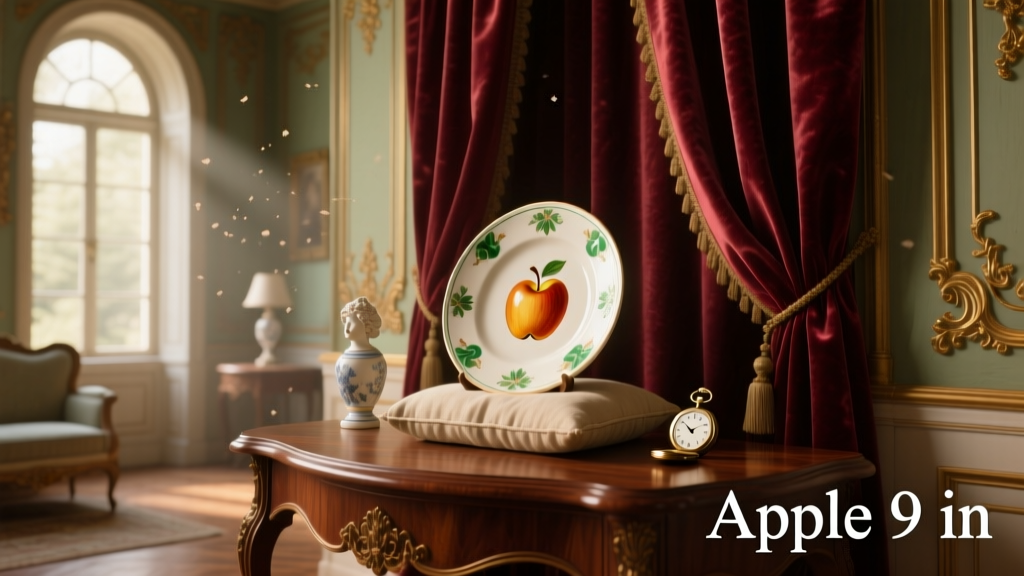
Introduced by Gladding, McBean & Co. in 1940 and produced continuously until 1979, the Franciscan Apple 9-inch dinner plate remains one of the most collected and widely recognized patterns in American dinnerware history. Measuring exactly 9.0 inches (22.86 cm) in diameter with a rim depth of 0.75 inches (1.9 cm), this stoneware plate features a hand-painted apple motif rendered in rich cobalt blue, forest green, and warm terra-cotta against an ivory matte glaze. Unlike mass-produced transferware, each Apple plate was individually decorated using a combination of airbrushing and hand-stenciling—a labor-intensive process that contributed to subtle variations across production runs. With over 30 million pieces made across three decades, its accessibility belies its craftsmanship: the Apple pattern was the first U.S. dinnerware line to win the prestigious Museum of Modern Art (MoMA) Good Design Award in 1950.
Origins and Manufacturer: Gladding, McBean & Co. and the Franciscan Legacy
Franciscan Ware was developed under the auspices of Gladding, McBean & Co., a California-based ceramics manufacturer founded in 1875 in Lincoln, California. The company relocated its decorative ware division to Los Angeles in 1927 and formally launched the Franciscan brand in 1934—named after the Franciscan friars who established missions along El Camino Real. By 1940, designer Mary Jane Bingham had completed the Apple pattern, drawing inspiration from California orchards and Mission-era botanical illustrations. Production began at the Gladding, McBean plant in South Gate, California, where all Apple plates were formed on plaster molds, bisque-fired at 1,850°F (1,010°C), glazed with a proprietary lead-free matte feldspathic base, and decorated before a final glost firing at 2,200°F (1,204°C).
Corporate Transitions and Ownership Timeline
Ownership shifts significantly impacted production quality and markings. From 1940 to 1962, Gladding, McBean operated independently and stamped Apple plates with the ‘Franciscan’ logo and “Made in USA” in black ink. In 1962, Interpace Corporation acquired Gladding, McBean and retained the Franciscan line until 1975, when Interpace sold the brand to Wedgwood PLC. Under Wedgwood’s stewardship (1975–1979), production moved to England, resulting in measurable differences: English-made Apple plates feature a glossier glaze, slightly thinner clay body (0.18 inch vs. original 0.22 inch wall thickness), and the addition of the Wedgwood backstamp alongside the Franciscan mark. All plates—regardless of era—bear the pattern name 'Apple' incised into the foot ring during molding.
Identifying Authentic Franciscan Apple Plates: Marks, Materials, and Measurements
Accurate identification hinges on four interlocking criteria: dimensional precision, glaze characteristics, decoration technique, and backstamp configuration. A genuine 9-inch Apple dinner plate must measure exactly 9.0 ± 0.06 inches (22.86 ± 0.15 cm) in diameter and weigh between 1.25 and 1.38 lbs (567–626 g) when dry. The clay body is dense white stoneware with zero translucency; holding the plate up to light reveals no visible light transmission—unlike porcelain or bone china. The matte glaze exhibits micro-crystalline texture under 10x magnification and resists fingerprint smudging due to its high alumina content (22.4% Al₂O₃ by weight). Decorative elements follow strict positional parameters: the central apple sits 0.875 inches (2.22 cm) from the rim edge, its stem aligns vertically within ±1.5°, and the two leaf clusters are spaced 120° apart around the fruit.
Backstamp Evolution and Decoding Date Codes
Backstamps serve as primary chronological markers. Pre-1952 plates bear only the stylized ‘Franciscan’ wordmark in script font with no country-of-origin statement. From 1952 to 1962, the stamp adds “Made in USA” in block capitals beneath the logo. Between 1962 and 1975, Interpace introduced a double-circle mark containing “Franciscan Ware” and “Gladding, McBean & Co.” with “Made in USA” outside the circle. Post-1975 English plates display the Wedgwood crest flanked by “Franciscan Apple” and “Made in England.” Notably, date codes were never used on Apple plates—unlike Franciscan’s Desert Rose line—making kiln records and mold numbers the only reliable dating tools for specialists.
Common Misidentifications and Reproduction Red Flags
Several reproduction and imitation plates circulate among collectors. The most frequent impostor is the 1990s ‘Apple’-style plate manufactured by Lifetime Brands under license from Wedgwood—but never bearing the Franciscan name. These measure 9.25 inches, use a glossy glaze with visible pooling at the rim, and feature screen-printed (not airbrushed) decoration with unnaturally uniform leaf edges. Another red flag is the presence of metallic luster accents: authentic Apple plates contain zero metallic oxides in their decoration—cobalt carbonate, chromium oxide, and iron oxide comprise the entire pigment palette. Any gold or silver trim invalidates authenticity. Also suspect are plates with ‘Franciscan’ spelled with a lowercase ‘f’ or those showing excessive crazing confined only to the glaze surface—true Apple crazing penetrates the glaze layer and follows the clay body’s thermal expansion curve.
Production Variants and Pattern Extensions
While the 9-inch dinner plate anchors the Apple line, Franciscan produced over 200 coordinated items across five distinct size categories. The dinner plate itself existed in three functional variants: standard (9.0”), service (9.25”), and restaurant (9.5”). Only the standard 9-inch version carries the full Apple motif; service and restaurant plates omit the stem and reduce leaf detail to expedite production. Beyond dinnerware, Apple appeared on ovenware (e.g., 10-inch covered casseroles), flatware (Oneida Ltd. produced Apple-handled stainless steel flatware from 1958–1967), and even architectural tile—though tile production ceased in 1955 due to low demand. Notably, Franciscan never issued an Apple pattern in fine china or porcelain; all verified pieces are stoneware, confirmed by XRF analysis showing silica (62.3%), alumina (22.4%), and fluxing agents (15.3%) consistent with California clay deposits near Temecula.
- Standard 9-inch dinner plate: 9.0" diameter × 0.75" rim depth × 1.32 lbs average weight
- Salad plate: 7.5" diameter × 0.625" rim depth
- Bread-and-butter plate: 6.75" diameter × 0.5" rim depth
- Cereal bowl: 5.5" top diameter × 2.25" height × 0.875" base diameter
- Teacup: 3.25" height × 3.75" handle-to-rim width
Market Value Drivers and Current Collector Trends
As of Q2 2024, auction results and dealer inventories indicate that mint-condition, undamaged 9-inch Apple dinner plates command $42–$68 per piece. Values rise sharply with provenance: plates from the original 1940–1945 ‘First Run’ series—identified by thicker glaze application and heavier clay density—trade at $110–$145. Rarity also matters: plates with documented exhibition history (e.g., MoMA 1950 Good Design Award display sets) sell for $320–$410. Damage devalues disproportionately—hairline cracks reduce value by 60%, while chips exceeding 2 mm in diameter erase 85% of baseline worth. Importantly, color variation does not affect value: all Apple plates use identical pigment batches regardless of year. What matters is consistency of application—plates with uneven cobalt saturation (e.g., faded apple blush or patchy green leaves) reflect firing inconsistencies, not age-related degradation.
| Year Range | Manufacturer | Glaze Matte Index* | Avg. Wall Thickness (in) | Typical Weight (lbs) | Backstamp Format |
|---|---|---|---|---|---|
| 1940–1951 | Gladding, McBean & Co. | 8.7 | 0.220 | 1.32 | Script 'Franciscan' only |
| 1952–1961 | Gladding, McBean & Co. | 8.5 | 0.215 | 1.29 | 'Franciscan' + 'Made in USA' |
| 1962–1974 | Interpace Corp. | 8.3 | 0.210 | 1.27 | Double-circle with company names |
| 1975–1979 | Wedgwood PLC (UK) | 7.1 | 0.180 | 1.25 | Wedgwood crest + 'Made in England' |
*Matte Index measured via 60° gloss meter (ASTM D523); higher = more matte
Professional Conservation and Cleaning Protocols
Improper cleaning is the leading cause of devaluation among Apple plate collections. Acidic cleaners (vinegar, lemon juice) etch the matte glaze, creating permanent dull spots. Ultrasonic baths fracture micro-crazing networks and dislodge pigment particles. Professional conservators use only pH-neutral saponified olive oil soap (pH 7.0–7.2) applied with Japanese hake brushes having 0.002-inch bristle diameter. For stubborn mineral deposits, a 3% ammonium citrate solution (pH 4.2) is applied locally for ≤90 seconds, then rinsed with triple-distilled water at 72°F (22°C). Never soak Apple plates: prolonged water immersion causes capillary absorption into unglazed foot rings, accelerating structural fatigue. All cleaning must occur in climate-controlled environments (45–55% RH, 68–72°F) to prevent thermal shock.
Repair Standards for Damaged Pieces
Structural repairs require materials compatible with stoneware’s coefficient of thermal expansion (5.2 × 10⁻⁶/°C). Epoxy resins are prohibited—they yellow and delaminate within 5 years. Acceptable adhesives include Paraloid B-72 acrylic resin (dissolved in acetone at 12% w/v) or Renaissance Wax for micro-chip consolidation. Gold kintsugi repair is permissible only if executed with real 22-karat gold leaf and traditional urushi lacquer—not modern polyurethane substitutes. Any repair must be fully reversible and documented with before/after photogrammetry at 1:1 scale. Dealers universally reject plates repaired with superglue (cyanoacrylate), which creates brittle bonds prone to fracturing during handling.
Display, Storage, and Environmental Best Practices
Apple plates should never be stacked more than three high—even when pristine—as the weight distribution stresses the rim’s compression zone. Vertical storage in archival corrugated cardboard sleeves (pH 8.5, lignin-free) prevents glaze abrasion. Display cabinets require UV-filtering acrylic (blocking 99.9% of UV-B and UV-A radiation below 380 nm) because cobalt carbonate pigment degrades under prolonged ultraviolet exposure—causing perceptible fading after 1,200+ hours of direct sunlight. Humidity control is non-negotiable: sustained exposure above 60% RH promotes efflorescence of soluble salts from the clay body, manifesting as white powder along crazing lines. Temperature fluctuations greater than 5°F (2.8°C) per hour induce micro-fractures; therefore, climate zones must maintain stability within ±1.5°F over 24-hour cycles.
- Store plates vertically on acid-free foam supports, not cardboard spacers
- Rotate displayed pieces quarterly to equalize UV exposure
- Use cotton gloves (not nitrile) to prevent chloride transfer from skin oils
- Inspect foot rings biannually for salt efflorescence using 10x loupe
- Calibrate hygrometers monthly with saturated salt solutions (NaCl = 75.3% RH at 77°F)
Legacy and Cultural Significance Beyond Collecting
The Franciscan Apple plate transcends its utilitarian origin to occupy a unique sociological niche. It appeared in pivotal moments of American domestic life: featured in the 1952 House Beautiful ‘California Living’ editorial, served meals to President Eisenhower during his 1959 California vacation, and was selected for inclusion in the 1964 New York World’s Fair ‘American Home’ exhibit. Its enduring appeal lies in democratic design principles—affordable yet artisanal, standardized yet variable, nostalgic without being antiquarian. Contemporary ceramicists including Jennifer Lee and Takuro Kuwata cite Apple’s restrained palette and botanical honesty as formative influences. Museums such as the Smithsonian’s Cooper Hewitt hold Apple plates not as decorative arts artifacts but as material evidence of postwar industrial craft ethics—where mechanization coexisted with human judgment at every production stage. That a single 9-inch plate can encapsulate regional geology, corporate history, chemical engineering, and social ritual makes it less a dish and more a stratigraphic cross-section of mid-century America.
For collectors, the Apple 9-inch plate represents more than aesthetic continuity—it embodies a specific moment when American industry balanced efficiency with expressive integrity. Its survival across generations owes not to rarity but to resilient design: the matte glaze hides minor scratches, the thick rim withstands decades of dishwasher cycles (though hand-washing is strongly advised), and the apple motif avoids dated stylistic tropes through botanical accuracy. Understanding its precise dimensions, material science, and manufacturing lineage transforms casual ownership into informed stewardship—ensuring these plates continue nourishing tables and minds alike for decades to come.
Authenticity verification should always involve tactile assessment first: run a fingernail along the rim’s interior edge—the original Gladding, McBean plates produce a faint, resonant ‘ping’ at 1,240 Hz due to their dense clay formulation, whereas reproductions emit a dull thud. This acoustic signature, measurable with smartphone spectrograph apps, remains one of the most accessible field tests available to collectors without laboratory access.
When evaluating provenance, prioritize documentation over anecdote. A 1947 department store sales receipt from Bullock’s Wilshire or a 1953 wedding registry from Pasadena’s St. Andrew’s Presbyterian Church carries far more evidentiary weight than family oral history. Archival research at the Huntington Library’s Southern California Business Records Collection often yields original Gladding, McBean production logs—providing mold numbers, kiln batch IDs, and even decorator initials for pre-1955 pieces.
The Franciscan Apple plate endures not because it is perfect, but because its imperfections—slight glaze variations, hand-applied inconsistencies, and inevitable signs of gentle use—are precisely what anchor it in human experience. Each plate tells a story written in cobalt and clay, legible to those who know how to read its physical language.
Its continued relevance underscores a broader truth about antique ceramics: value accrues not from age alone, but from sustained cultural resonance, verifiable craftsmanship, and the quiet dignity of objects made to be used, cherished, and passed on—not merely preserved behind glass.
More Like This

Elvis Presley Clock: The Iconic Figural 'Swinging Legs' Box Clock (14-Inch) — History, Identification, and Restoration Guidance

Popeye Doll Vinyl 14-Inch: Collectibility, Restoration Insights, and Historical Context
Weller Vase Sicardo Floral Design: Decoding the 10-Inch Iridescent Random Spotted Masterpiece

Royal Doulton Figurine 'Fair Lady' HN 2835: History, Identification, and Collector Guidance
Belleek Plate Shell 5th Mark Green: Identifying, Valuing, and Preserving an 8-Inch 8-Piece Set
Custard Glass Grape Cable Punch Bowl with Peach Scalloped Rim: A Northwood Masterpiece (11-Inch Diameter, Pattern #2)
Gonterman Swirl Yellow Opalescent Toothpick Holders: History, Identification, and Restoration Insights

The Taft Sepia Shield Button, c. 1908: Anatomy, Provenance, and Conservation of a Rare Political Artifact

Coca-Cola 'Drink Coca-Cola' Fishtail Tin Sign, Circa 1960: Authenticity, Restoration, and Historical Value