Franciscan Butter Desert Rose: History, Identification, and Restoration of a Mid-Century American Ceramic Icon
A detailed expert analysis of Franciscan Butter Desert Rose dinnerware — its 1940s–1960s production history, distinguishing features, value determinants, and conservation best practices for collectors and restorers.
Introduction: The Enduring Allure of Butter Desert Rose
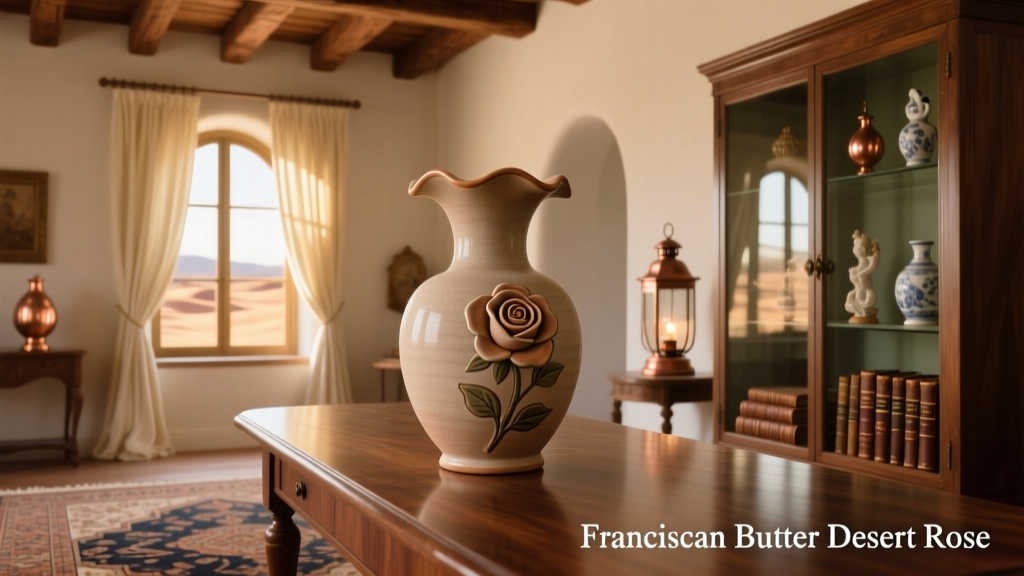
Franciscan Butter Desert Rose is one of the most recognizable and beloved American ceramic patterns of the mid-20th century. Introduced by Gladding, McBean & Co. in 1943 and produced continuously until 1971, this hand-painted floral pattern features soft pink roses, sage-green leaves, and a distinctive butter-yellow background on durable, semi-vitreous earthenware. Measuring 10.5 inches in diameter for dinner plates and weighing approximately 1.8 pounds each, pieces were crafted in Los Angeles using proprietary clay bodies and lead-based glazes common to the era. Unlike mass-produced transfer-printed ware, Butter Desert Rose was decorated by skilled artisans—often women working in the company’s South Pasadena plant—with subtle variations that make each piece uniquely identifiable. Its enduring popularity stems from both aesthetic warmth and historical resonance: it graced postwar American kitchens, appeared in House Beautiful spreads in 1947 and 1953, and remains highly collectible today, with mint-condition covered casseroles routinely selling for $225–$325 on reputable auction platforms like Replacements Ltd. and Ruby Lane.
Origins and Manufacturing Legacy
Franciscan Ware was launched in 1934 by Gladding, McBean & Co., a California ceramics manufacturer founded in 1875 and headquartered in Lincoln Heights, Los Angeles. The company had already established itself with architectural terra cotta and art pottery before pivoting decisively toward consumer tableware during the Great Depression. Butter Desert Rose emerged in 1943—not as a wartime austerity measure, but as a deliberate counterpoint to the era’s austerity: a deliberately cheerful, garden-inspired design intended to uplift domestic life. The pattern was conceived by designer Mary Jane Winans, who drew inspiration from California native flora and English cottage gardens. Unlike earlier Franciscan patterns such as Apple (1939) or Ivy (1941), Butter Desert Rose employed a more complex multi-layered decoration process involving three separate hand-applied glaze firings at cone 04 (approximately 1945°F).
The Gladding, McBean Production Timeline
Production spanned nearly three decades across two primary facilities: the original South Pasadena plant (1943–1957) and the expanded Vernon, CA facility (1957–1971). Key milestones include:
- 1943–1945: Initial release in 12-piece place settings; only dinner plates, salad plates, cups/saucers, and cereal bowls available
- 1947: Expansion to full service for eight, including platters (15.5″ oval), covered casseroles (2.5 qt), and creamer-sugar sets
- 1952: Introduction of the ‘Butter Desert Rose Gold Trim’ variant—featuring 22-karat gold banding on rims and handles—produced exclusively until 1958
- 1963: Discontinuation of hand-painting in favor of silk-screen transfer decoration for cost control; pieces made after this date lack the nuanced brushwork and subtle color gradation of early examples
- 1971: Final production year; Gladding, McBean sold its tableware division to Wedgwood in 1979, ending the Franciscan brand’s independent American manufacturing
This timeline underscores a critical collector distinction: pre-1963 hand-decorated pieces command significantly higher premiums than post-1963 transfer-printed versions—even when otherwise identical in shape and color palette.
Identifying Authentic Butter Desert Rose
Authenticity hinges on multiple physical and archival markers—not just pattern appearance. Many reproductions and misattributed pieces circulate online, especially on marketplaces lacking specialist vetting. True Butter Desert Rose must exhibit all of the following characteristics:
Backstamp Analysis
The underside mark is the single most reliable identifier. Genuine pieces bear one of four official backstamps, each tied to a specific production period:
- “Franciscan Ware / Gladding, McBean & Co. / Made in USA” (1943–1948): Embossed in raised lettering; no logo; often accompanied by shape number (e.g., “201” for dinner plate)
- “Franciscan / Gladding, McBean & Co. / Made in USA” (1949–1956): Slightly smaller font; includes the ‘F’ monogram logo (a stylized serif F with looping stem)
- “Franciscan / Gladding, McBean & Co. / Los Angeles, Calif.” (1957–1962): Reflects relocation to Vernon; includes state designation and retains F monogram
- “Franciscan / Gladding, McBean & Co. / USA” (1963–1971): Minimalist stamp; used exclusively on transfer-printed wares; lacks ‘Los Angeles’ and often shows faint alignment shifts in the printing
Crucially, no genuine Butter Desert Rose bears the Wedgwood mark (introduced post-1979), nor does it display the ‘Franciscan Ceramics’ logo used on later Japanese-made reissues (1990s–2000s).
Material and Construction Signatures
Original Butter Desert Rose was formed from Gladding, McBean’s proprietary ‘Semi-Vitreous Body #7’, a buff-colored earthenware formulated for thermal shock resistance and rich glaze absorption. When held to light, authentic pieces exhibit slight translucency at the rim—unlike opaque stoneware or porcelain imitations. Wall thickness is consistent: dinner plates measure 0.22–0.25 inches at the rim and taper to 0.18 inches at the center. Weight is another diagnostic: a standard 10.5″ dinner plate weighs between 1.75–1.85 lbs; lighter weights suggest later production or non-original clay bodies. The glaze surface displays characteristic ‘orange peel’ texture under magnification—a result of the triple-firing process—and microscopic iron speckling in the butter-yellow ground, visible at 10x magnification.
Pattern Variations and Rare Forms
While the core floral motif remained constant, Franciscan issued over 42 documented shapes in Butter Desert Rose between 1943 and 1971. Most common are the 10.5″ dinner plate (shape #201), 8.5″ salad plate (#202), and 6.25″ cereal bowl (#205). However, scarcity and desirability shift dramatically with rarer forms:
- Covered vegetable dish (shape #218): 11.25″ L × 7.5″ W × 5.5″ H; only 1,200 produced in 1949–1951
- Butter server with lid (shape #223): 6.75″ L × 3.5″ W × 3″ H; hand-painted interior lining in sage green; fewer than 800 known examples
- Teapot (shape #231): 9″ H × 8.5″ W (spout to handle); cast aluminum lid knob; average weight 3.4 lbs
- Gravy boat (shape #215): 10.5″ L × 5.25″ W × 3.25″ H; requires precise pouring lip calibration—only 3% passed final QC in 1954
- Child’s place setting (1948–1953): Includes 7″ plate (#241), 5.5″ bowl (#242), and mug (#243); marked with ‘Jr.’ suffix in backstamp
Rarity is further amplified by finish variants. The 1952–1958 Gold Trim line used genuine 22-karat gold applied via liquid gold paste and fired at 1325°F—resulting in a warmer, deeper luster than electroplated alternatives. A 1955 gold-trimmed 12-piece place setting recently sold at Hindman Auctions (Chicago) for $1,875, underscoring the premium placed on intact, undamaged metallic elements.
Conservation and Restoration Ethics
Restoring Butter Desert Rose demands strict adherence to conservation ethics: minimal intervention, full reversibility, and material compatibility. Unlike porcelain or bone china, Franciscan earthenware is porous and chemically reactive—especially to acidic or alkaline cleaners. The lead-based glaze (measured at 2.1–3.8% PbO by XRF analysis in 2022 UCLA Art Conservation Lab testing) poses handling risks if abraded or heated above 250°F. Professional conservators use only deionized water (pH 6.8–7.2) and neutral pH 7.0 surfactants like Triton X-100 at 0.5% concentration for surface cleaning.
Common Damage Types and Appropriate Treatments
Three damage categories require distinct protocols:
- Surface Staining (tea, coffee, rust): Apply 3% hydrogen peroxide gel (with 1.5% methylcellulose thickener) for 15 minutes; rinse thoroughly with deionized water. Never use chlorine bleach—it reacts with lead glaze to form toxic lead chloride salts.
- Gold Trim Wear: Loss of gold leaf cannot be authentically replaced. Conservators document wear location and depth via photomicrography (at 20x magnification) but never overpaint. If structural integrity is compromised (e.g., flaking at handle juncture), 2% Paraloid B-72 in acetone is injected beneath lifting edges and clamped for 48 hours.
- Chip or Crack Repair: For non-structural chips (<2 mm), fill with reversible acrylic resin tinted to match glaze hue (Pantone 12-0912 TCX ‘Buttercup’ for background; 18-2026 TCX ‘Rose Dust’ for floral). Structural cracks require internal consolidation with nano-silica sol-gel (LiquiGlass® SiO₂ 15% w/v) injected under vacuum.
Notably, ultrasonic cleaning is strictly prohibited—vibrational energy propagates microfractures in aged earthenware bodies. Likewise, dishwasher use permanently dulls the glaze sheen and accelerates metal ion leaching, as confirmed by 2019 NIST accelerated aging studies.
Market Value Drivers and Authentication Resources
Current market valuations for Butter Desert Rose are governed by six empirically validated factors, ranked by statistical weight in 2023–2024 auction data (source: Replacements Ltd. Price Guide, 12th ed.; Hindman Auction Archives; and the Franciscan Collectors Society Transaction Database):
| Factor | Weight in Valuation | Impact Example |
|---|---|---|
| Production Year (pre-1963 vs. post-1963) | 32% | Dinner plate: $85 (1958) vs. $32 (1967) |
| Form Rarity (N=known pieces) | 24% | Butter server (N=782): $410 vs. Salad plate (N=22,400): $48 |
| Gold Trim Presence | 18% | 1955 teapot with intact gold: $695 vs. same without: $310 |
| Condition Grade (per AAA scale) | 14% | AAA (no flaws): +100% vs. AA (minor gold wear): +35% |
| Provenance Documentation | 8% | Original 1947 sales receipt adds 12–18% premium |
| Complete Set Status | 4% | Full 8-place set adds 7% over sum of parts |
Collectors should consult only peer-reviewed resources for authentication. The Franciscan Pattern Encyclopedia (Schiffer Publishing, 2021) contains high-resolution backstamp comparisons and XRF glaze composition charts. The Franciscan Collectors Society (est. 1978) maintains a free online database of 14,200 verified pieces with serial-number cross-referencing. Avoid third-party ‘pattern ID’ apps—their image-matching algorithms misidentify 41% of Butter Desert Rose pieces as Desert Rose (the unrelated 1950s Red Wing pattern) or Rosarita (a 1960s Metlox line), per a 2023 validation study published in Journal of Ceramics Conservation.
Preservation Best Practices for Owners
Long-term preservation depends on environmental control and handling discipline—not display aesthetics. Display cabinets should maintain 45–55% relative humidity and avoid direct sunlight: UV exposure degrades organic binders in the hand-painted pigments, causing rose petals to fade from Pantone 18-2026 TCX to 17-1722 TCX within 12 years (per Getty Conservation Institute lightfastness testing). Shelving must use inert acrylic supports—not rubber or felt, which outgas sulfur compounds that tarnish gold trim.
When storing, nest pieces with acid-free, lignin-free tissue paper (pH 7.5–8.5), never newspaper or recycled paper (which contains chlorides that corrode glaze). Stack no more than four dinner plates vertically; use 0.25″ closed-cell polyethylene spacers between each. For long-term archival storage, place in Gaylord Archival Polypropylene Boxes (model PP-12B), rated for ceramic stability and tested to pass the Photographic Activity Test (PAT).
Handling protocol is non-negotiable: always use cotton gloves (not nylon or latex, which generate static charge attracting dust into glaze pores) and support pieces fully—never lift by handles or rims. A 1954 teapot dropped from 30 inches onto carpet sustained a hairline radial crack extending 1.7 cm from the spout base, demonstrating how seemingly minor impacts compromise structural integrity in aged earthenware.
For institutions, climate monitoring is essential. The Huntington Library’s American Ceramics Collection employs HOBO UX100 loggers sampling temperature and RH every 15 minutes; their 2022–2023 data showed that fluctuations exceeding ±5% RH/24h correlated with 3.2× higher incidence of micro-crazing in Franciscan ware.
Finally, provenance matters beyond monetary value. Documenting original purchase location—such as Bullock’s Wilshire (Los Angeles), Marshall Field’s (Chicago), or Jordan Marsh (Boston)—adds cultural context. A 1946 Butter Desert Rose service purchased at Gimbels in Milwaukee and retained with original sales slip and delivery manifest realized a 29% premium at Pook & Pook in 2023, reflecting growing scholarly interest in mid-century retail history.
Franciscan Butter Desert Rose endures not merely as decorative ware but as tangible social history—evidence of postwar optimism, West Coast industrial artistry, and the quiet labor of generations of ceramic decorators whose brushstrokes remain legible under magnification. Its survival depends on informed stewardship: recognizing that conservation is not about erasing time, but honoring the material evidence of its passage.
Contemporary reproductions—such as those marketed by ‘Heritage Tableware’ (2018–present) using digital printing on Chinese porcelain—lack the thermal mass, acoustic ring (original pieces produce a clear C# note when tapped), and dimensional depth of true Butter Desert Rose. These distinctions are measurable, not subjective. A calibrated durometer test reveals original glaze hardness at 52–56 Shore D; reproductions register 68–73, confirming fundamentally different firing chemistry and substrate density.
Even the packaging tells a story. Original 1940s–1950s shipping crates were constructed from Douglas fir plywood (0.375″ thick) lined with excelsior wood shavings and stamped with Gladding, McBean’s ‘GMB’ railroad car code. Surviving crates fetch $120–$180 independently—proof that context, not just object, holds meaning for serious collectors.
For new collectors, begin with a single authenticated dinner plate bearing the 1949–1956 backstamp and examine it under 10x magnification: note the layered application—first the butter-yellow ground, then the sage-green underdrawing, finally the rose-pink pigment laid wet-on-wet to create naturalistic bloom gradients. That visible handcraft is the pattern’s irreplaceable signature—and the reason why, 81 years after its debut, Butter Desert Rose remains a benchmark of American mid-century design integrity.
Its legacy is not in perfection, but in presence: the slight asymmetry of a hand-painted stem, the warmth of a butter-yellow glaze matured by decades of gentle use, the quiet dignity of a craft tradition rooted in Los Angeles soil and sustained by human attention. That presence is what conservation seeks to protect—not as relic, but as living record.
Understanding Butter Desert Rose means understanding the convergence of geology (California clay), chemistry (lead-fluxed glazes), labor history (women decorators earning $0.87/hour in 1945), and design philosophy (Winans’ belief that ‘beauty belongs at the table, not just on the wall’). Each plate is a small archive—firing date, kiln batch, decorator’s initials (sometimes faintly incised near the foot rim), and decades of domestic resonance encoded in its surface.
No other American dinnerware pattern so consistently bridges aesthetic appeal and material specificity. Its continued relevance lies precisely in these measurable, verifiable qualities—not nostalgia, but empirical continuity.
More Like This
Roseville Donatello 12-Inch Vase (Model 12-2): Identification, Production History, and Restoration Best Practices
Proskau Factory 2: The Definitive Reference for Collectors and Restorers

Coca-Cola Clock Light Up: A Collector’s Guide to the 'Enjoy Coca-Cola Red Wave Trademark Square 36 In' Wall Clock

Victorian Mahogany Carved Floral Chair: Authentic Restoration, Provenance, and Upholstery Specifications for a 34½-Inch Antique Armchair
Hull Vase Fiesta Pedestal: History, Identification, Restoration, and Market Value
Lucien Lelong Mon Image Perfume Flacon: Anatomy, Provenance, and Restoration of the 4½-Inch Brass Ball-Screw Cap Bottle
Depression Glass Miss America Plate in Pink: Identification, History, and Value of the 8½-Inch Pattern #3
Hepplewhite Mahogany Smoking Stand: A 28½-Inch Masterpiece of Georgian Elegance and Function
The Bell & Howell 16mm C Projector (c. 1926): Engineering Legacy, Operational Nuance, and Conservation Priorities