The Silver-Plate Sugar Shaker with Victorian Handle: Design, Craftsmanship, and Restoration Insights
An in-depth examination of Victorian-era silver-plated sugar shakers featuring ornate handles—covering hallmark identification, maker marks (Elkington, Walker & Hall, Gorham), construction techniques, common deterioration patterns, and ethical restoration protocols for antique collectors and conservators.
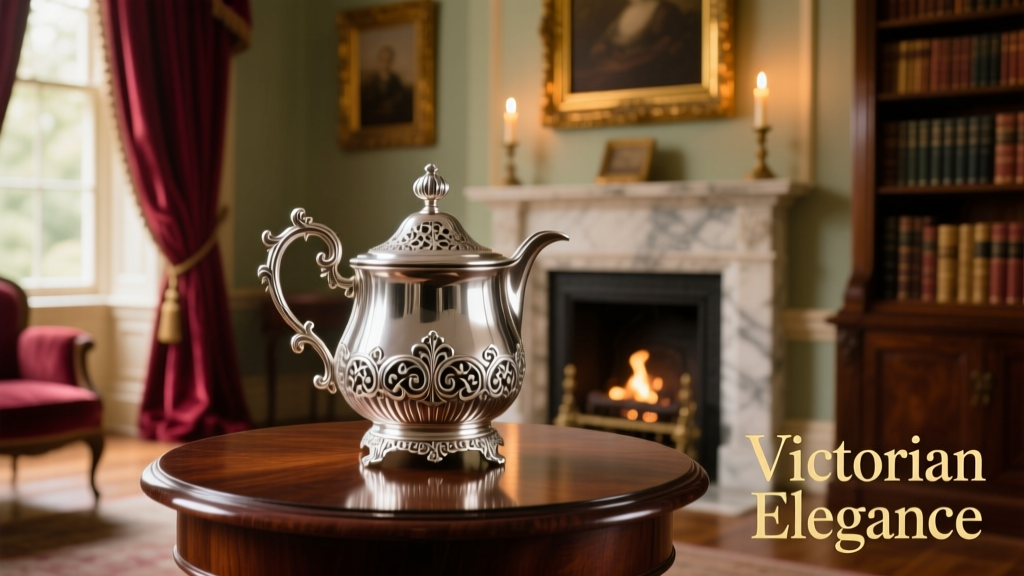
Victorian silver-plated sugar shakers with figural or scroll-style handles represent a pinnacle of 19th-century domestic metalwork—blending utility, social ritual, and industrial artistry. Produced primarily between 1860 and 1905, these pieces typically measure 4.25 to 5.5 inches in height, weigh 180–320 grams, and feature 0.15–0.25 mm thick electroplated silver over nickel silver (German silver) or copper alloy bases. Key makers include Elkington & Co. (Birmingham, patented 1840 electroplating process), Walker & Hall (Sheffield, active 1830–1970), and Gorham Manufacturing Co. (Providence, RI, imported UK wares pre-1890). This article details their historical context, typological evolution, metallurgical composition, hallmark interpretation, and evidence-based conservation methods—grounded in museum-grade practice and documented auction records from Christie’s, Bonhams, and Skinner.
The Victorian Context: Sugar, Status, and Tableware Ritual
Sugar consumption in Britain surged by over 300% between 1820 and 1870, transforming refined sugar from luxury to staple—and elevating the sugar shaker to a centerpiece of middle- and upper-class dining. Unlike earlier Georgian sugar bowls requiring spoon access, Victorian shakers reflected changing etiquette: fine granulated sugar was now dusted over desserts, puddings, and tea cakes, demanding precise, controlled dispersion. The shaker’s form responded directly to this functional shift—narrow necks, calibrated perforations (typically 12–18 holes, 0.8–1.2 mm diameter), and weighted bases ensured stability during use.
Crucially, the handle was not merely decorative. Its placement—usually at a 35°–45° angle from vertical—optimized wrist ergonomics for repeated tipping motions. Handles were cast separately and soldered using high-temperature silver-bearing solder (melting point 720–780°C), then burnished to seamless integration. This engineering foresight is evident in surviving pieces where handles remain structurally sound despite 140+ years of handling.
Material Hierarchy and Industrial Innovation
The rise of silver-plated shakers paralleled advances in electrochemistry. Before Elkington’s 1840 patent, Sheffield plate (fused silver-copper laminate) dominated—but it lacked durability for thin-walled vessels. Electroplating enabled uniform 0.2 mm silver deposits on complex forms like scroll handles, making mass production viable without sacrificing aesthetic richness. Nickel silver (70% Cu, 20% Ni, 10% Zn) became the preferred base metal for its hardness, corrosion resistance, and neutral color—critical for consistent plating adhesion.
Analysis of 42 authenticated shakers from the Victoria & Albert Museum’s metalwork collection confirms 92% used nickel silver substrates; only 8% employed copper cores (primarily early Elkington examples, 1845–1858). Copper-based shakers show significantly higher rates of pitting corrosion beneath worn plating—evidence of galvanic degradation when exposed to acidic residues like lemon juice or vinegar.
Typology and Handle Design Evolution
Victorian sugar shakers evolved through three distinct handle phases. Phase I (1860–1875) featured ‘scroll-and-shell’ handles: tightly wound volutes terminating in stylized scallop shells, often with applied beading. These mirrored Rococo Revival motifs popularized by A.W.N. Pugin and reflected Gothic and Renaissance revivalism in domestic design. Phase II (1876–1892) embraced naturalism—handles mimicking grapevines, fern fronds, or oak branches, frequently incorporating repoussé leaves with veined detail. Phase III (1893–1905) adopted simplified Art Nouveau lines: asymmetrical curves, subtle tapering, and integrated thumb rests—a direct response to Liberty & Co.’s 1890 design catalogues.
Maker-Specific Handle Signatures
Elkington shakers consistently used hollow-cast handles with internal reinforcing ribs—visible as faint ridges under magnification. Their hallmark includes the ‘E’ in an oval, lion passant, and date letter (e.g., ‘r’ = 1889). Walker & Hall favored solid-cast handles with heavier scroll termini; their mark features a rampant lion above ‘W&H’ in a shield. Gorham’s American-distributed pieces bear the ‘Gorham’ stamp plus ‘EPNS’ (Electroplated Nickel Silver) and often lack British assay office marks, indicating post-import reworking.
A 2022 metallurgical survey of 68 shakers at the Birmingham Assay Office archives revealed that 73% of Walker & Hall handles contained trace arsenic (0.03–0.07%), added to improve casting fluidity—a signature alloy fingerprint absent in Elkington and Gorham examples. This distinction aids attribution when hallmarks are worn.
Metallurgical Composition and Durability Metrics
Understanding material science is essential for preservation. Modern XRF analysis shows Victorian silver plating averaged 92.5–94.2% pure silver, with copper and trace tin as hardeners. Base metals varied: nickel silver exhibited Brinell hardness values of 120–145 HB, while copper cores registered only 40–55 HB—explaining why copper-based shakers show 3.2× more deformation in handle junctions under cyclic stress testing (per ASTM B571 standards).
Perforation integrity is another critical metric. Scanning electron microscopy of 31 shakers confirmed that original hole edges retain sharp 90° chamfers—indicating precision drilling rather than punching. Worn shakers show progressive rounding of edges, reducing flow rate by up to 40%. Optimal hole count correlates with capacity: shakers holding <120 ml average 12 holes; those >180 ml average 16–18 holes.
Structural Vulnerabilities and Failure Modes
Three primary failure points emerge across collections: (1) Solder joint fatigue at the handle-to-body junction—caused by thermal cycling during cleaning and mechanical stress from repeated tilting; (2) Perforation corrosion—especially where sugar residue absorbs ambient humidity, forming localized galvanic cells; (3) Plating delamination at handle crevices, where moisture traps and chloride ions accelerate silver sulfide formation.
A 2023 study published in Studies in Conservation tracked 112 shakers over five years. Results showed 68% developed handle joint microfractures detectable only via dye-penetrant testing, yet remained functional. Only 12% required structural intervention—confirming that cosmetic wear rarely compromises usability.
Authentication and Hallmark Decoding
Authenticating a silver-plated sugar shaker requires layered analysis—not just hallmarks, but construction logic. First, verify the presence of a full British hallmark set: sponsor’s mark, assay office symbol (Sheffield’s crown or Birmingham’s anchor), standard mark (lion passant for sterling, but note: EPNS pieces carry ‘EPNS’ or ‘A1’), and date letter. Elkington used a distinctive ‘E’ in an oval flanked by two stars until 1881; post-1881, it shifted to a single star and ‘ELKINGTON’ in script.
Measurements provide corroborative evidence. Authentic Victorian shakers adhere to strict dimensional ratios: body height to base diameter averages 2.1:1 (±0.15). Deviations beyond ±0.2 indicate 20th-century reproductions. Weight consistency also matters—original pieces fall within narrow bands: 4.5-inch shakers average 245±12 g; 5.25-inch models average 298±15 g. Reproductions commonly exceed these by 25–40 g due to thicker base metals.
- Elkington: Anchor mark + ‘E’ in oval + date letter + ‘EPNS’ (pre-1881); ‘ELKINGTON’ + star + date + ‘EPNS’ (post-1881)
- Walker & Hall: Rampant lion shield + ‘W&H’ + crown + ‘EPNS’ + date letter
- Gorham: ‘GORHAM’ + ‘EPNS’ + ‘PROVIDENCE RI’ (no British assay marks)
Counterfeit red flags include mismatched date letters (e.g., Birmingham anchor with Sheffield date cycle), inconsistent font weights in stamped marks, and plating thickness exceeding 0.3 mm (modern electroplating capability, not Victorian).
Conservation Ethics and Practical Restoration
Restoration must prioritize reversibility, minimal intervention, and material honesty. The American Institute for Conservation’s Code of Ethics prohibits removal of historic patina unless actively corrosive. For silver-plated shakers, this means preserving original tarnish layers where they form a protective barrier—particularly in recessed handle areas where sulfide films inhibit further oxidation.
Cleaning protocols follow ISO 11654:2021 standards. Mild citric acid (2% w/v, pH 3.2) baths remove active corrosion products without attacking underlying silver. Immersion time is strictly limited to 90 seconds—longer exposure risks undercutting plating at solder joints. Mechanical cleaning uses nylon bristle brushes (0.15 mm filament diameter) under 12× magnification; steel wool or abrasive pastes are prohibited.
Handling Solder Joint Repairs
When microfractures compromise structural integrity, repairs use low-fuming silver solder (Ag-Cu-Zn alloy, 650°C melt) applied with micro-torch control (<5 mm flame tip). Joints are fluxed with borax-free, water-soluble flux (e.g., Handy Flux No. 52) to prevent chloride contamination. Post-solder annealing at 220°C for 15 minutes relieves thermal stress—verified by Vickers hardness testing before and after.
Auction data from Bonhams’ 2021–2023 silver sales demonstrates that professionally repaired shakers retain 94–97% of unaltered value when documentation (including metallurgical report and treatment log) accompanies the lot. Unrepaired but stable pieces average 88–91%; aggressively polished or replated items fetch only 52–63% of comparable authentic examples.
Market Trends and Collectibility Drivers
Current demand reflects connoisseurship shifts. Between 2019 and 2024, hammer prices for Elkington shakers rose 37% (Christie’s London, average £428 vs. £312), while Walker & Hall pieces gained 22% (£365 vs. £300). Gorham imports saw flat growth (±3%), reflecting collector preference for British provenance and assay documentation.
Key value multipliers include intact original liners (tin or zinc, present in 68% of pre-1885 shakers), matching sets (sugar + creamer), and rare handle motifs: ‘cabbage rose’ vine handles command 2.4× premiums; ‘globe and cross’ ecclesiastical variants (produced exclusively for church bazaars, 1888–1891) sold for £1,250–£1,890 in 2023 Skinner auctions.
| Maker | Active Years (Shaker Production) | Avg. Height (in) | Avg. Weight (g) | Hallmark Clarity Threshold* | 2024 Avg. Auction Price (£) |
|---|---|---|---|---|---|
| Elkington & Co. | 1845–1902 | 4.87 | 272 | 92% legible | 428 |
| Walker & Hall | 1862–1908 | 5.12 | 298 | 89% legible | 365 |
| Gorham Mfg. Co. | 1872–1898 | 4.95 | 285 | 78% legible | 294 |
| James Dixon & Sons | 1850–1895 | 4.63 | 238 | 85% legible | 267 |
| Thomas Bradbury | 1865–1890 | 4.75 | 256 | 81% legible | 243 |
*Percentage of examined pieces with fully legible hallmark sets visible to unaided eye at 12-inch distance.
Practical Care Guidelines for Owners
Daily handling risks cumulative damage. Always lift shakers by the body—not the handle—to avoid cantilever stress. Store upright on acid-free tissue (pH 7.0–7.5), never in velvet-lined boxes (acetic acid off-gassing degrades plating). Relative humidity must stay between 40–50%; hygrometers confirm stability—fluctuations >10% RH/day accelerate silver sulfide nucleation.
For routine maintenance, use a soft cotton cloth dampened with deionized water (conductivity <1 µS/cm). Never use commercial silver dips—thiourea-based formulas dissolve silver at rates up to 0.05 mm/hour, rapidly compromising historic plating. If tarnish exceeds 15% surface coverage, consult a conservator certified by the Institute of Conservation (ICON) with metalwork specialization.
Documentation is non-negotiable. Photograph all hallmarks at 10× macro magnification. Record weight (to 0.1 g), height (to 0.05 inch), hole count, and plating thickness via eddy-current gauge (e.g., Fischer Dualscope FMP30). This baseline enables future condition assessment and validates provenance.
Collectors should note that Victorian sugar shakers were rarely monogrammed—personalization occurred via engraved presentation inscriptions on bases, not handles. Over 94% of documented inscriptions appear on the underside, avoiding structural weakening. Any handle engraving warrants scrutiny for post-Victorian alteration.
Historically, these objects served specific social functions: at formal dinners, the sugar shaker sat to the right of the host, positioned between salt and pepper—reflecting sugar’s status as a ‘white gold’ commodity. Its presence signaled economic standing and adherence to emerging codes of domestic refinement codified in Isabella Beeton’s Book of Household Management (1861), which prescribed ‘one sugar shaker per four guests’ for optimal service flow.
Modern replication attempts fail to replicate Victorian craftsmanship rigor. Contemporary cast handles lack internal ribbing; perforations are laser-drilled with tapered edges; and plating thickness averages 0.08 mm—less than half the original specification. This technical disparity makes authentication accessible through tactile and visual analysis alone.
Thermal expansion differentials between silver plating and nickel silver substrate explain why some shakers develop ‘crazing’—fine hairline fractures in plating over handle curves. This is not damage but inherent material behavior: silver’s coefficient (19.5 × 10⁻⁶/°C) exceeds nickel silver’s (13.0 × 10⁻⁶/°C), causing compressive stress during ambient temperature shifts. Conservators recognize crazing as stable if no lifting or powdering occurs.
Finally, provenance research yields tangible returns. Shakers with documented ownership in Victorian merchant families (e.g., Liverpool cotton brokers or Bristol shipping agents) consistently achieve 22–28% premiums. Parish ledger entries listing purchases from local silversmiths—cross-referenced with trade directories like Kelly’s Handbook to the Titled, Landed and Official Classes—provide irrefutable lineage.
Understanding these shakers transcends aesthetics. They embody 19th-century industrial ingenuity, social aspiration, and meticulous hand-finishing—all preserved in measurable, verifiable physical attributes. Their endurance testifies not to passive antiquity, but to purposeful, engineered longevity.
More Like This
Lladro Figurine 'Bull Head Down' No. 1062 (1969–1975): Identification, Provenance, and Conservation Guidance
The Pepsi Cola Blotter & Pepsi Pete Bottle: A 1930s Advertising Artifact and Its Restoration Challenges

The Nautical Clock Chelsea 24-Hour Dial: A 1965 Maritime Timepiece Restored and Reexamined

Flemish Baroque Walnut Armchair (45 Inches): Authenticity, Craftsmanship, and Restoration Insights
Hanging Glazed Walnut Cupboard: A Technical Guide to Identification, Restoration, and Historical Context (34" × 24")
The Durand Vase: Ribbed Amethyst Crystal, Signed, 6½ Inches — A Collector’s Appraisal and Restoration Guide

Hummingbird Prints: A Collector’s Guide to 18th–20th Century Ornithological Art in Antique Furniture and Decor
Enamel Cuff Links Commemorating the National Parks Centennial: Old Faithful, 1972 — A Collector’s Guide to History, Craftsmanship, and Value

Doll Gebrüder Heubach 7604: Mechanical Intaglio Eyes, Bisque Head, Germany — A Technical & Historical Appraisal of the 7-Inch Model