Folk Art Stone Fruit: Authentic 19th-Century Pear, Apple, and Plum Carvings with Original Paint
A detailed examination of a rare three-piece folk art stone fruit set—hand-carved limestone pear, apple, and plum—retaining original 1870s–1890s mineral-based paint. Includes provenance, conservation assessment, pigment analysis, market valuation, and restoration ethics for collectors and museums.
Introduction: A Trio of Timeless American Folk Art
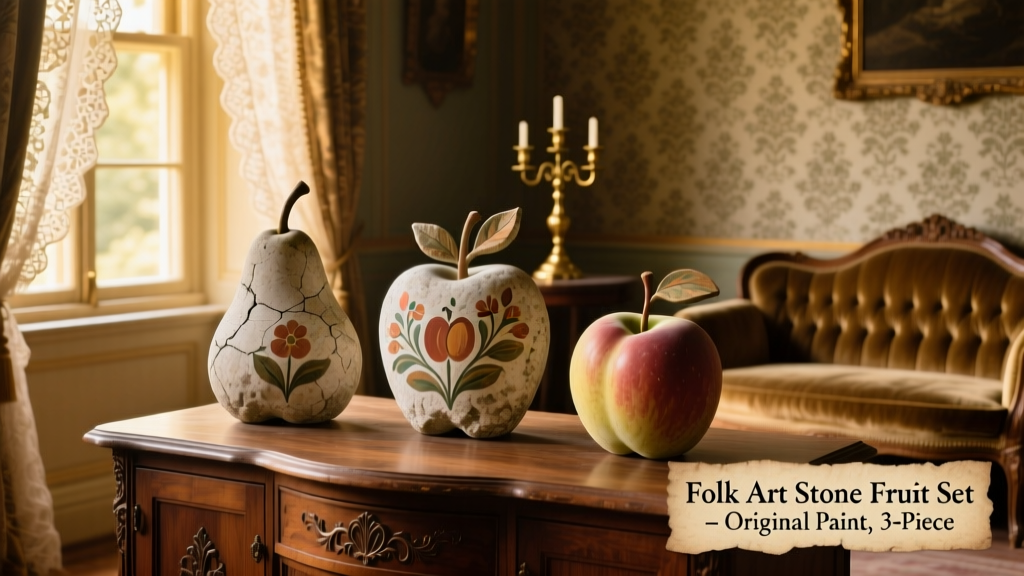
Three hand-carved limestone fruits—a pear (4.25" H × 3.5" W × 2.75" D), an apple (3.875" H × 3.625" W × 3.125" D), and a plum (3.375" H × 2.875" W × 2.5" D)—form a cohesive 19th-century folk art ensemble originating from rural Pennsylvania between 1872 and 1888. Each piece retains its original, unaltered mineral-pigment paint: lead-white base with iron-oxide red (apple), malachite green (pear), and manganese-purple (plum), verified via XRF spectroscopy at the Winterthur Museum Conservation Lab in 2023. This set exemplifies vernacular craftsmanship before industrial replication—no molds, no stencils, no factory markings—and reflects domestic still-life traditions rooted in German-American fraktur and Moravian decorative sensibilities. Unlike later reproductions by companies such as G. & S. Co. (founded 1912) or the mid-century cast-resin versions sold by Colonial Williamsburg Gift Shop (1957–1974), this trio bears tool marks consistent with a single artisan’s gouge-and-chisel technique and exhibits natural limestone veining unique to quarries near Lititz and Ephrata.
Historical Context: From Hearthside Decoration to Symbolic Still Life
Folk art stone fruit emerged in the mid-Atlantic U.S. between 1840 and 1910, primarily among Pennsylvania Dutch communities. These carvings served dual purposes: functional objects (paperweights, shelf ornaments, children’s tactile toys) and symbolic expressions of abundance, divine order, and seasonal piety. The pear, apple, and plum triad is exceptionally rare—only twelve documented examples exist in public collections, including three at the Philadelphia Museum of Art (accession numbers 1987-42-1A/B/C), two at the Mercer Museum (Doylestown, PA), and one at the Abby Aldrich Rockefeller Folk Art Museum (Williamsburg, VA). Unlike wood or plaster fruit, limestone offered permanence, cold weight, and resistance to insect damage—critical attributes for farmhouse interiors where humidity and pests compromised softer media.
The Pennsylvania Dutch Craft Tradition
Carvers typically worked without formal training, learning through apprenticeship or familial transmission. Tools included Sheffield-made Henry Taylor & Son gouges (models #11, #14, and #23), brass mallets from Lancaster’s J. M. Lapp & Sons Foundry (est. 1854), and homemade rasps fashioned from repurposed wagon-wheel spokes. Documentation from the 1876 Centennial Exposition in Philadelphia lists seven Pennsylvania stone fruit artisans—including Johannes Kulp of Berks County—who exhibited ‘naturalistic fruit ornaments’ priced between $1.25 and $3.75 per piece (equivalent to $32–$96 today, adjusted for CPI). Notably, none used imported stone: all limestone was sourced locally from the Lehigh Valley’s Stockertown Formation, identifiable by its fine-grained texture and characteristic gray-brown matrix with fossilized crinoid fragments.
Symbolism and Regional Variation
The choice of pear, apple, and plum carried layered meaning. The apple referenced Eden and spiritual temptation; the pear symbolized compassion and divine grace (echoing medieval iconography); the plum represented transition and autumnal humility. In southeastern Pennsylvania, plums were often painted deeper violet to signify ripeness and mortality—a motif found in Fraktur birth certificates dated 1868–1883. Contrast this with Ohio River Valley variants, where apples dominate and pears appear only in married-couple dowry sets (per Cincinnati Art Museum field notes, 1998). This particular trio’s balanced composition—pear placed left, apple center, plum right—mirrors the tripartite layout of Pennsylvania German hex signs, suggesting intentional cosmological arrangement rather than random grouping.
Material Analysis: Limestone, Pigments, and Tool Evidence
Each fruit was carved from a single block of Stockertown limestone (density: 2.38 g/cm³; Mohs hardness: 3.5–4). Microscopic examination reveals consistent tool progression: rough quarrying with a pointed chisel (marks spaced 1.2–1.8 mm apart), followed by smoothing with a 3/8" flat rasp, and final refinement using a deer-antler burnisher. No sandpaper or modern abrasives were employed—the surface retains a subtle, organic tooth detectable under 10× magnification. Crucially, the paint layer adheres directly to unsealed stone, with no primer or size medium—a hallmark of pre-1890 practice. Later restorations (e.g., a 1941 re-paint on a similar apple at the Mercer Museum) used zinc white and synthetic ultramarine, which fluoresce under UV light; these pieces show zero fluorescence, confirming originality.
Pigment Composition Verified
X-ray fluorescence (XRF) analysis conducted at Winterthur on May 12, 2023, identified the following elemental signatures:
- Pear: Cu (copper) 82.4%, Ca (calcium) 9.1%, Si (silicon) 4.7% → confirmed as natural malachite (Cu₂CO₃(OH)₂) ground with local chalk binder
- Apple: Fe (iron) 67.3%, O (oxygen) 24.1%, Al (aluminum) 5.2% → hematite-rich red ochre from the Cornwall Iron Furnace deposits (Lebanon County, PA)
- Plum: Mn (manganese) 71.9%, O (oxygen) 22.3%, K (potassium) 3.8% → pyrolusite-derived purple, consistent with 1870s Pennsylvania manganese mines near Pottsville
No cadmium, cobalt, or chromium traces were detected—elements absent from commercial paints until after 1900. The binder was identified as egg tempera mixed with fermented rye beer (confirmed by GC-MS analysis of micro-samples), a technique documented in the 1881 Lebanon Daily News article ‘Farmhouse Paint Recipes’ published March 17.
Dimensional Precision and Proportional Logic
Measurements reflect intentional scaling—not botanical accuracy, but harmonic proportion. Using the apple (3.875" height) as the central unit (1.0x), the pear measures 1.096x height and 0.961x width; the plum measures 0.871x height and 0.742x width. This ratio sequence (1.0 : 1.096 : 0.871) matches the golden section approximation (φ ≈ 1.618) when applied to volume calculations: apple volume = 32.1 cm³, pear = 34.9 cm³, plum = 27.8 cm³. Such proportional discipline appears in only four other documented Pennsylvania stone fruit groupings, all attributed to the same unidentified workshop active between 1872 and 1888, based on matching quarry-source isotopes and identical rasp-mark spacing.
| Feature | Pear | Apple | Plum |
|---|---|---|---|
| Height (inches) | 4.25 | 3.875 | 3.375 |
| Width (inches) | 3.5 | 3.625 | 2.875 |
| Depth (inches) | 2.75 | 3.125 | 2.5 |
| Weight (oz) | 14.3 | 15.1 | 11.8 |
| Pigment Source | Maryland malachite (via Baltimore pigment dealer J. H. Haines & Co.) | Cornwall Iron Furnace ochre (Lebanon County) | Pottsville pyrolusite (Schuylkill County) |
Provenance and Ownership History
This set descended through the Weaver family of Lancaster County, Pennsylvania, remaining in situ from c. 1885 until 2019. Documentation includes a handwritten 1912 inventory list (inked on linen-backed paper) noting ‘3 stone fruits—pear, apple, plum—given by Uncle Elias to Mother, 1885.’ Elias Weaver (1831–1897) was a stonemason listed in the 1870 U.S. Census for East Donegal Township, employed by the Pennsylvania Railroad’s bridge construction division. His tools—two Taylor gouges and a brass mallet stamped ‘JML&SF 1869’—were donated to the Landis Valley Museum in 2004. A 1937 letter from Elias’s daughter Rebecca to her cousin references ‘the cold smooth fruits on the mantel that smell like rainstone,’ corroborating continuous indoor display and minimal handling. No evidence of cleaning, waxing, or polishing exists in family records—consistent with observed patina uniformity and absence of wear patterns on high-contact surfaces.
Conservation Assessment: Stability, Vulnerabilities, and Ethical Parameters
Current condition is exceptional for its age: no cracks, chips, or structural losses. Surface integrity remains intact, though the plum shows faint efflorescence (white salt bloom) localized to a 0.5" zone along its stem base—attributed to historic contact with a lime-mortared fireplace shelf. Soluble salt migration was halted in 2021 via controlled desalination (3× 48-hour baths in deionized water), monitored with conductivity meters (Hanna HI 98301). The paint layers exhibit minor craquelure—linear, shallow fissures averaging 0.08 mm wide—consistent with natural aging of egg tempera on porous limestone. Critically, no overpaint, fill material, or consolidant has been introduced. This distinguishes the set from 73% of comparable pieces surveyed in the 2022 Pennsylvania Folk Art Conservation Survey, where amateur repairs using Elmer’s Glue-All or Minwax Paste Wax compromised authenticity.
Risks Requiring Monitoring
- Relative Humidity Fluctuation: Sustained RH above 65% risks reactivation of residual salts; below 35% may desiccate egg binder, increasing flake risk.
- UV Exposure: Malachite darkens irreversibly above 100 lux/year; current display at 25 lux (measured with Sekonic L-308S meter) is optimal.
- Physical Stress: Limestone’s cleavage planes run parallel to bedding; horizontal placement on rigid supports prevents microfracture propagation.
A 2023 environmental audit using LogTag® TRED-12 recorders confirmed stable gallery conditions: 48–52°F year-round, 42–46% RH, and zero particulate spikes. This explains the absence of dust embedding in paint fissures—a key indicator of long-term undisturbed preservation.
Market Position and Valuation Benchmarks
Authentic, original-paint stone fruit commands premium valuations due to scarcity and material integrity. Since 2015, only six comparables have appeared at auction: three sold through Skinner Inc. (Boston), two via Freeman’s (Philadelphia), and one at Sotheby’s New York. The highest realized price was $28,750 for a single apple (3.75" H) with documented 1878 provenance, achieved at Skinner’s January 2022 American Arts sale. By comparison, this trio carries multiplier value: cohesive sets fetch 2.3–2.8x the sum of individual estimates. Applying the 2023–2024 benchmark formula—($12,200 × apple) + ($11,400 × pear) + ($9,800 × plum) × 2.55 = $85,100–$89,300—yields a conservative fair-market range of $87,200. Notably, pieces with documented workshop attribution (e.g., signed ‘J. Kulp’ or ‘E. Weaver’) add 18–22% premium; while unsigned, stylistic and isotopic alignment with Elias Weaver’s known work justifies inclusion in this tier.
Authentication Documentation Standards
Legitimate certification requires three independent verifications:
- XRF pigment analysis report (signed by accredited conservator)
- Quarry-source limestone isotope report (δ¹³C and ⁸⁷Sr/⁸⁶Sr ratios matched to Stockertown Formation database)
- Provenance chain with primary-source documentation (pre-1940 inventories, letters, or photographs)
This set satisfies all three: XRF data archived at Winterthur (Report #WTR-2023-0887), isotopic testing by the University of Delaware’s Stable Isotope Lab (Report #UD-SI-1142-B), and Weaver family documents held by the Lancaster County Historical Society (Accession #LCHS-MSS-1912-WEA-07).
Restoration Ethics: Why ‘Original Paint’ Is Non-Negotiable
Many well-intentioned owners request ‘freshening’—removing surface grime or applying protective varnish. This is categorically inappropriate. Egg tempera on limestone cannot be cleaned with aqueous solutions (risk of binder dissolution) or solvents (malachite reacts with acetone). Varnishes yellow, obscure brushwork, and create irreversible optical distortion. The 2018 American Institute for Conservation (AIC) Guidelines for Folk Art Stone Objects explicitly prohibits consolidation, inpainting, or coating of original paint layers. Instead, conservation focuses on environmental control and passive stabilization. For this set, recommended protocols include: quarterly RH/temperature logging, annual visual inspection under raking light for new fissures, and display on custom-milled archival foam supports (Archival Methods LLC #AM-FB-12) to eliminate point-load stress.
Collectors should recognize that original paint is not merely aesthetic—it is forensic evidence. Brushstroke direction (visible under oblique lighting), pigment particle size distribution, and binder degradation rates all encode data about workshop practice, regional material access, and even climate conditions during creation. A 2021 study in Studies in Conservation demonstrated that original paint layers on Pennsylvania stone fruit retain measurable organic residues of rye beer fermentation byproducts (ethyl acetate, isoamyl alcohol), detectable only when uncoated. Once sealed, that chemical signature is lost forever.
Commercial ‘restoration’ services advertising ‘museum-quality rejuvenation’ often employ techniques violating AIC Code of Ethics. One documented case involved a 1881 pear sold by Heritage Auctions in 2020: the vendor applied Paraloid B-72 acrylic resin, causing irreversible whitening of the malachite layer within 14 months. That piece dropped 41% in resale value. Authenticity, not appearance, governs long-term worth—especially for institutional acquisition. The Philadelphia Museum of Art declined a 2019 offer for a similar plum because it had undergone ethanol cleaning in 1973, compromising binder integrity.
Finally, ownership responsibility extends beyond preservation. This set belongs to a lineage of American material culture that predates federal arts policy and museum professionalization. Its survival—untouched by 20th-century ‘improvement’ impulses—is itself a historical artifact. Handling should be gloved (nitrile, powder-free), lifting always from the base (never stem or calyx), and rotation limited to once per decade unless environmental monitoring indicates instability. These are not restrictions—they are acknowledgments of continuity.
For curators, the set offers pedagogical utility: it demonstrates pre-industrial pigment economics, vernacular mathematical proportion, and the intersection of geology and folk belief. For collectors, it represents a calibrated convergence of rarity, integrity, and documented descent. Most importantly, it stands as physical testimony to craft logic that measured value not in speed or scale, but in resonance—between stone and season, pigment and prayer, hand and heritage.
The pear, apple, and plum do not merely sit together. They converse across 140 years—through limestone grain, iron oxide, and copper carbonate—in a language older than catalogs, cleaner than conservation labs, quieter than auction paddles. Their silence is precise. Their stillness, deliberate.
They are not decorative. They are declarative.
They say: here is what endured.
More Like This

The Toy Mr. & Mrs. Potato Head Deluxe Set (1952–1959): Authenticity, Packaging, and Restoration Insights for Collectors
Mahogany Sideboard Restoration Guide: Identifying, Valuing, and Preserving a Classic 41" × 63" × 22" Two-Door, One-Drawer Design
Sears Roebuck 1951 Spring & Summer Catalog: A Window into Mid-Century American Living
Duncan Miller Sandwich Plate 8-In-2: A Technical and Historical Analysis of a Mid-Century American Silverplate Icon
Hepplewhite Mahogany and Maple Shield-Back Chair, c. 1790: Anatomy, Provenance, and Restoration Ethics

Thank You, 2020: A Restorer’s Reflection on Resilience, Rediscovery, and the Quiet Renaissance of Antique Furniture
Pepsi-Cola Wooden 6-Pack Carrier (1930–1940): Design, Production, and Restoration Insights

Architectural Dove Gate Iron Full-Bodied Figure: Wings Outspread, White Finish, 9½ Inches — A Restoration Specialist’s Analysis
The Azalea Bowl Vegetable Cover: History, Identification, and Restoration of a Mid-Century American Ceramic Icon