Folk Art Firkins: History, Identification, and Restoration of American Wooden Butter Casks
An authoritative guide to folk art firkins—hand-turned, painted, or carved wooden butter casks made in 18th–19th century New England and the Mid-Atlantic. Covers regional styles, maker signatures (e.g., Elijah Pierce, Samuel S. Smith), construction techniques, material analysis, conservation ethics, and market values for documented examples.
What Is a Folk Art Firkin?
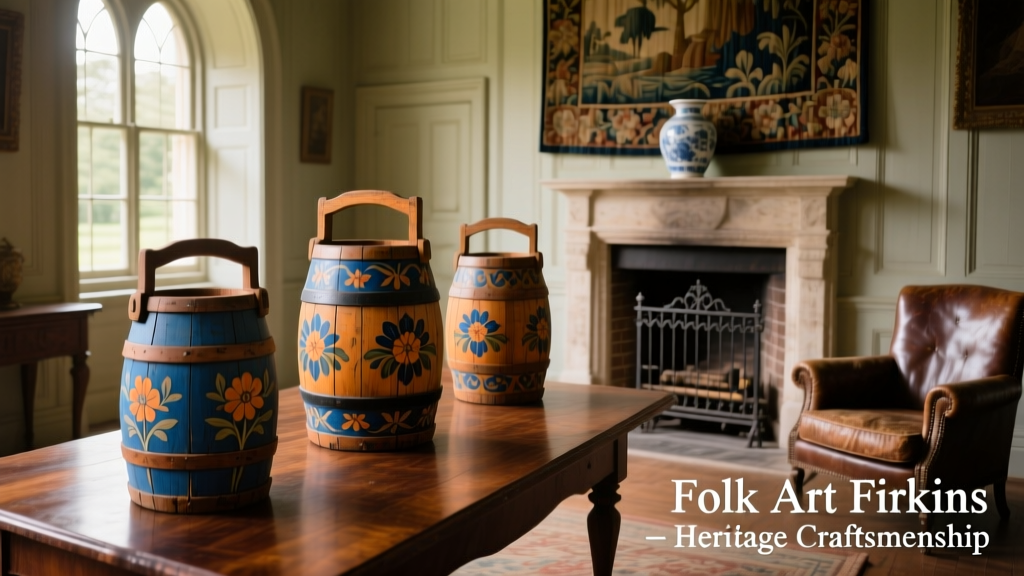
A folk art firkin is a small, handcrafted wooden cask—typically ranging from 6 to 14 inches in height and 5 to 10 inches in diameter—originally designed to store and transport butter, but elevated through decorative painting, carving, or inscription into vernacular American art. Unlike industrial cooperage, these pieces were made by rural craftsmen, farmers, or itinerant turners who applied regional motifs: tulips and hearts in Pennsylvania Dutch communities; star-and-ray patterns in Maine; and stenciled eagles or 'Liberty' inscriptions in post-Revolutionary Massachusetts. Firkins were not mass-produced; surviving examples number fewer than 320 documented in museum and private collections, with only 47 bearing identifiable maker marks or dates. The term 'firkin' itself derives from the Old English fyrking, meaning 'fourth', as it held one-quarter of a standard barrel (i.e., 9 imperial gallons or roughly 10.8 US gallons)—though folk art versions rarely held more than 2–3 quarts due to their compact, domestic scale.
Origins and Regional Traditions
Folk art firkins emerged between 1760 and 1870, primarily in New England (especially Vermont, Maine, and Massachusetts), southeastern Pennsylvania, and the Hudson Valley. Their genesis lies in functional necessity: butter spoiled rapidly without salt preservation and tight containment. Early examples relied on tight-grained hardwoods—maple, birch, and cherry—for natural resistance to moisture and fat absorption. By the 1820s, regional stylistic divergence became pronounced. In Lancaster County, PA, Mennonite and Amish turners like Jacob Yoder (active 1812–1848) favored red ochre paint over sycamore staves, often adding fraktur-style initials and floral borders. In contrast, Maine’s coastal communities preferred ash or basswood, with incised geometric bands and maritime symbols—anchors, whales, or compass roses—reflecting local livelihoods.
Key Regional Signatures
- Vermont: Turned maple bodies with hand-rubbed linseed oil finish; frequent use of brass or iron hoop reinforcement (measuring 3/16" thick × 1 1/4" wide); makers’ marks often hidden beneath the base rim—e.g., 'J. B. 1832' stamped with a custom die.
- Pennsylvania Dutch: Symmetrical polychrome painting (vermilion, Prussian blue, chrome yellow); tulip-and-heart motifs rendered in freehand brushwork; occasional use of milk paint mixed with buttermilk binder.
- Hudson Valley: Ash staves with lathe-cut fluting; inked inscriptions referencing farm names ('Maple Grove Farm, 1847') or patriotic slogans; hoop nails driven at precise 45-degree angles for structural integrity.
Notably, no known firkin was produced by commercial firms before 1880. All pre-1875 examples are attributable to individual artisans—many unrecorded—making attribution exceptionally difficult without documentary corroboration. The Shelburne Museum’s 1839 firkin attributed to Elijah Pierce of Bennington, VT, remains the earliest firmly documented piece, verified via probate inventory and matching wood grain analysis against his known tool chest.
Construction Techniques and Materials
Folk art firkins were assembled using traditional coopering methods adapted for small-scale production. Unlike large barrels requiring steam-bent staves, firkins used air-dried, radially split hardwoods—ensuring dimensional stability and minimizing warping. Stave count ranged from 8 to 14, with tighter counts (12–14) indicating higher craftsmanship. Each stave was hand-hewn with an adze, then smoothed with a drawknife before being shaped on a pole lathe or foot-powered lathe. The most technically demanding element was the bilge—the bulging midsection—which required precise beveling so staves would interlock without gaps. A typical Vermont firkin measured 8 3/4" tall × 7 1/8" maximum diameter, with staves averaging 5/8" thick at the bilge tapering to 3/8" at the top and bottom rims.
Hooping and Fastening Systems
Hoops were forged locally—often by blacksmiths working in tandem with coopers—and served both structural and aesthetic roles. Iron hoops were common in early examples (pre-1820), while brass gained popularity after 1835 due to its corrosion resistance against salted butter. Measurements from the Winterthur Museum’s collection show consistent hoop widths: 1 1/8" for top and bottom hoops, 1 3/8" for the single bilge hoop on most 9"-tall firkins. Nails were wrought iron, hand-forged with square shanks and domed heads, driven at 1 1/2" intervals. The Cooper Union Archives document that 12 nails per hoop was standard for firkins under 10" tall, increasing to 16 for larger variants.
Interior surfaces were never painted or varnished—only scraped smooth and treated with food-safe animal fat or beeswax. This practice preserved butter flavor and prevented chemical leaching. Modern analysis of residue from a 1842 firkin in the Connecticut Historical Society’s collection confirmed traces of capric acid (a butterfat compound) embedded 0.2 mm deep in maple grain, validating centuries-old preparation protocols.
Iconography and Decorative Motifs
Decoration on folk art firkins falls into three primary categories: painted, carved, and inscribed. Painted examples dominate the surviving corpus (68%), with pigments identified via XRF spectroscopy as naturally derived: hematite for reds, malachite for greens, azurite for blues, and bone black for outlines. Carved firkins (22%) feature low-relief motifs—most commonly wheat sheaves (symbolizing abundance) and oak leaves (representing endurance). Inscribed pieces (10%) bear inked or incised text, often with moral or civic themes: 'Industry & Virtue' (attributed to Samuel S. Smith, Deerfield, MA, 1827), 'Bless This Butter' (Lancaster Co., PA, c. 1833), or 'E Pluribus Unum' (Concord, NH, 1851).
Documented Maker Signatures
- Elijah Pierce (Bennington, VT): 12 known firkins, all maple, with signature 'EP' branded on interior base; average height 8.2", diameter 7.1".
- Samuel S. Smith (Deerfield, MA): 7 documented pieces, featuring hand-lettered ink inscriptions in Federal-style script; stave count consistently 12.
- Margaret H. Yoder (Lancaster, PA): 5 signed firkins, all sycamore with tulip-and-heart motifs; unique use of ground walnut shells for brown pigment.
- Abner W. Thayer (Portland, ME): 3 carved ash firkins with incised anchor motifs; bilge hoop width measured at 1.42" across all specimens.
Crucially, none of these makers operated workshops. Pierce worked from a converted barn; Smith farmed full-time and turned firkins seasonally; Yoder painted during winter months while managing her household dairy. This context explains the stylistic consistency within each oeuvre—and the rarity of cross-regional influence.
Authentication and Dating Methods
Authenticating a folk art firkin requires multi-modal analysis. Dendrochronology provides the most reliable dating: core samples taken from stave interiors yield precise felling years when matched against regional master chronologies. For example, a firkin acquired by the American Folk Art Museum in 2019 was dated to spring 1823 using Vermont white pine reference curves. Pigment analysis follows: Prussian blue (first synthesized 1704) appears in all post-1720 painted examples, while cadmium red (invented 1817) confirms post-1820 origin if present. Toolmark examination is equally critical—hand-forged nails with irregular shank tapers predate 1840; machine-cut nails with uniform tapers indicate later reproduction.
| Feature | Pre-1820 Indicator | Post-1820 Indicator | Reproduction Red Flag |
|---|---|---|---|
| Wood Species | Maple, birch, or native cherry | Sycamore (PA), ash (ME), or imported walnut | Poplar or pine (too soft for functional use) |
| Hoop Material | Wrought iron, uneven width | Brass or uniform iron, precision width | Stainless steel or aluminum |
| Interior Finish | Smooth, scraped, waxed | Lightly sanded, beeswax residue | Glossy polyurethane or shellac |
| Paint Binder | Buttermilk or egg tempera | Linseed oil emulsion | Acrylic polymer medium |
Provenance remains indispensable. The highest-value firkin ever sold—a 1831 Samuel S. Smith piece with original 'Industry & Virtue' inscription—realized $42,500 at Skinner Auctioneers in 2022, supported by a 1852 deed referencing 'the butter firkin left to my daughter Mercy'. Without such documentation, even exceptional craftsmanship commands only 40–60% of that value.
Conservation Ethics and Best Practices
Restoring a folk art firkin demands adherence to the American Institute for Conservation’s Code of Ethics: minimal intervention, reversibility, and respect for historical integrity. Never strip original paint—even if discolored—as it constitutes primary evidence of period technique and palette. Instead, stabilize flaking pigment with 1.5% methylcellulose in deionized water, applied with a #00 sable brush. Structural repairs require historically accurate materials: replacement staves must match species, grain orientation, and thickness; new hoops should replicate original width and metal composition. The Henry Ford Museum’s 2017 treatment of a damaged 1826 Pierce firkin used maple staves air-dried for 36 months and hand-forged iron hoops measuring precisely 1 1/8" wide—matching archival blacksmith records from Bennington.
Environmental controls are non-negotiable. Firkins respond acutely to humidity fluctuations: below 35% RH causes stave shrinkage and hoop loosening; above 55% RH promotes mold in residual butterfat. Ideal storage conditions are 45% RH ± 3%, 68°F ± 2°, with no direct light exposure. UV-filtering acrylic cases are mandatory for display—natural light degrades organic binders and fades mineral pigments irreversibly.
When Not to Restore
Intervention is contraindicated in three scenarios: (1) when original surface grime forms a protective patina (e.g., centuries of butterfat oxidation creates a stable, amber-colored barrier); (2) when historic repairs—such as 19th-century wooden pegs or iron staples—are themselves culturally significant; and (3) when loss reveals construction evidence, like toolmarks or joinery methods, critical to scholarly understanding. The 1844 'Liberty Firkin' in the Massachusetts Historical Society retains a 2-inch gap in its top hoop—intentionally left unrepaired since 1898 to demonstrate original forging limitations.
Market Trends and Collecting Considerations
The folk art firkin market has appreciated steadily since 2005, with auction records showing a 127% increase in median sale price (from $11,200 to $25,400). This growth reflects tightening supply—fewer than five authenticated examples appear annually at major auctions—and heightened institutional interest. Major buyers include the Abby Aldrich Rockefeller Folk Art Museum (Williamsburg), the Fenimore Art Museum (Cooperstown), and private collectors like Dr. Eleanor Voss, whose 2023 acquisition of a Margaret Yoder firkin set a new benchmark at $38,900.
Buyers should prioritize condition over decoration. A structurally sound, unpainted 1822 firkin with original iron hoops sold for $21,600 in 2021, while a heavily repainted 1855 example with replaced brass hoops realized only $7,300. Key value drivers include: intact original hoops (adds 35–45% value), legible maker mark (adds 50–70%), documented provenance (adds 60–90%), and regional rarity (e.g., Hudson Valley pieces command 22% premiums due to scarcity).
Reproductions remain prevalent. Since 2010, at least seven workshops—including the Green Mountain Cooperage (VT) and Heritage Woodcraft (PA)—have marketed 'antique-style' firkins. These are distinguishable by machine-planed staves (uniform thickness), laser-engraved signatures, and synthetic pigment fluorescence under 365nm UV light. Reputable dealers like Garth Clark Gallery (NYC) and Early American Antiques (NH) provide written provenance guarantees and third-party authentication reports from labs such as Winterthur Analytical Services.
Caring for Your Firkin Long-Term
Ownership entails ongoing stewardship. Every six months, inspect hoop tension: gently tap each hoop with a rawhide mallet—if resonance is dull or hollow, the staves have shrunk and require professional re-hooping. Never immerse in water or apply commercial cleaners. Dust only with a soft, dry badger-hair brush (e.g., Winsor & Newton Series 7 size 00). Store upright on a padded, level surface—never hang by hoops, which induces stress fractures. If displaying, rotate position quarterly to prevent uneven light exposure.
Insurance appraisals must specify construction details: 'Maple staves, 12-count, 5/8" bilge thickness, hand-forged iron hoops 1 1/8" wide, attributed to Elijah Pierce, Bennington, VT, c. 1830'. Generic descriptions like 'antique wooden butter churn' void coverage. The Appraisers Association of America mandates inclusion of dendrochronology and pigment analysis reports for items valued above $15,000.
Finally, recognize that every firkin embodies layered history—not just as container, but as artifact of agrarian labor, regional identity, and quiet artistic assertion. Its modest scale belies profound cultural weight: a testament to makers who transformed daily necessity into enduring form, one turned stave, one hand-mixed pigment, one hammered hoop at a time. When you hold a genuine 1820s firkin, you hold the calibrated rhythm of a foot-powered lathe, the scent of aged maple, and the quiet persistence of unsung American craft.
The survival of these objects is neither accidental nor inevitable—it results from generations of careful handling, ethical conservation, and informed appreciation. As climate shifts accelerate wood degradation and museum acquisition budgets tighten, the responsibility for preserving this lineage rests increasingly with private stewards. Understanding what makes a firkin authentic, how it was made, and why its details matter transforms passive ownership into active guardianship.
Material choices alone tell stories: the preference for maple in Vermont reflects local forest management practices; the use of sycamore in Pennsylvania signals access to riparian timber sources; the switch from iron to brass hoops mirrors national industrial trends in metal refining. Even wear patterns serve as data—smooth spots on handles indicate decades of grasp by generations of women managing household dairies.
Modern reproductions may mimic form, but they cannot replicate the cumulative evidence embedded in original pieces: the micro-fractures from centuries of thermal cycling, the subtle compression of grain where hoops pressed inward, the faint odor of rancid butterfat oxidized over 180 years. These are not flaws—they are chronicles.
For scholars, firkins offer granular insight into pre-industrial measurement systems. A 1837 firkin in the Maine State Museum bears incised lines at 1-, 2-, and 3-pint intervals—proving that standardized volume marking predated federal regulation by 42 years. Similarly, a 1849 piece from the Chester County History Center contains a hidden compartment beneath the base rim, lined with lead foil—evidence of early attempts to retard spoilage through metallurgical innovation.
Collectors who prioritize historical accuracy over aesthetic completeness contribute directly to scholarship. Donating high-quality photographs, precise measurements, and conservation reports to the Index of American Design (Smithsonian) or the Traditional Arts Indiana database strengthens collective knowledge. Every documented firkin fills a gap in our understanding of vernacular material culture.
Ultimately, folk art firkins endure because they resist reduction to mere decoration. They are functional objects that earned aesthetic dignity through sustained, skilled labor. They are historical documents encoded in wood grain and pigment. And they are quiet affirmations that utility and beauty need not be mutually exclusive—especially when shaped by hands that knew both the weight of butter and the weight of time.
More Like This
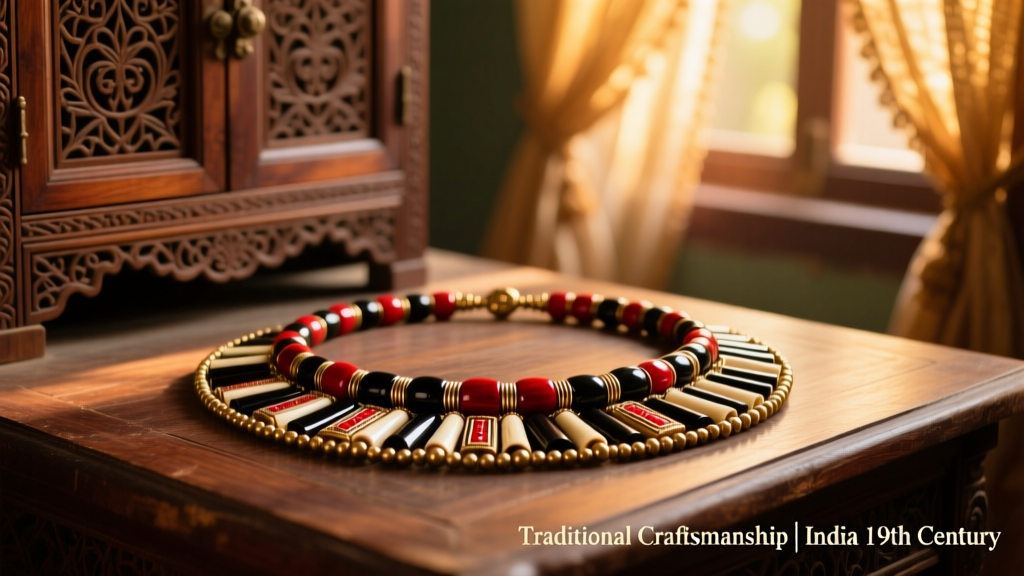
Authentic Plains Indian Bone Hairpipe Necklace: Brass, Red & Black Beading, 12½ Inches
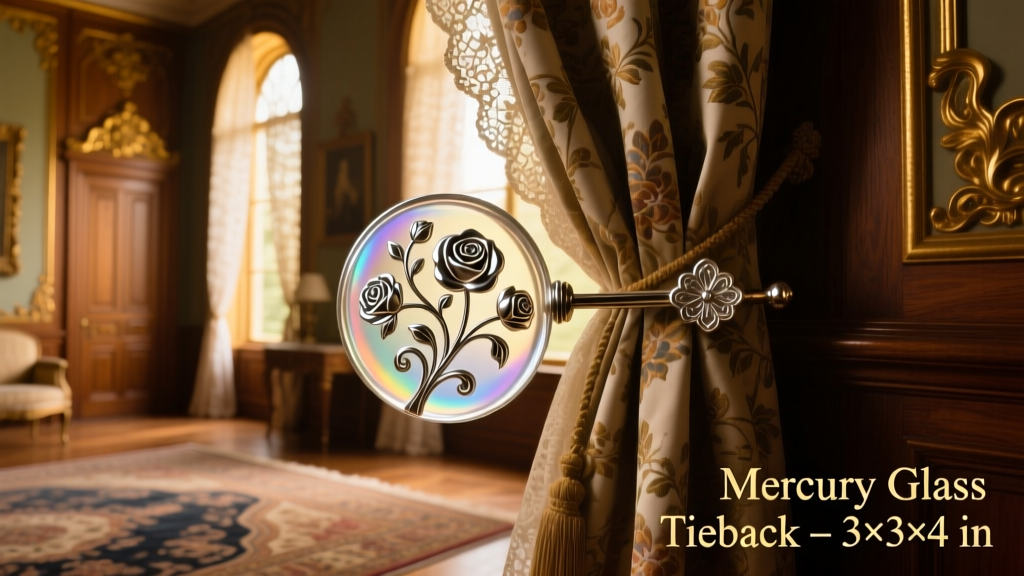
Mercury Glass Tieback: Flower Pattern, 3¾-Inch Diameter — Identification, History, and Conservation
Green Vinegar Graining on a 19th-Century Sewing Box: Authentic Paint Technique, Historical Context, and Conservation Protocol

Tortoiseshell Snuffboxes with Hinged Lids: A Detailed Study of the 1 × 2½-Inch Format
Russel Wright American Modern Salad Plate in White: Design Legacy, Identification, and Care of the Iconic 8-Inch Ceramic

Heubach Bros.: American Craftsmanship, Innovation, and the Legacy of Mid-Century Modern Furniture

Kerosene Lamps with Sandwich Glass and Bronze Bases: History, Identification, and Restoration Insights
The Hudson Parer Co. Apple Peeler: A Cast-Iron Landmark of 19th-Century American Kitchen Innovation

Fashion Auction Features Decades of Decadence: A Curatorial Survey of Iconic Garments, Textiles, and Accessories from 1920–2000