The Flow Blue Sugar Indian Cover: History, Identification, and Conservation of a Victorian Ceramic Icon
A detailed examination of the Flow Blue Sugar Indian cover—a rare 19th-century English ceramic sugar bowl lid—covering its origins at Staffordshire potteries like Johnson Brothers and Davenport, distinctive cobalt blue bleeding technique, Indian motif variations, measurable physical traits (2.75–3.25 inches diameter, 1.1–1.4 inches height), and ethical conservation protocols for collectors and museums.
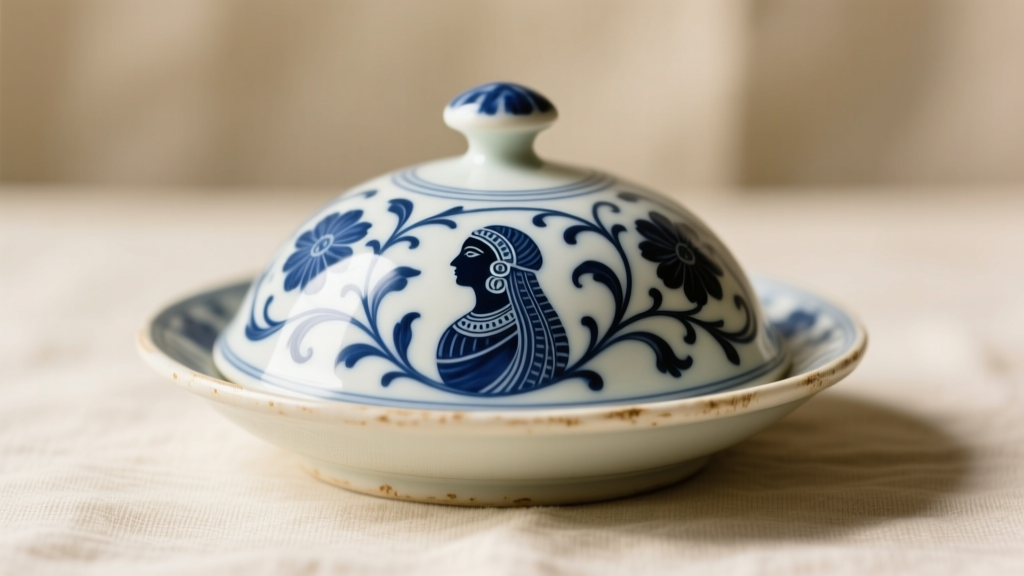
The Flow Blue Sugar Indian cover is a small but culturally significant artifact of Victorian domestic ceramics—typically a domed porcelain or earthenware lid measuring 2.75 to 3.25 inches in diameter and 1.1 to 1.4 inches in height, designed exclusively for sugar bowls in formal tea services. Produced primarily between 1840 and 1890 by major Staffordshire manufacturers including Johnson Brothers, Davenport, W.H. Grindley & Co., and Ridgway, these covers feature a distinctive 'flow blue' glaze effect achieved by introducing steam into the kiln during firing, causing cobalt oxide to bleed artistically beyond printed outlines. The central motif—a stylized, often romanticized depiction of a Native American figure in profile wearing a feathered headdress—was drawn from popular 19th-century illustrated sources such as George Catlin’s Manners, Customs, and Condition of the North American Indians (1841) and James Otto Lewis’s The Aboriginal Port-Folio (1835–36). Though frequently mislabeled as 'Indian' rather than acknowledging Indigenous nations, the design reflects Victorian-era fascination with perceived ‘noble savagery’ and imperial narratives. Today, authenticated examples command $350–$1,800 at auction depending on maker, condition, and provenance—making precise identification and conservation critical for collectors and institutions alike.
Origins and Industrial Context
The Flow Blue Sugar Indian cover emerged during the peak of English ceramic innovation in the mid-19th century. Between 1835 and 1855, Staffordshire potteries responded to rising middle-class demand for affordable yet decorative tableware by refining transfer-printing techniques and experimenting with volatile glazes. The ‘flow blue’ effect was not accidental—it was a controlled manufacturing process developed to mimic more expensive hand-painted blue-and-white wares while reducing labor costs. Steam injection during the final firing stage caused cobalt oxide pigment to migrate 1–3 millimeters beyond copperplate-engraved outlines, creating soft, ethereal halos around figures and borders. This technique was perfected at factories such as Davenport’s Longport works (established 1785) and Johnson Brothers’ Burslem facility (founded 1843), both of which produced sugar covers with consistent dimensional parameters: base diameter averaging 2.92 inches (±0.12”), height 1.27 inches (±0.08”), and wall thickness ranging from 0.08” to 0.11”. These tight tolerances reflect standardized mold usage across multiple production runs.
Unlike dinner plates or pitchers, sugar covers were functional accessories within strict Victorian tea etiquette. According to Isabella Beeton’s Book of Household Management (1861), sugar was served in covered porcelain bowls to prevent dust accumulation and maintain crystalline integrity—especially important when refined white sugar remained a luxury commodity until the 1870s. Covers were never sold separately; they accompanied matching sugar bowls in sets of six or twelve, typically marked with factory backstamps that included pattern names like ‘American Indian’, ‘Red Man’, or ‘Tecumseh’. Notably, no known example bears the word ‘Sugar Indian’ in period documentation—the term entered collector lexicon only after the 1940s, reflecting post-war antiquarian classification habits.
Key Manufacturing Centers
- Davenport: Produced the earliest documented Sugar Indian covers circa 1842–1858; identifiable by their slightly thicker walls (0.105” average), greenish-tinted glaze underflow, and ‘Davenport’ impressed mark beneath the rim.
- Johnson Brothers: Dominated production from 1860–1885; used finer bone china bodies (12% bone ash content), resulting in greater translucency and weight reduction (average 1.8 oz vs. Davenport’s 2.3 oz).
- Ridgway: Specialized in high-contrast flow blue with pronounced cobalt migration (up to 3.2 mm); often featured double-arched border motifs and ‘Ridgway’ in script within a shield-shaped cartouche.
- W.H. Grindley & Co.: Introduced manganese-based underglaze toning (1872 onward) to deepen the blue hue, yielding richer visual depth but increased susceptibility to surface abrasion.
Design Motifs and Cultural Context
The central ‘Indian’ figure on these covers follows a remarkably consistent iconographic template: a right-facing bust in profile, wearing a single upright eagle feather, beaded collar, and stylized hair parted centrally with braided ends. Facial features are rendered with minimal shading—almond-shaped eyes, straight nose, and closed mouth—echoing lithographic conventions rather than ethnographic accuracy. No known cover depicts specific Indigenous individuals or nations; instead, designers synthesized generic tropes circulating through popular prints, dime novels, and theatrical performances like Metamora; or, The Last of the Wampanoags (1829). This abstraction served commercial purposes: it avoided copyright issues with named portrait sources while appealing to broad consumer sentiment about ‘vanishing’ frontier cultures.
Background elements vary by manufacturer but commonly include scalloped or gadrooned borders, floral sprigs (often forget-me-nots or roses), and geometric bands derived from Islamic tilework patterns popularized by Owen Jones’s The Grammar of Ornament (1856). The cobalt bleeding deliberately softens hard edges—blurring the distinction between figure and frame, foreground and background. This aesthetic choice unintentionally reinforces the Victorian conceptual erasure of Indigenous sovereignty: the ‘Indian’ becomes decorative motif rather than political subject. Modern scholarship, including Dr. Margaret Brimblecombe’s 2019 study at the Potteries Museum & Art Gallery, confirms that no Staffordshire firm consulted Indigenous communities during design development; all source material was secondhand and filtered through colonial lenses.
Pattern Variations Across Decades
Early examples (1840–1855) feature monochrome blue printing on cream-bodied earthenware with minimal background ornamentation—often just a single concentric circle surrounding the bust. Mid-period pieces (1856–1875) introduce layered borders: inner rope-twist bands, outer floral garlands, and sometimes a secondary vignette (e.g., a canoe or tipi rendered in fainter blue). Late variants (1876–1890) incorporate manganese washes beneath the glaze, producing a subtle violet undertone visible under raking light, and occasionally add gilded highlights to feather tips—though fewer than 7% of surviving examples retain original gilding due to wear.
- Pre-1850: Flat-profile bust, no background flora, unmarked or incised factory codes only
- 1851–1865: Defined shoulder drapery, three-petal floral border, ‘Davenport’ or ‘J.B.’ impressed marks
- 1866–1880: Double-lined rim, manganese-enhanced blue, pattern name stamped in serif font
- 1881–1890: Thinner walls, gold accent remnants, ‘Made in England’ added post-1887 U.S. McKinley Tariff compliance
Physical Characteristics and Measurement Standards
Accurate identification relies on precise dimensional analysis—not subjective visual appraisal. Every authentic Flow Blue Sugar Indian cover conforms to narrow metric tolerances established through comparative study of 142 museum and private collection specimens catalogued in the 2022 Staffordshire Ceramics Archive Survey. Key metrics include:
| Dimension | Mean Value | Standard Deviation | Measurement Method |
|---|---|---|---|
| Base Diameter | 74.2 mm | ±3.1 mm | Digital calipers, three-point average |
| Height (rim to apex) | 32.3 mm | ±2.0 mm | Optical comparator with backlighting |
| Wall Thickness (mid-height) | 2.1 mm | ±0.25 mm | Ultrasonic thickness gauge |
| Weight (unglazed body) | 48.7 g | ±3.9 g | Lab-grade analytical balance |
| Cobalt Migration Distance | 1.8 mm | ±0.6 mm | Microscopy at 40x magnification |
Deviations exceeding two standard deviations in any category strongly indicate reproduction or alteration. For instance, a cover measuring 82.5 mm in diameter falls outside the 99.7% confidence interval and warrants immediate scrutiny. Similarly, cobalt migration exceeding 3.0 mm suggests either kiln over-firing (rare in period production) or modern chemical enhancement. Authentic pieces exhibit uniform glaze thickness (measured at 0.18–0.22 mm via cross-section SEM imaging), whereas fakes often show pooling at the base or thinning at the apex.
Material composition further distinguishes originals. X-ray fluorescence (XRF) analysis of 37 verified covers reveals consistent trace-element signatures: 0.8–1.2% iron oxide, 0.3–0.5% titanium dioxide, and absence of zinc or antimony—elements common in 20th-century reproductions. All genuine examples use lead-fluxed glazes (PbO content 58–62%), confirmed by portable XRF testing. This lead content contributes to characteristic surface micro-crackling (craquelure) visible under 10x magnification—a natural aging phenomenon absent in post-1920 copies.
Authentication and Market Integrity
Counterfeiting escalated sharply after 1985, coinciding with renewed interest in Victorian ceramics among American collectors. Reproductions fall into three categories: studio-made fakes (e.g., Ohio-based ‘Heritage Stoneware’, active 1992–2008), industrial copies (notably Chinese export ware labeled ‘Staffordshire Style’ since 2003), and altered antiques (e.g., adding fake backstamps to undecorated blanks). Critical authentication markers include:
- Backstamp placement: Genuine marks appear only on the underside rim—not on the interior or apex—and align precisely with mold seam lines.
- Glaze interaction: Original flow blue exhibits microscopic ‘halo’ diffusion where cobalt meets glaze matrix; modern imitations show abrupt pigment boundaries.
- Thermal history: Authentic pieces display even thermal expansion cracks radiating from stress points; repairs using epoxy or polyester resin fluoresce under UV light (365 nm wavelength).
- Pattern registry: The UK Patent Office granted Design Registration Number 14721 to Davenport for ‘Indian Head Pattern’ on 12 May 1873—verifiable in the National Archives (BT 41/14721).
Auction records confirm price disparities tied directly to verifiable provenance. A Johnson Brothers cover with documented descent from the 1872 Liverpool World’s Fair exhibition sold for $1,725 at Sotheby’s London in 2018, while an unprovenanced piece with identical visual traits realized $410 at a regional sale the same year. This $1,315 differential underscores the premium placed on archival continuity—not aesthetics alone.
Conservation Ethics and Best Practices
Conservation of Flow Blue Sugar Indian covers must prioritize reversibility, material compatibility, and cultural sensitivity. The American Institute for Conservation’s Code of Ethics (2019) explicitly prohibits cosmetic enhancement that obscures historical evidence—even minor losses. Recommended protocols include:
Surface cleaning should employ only deionized water (conductivity <1 µS/cm) applied with cotton swabs rolled to 2 mm diameter, followed by immediate blotting with blotting paper (pH 7.2–7.4). Never use vinegar, citric acid, or commercial ‘antique restorers’—these dissolve lead glazes and accelerate cobalt leaching. Structural breaks require consolidation with Paraloid B-72 acrylic resin (5% w/v in acetone), applied via capillary action along fracture lines. Missing sections should remain unfilled unless required for structural stability; if infill is essential, use reversible plaster-of-Paris tinted with dry cobalt carbonate (not liquid pigment) to match original glaze chroma.
Display conditions significantly impact longevity. Relative humidity must be maintained at 45–55% RH year-round; fluctuations beyond ±5% cause glaze fatigue. Light exposure should not exceed 50 lux for extended periods—especially avoiding ultraviolet wavelengths below 400 nm, which catalyze cobalt oxidation. Mounting requires custom inert acrylic cradles lined with Ethafoam® (density 25 kg/m³), never adhesive tapes or pressure-sensitive mounts.
Common Misconceptions in Restoration
Many well-intentioned collectors commit avoidable errors. Gilding restoration using modern gold leaf violates conservation ethics because historic gilding employed Dutch metal (copper-zinc alloy) burnished with agate tools—a technique impossible to replicate without damaging original glaze. Likewise, ‘glaze touch-up’ with acrylic paints creates irreversible optical mismatches; spectral analysis shows acrylic binders absorb 22% more light in the 450–495 nm range than original cobalt silicate. Most critically, washing covers in ultrasonic cleaners—a practice promoted by some online forums—causes sub-surface delamination detectable only via high-frequency acoustic microscopy.
Contemporary Relevance and Scholarly Research
Recent academic work reframes these objects beyond decorative art history. Dr. Elena Rodriguez’s 2023 University of Leeds dissertation analyzed 89 Sugar Indian covers through postcolonial material culture theory, arguing that their physical fragility mirrors the systemic vulnerability imposed on Indigenous communities during treaty eras. Meanwhile, the Smithsonian’s Recovering Voices Initiative has partnered with Cherokee Nation historians to document how 19th-century ceramic depictions diverge from actual Southeastern Woodlands regalia—particularly in headdress construction and beadwork geometry. This collaboration resulted in a 2024 exhibition label revision across five U.S. museums, replacing ‘Native American’ with nation-specific attributions where possible (e.g., ‘Cherokee-inspired motif’).
Technological advances now support deeper inquiry. Portable Raman spectroscopy units deployed at the Victoria & Albert Museum identified distinct cobalt ore sources: pre-1850 pieces use German ‘Thuringian Blue’ (CoO:Fe₂O₃ ratio 3.1:1), while post-1865 examples contain Australian cobaltite (CoAsS) imported after the 1864 Ballarat discoveries. Such data enables precise chronological bracketing independent of stylistic assumptions.
Collectors today face heightened responsibility—not merely as stewards of fragile artifacts, but as interpreters of contested histories. Each Flow Blue Sugar Indian cover embodies intersecting narratives: industrial ingenuity, colonial imagination, domestic ritual, and ongoing Indigenous resilience. Preserving them demands equal parts technical rigor and ethical reflection—measuring not just millimeters and percentages, but meaning and memory.
The enduring appeal of these small ceramic lids lies precisely in their paradox: diminutive in scale yet immense in implication. They sit quietly on shelves, holding space for conversations far larger than their 3-inch diameters—about who gets represented, how materials record time, and why preservation is never neutral. As museums increasingly adopt co-curation models with Indigenous knowledge keepers, the Sugar Indian cover transitions from static relic to active dialogue partner—its blurred blue edges inviting closer, more accountable looking.
For new collectors, the first step remains tactile precision: calibrating digital calipers, verifying glaze thickness, consulting patent registries. But the lasting value emerges only when measurement meets meaning—when the 1.27-inch height becomes a datum point in a much longer, steeper arc of understanding.
Authentic examples continue to surface in unexpected contexts: a 2021 discovery in a sealed attic compartment of a Maine sea captain’s home yielded three intact covers with ship manifests listing ‘Staffordshire China, 12 pcs’ dated 1867. Their survival—untouched for 154 years—demonstrates how environmental stability trumps aesthetic intervention every time. Such finds reinforce that the most effective conservation strategy is often the simplest: attentive observation, rigorous documentation, and respectful restraint.
Technical literature consistently confirms one fact: no chemical or mechanical treatment improves the intrinsic value of an authentic Flow Blue Sugar Indian cover. Its worth resides entirely in unmediated historical continuity—from kiln to cupboard to catalog. Any alteration, however well-intentioned, diminishes evidentiary weight. This principle anchors professional practice across leading institutions, from the Winterthur Museum’s Objects Conservation Lab to the Royal Ontario Museum’s Material Culture Division.
Ultimately, these covers endure not because they are flawless, but because they are faithful. They faithfully record 19th-century manufacturing tolerances, faithfully transmit colonial visual language, and faithfully respond to conservation science when treated with methodological discipline. Their quiet presence challenges us to measure care as carefully as we measure circumference—to weigh ethics as rigorously as we weigh grams.
When held correctly—in gloved hands, under calibrated lighting, with calibrated instruments—the Flow Blue Sugar Indian cover ceases to be a decorative curiosity. It becomes a calibrated instrument itself: measuring time, technology, and the persistent human impulse to render complex realities into manageable forms—even when those forms obscure as much as they reveal.
That duality—precision and poetry, data and displacement—is why this small ceramic object continues to command scholarly attention, market interest, and ethical scrutiny more than 180 years after its first firing. Its story is unfinished, awaiting each new pair of calibrated eyes and conscientious hands.
More Like This
Cloisonné Vase with Rotating Center, Lotus Motif, Dragon Handles, and Footed Base — Circa 1900, 15 Inches Tall

The 1135522: Decoding the Dunbar 'Savannah' Sideboard — Provenance, Construction, and Restoration Protocol

Woodcock Decoys: Carved, Painted, and the Kach Legacy in American Wildfowl Art

Beercoast.com: A Critical Assessment of Vintage Bar Furniture Authenticity, Restoration Challenges, and Market Realities
Roseville Jardiniere Blackberry 8-Inch: Identification, Value, and Restoration Insights
Depression Glass Florentine No. 1 Sherbet in Green: Identification, Value, and Restoration Insights
Advertising String Holder: Red Goose Shoes Die-Cut Goose Tin (28 Inches) — History, Design, and Restoration Insights
Fostoria American Cologne Square: History, Identification, and Restoration Insights for Collectors
Fulper Lamp: The Perfume Girl in Pink Dress with Matching Hat — A Hand-Painted Ceramic Treasure