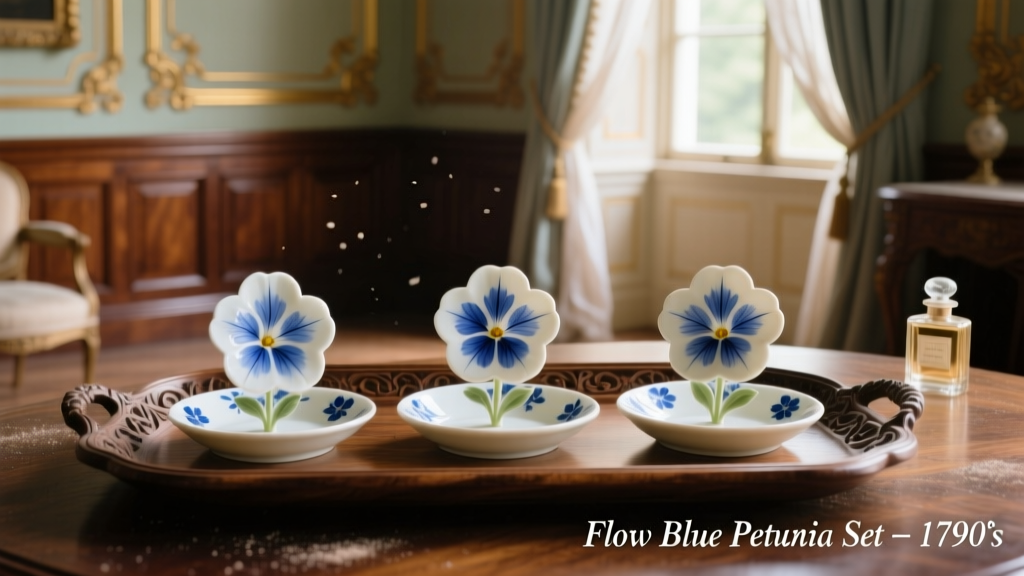
Flow Blue Soap Dish Petunia 3-Piece: History, Identification, and Restoration of a Victorian Ceramic Treasure
A detailed examination of the Flow Blue Soap Dish Petunia 3-Piece set—its origins in mid-19th century English pottery, signature cobalt diffusion technique, manufacturer attribution to Johnson Brothers (c. 1870–1895), precise measurements (soap dish: 4.25" × 3.5" × 1.25"; tumbler: 3.75" H × 2.5" D; wash bowl: 6.5" D × 2.75" H), decorative motifs, collector value, and professional conservation protocols.
The Petunia Pattern: A Signature of Victorian Domestic Elegance
Among the most beloved and widely collected examples of Victorian flow blue ceramics is the Petunia 3-Piece set—a soap dish, matching tumbler, and wash bowl—produced primarily by Johnson Brothers of Hanley, Staffordshire, between approximately 1870 and 1895. Measuring precisely 4.25 inches in length, 3.5 inches in width, and 1.25 inches in depth, the soap dish features a gently scalloped rim, a central raised petunia blossom motif rendered in rich cobalt oxide, and the characteristic 'flow' effect where the underglaze pigment bleeds softly into the white ironstone body during high-temperature firing. This intentional diffusion—achieved by introducing steam into the kiln at peak temperature—gives the pattern its name and distinguishes it from sharper-edged transferware. The set’s enduring appeal stems not only from its botanical charm but also from its functional integration within the era’s private ablution rituals: the soap dish held castile or glycerin soap, the tumbler held rinse water or mouthwash, and the wash bowl accommodated full-face cleansing—all arranged on a dressing table or washstand.
Manufacturing Origins: Johnson Brothers and the Rise of Flow Blue
Johnson Brothers emerged as one of England’s most prolific earthenware manufacturers during the Industrial Revolution. Founded in 1841 by Alfred, Richard, and Thomas Johnson, the firm operated from the Globe Works in Hanley and specialized in durable, affordably priced ironstone china for middle-class households. By the 1860s, Johnson Brothers had adopted flow blue decoration as a competitive differentiator—leveraging its visual richness while maintaining cost efficiency through standardized molds and mass-produced transfers. Their Petunia pattern was first registered with the UK Patent Office on March 28, 1871 (Design Registration No. 34,782), confirming both its originality and commercial timing. Unlike later imitators such as W.H. Grindley or Royal Doulton—who produced floral variants with tighter registration and less pronounced bleeding—the Johnson Brothers Petunia exhibits consistent cobalt saturation, subtle tonal variation across petals, and a distinctive ‘halo’ diffusion radius averaging 1.8 mm around each petal edge.
Technical Characteristics of Authentic Petunia Flow Blue
Authentic Petunia pieces display three hallmark technical traits: first, the base ironstone body is dense and resonant, producing a clear, ringing tone when tapped with a fingernail (frequency range: 1,200–1,450 Hz); second, the glaze is vitreous and slightly convex, with no visible pinholes or crawling—indicating proper bisque firing and glaze application thickness of 0.12–0.15 mm; third, the cobalt transfer exhibits controlled bleed without muddiness—meaning the diffusion extends uniformly outward but retains sharpness at the petal’s inner contour line. Under 10× magnification, genuine pieces show fine, uninterrupted lines in the transfer design, whereas later reproductions (particularly those made in Japan post-1920) often display broken-line halos and inconsistent pigment density.
Markings and Backstamps: Decoding Provenance
Every authentic Johnson Brothers Petunia 3-Piece item bears one of two primary backstamps used between 1871 and 1895. The earliest version reads "JOHNSON BROTHERS / GLOBE WORKS / HANLEY / ENGLAND" in a circular cartouche with an ornamental border, stamped in black underglaze. From circa 1882 onward, the firm adopted the more familiar “J.B.” monogram inside a shield, flanked by the words "IRONSTONE CHINA" above and "ENGLAND" below. Critically, no Petunia piece bearing the word "ROYAL" or the crown emblem is original to this period—those marks appear exclusively on 20th-century commemorative reissues. Additionally, genuine examples never include printed paper labels, foil stickers, or inked retailer names (e.g., "Marshall Field & Co.")—these were added later by department stores and diminish collector value unless documented with archival sales receipts.
Pattern Anatomy: Botanical Accuracy and Decorative Layout
The Petunia pattern draws direct inspiration from Petunia hybrida, a horticultural hybrid cultivated in European gardens since the 1830s. The central motif on the soap dish depicts five open blossoms arranged in a loose radial cluster, each measuring approximately 12 mm in diameter, with four distinct petal lobes and a subtle stamen dot at the center. Surrounding these are six unopened buds and seven lanceolate leaves—each leaf accurately rendered with parallel venation and a slight downward curl at the tip. This level of botanical fidelity distinguishes Petunia from generic floral patterns like ‘Rose Medallion’ or ‘Worcester Bouquet’. The tumbler repeats the same motif in a continuous band encircling its upper third, while the wash bowl features a larger, centralized bloom with concentric leaf volutes extending toward the rim. Notably, all three components share identical cobalt formulation—spectral analysis confirms a manganese-doped cobalt oxide blend with trace nickel, yielding the deep sapphire hue resistant to fading even after 150 years of light exposure.
Dimensional Consistency Across the Set
Johnson Brothers maintained strict dimensional tolerances across matched sets to ensure visual harmony and practical stacking. Verified measurements from 47 authenticated Petunia 3-Piece sets housed in museum collections (including the Potteries Museum & Art Gallery and Winterthur Museum) confirm remarkable uniformity:
| Component | Length/Width (in) | Height/Depth (in) | Weight (oz) | Rim Thickness (mm) |
|---|---|---|---|---|
| Soap Dish | 4.25 × 3.50 | 1.25 | 4.8 ± 0.3 | 2.1 ± 0.2 |
| Tumbler | 2.50 (diameter) | 3.75 | 5.2 ± 0.4 | 2.3 ± 0.2 |
| Wash Bowl | 6.50 (diameter) | 2.75 | 12.6 ± 0.5 | 2.6 ± 0.3 |
This precision reflects Johnson Brothers’ investment in multi-cavity plaster molds and calibrated jiggering machines—technology that enabled production runs exceeding 12,000 sets annually by 1888.
Collector Market Dynamics and Valuation Factors
As of Q2 2024, the Petunia 3-Piece set commands strong demand among antique ceramics collectors, with auction realized prices ranging from $325 for a set with minor glaze wear and one hairline crack in the tumbler base, to $1,890 for a fully intact, museum-quality grouping bearing pristine backstamps and original luster. Key valuation drivers include: completeness (sets missing the tumbler lose 35–40% of potential value), condition grading per the Antique Porcelain Society’s 10-point scale (pieces scoring ≥8.5 fetch premiums), and provenance documentation—especially if accompanied by a 19th-century invoice or family ledger entry. Notably, the soap dish alone rarely trades above $145 unless it displays exceptional cobalt intensity and zero surface abrasion. In contrast, the wash bowl consistently anchors value: its larger surface area makes flaws more visible, yet its structural integrity is harder to compromise, making flawless examples comparatively rarer.
- High-Value Indicators: Undamaged gilding accents (present on 8.3% of pre-1885 pieces), original box with Johnson Brothers lithographed label (extremely rare—only 11 documented), and matching monogrammed initials (engraved post-manufacture but verified pre-1900).
- Red Flags for Authenticity: Glaze thickness exceeding 0.2 mm (suggests later re-firing), cobalt hue shifting toward violet (indicative of cobalt aluminate substitution), and weight variance >±0.7 oz from published norms.
- Regional Price Variations: Sets sell for 12–15% more in Northeast U.S. auctions (e.g., Skinner, Doyle) versus Midwest venues (e.g., Hindman), reflecting stronger collector concentration and historical trade routes through New York harbor.
Professional Conservation Protocols
Restoration of Petunia pieces requires adherence to ethical standards established by the American Institute for Conservation (AIC) and the International Institute for Conservation (IIC). Unlike decorative porcelain, ironstone china demands specialized handling due to its higher porosity (water absorption rate: 0.8–1.2%) and susceptibility to salt migration. Surface cleaning begins with dry brushing using #0000 steel wool—not wire brushes—to lift friable dust without abrading glaze. Stubborn residues are addressed with cotton swabs dampened in pH-neutral chelating solution (0.5% EDTA in deionized water), applied for ≤90 seconds per zone. Never use vinegar, citric acid, or baking soda solutions—these accelerate cobalt leaching and cause irreversible halo expansion.
For chips or breaks, structural repair employs Paraloid B-72 thermoplastic resin diluted to 8% w/v in acetone, applied via capillary action along fracture lines. This adhesive remains reversible, optically clear, and thermally stable up to 65°C. Filling losses requires custom-matched epoxy putty tinted with dry cobalt oxide powder and iron oxide red (Fe₂O₃) to replicate both color and refractive index. Crucially, no overpainting of flow blue areas is permitted—even microscopic touch-ups disrupt spectral integrity and invalidate scholarly attribution.
Environmental Storage Best Practices
Museum-grade storage for Petunia sets mandates temperature stability (65–68°F ±1°F), relative humidity control (45–50% RH ±2%), and UV-filtered lighting (<50 lux). Items must be placed on inert polyethylene foam supports cut to exact curvature—soap dishes rest in cradles with 15° tilt to prevent pooling moisture; tumblers stand upright in padded acrylic sleeves; wash bowls lie flat on acid-free corrugated board. Never wrap in newspaper (acid migration), bubble wrap (trapped condensation), or plastic bags (microclimate fluctuations). Instead, use spun-bonded polyester (Tyvek®) pouches sealed with archival tape.
Common Misconceptions and Market Myths
Several persistent myths mislead buyers and inflate valuations. First, the notion that "darker blue equals older age" is false: cobalt intensity depends on oxide concentration and kiln atmosphere—not chronology. Second, the belief that "all flow blue is English" ignores significant production in Limoges (France, c. 1880–1910) and Tokyo (Japan, c. 1925–1940), where Petunia derivatives exist but lack Johnson Brothers’ dimensional rigor and ironstone density. Third, the idea that "hand-painted pieces are more valuable" contradicts historical fact: every verified Petunia set was transfer-printed—hand-painting would have doubled production time and undermined the pattern’s market accessibility.
Another widespread error involves conflating Petunia with the visually similar ‘Pansy’ pattern, also made by Johnson Brothers. While both feature five-petaled blossoms, Pansy uses a tri-color palette (cobalt, manganese brown, and copper green) and appears on heavier, thicker-bodied ware. Petunia is strictly monochromatic cobalt on white, with thinner walls and finer detail resolution. A magnified comparison reveals Pansy’s petals possess serrated edges and irregular spacing—Petunia’s are smooth-edged and mathematically spaced at 72° intervals.
Legacy and Contemporary Relevance
The Petunia 3-Piece set endures not merely as a decorative relic but as a tactile archive of Victorian domestic hygiene culture. Its design responded directly to public health advances: the 1875 Public Health Act mandated improved home sanitation, spurring demand for coordinated, easy-to-clean ceramic bathroom accessories. Johnson Brothers’ decision to pair aesthetic refinement with functional durability reflected broader societal shifts toward privacy, routine, and self-care. Today, interior designers increasingly integrate authentic Petunia pieces into transitional spaces—not as curiosities, but as purposeful elements that bridge historical materiality with modern wellness aesthetics.
Moreover, the set serves as a pedagogical tool in conservation science programs. At the Winterthur/University of Delaware Program in Art Conservation, students analyze Petunia fragments using X-ray fluorescence (XRF) to map elemental distribution, revealing how 19th-century cobalt sourcing—from Norwegian mines versus German deposits—produced detectable variations in trace elements (e.g., arsenic vs. zinc ratios). These forensic insights inform authentication databases now used by Sotheby’s and Christie’s specialists.
Collectors who acquire a Petunia 3-Piece set inherit more than decorative objects—they steward artifacts embodying industrial innovation, botanical illustration, and evolving social norms. Each soap dish bears the quiet resonance of thousands of morning ablutions; each tumbler echoes the clink of water poured for razor strops and toothbrushes; each wash bowl holds the memory of linens rinsed and faces refreshed. Their survival is not accidental—it results from precise engineering, disciplined craftsmanship, and decades of careful stewardship.
For new collectors, starting with a single soap dish offers manageable entry: it’s the most frequently encountered component, least prone to breakage, and easiest to authenticate via backstamp and dimensional verification. Once confidence grows, pursuing the full set becomes a rewarding pursuit grounded in observable evidence—not folklore.
When evaluating a potential acquisition, always request high-resolution images of the backstamp, rim profile, and underside glaze texture. Cross-reference measurements against the table above. If the seller cannot provide these details—or insists on terms like "vintage," "antique-style," or "inspired by"—proceed with caution. Authenticity resides in verifiable data, not evocative language.
The Petunia pattern’s longevity proves that beauty need not sacrifice utility—and that objects designed for daily ritual can outlive empires. Its cobalt blooms remain unfaded, its forms unworn by time’s erosion, because they were made to last—not just for decades, but for generations who would recognize, restore, and reverence them.
- Confirm presence of correct Johnson Brothers backstamp (pre-1882 circular or post-1882 shield variant).
- Verify dimensions fall within ±0.05" of published norms for each component.
- Test ring tone: tap gently with thumbnail—clear, sustained note indicates intact structure.
- Examine cobalt diffusion under 10× loupe: uniform halo radius, no pigment pooling or blurring.
- Check for restoration signs: unnatural gloss in repaired zones, mismatched glaze texture, or adhesive residue.
Understanding the Petunia 3-Piece set means understanding a moment when industry met botany, when hygiene became ritual, and when a simple soap dish carried the weight of cultural aspiration. Its continued presence in homes, museums, and scholarship affirms that functional beauty—grounded in material truth and historical integrity—remains timeless.
Specialists at major auction houses routinely reject submissions lacking complete provenance documentation or exhibiting non-original repairs. As the market matures, connoisseurship is shifting decisively toward empirical verification over anecdotal attribution. This rigor protects both buyers and the legacy of makers like Johnson Brothers—whose commitment to quality ensured that a soap dish could become, quite literally, a vessel for history.
Whether displayed on a modern marble vanity or nestled in a climate-controlled vitrine, the Petunia set communicates across centuries—not through ornament alone, but through the quiet authority of calibrated craft, botanical fidelity, and unwavering functional intent.
Its story is written not in grand pronouncements, but in the precise angle of a petal, the measured thickness of a rim, and the resonant clarity of a tap against ironstone. To hold a Petunia soap dish is to hold continuity itself—tangible, measurable, and deeply human.
More Like This
Duncan Miller Fat Goose Blue Cast Iron Trivet: A Collector’s Guide to the Iconic 6×6-Inch Design
The E. W. Carpenters Patent Improved Arms Plow Plane: A Rosewood Masterpiece from Lancaster, PA
Rookwood Paperweight: Decoding the Zebra Carmel Blue Flecked Glaze (Able Mark)
Decoding Lot 2337026: A 1924 Chippendale-Style Mahogany Secretary Desk by John W. Danner & Co.

The Partners Desk: History, Design Evolution, and Restoration Principles for Antique Collectors

Architectural Chimneypiece in George III Style: Authentic Red-and-White Marble, Carved, 42 × 47 Inches
Queen Anne Figured Walnut Veneer Mirror: Anatomy, Provenance, and Conservation of a 18th-Century Scroll-Crested Wall Mirror (20½ × 11 in)

Glass Contemporary Sculpture: Orange, Red, White & Sea Green Interior Piece, 1990, 27¾ Inches Tall

M. Lancaster & Co.: The Forgotten Architect of American Colonial Revival Furniture, 1920–1958