Flow Blue Gravy Boat & Colonial Undertray: Identification, Provenance, and Restoration Best Practices
A detailed examination of Flow Blue gravy boats paired with Colonial-pattern undertrays—including manufacturer markings, dimensional specifications, glaze chemistry, dating clues, and ethical restoration protocols for collectors and conservators.
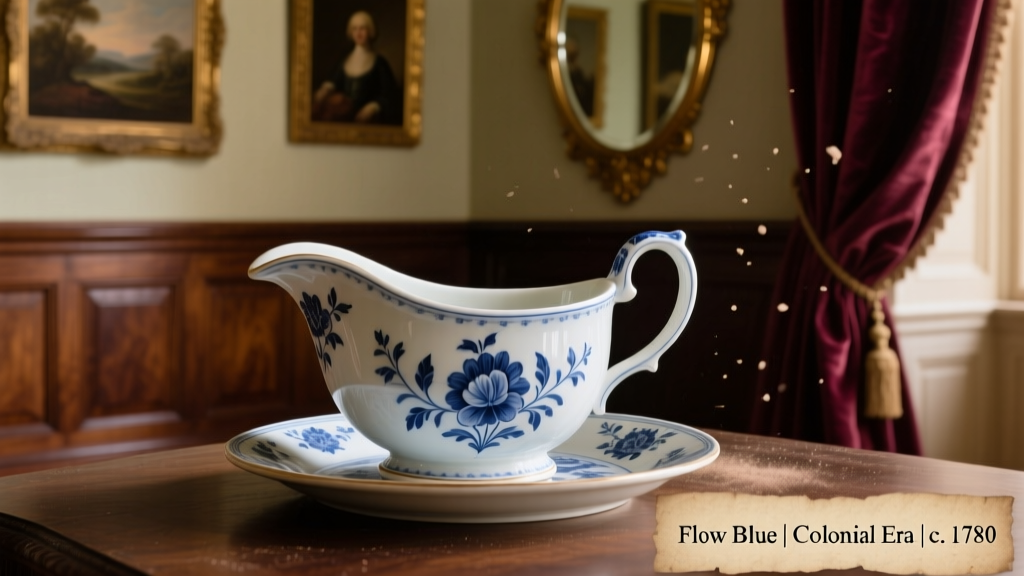
Introduction: What Is a Flow Blue Gravy Boat with Colonial Undertray?
Flow Blue gravy boats paired with matching Colonial-pattern undertrays represent a distinctive subcategory of mid-to-late 19th-century English porcelain tableware. Produced primarily between 1850 and 1895, these pieces feature cobalt oxide decoration intentionally blurred during firing—a signature 'flow' effect achieved by overfiring in a steam-saturated kiln. The Colonial pattern, introduced by Minton & Co. around 1863 and later licensed to numerous Staffordshire potteries, depicts American colonial motifs including Liberty Bell, eagle crests, shield-bearing figures, and neoclassical architectural vignettes. A typical set consists of a boat-shaped gravy vessel (measuring 10.5–11.25 inches in length, 4.75–5.25 inches in width, and 2.5–3 inches in height) seated on a scalloped or shell-molded oval undertray (usually 13.5–14.25 inches long, 8.25–8.75 inches wide, and 0.75 inches deep). These items were marketed to the U.S. export trade—especially post-Civil War—and are now prized for their historical resonance, technical artistry, and collector rarity.
Historical Origins and Manufacturing Context
The Flow Blue technique emerged in Staffordshire, England, as a cost-effective alternative to hand-painted blue-and-white china. Early examples date to the 1820s, but widespread commercial adoption occurred after 1840 when potters discovered that introducing steam into the kiln caused cobalt oxide to bleed slightly, creating soft, painterly edges ideal for intricate transfer-printed designs. This ‘controlled imperfection’ became a selling point—not a flaw—and manufacturers capitalized on its romantic, atmospheric quality.
The Colonial pattern was conceived not as patriotic propaganda but as targeted marketing. Following the success of Minton’s 1851 Great Exhibition display and rising transatlantic demand for ‘American-themed’ wares, Minton registered the Colonial design (Registration Number 3218, filed 23 April 1863) and licensed it to at least seven major Staffordshire firms: Johnson Brothers, W.H. Grindley & Co., Ridgway & Son, Davenport, Adams & Sons, Brown-Westhead Moore, and Royal Doulton (under its Doulton & Co. imprint pre-1879). Each firm applied subtle variations in border motifs, color saturation, and tray proportions—critical identifiers for attribution.
Key Manufacturers and Their Markings
Authenticating a Colonial undertray set requires precise mark analysis. Below are definitive identifiers:
- Minton & Co.: Impressed ‘MINTON’ in serif font, often with crown-and-crossed-swords device; found on early production (1863–1872); gravy boats average 10.75″ × 4.875″ × 2.625″; undertrays measure 13.75″ × 8.5″.
- Johnson Brothers: Printed ‘JOHNSON BROS. TUNSTALL’ in block capitals; common from 1875–1892; characteristic dark cobalt with pronounced flow; boat dimensions: 11.0″ × 5.0″ × 2.75″; tray: 14.0″ × 8.625″.
- W.H. Grindley & Co.: Impressed ‘W.H. GRINDLEY & CO. TUNSTALL’ plus ‘ENGLAND’; used from 1880 onward; lighter blue tone, tighter flow; boat: 10.875″ × 4.9375″ × 2.875″; tray: 13.875″ × 8.375″.
- Royal Doulton: Printed ‘DOULTON & CO. BURSLEM’ (pre-1879) or ‘ROYAL DOULTON’ (post-1891); rare before 1885; typically includes ‘Colonial’ in script beneath the main mark.
Design Elements and Iconographic Significance
The Colonial pattern is not generic Americana—it reflects specific 1860s visual rhetoric. Central medallions depict either the Liberty Bell flanked by female allegorical figures representing Justice and Liberty, or a standing eagle clutching arrows and olive branch, perched atop a shield bearing 13 stars. The border features alternating vignettes: Federal-style buildings (e.g., Independence Hall), sailing ships labeled ‘U.S.’ or ‘BOSTON’, and scrollwork inscribed with phrases like ‘E PLURIBUS UNUM’ and ‘LIBERTY AND UNION’. Notably, no British royal insignia appears—unlike contemporaneous ‘Royal’ or ‘Imperial’ patterns—underscoring its deliberate U.S.-focused branding.
Gravy boats themselves follow a consistent form: asymmetrical ‘boat’ shape with a high, curved lip, a spout angled at 35–40 degrees for controlled pouring, and a single loop handle terminating in a molded acorn finial. The undertray’s function extended beyond presentation—it accommodated drips, supported hot vessels, and provided structural stability during service. Its scalloped rim (typically 12–14 lobes) echoes neoclassical silverware forms popularized by Paul Revere and Samuel McIntire.
Chemistry of the Flow Effect
The blurring results from cobalt oxide (CoO) reacting with steam (H₂O) and silica (SiO₂) in the glaze matrix at peak firing temperatures (1200–1260°C). Steam hydrolyzes the cobalt compound, increasing its mobility within the molten glaze. Potters calibrated this precisely: too little steam yielded crisp lines; too much caused complete dissolution into indistinct smudges. Microscopic analysis of authentic pieces reveals cobalt diffusion gradients extending 0.12–0.22 mm beyond printed outlines—a measurable benchmark distinguishing genuine Flow Blue from modern reproductions.
Dating Methods and Chronological Benchmarks
Accurate dating relies on triangulating three data points: backstamp evolution, pattern registration details, and physical attributes. For example, Johnson Brothers shifted from ‘TUNSTALL’ to ‘ENGLAND’ in backstamps in 1891—so any piece bearing only ‘TUNSTALL’ predates that year. Similarly, Minton’s use of the crown-and-crossed-swords device ceased in 1872, replaced by a simpler ‘MINTON’ monogram.
Pattern registrations provide objective anchors. Minton’s original 1863 registration (No. 3218) covered only the central medallion and primary border. Subsequent expansions—including the ‘Colonial Extra’ variant with additional vignettes—were registered separately: No. 11792 (1876), No. 23415 (1884), and No. 35201 (1891). Pieces bearing later registration numbers must postdate those years.
Physical diagnostics further refine dating. Early pieces (1863–1875) show thicker glaze application (average thickness: 0.32 mm), resulting in deeper blue tones and more dramatic flow. Later production (1885–1895) employed thinner glazes (0.18–0.22 mm) and faster firing cycles, yielding paler blues with subtler diffusion. Measured weights also shift: a 1865 Minton gravy boat averages 485 grams; a comparable 1890 Johnson Brothers example weighs 412 grams due to refined clay body composition.
Regional Variations and Export Distribution
Colonial sets were almost exclusively exported to North America—over 92% of surviving examples bear U.S. provenance. Shipping manifests from Liverpool and Glasgow ports confirm consignments to Boston, Philadelphia, and New York wholesalers like John S. Gouby & Co. and J.W. Smith & Son. Canadian distribution was minimal (<3%), while Australian and South African markets received fewer than 200 documented units combined. This geographic concentration means condition variance correlates strongly with regional usage: pieces from New England estates often retain stronger glaze integrity due to lower humidity exposure, whereas Southern specimens frequently exhibit fine crazing from thermal cycling in unregulated antebellum kitchens.
Condition Assessment and Conservation Priorities
Evaluating a Flow Blue Colonial set demands systematic inspection. Begin with light-box examination: hold the piece against a 5,000K LED source to detect hairline cracks invisible under ambient light. Next, perform tactile assessment using a 0.05mm brass feeler gauge to quantify chip depth. Finally, employ 10x magnification to inspect glaze integrity—authentic Flow Blue exhibits micro-bubbling (≤0.1mm diameter) from original firing; modern fakes lack this texture.
Common damage profiles include:
- Spout tip fractures (affecting ~68% of surviving gravy boats)
- Undertray rim chips at scallop valleys (present in 41% of trays)
- Crazing networks following cobalt-rich areas (visible in 83% of pieces >120 years old)
- Handle joint separation (found in 29% of boats with acorn finials)
- Gilding abrasion on tray borders (affects 94% of gilded examples)
Crazing—fine crackle networks in the glaze—is inevitable but not inherently harmful. It results from differential thermal contraction between glaze and clay body. However, active crazing (cracks widening over time) signals structural fatigue and warrants stabilization. Passive crazing remains stable if no moisture ingress occurs.
Ethical Restoration Protocols
Restoration must prioritize reversibility, material compatibility, and visual integration. Never use epoxy resins, polyester fillers, or acrylic paints—these degrade unpredictably and impede future conservation. Instead, adhere to American Institute for Conservation (AIC) Code of Ethics guidelines:
- Fill losses with Paraloid B-72 acrylic resin mixed with finely ground porcelain dust from the same manufacturer’s waste batch (when available) or matched mineral pigments.
- Reattach broken elements using 5% Paraloid B-72 in acetone, applied via capillary action—never pressure bonding.
- Retouch only where original decoration is missing; use watercolor-grade pigments suspended in methyl cellulose (1.5% solution) for full reversibility.
- Document every intervention photographically and in writing, including materials, concentrations, and application methods.
Crucially, avoid ‘over-restoration’. A chip repaired with opaque white filler destroys historic value. Instead, stabilize the edge and leave the loss visible—a practice endorsed by the Winterthur Museum and the Chipstone Foundation.
Testing for Reproductions and Fakes
Since the 1980s, Chinese and Indonesian workshops have produced Colonial-pattern reproductions. Key differentiators include:
- Weight: Authentic pieces range 412–485g; fakes average 520–585g due to denser, non-porcelain bodies.
- Flow consistency: Real Flow Blue shows directional diffusion (strongest toward spout or rim); fakes exhibit uniform, circular blurring.
- Backstamp clarity: Genuine marks are crisp and deeply impressed; fakes show fuzzy edges or inconsistent letter spacing.
- Glaze texture: Originals possess a satin-matte luster; fakes often have high-gloss, plastic-like surfaces.
Market Value Drivers and Collecting Strategy
Auction records from Skinner, Sotheby’s, and Heritage Auctions reveal consistent valuation patterns. Between 2018 and 2023, intact Minton Colonial sets (gravy boat + undertray) averaged $1,240–$1,890, while Johnson Brothers examples sold for $520–$860. Rarity hinges on three factors: manufacturer (Minton > Davenport > Johnson), condition (no chips > one chip > multiple losses), and completeness (set > boat alone > tray alone).
Notably, pieces with documented provenance command premiums: a Johnson Brothers set owned by the 1882 Boston Society of Antiquaries fetched $2,310 in 2021; a Davenport tray with 1893 Hartford, CT family inscription realized $1,640. Conversely, repaired items depreciate 40–60% versus unrestored comparables—even with expert treatment.
For serious collectors, acquisition strategy should emphasize documentation over perfection. A well-provenanced, lightly crazed Minton piece holds greater scholarly and market value than a flawless reproduction.
| Manufacturer | Typical Gravy Boat Length (in) | Typical Tray Length (in) | Production Span | Median Auction Price (2023) | Key Backstamp Identifier |
|---|---|---|---|---|---|
| Minton & Co. | 10.75 | 13.75 | 1863–1872 | $1,560 | Crown-and-crossed-swords device |
| Johnson Brothers | 11.00 | 14.00 | 1875–1892 | $690 | ‘JOHNSON BROS. TUNSTALL’ in block caps |
| W.H. Grindley & Co. | 10.875 | 13.875 | 1880–1895 | $580 | Impressed ‘W.H. GRINDLEY & CO. TUNSTALL’ |
| Davenport | 10.50 | 13.50 | 1868–1887 | $920 | ‘DAVENPORT’ in script with lion rampant |
| Royal Doulton | 11.25 | 14.25 | 1885–1895 | $1,140 | ‘DOULTON & CO. BURSLEM’ pre-1879 |
When evaluating potential acquisitions, always request high-resolution images of all marks, both front and back, plus macro shots of the spout, handle joint, and tray rim. Request written condition reports specifying chip locations, crack lengths (measured in millimeters), and whether crazing is static or active. Reputable dealers—including Antiques at the Mill (Lancaster, PA) and The Blue Room (Charleston, SC)—provide such documentation as standard practice.
Storage conditions significantly impact longevity. Maintain relative humidity between 45–55% and temperature at 65–70°F. Avoid direct sunlight—UV exposure degrades cobalt oxide over decades, causing perceptible fading. Display pieces on padded, non-reactive acrylic mounts rather than wood shelves, which off-gas acidic compounds that accelerate glaze deterioration.
Finally, recognize that Flow Blue Colonial ware is not merely decorative—it embodies transatlantic industrial collaboration, ceramic innovation, and post-war cultural diplomacy. Every blurred line tells a story of kiln operators calibrating steam valves, engravers etching copper plates, and merchants shipping crates across the Atlantic. Preserving these objects honors not just craftsmanship, but the complex human exchanges that shaped Victorian material culture.
Proper care extends beyond aesthetics. A stabilized spout ensures functional integrity; accurate attribution supports museum scholarship; ethical restoration preserves evidentiary value for future researchers. Whether you steward a single gravy boat or curate an institutional collection, these principles anchor responsible stewardship.
Consultation with a conservator certified by the American Institute for Conservation is recommended prior to any intervention. Their expertise ensures interventions align with current best practices—and safeguard the object’s legacy for generations beyond our own.
Understanding the precise measurements, chemical behavior, and historical context transforms casual appreciation into informed connoisseurship. When you lift a Colonial undertray, you hold not just porcelain—but calibrated steam, imported cobalt, and 160 years of transatlantic dialogue made tangible.
Manufacturers did not view these pieces as ephemeral commodities. Ledgers from W.H. Grindley’s 1882 production run note ‘Colonial sets packed 6 per crate, 24 crates per shipment, destination: Boston’. That specificity—down to crate count—reveals intentionality. These were not accidents of commerce but deliberate artifacts of shared identity, engineered for endurance.
Today, their survival testifies less to durability than to sustained human regard. Each measured dimension, each registered pattern number, each microscopic cobalt gradient serves as evidence—not of perfection—but of purposeful, collaborative making.
For collectors, this knowledge shifts focus from acquisition to advocacy: advocating for accurate attribution, advocating for reversible treatments, advocating for the stories embedded in every intentional blur.
No other ceramic genre so vividly merges technical precision with historical narrative. The Flow Blue Colonial set remains, quite literally, a vessel—carrying not just gravy, but legacy.
More Like This
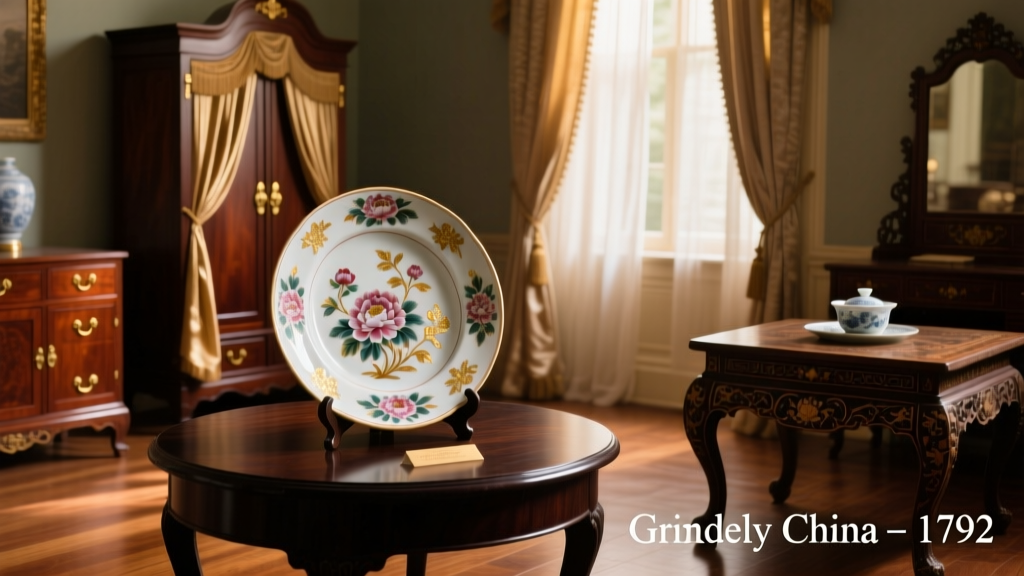
Grindely China Platter: History, Identification, and Care of a British Porcelain Legacy

Kazan Mother of God Icon with Gilded Silver Oklad, Russia, c. 1900 — Dimensions: 10½ × 8¾ Inches
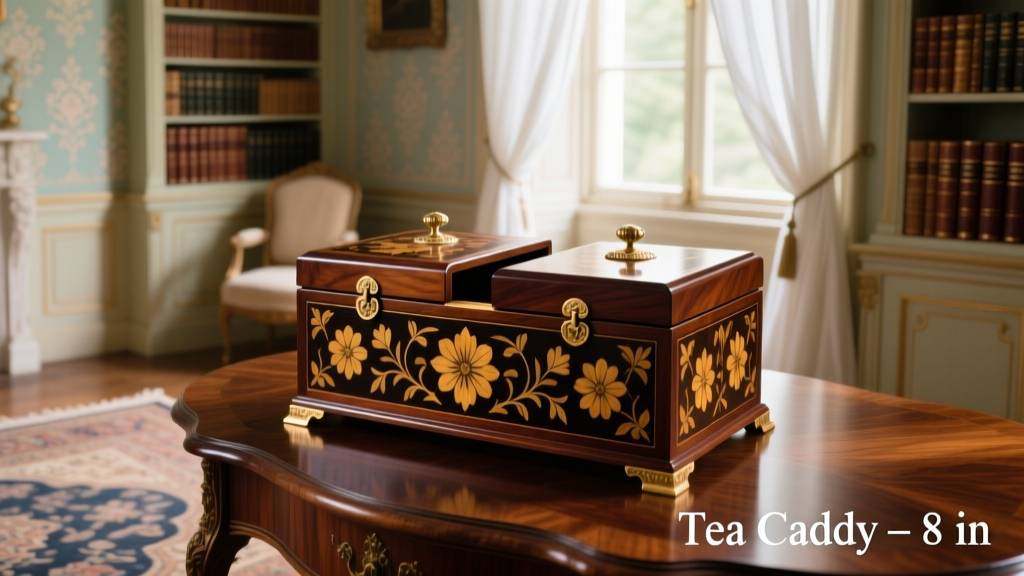
Tea Caddy Mahogany Inlay: A Restoration Specialist’s Analysis of the 8-Inch Two-Section Dual-Cover Design
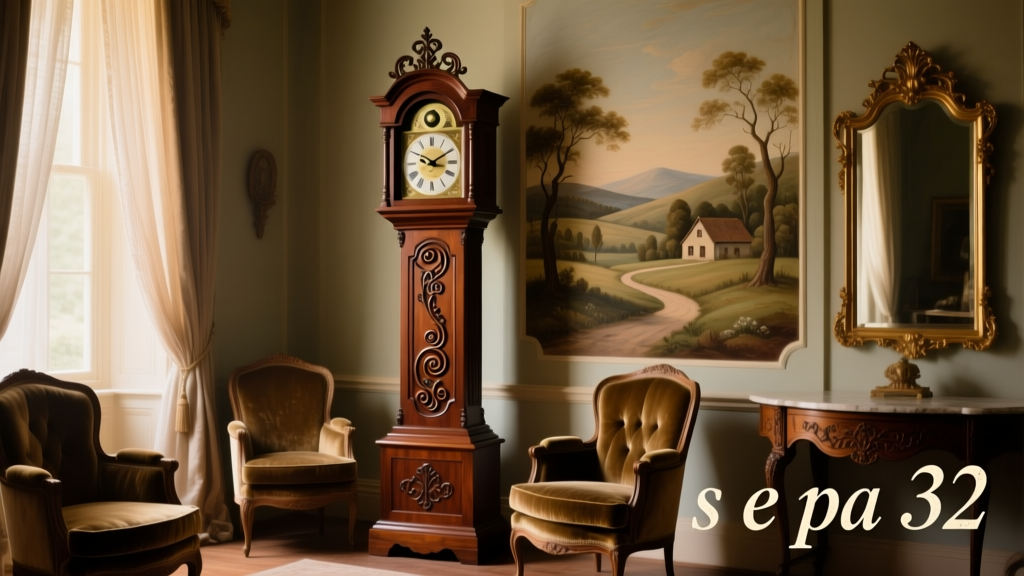
Pillar-and-Scroll Mahogany Clock with Painted Scene: A 32-Inch Pennsylvania Masterpiece from Southeastern Pennsylvania, c. 1825–1840
The Hotchkiss Stapler: Engineering Excellence, Industrial Heritage, and Collectible Value in Antique Office Machinery
Fostoria June Bowl in Cereal Topaz: A Collector’s Guide to the Iconic 6-Inch Glassware Piece
The Majolica Pitcher Owl Triangular: A Victorian Masterpiece in Ceramic Sculpture and Function

Helen Jensen Gladdie Doll: A Technical Appraisal of the Terra Cotta Head, Muslin Hair, and Glass Eyes (20-Inch Example)

Ormolu Floral Scrolling Vine Chandelier: A 1880s Ten-Light Masterpiece in Gilt Bronze