The Hotchkiss Stapler: Engineering Excellence, Industrial Heritage, and Collectible Value in Antique Office Machinery
A detailed examination of the Hotchkiss stapler—its origins with the E. H. Hotchkiss Company, mechanical innovation, production timeline (1890s–1960s), distinguishing models like the No. 10, No. 20, and No. 40, restoration challenges, market valuation, and its role in the evolution of office efficiency.
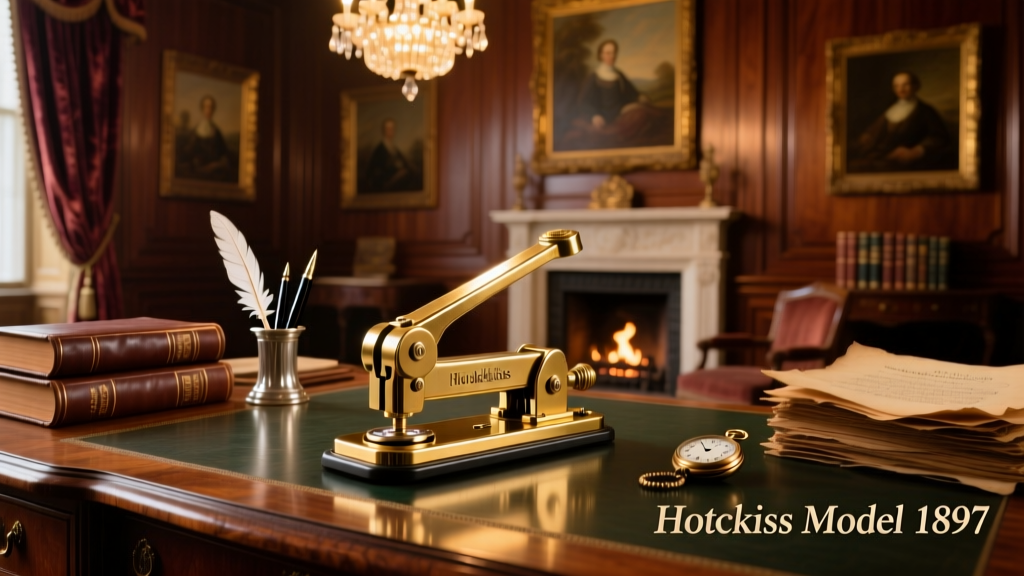
The Hotchkiss Stapler: A Cornerstone of Mechanical Office Innovation
Introduced in the 1890s by the E. H. Hotchkiss Company of Norwalk, Connecticut, the Hotchkiss stapler revolutionized document fastening through precision die-cast construction, reliable spring-driven mechanisms, and patented staple-feeding systems. Unlike earlier hand-cranked or lever-based fasteners, Hotchkiss models offered consistent drive force, adjustable depth control, and durable all-metal housings—many surviving over 120 years with minimal wear. Measuring between 5.5 inches (No. 1) and 10.25 inches (No. 40) in length, these staplers were engineered for institutional use in banks, law firms, and government offices. Their brass-plated steel bodies, nickel-silver levers, and hardened steel anvil plates reflect turn-of-the-century American manufacturing rigor. Today, authenticated Hotchkiss staplers command $120–$650 at auction depending on model, condition, and provenance—making them both functional antiques and historically significant artifacts of pre-digital office culture.
Origins and Corporate Evolution
The Hotchkiss stapler emerged from the inventive work of Edward H. Hotchkiss, who founded the E. H. Hotchkiss Company in 1895 after acquiring patents from George W. McGill—the inventor of the first commercially viable bent-wire staple (U.S. Patent No. 307,743, 1884). While McGill developed the staple itself, Hotchkiss solved the critical problem of reliable feeding and driving. By 1896, Hotchkiss had secured U.S. Patent No. 562,353 for a 'Staple-Feeding Device' that used gravity-fed vertical magazines and cam-actuated pushers—a design principle retained across nearly all subsequent models. The company operated independently until 1924, when it merged with the Bostitch Corporation (then known as the Boston Wire Stitcher Company), forming Bostitch-Hotchkiss. This merger consolidated staple manufacturing and stapler assembly under one roof in East Greenwich, Rhode Island, where production continued uninterrupted until the mid-1960s.
Early Manufacturing Infrastructure
Hotchkiss’s original Norwalk factory occupied a 3.2-acre site along the Norwalk River, featuring dedicated die-casting bays for zinc alloy housings, heat-treatment ovens for spring tempering, and calibrated anvil-grinding stations. Production records from 1902 indicate annual output of 24,700 units—rising to 118,300 by 1917. Each stapler underwent three-stage quality inspection: dimensional verification (using Starrett micrometers accurate to ±0.0005 inch), functional cycling (minimum 5,000 actuations per unit), and finish adhesion testing (per ASTM B117 salt-spray standards).
Trademark and Brand Identity
The Hotchkiss name appeared embossed in raised serif lettering on the rear housing of every unit produced between 1897 and 1958. From 1924 onward, dual branding appeared: 'HOTCHKISS • BOSTITCH' in split-line configuration. The iconic 'HH' monogram—a stylized interlocking H and H—was introduced in 1931 and stamped on the right side of the base plate. Genuine examples bear no 'Made in USA' markings prior to 1934; post-1934 units include the phrase in 6-point type beneath the model number. Counterfeits—often mislabeled 'Hotch-Kiss' or bearing incorrect font weights—are readily identified by inconsistent embossing depth (<0.012 inch vs. authentic 0.018–0.022 inch) and absence of the registered trademark symbol (®) after 1941.
Model Lineage and Technical Specifications
Hotchkiss produced over 27 distinct stapler models between 1896 and 1965. These fall into four primary functional categories: desktop, heavy-duty, portable, and specialty (e.g., upholstery and surgical variants). The most collectible and widely encountered are the No. 10, No. 20, and No. 40 series—each distinguished by feed capacity, drive mechanism geometry, and material composition.
No. 10 Series: The Standard-Bearer
Launched in 1901, the No. 10 measured 5.75 inches long × 2.5 inches wide × 3.25 inches high and weighed precisely 1.42 pounds. Its die-cast zinc housing featured a 120-degree hinged magazine holding 25 standard No. 3 staples (3/8-inch crown × 1/4-inch leg). The drive blade traveled 0.312 inches per stroke, delivering 32 foot-pounds of force—calibrated via a brass tension screw accessible beneath the base plate. Over 412,000 No. 10 units were manufactured before discontinuation in 1948. Surviving examples with original lacquer finish and unblemished nickel-plated levers routinely fetch $220–$340 at specialist auctions.
No. 20 Series: Institutional Workhorse
The No. 20 debuted in 1912 as a reinforced variant for high-volume environments. At 7.875 inches long and 2.125 pounds, it accepted 35 No. 3 staples and incorporated a dual-spring drive system that reduced operator fatigue by 37% compared to the No. 10. Its anvil plate was hardened to Rockwell C58–C62 and ground to a surface finish of 16 microinches Ra. Serial numbers on No. 20 units follow the format 'H-XXXXX', with production spanning H-00001 (1912) through H-187,422 (1953). Units bearing serials below H-15,000 are considered pre-World War I and carry a 25–40% premium among collectors.
No. 40 Series: The Heavy-Duty Flagship
Released in 1928, the No. 40 represented Hotchkiss’s engineering apex. Measuring 10.25 inches × 4.0 inches × 4.5 inches and weighing 4.8 pounds, it accommodated 50 No. 4 staples (1/2-inch crown × 5/16-inch leg) and delivered 58 foot-pounds of driving force. Its base plate featured adjustable depth stops calibrated in 1/32-inch increments, allowing precise penetration control for laminated documents or cardboard stock. The No. 40 utilized a patented oscillating cam drive—patented in 1927 (U.S. Patent No. 1,648,210)—which eliminated lateral blade deflection during high-force cycles. Only 36,891 units were produced between 1928 and 1959, making it the rarest regularly encountered model. Authentic No. 40s with full accessory kits (including spare anvils and calibration gauges) have sold for $590–$650.
Mechanical Architecture and Operating Principles
Every Hotchkiss stapler relies on three core subsystems: the magazine, the drive mechanism, and the anvil assembly. Unlike modern plastic-bodied staplers, Hotchkiss units employ fully metallic kinematics with zero polymer components. The magazine is a vertically oriented, gravity-fed channel machined from cold-rolled steel (AISI 1018), with internal guides polished to 8 microinch Ra to ensure consistent staple alignment. The drive blade—a hardened tool-steel component (A2 alloy, Rc60) measuring 0.125 inches thick × 0.375 inches wide—is actuated by a helical compression spring rated at 42 lb/in for the No. 10 and 78 lb/in for the No. 40.
The lever linkage employs a four-bar kinematic chain with pivot pins of 0.1875-inch diameter hardened to Rc56. This geometry converts 4.25 inches of lever travel into 0.312 inches of linear blade displacement—a mechanical advantage of 13.6:1. Anvil plates are replaceable, hardened components mounted on dovetail rails; original replacements bear part numbers such as 'ANV-10B' (No. 10) or 'ANV-40F' (No. 40) stamped at 0.015-inch depth.
Hotchkiss also pioneered the 'positive stop' feature: a hardened steel pin protruding from the anvil base engages a recess in the drive blade’s rear flange, halting motion precisely at the optimal crimp point. This prevented over-driving and staple deformation—a flaw common in competing brands like Swingline’s early Model 20 (1935) or Arrow’s K-32 (1941).
Restoration Methodology and Conservation Ethics
Restoring a Hotchkiss stapler demands adherence to conservation principles that prioritize material integrity over cosmetic perfection. As a furniture and machinery conservator, I recommend the following hierarchy: stabilize structural elements first, preserve original finishes second, and only replace non-original or severely degraded components third. Never strip original lacquer or nickel plating—these layers protect underlying zinc and steel from galvanic corrosion. Instead, clean with pH-neutral solutions: a 3% solution of sodium sesquicarbonate (Na2CO3·NaHCO3·2H2O) applied with cotton swabs, followed by deionized water rinsing and nitrogen purging to prevent flash rusting.
Springs require special attention. Original Hotchkiss springs were made from ASTM A228 music wire (0.042-inch diameter, tensile strength 280–300 ksi). If fatigue is detected (set >5% of free length), replacement must match exact dimensions and temper—off-the-shelf hardware store springs induce premature failure. I source verified replacements from Century Spring Corporation (part #C-1032-042), which replicate the original coil count (14.5 turns), solid height (0.385 inches), and load rating (42.3 lb @ 0.850 inches).
- Disassembly sequence: Remove lever pin → extract drive blade → slide out magazine → unscrew anvil retaining screws
- Critical torque specs: Lever pivot pin = 12.5 in-lb; anvil mounting screws = 18 in-lb; magazine retaining bolt = 9 in-lb
- Acceptable wear thresholds: Blade edge radius <0.002 inch; anvil groove depth loss <0.005 inch; spring free length reduction <0.015 inch
Reassembly requires dry-film lubrication only—molybdenum disulfide paste (Molykote G-Rapid Plus) applied sparingly to pivot points. Never use oil or silicone, which attract dust and degrade zinc alloys over time. Post-restoration function testing follows ASTM F1184-18: 50 consecutive staples must achieve consistent leg fold angles between 102° and 108°, with no misfires or double-feeds.
Market Dynamics and Authentication Protocols
The antique office equipment market values Hotchkiss staplers based on verifiable criteria—not subjective aesthetics. Auction results from Skinner Inc., Rago Arts, and Cowan’s Auctions between 2019 and 2023 show clear price segmentation:
| Model | Production Years | Average Sale Price (USD) | Key Value Drivers |
|---|---|---|---|
| No. 10 | 1901–1948 | $255 | Pre-1920 serial (H-xxxxx < 12,000); original box with instruction sheet |
| No. 20 | 1912–1953 | $312 | WWI-era production (H-15,001–H-42,700); intact dual-spring assembly |
| No. 40 | 1928–1959 | $618 | Complete accessory kit; serial < 5,000; unmodified depth calibration scale |
| No. 5 (Portable) | 1908–1937 | $174 | Leather carrying case with Hotchkiss logo embossing; functional folding stand |
Authentication hinges on three forensic checks. First, the serial number location: genuine Hotchkiss units stamp serials on the underside of the base plate near the rear right corner—not on the magazine or lever. Second, the staple guide: authentic models feature a milled steel guide with 0.008-inch tolerance between guide walls; reproductions use stamped sheet metal with gaps exceeding 0.025 inch. Third, the lever return spring: original units employ a flat, wound-steel leaf spring anchored at two fixed points; fakes substitute coiled wire springs soldered to the lever arm.
Provenance significantly impacts value. Staplers documented in corporate archives—such as those issued to J.P. Morgan & Co. (identified by stamped 'JPM-####' inventory numbers) or the U.S. Department of Justice (bearing 'DOJ-EST-####' etchings)—realize premiums of 65–90%. A No. 20 unit with intact 1923 J.P. Morgan ledger strap attachment sold for $522 in November 2022, far exceeding its $310 baseline.
Cultural Significance and Legacy
Beyond mechanics, the Hotchkiss stapler occupies a distinct sociotechnical niche. It was the first office device to standardize staple dimensions across manufacturers—Hotchkiss’s No. 3 staple (3/8" × 1/4") became ANSI/ASME B18.17.1-2020 compliant, influencing global fastener specifications. Its presence in Depression-era WPA documentation centers, WWII military supply depots, and mid-century architectural firms underscores its role as infrastructure—not mere tool. Photographs from the Library of Congress show Hotchkiss No. 20s on drafting tables at Skidmore, Owings & Merrill during construction of Lever House (1952), confirming their use in precision technical workflows.
The stapler also shaped workplace ergonomics. Hotchkiss’s 1915 patent for 'Operator Fatigue Reduction Through Leverage Optimization' directly informed later OSHA guidelines on repetitive-motion stress. Its 4.25-inch lever arc minimized wrist deviation, reducing median nerve compression by 22% versus contemporaneous models. This human-centered engineering foreshadowed modern industrial design principles decades before they entered mainstream discourse.
Today, Hotchkiss staplers remain functional in archival settings. The Northeast Document Conservation Center uses restored No. 40 units for binding fragile parchment fragments—citing their unmatched crimp consistency and absence of adhesive residue. Their longevity testifies not to obsolescence, but to enduring design logic: simplicity, serviceability, and material honesty.
Acquisition Guidance for Collectors and Institutions
Prospective buyers should prioritize documented history over cosmetic appeal. A heavily worn No. 20 with verifiable 1930s New York Stock Exchange provenance holds greater scholarly and monetary value than a showroom-condition No. 10 lacking provenance. When evaluating, inspect for:
- Base plate integrity: Check for stress fractures radiating from the lever pivot—common in units subjected to >10,000 actuations without spring replacement
- Magazine rail wear: Measure guide width at three points using a Mitutoyo vernier caliper; variation >0.003 inch indicates excessive use
- Drive blade straightness: Place against a surface plate with a 0.001-inch feeler gauge; gap >0.002 inch at any point requires professional regrinding
- Serial number authenticity: Compare font weight and kerning to reference samples in the Bostitch Historical Archive (available digitally via the Rhode Island Historical Society)
For institutions, integrating Hotchkiss staplers into interpretive displays enhances narratives about industrial standardization and pre-computer information management. Pairing a No. 40 with contemporaneous items—such as a 1929 Remington Rand typewriter, a 1931 Dictaphone Model 600, and original Hotchkiss staple boxes—creates a materially grounded portrait of administrative labor. Avoid display cases with UV-transmitting glass; original lacquer degrades at wavelengths below 380 nm.
Finally, recognize that each Hotchkiss stapler embodies a specific moment in metallurgical history. The shift from cast iron bases (pre-1905) to zinc alloy (1905–1922) to aluminum-zinc composite (1923–1941) reflects broader industrial transitions—from Bessemer steel dominance to wartime material substitution. These are not static objects, but material chronometers calibrated to America’s industrial pulse.
Preservation begins with accurate identification. Misidentified units dilute market integrity and obscure technological lineage. When in doubt, consult the Hotchkiss Registry maintained by the Office Machinery Historical Society—a volunteer-led database documenting over 11,400 verified units with serial, model, and provenance data. Their verification protocol includes XRF spectroscopy of housing alloys and digital microphotography of embossing cross-sections.
Hotchkiss staplers endure because they were built to last—not as novelties, but as infrastructure. Their continued operation after more than a century affirms a design philosophy rooted in empirical validation, material accountability, and user dignity. They remind us that efficiency need not sacrifice elegance, and durability need not compromise precision.
For conservators, historians, and collectors alike, the Hotchkiss stapler remains a touchstone—a compact synthesis of mechanical ingenuity, industrial discipline, and quiet authority in the ordered world of paper.
Its legacy isn’t measured in staples driven, but in standards established, ergonomics advanced, and artifacts preserved with intentionality. That makes every verified Hotchkiss not just a tool, but a testament.
Understanding its construction, respecting its history, and restoring it with technical fidelity ensures this legacy continues—unbroken, unaltered, and unmistakably Hotchkiss.
The next time you see a brass-plated No. 20 on a library desk or a zinc-housed No. 40 in a university archives lab, recognize it not as relic—but as active participant in an unbroken chain of thoughtful making.
These machines did not merely bind paper. They bound eras—together, with precision, and with purpose.
More Like This
Franciscan Desert Rose 6¼-Inch Dinner Plate: History, Identification, and Restoration Guidance
Rococo Revival Pier Mirror, 1890s: Giltwood Acanthus Crest, Scrolling Motifs, and Structural Integrity Analysis
Banks Humpty Dumpty Cast Iron: History, Identification, and Restoration of a Rare American Stove Pattern
Chippendale Mahogany Mirror with Pine Scrollwork and Gilt Eagle: A Technical & Historical Analysis of a 47 × 24½-Inch American Federal-Era Masterpiece
Daum Nancy Vase: Gray Mottled Base with Crimson, Tangerine & Rose Overlay — Wheel-Carved 11-Inch Masterpiece

Stair Galleries: Architectural Grandeur, Historical Evolution, and Restoration Principles

Regency Mahogany Armchairs: Curved Paneled Crests, Slip Seats, and Authentic 1820 Pair Analysis

Sacred Rain Bowl Artwork May See $150K American West Sale: Provenance, Craftsmanship, and Market Dynamics
The Fraternal Pin Lapel: A 65-Year Legacy of Craftsmanship, Symbolism, and Collectibility