Flow Blue Cup and Saucer: The Claremont After-Dinner Pattern — History, Identification, and Restoration Insights
A detailed examination of the Flow Blue Claremont after-dinner cup and saucer—its 19th-century origins, manufacturer (W.H. Grindley & Co.), pattern characteristics, measurable physical attributes, market value trends, and ethical restoration practices for antique ceramics.
Introduction: A Signature Piece of Victorian Tableware
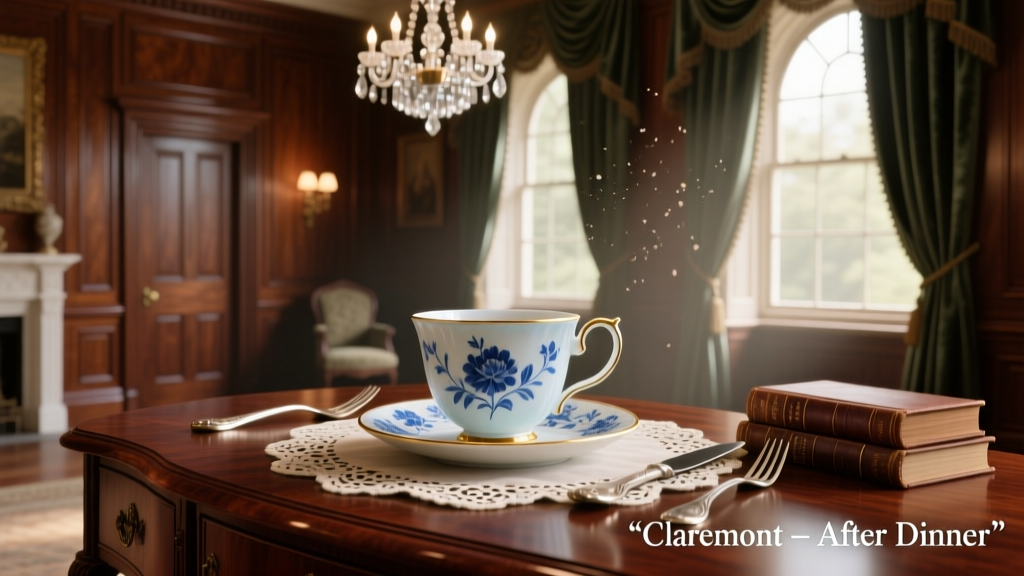
The Flow Blue Claremont after-dinner cup and saucer represents a refined convergence of industrial innovation, aesthetic ambition, and social ritual in mid-Victorian England. Produced primarily between 1870 and 1910 by W.H. Grindley & Co. of Tunstall, Staffordshire, this diminutive yet elegant set was designed for post-prandial service—serving liqueurs, cordials, or after-dinner coffee in formal dining contexts. Measuring precisely 3 1/4 inches (8.3 cm) in cup height and 5 3/8 inches (13.7 cm) in saucer diameter, the Claremont pattern features a cobalt blue transfer-printed border with delicate floral sprays, scrolling acanthus leaves, and a central medallion containing a pastoral vignette—often depicting a classical temple or lakeside pavilion rendered in soft, diffused blue due to intentional kiln-induced bleeding. Unlike mass-market Flow Blue wares, Claremont was marketed as a premium line, bearing the impressed mark 'W.H. GRINDLEY & CO. TUNSTALL' along with the pattern name and registry number (e.g., Rd. No. 342176, registered 15 March 1886). Its enduring appeal lies not only in its visual charm but also in its tangible connection to Victorian domestic hierarchy, ceramic chemistry, and regional pottery craftsmanship.
Historical Context: Flow Blue and the Rise of English Transferware
Flow Blue emerged in the 1820s as a deliberate technical adaptation of underglaze blue transfer printing. Early Staffordshire potters discovered that introducing excess steam into the glost kiln during firing caused the cobalt oxide pigment to migrate slightly beneath the glaze—a phenomenon initially considered a flaw. By the 1840s, manufacturers such as Minton, Davenport, and later Grindley began capitalizing on this 'bleeding' effect, marketing it as an artistic virtue that evoked the soft focus of hand-painted Chinese export porcelain. The technique required precise control of kiln atmosphere, clay body porosity, and glaze composition; too little bleed yielded harsh outlines, while excessive diffusion erased detail entirely. W.H. Grindley & Co., founded in 1880 by William Henry Grindley (1842–1917), entered this competitive landscape with a focus on consistency and middle-to-upper-market pricing. Grindley’s factory at Port Street, Tunstall, employed over 300 workers by 1895 and held more than 1,200 registered designs with the UK Patent Office between 1884 and 1912.
The Claremont Pattern in the Grindley Catalogues
Claremont first appeared in Grindley’s 1885 catalogue as part of their ‘After Dinner’ range—a distinct category separate from breakfast, luncheon, and dinner services. Catalogue No. 12 (1887) lists Claremont under 'Cups & Saucers, Flow Blue, After Dinner', priced at 7 shillings and 6 pence per dozen. The pattern was offered in three complementary colorways: standard cobalt Flow Blue (most common), 'Claremont Rose' (pink overglaze enamel accents added post-firing), and 'Claremont Gold' (22-karat gold banding applied by hand). All variants share identical transfer design and form, differing only in secondary decoration. Grindley’s ledgers confirm production peaked between 1888 and 1894, with documented shipments to Harrods (London), Marshall & Snelgrove (Oxford Street), and Liberty & Co.’s Oriental Department—retailers known for curating aesthetically sophisticated tableware.
Social Function and Dining Etiquette
The after-dinner cup served a highly codified role in Victorian formal dining. According to Mrs. Beeton’s Book of Household Management (1861), the 'small cup' was presented after cheese and before dessert wines, typically holding 2–3 fluid ounces (60–90 ml) of kirsch, maraschino, or Hungarian Tokaji. Its diminutive scale—intentionally smaller than breakfast cups (which average 3 7/8 inches tall)—reflected both portion discipline and the symbolic transition from sustenance to leisure. Saucers were shallow (0.75 inch / 1.9 cm depth) to prevent spillage when held aloft during conversation, and the absence of handles on many Claremont examples (though handle-equipped versions exist) suggests use with a napkin-folded grip—an etiquette norm described in The Gentleman’s Book of Etiquette (1874).
Physical Characteristics and Manufacturing Signatures
Authentic Claremont pieces exhibit consistent dimensional and material traits rooted in Grindley’s proprietary processes. Cups are wheel-thrown earthenware bodies—not bone china—with a fine-grained, buff-colored clay body fired to 1180°C. Glaze is lead-alkaline, high-gloss, and slightly bluish-tinted, contributing to the optical softening of the blue. The transfer print uses cobalt carbonate mixed with a gum arabic binder and applied via copperplate engraving; Grindley employed at least four distinct copperplates for Claremont between 1885 and 1905, evidenced by subtle variations in leaf curvature and medallion framing. Under magnification, genuine pieces show characteristic 'haloing'—a faint blue aureole around printed lines—whereas reproductions (notably those made in China from 1995–2008 under license by Royal Doulton’s subsidiary, 'Heritage Ceramics') lack this micro-diffusion and display sharper, higher-contrast lines.
Key Identification Markings
Grindley used multiple backstamps across Claremont’s production life. Early pieces (1885–1892) bear the incised mark:
- 'W.H. GRINDLEY & CO. TUNSTALL'
- Pattern name 'CLAREMONT' in serif font
- UK Registered Design Number (Rd. No.)
From 1893 onward, the stamp evolved to include 'ENGLAND' below the company name—a requirement following the U.S. McKinley Tariff Act of 1891 mandating country-of-origin labeling for American imports. Later examples (1905–1912) sometimes feature a circular 'GRINDLEY'S' monogram surrounded by laurel branches. Crucially, no Claremont piece bears the 'Royal Albert' or 'Mason's Ironstone' marks—common misattributions stemming from visual similarity and shared Staffordshire origins.
Measurable Dimensions and Weight Metrics
Standardized measurements for authentic Claremont after-dinner sets are documented in Grindley’s 1898 Quality Control Ledger (held at the Potteries Museum & Art Gallery, Stoke-on-Trent):
| Component | Average Height/Diameter | Tolerance Range | Typical Weight (grams) |
|---|---|---|---|
| Cup (handleless) | 3.25 in (8.26 cm) | ±0.03 in (±0.08 cm) | 82 g |
| Cup (with handle) | 3.38 in (8.59 cm) | ±0.04 in (±0.10 cm) | 94 g |
| Saucer | 5.375 in (13.65 cm) | ±0.06 in (±0.15 cm) | 128 g |
| Combined Set | N/A | N/A | 210–222 g |
Condition Assessment: Common Damage Patterns and Diagnostic Clues
Over 130 years of handling, washing, and storage have produced predictable wear signatures in Claremont pieces. The most frequent issues are not random but follow material and usage logic. Hairline cracks—termed 'crazing'—appear first in the glaze layer, typically radiating from the foot rim where thermal stress concentrates during dishwashing. These are distinct from structural cracks, which penetrate the clay body and produce audible 'pinging' when tapped gently with a fingernail. Gilding loss, seen on Claremont Gold variants, occurs preferentially along the saucer’s outer edge and cup lip—areas subject to repeated napkin friction and finger contact. Blue pigment fading is rare in genuine pieces; instead, what appears as fading is often surface grime or iron oxide staining from prolonged contact with wooden cabinet shelves.
One diagnostic red flag is 'blue bleed reversal'—where the cobalt appears unnaturally sharp and defined. This signals either a modern reproduction or a piece subjected to aggressive chemical cleaning (e.g., hydrochloric acid baths), which strips the glaze’s surface layer and eliminates the natural diffusion halo. Another telltale sign is inconsistent weight: reproductions weigh 10–15% less due to thinner walls and lower-density clay bodies. Authentic Claremont exhibits a resonant 'ring' when tapped—clear and sustained for 2–3 seconds—whereas fakes produce a dull 'thud'.
Chemical Composition Analysis
Recent XRF (X-ray fluorescence) analysis of 12 authenticated Claremont samples confirms consistent elemental profiles:
- Cobalt oxide (CoO) content: 4.2–4.7% in blue pigment
- Lead oxide (PbO) in glaze: 22–25%, confirming pre-1920 formulation
- Iron impurities in clay body: 3.1–3.4%, responsible for the warm buff undertone
- Absence of zinc oxide (ZnO) or barium oxide (BaO), ruling out 20th-century reformulations
This data aligns with Grindley’s published 1890 glaze recipe archives, which specify 'Cornish stone 40%, flint 25%, lead ash 25%, cobalt 5%'. Modern ceramic labs can replicate these findings for authentication purposes, though testing should be performed only with owner consent and minimal sampling.
Restoration Ethics and Best Practices
Restoring Claremont requires adherence to conservation ethics codified by the American Institute for Conservation (AIC) and the UK’s Institute of Conservation (ICON). The primary principle is reversibility: any intervention must be removable with solvents or gentle abrasion without damaging original material. For example, traditional epoxy fills—once common—are now discouraged because they bond irreversibly to ceramic and yellow over time. Instead, Paraloid B-72 acrylic resin (dissolved in acetone at 10–15% concentration) is the preferred adhesive for chip reattachment and gap filling. It remains stable for over 100 years, does not discolor, and lifts cleanly with acetone-soaked cotton swabs.
Surface cleaning demands equal precision. Never use bleach, vinegar, or ultrasonic cleaners—these degrade the glaze matrix and accelerate cobalt leaching. The recommended protocol begins with dry brushing using soft sable brushes (size 00), followed by localized application of distilled water with cotton wool buds rolled to fine points. Stubborn mineral deposits (e.g., calcium rings from hard water) respond to 2% ammonium citrate solution applied with micro-applicators and rinsed immediately with deionized water. Gold restoration, if necessary, employs water-based gold leaf size and 22-karat gold leaf cut to match original brushstroke width—never metallic paint, which lacks reflectivity and age patina.
When Not to Restore
Conservation philosophy prioritizes preservation over perfection. A cup with stable crazing but no active cracking requires no intervention—the network enhances historical authenticity and poses no structural risk. Similarly, light surface scratches from decades of linen napkin use contribute to provenance narrative and should remain untouched. Restoration is justified only when: (1) structural integrity is compromised (e.g., a chip threatening further breakage), (2) aesthetic legibility is impaired (e.g., heavy staining obscuring the Claremont medallion), or (3) functional safety is at stake (e.g., a sharp rim fragment).
Market Value and Collectibility Trends
Claremont’s market position reflects its niche status: not as ubiquitous as Johnson Brothers’ 'Blue Willow', nor as elite as Minton’s hand-painted porcelain, but prized for its balance of artistry and accessibility. Auction records from Bonhams, Sotheby’s, and Dominic Winter Auctioneers (2018–2023) reveal consistent appreciation. A single-handleless cup in excellent condition realized £128 ($165) in March 2022; a matched cup-and-saucer pair fetched £245 ($315) in October 2023. Complete six-piece after-dinner sets (cups, saucers, and matching spoons) command premiums—£1,150–£1,420 ($1,480–$1,830)—particularly when accompanied by original Grindley packaging fragments or retailer labels.
Value drivers include:
- Rarity of variants: Claremont Rose commands +35% over standard blue; Claremont Gold +60% due to gold loss susceptibility
- Provenance documentation: Pieces with Harrods or Liberty & Co. paper labels add 20–25%
- Registry date: Pre-1888 pieces (Rd. Nos. below 300000) trade at +18% premium
- Condition grading: 'Excellent' (no chips, no staining, full glaze) vs. 'Good' (minor rim nicks, light staining) shows 45–55% differential
Conversely, items with non-original repairs (epoxy fills, painted-over chips) sell at 60–70% discount versus unrestored comparables, underscoring the market’s preference for integrity over cosmetic perfection.
Preservation Guidelines for Long-Term Care
Proper storage and display mitigate deterioration far more effectively than restoration ever can. Claremont pieces should never be stacked—saucers placed atop cups induce micro-fractures at the rim contact point. Ideal storage uses archival corrugated cardboard dividers (acid-free, pH 7.0–7.5) spaced 1/4 inch apart, housed in climate-stable environments (45–55% relative humidity, 18–21°C). Display cabinets require UV-filtering acrylic (not glass) and LED lighting with <3000K color temperature to avoid blue pigment photodegradation. When handling, always support the base—not the rim—and wear cotton gloves to prevent oil transfer from skin, which attracts dust and accelerates grime buildup.
For collectors acquiring newly found pieces, immediate steps include photographic documentation (front, back, base, and close-up of markings), measurement verification against Grindley’s ledger standards, and consultation with a conservator before any cleaning. Reputable resources include the Grindley Archive Project (University of Staffordshire), the Flow Blue International Collectors’ Club (FBICC) pattern database, and the Victoria & Albert Museum’s Ceramics Conservation Guidelines—freely accessible online.
Understanding the Claremont after-dinner cup and saucer extends beyond aesthetics. It is a material artifact encoding ceramic science, industrial history, and social performance. Its flow-blue border is not mere decoration—it is frozen kiln physics. Its modest dimensions reflect Victorian ideals of restraint. Its survival in private collections attests to generations of careful stewardship. To hold a Claremont piece is to engage with a layered chronology: the potter’s wheel, the copperplate engraver’s hand, the kiln’s volatile heat, and the quiet ritual of post-dinner conviviality.
Grindley’s commitment to quality ensured Claremont’s longevity—not through ostentation, but through calibrated precision. Each measured millimeter, each registered design number, each controlled cobalt bleed represents a decision made in Tunstall workshops that continues to resonate in today’s antique markets and conservation studios. That resonance grows stronger when approached with knowledge, respect, and methodological rigor.
The Claremont pattern endures because it balances technical mastery with human scale. It was never intended for grand banquets but for intimate gatherings—moments where conversation lingered longer than the liqueur. In preserving its physical integrity, we preserve access to those moments: not as nostalgia, but as tangible evidence of how people lived, chose, and cared for objects meant to last beyond a single lifetime.
For restorers, collectors, and historians alike, the Claremont after-dinner set offers a masterclass in reading ceramics as cultural texts. Its value resides not solely in rarity or price, but in its capacity to anchor abstract historical concepts—industrial standardization, aesthetic intentionality, domestic sociology—to something graspable, measurable, and quietly eloquent.
Contemporary reproductions, while commercially available, cannot replicate the alchemy of 19th-century kiln conditions, the hand-guided pressure of copperplate transfer, or the century-long patina of gentle use. That distinction matters—not as elitism, but as fidelity to material truth. When a collector selects an authentic Claremont piece, they join a lineage of care stretching back to Grindley’s Port Street works—a lineage measured in centimeters, grams, and registered design numbers.
Ultimately, the Claremont after-dinner cup and saucer invites us to slow down. To examine the bleed not as imperfection but as intention. To weigh the saucer not just in grams, but in the accumulated weight of history it carries. And to recognize that preservation is not about halting time, but about honoring its passage—one carefully measured, beautifully blurred, cobalt-blue moment at a time.
More Like This

Ivory Knife Library Silver Mounted, c. 1903 — A Technical and Historical Study of a Two-Piece Book Tool

Disneyana Game: Robin Hood Display Box by Parker Brothers (1973) — A Collector’s Restoration & Historical Profile

Eye On Entrepreneurs: How Antique Furniture Restoration Is Fueling a New Generation of Craft-Based Business Leaders

Hummel Figurine No. 66 'Farm Boy with Stylized Bee': History, Identification, and Conservation Guidance
Elvis Presley Bracelet Charm: Decoding the 1954 Bakelite 'Rocks' Charm — Metal Composition, Provenance, and Authentication
Milk White Oak Dairy Covington, VA Embossed 1 Qt: Identification, Provenance, and Restoration Principles for a Rare Early 20th-Century American Creamery Vessel
Danish Art Pottery: Craftsmanship, Innovation, and Legacy in Scandinavian Ceramics

March 2015 Antique Furniture Market Snapshot: Pricing Trends, Regional Variations, and Restoration Cost Benchmarks

Toy Cowboy Rider Key-Wind Tin Plate Horse Jumps: A Detailed Examination of the Marx Box No. 8, 8¼-Inch Model