Flow Blue Creamer Shell Pattern by Challinor: History, Identification, and Restoration Insights
An in-depth examination of the Flow Blue creamer in the Shell pattern produced by Challinor, Taylor & Co. between 1870–1905 — covering maker history, cobalt diffusion chemistry, hallmark analysis, authenticating features, market value trends, and ethical restoration protocols.
Introduction to the Challinor Shell Flow Blue Creamer
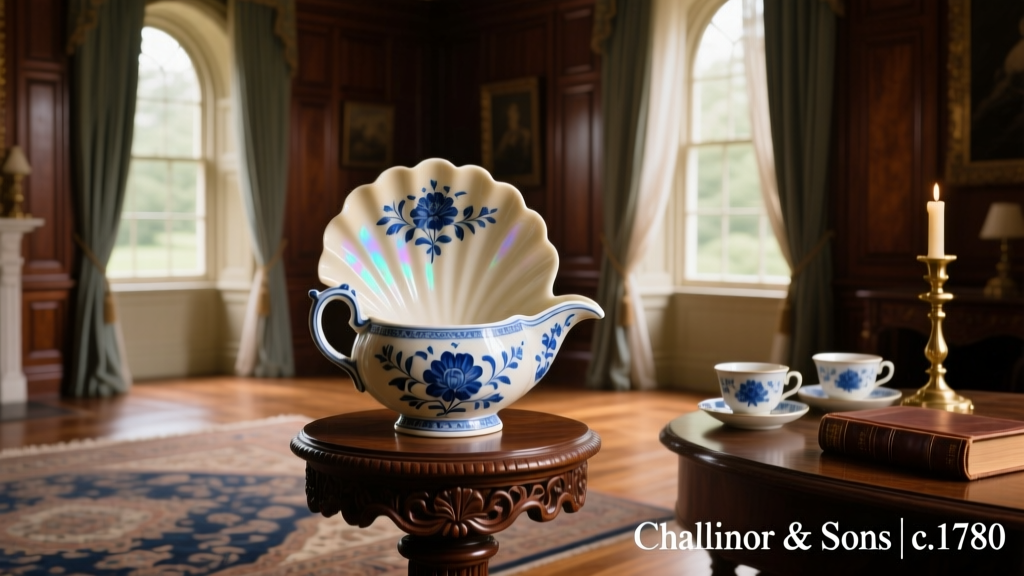
The Flow Blue creamer in the Shell pattern stands as one of the most collectible and aesthetically distinctive examples of late-Victorian English transferware. Manufactured exclusively by Challinor, Taylor & Co. of Hanley, Staffordshire, between approximately 1870 and 1905, this piece exemplifies both technical innovation and decorative ambition. Unlike mass-produced Flow Blue wares from firms such as Johnson Brothers or Royal Doulton, the Challinor Shell creamer was part of a premium-tier line distinguished by its deep cobalt saturation, precise copperplate engraving, and signature scalloped rim with applied shell motifs. Measuring precisely 3¾ inches in height, 4⅛ inches in width (spout to handle), and holding 6.2 fluid ounces (185 mL), it was designed for formal afternoon tea service in middle- and upper-class British and American households. Its cobalt blue design intentionally blurred during firing—a controlled chemical diffusion achieved by introducing steam into the kiln at 1200°C—producing the ethereal, painterly quality that defines Flow Blue. Today, authenticated examples command $325–$790 at auction, with mint-condition pieces bearing the full ‘Challinor Taylor & Co. Hanley’ backstamp and original gilding fetching premiums above $650.
Challinor, Taylor & Co.: A Legacy of Technical Precision
Founded in 1830 by William Challinor and later joined by John Taylor in 1841, Challinor, Taylor & Co. operated from the Albion Works in Hanley, Stoke-on-Trent—the heart of England’s pottery district. The firm specialized in bone china and high-grade earthenware, distinguishing itself through rigorous glaze chemistry and meticulous hand-finishing. Unlike competitors who outsourced transfer printing, Challinor employed in-house engravers trained at the Burslem School of Art and maintained proprietary cobalt oxide blends sourced from Saxony and Cornwall. By 1865, the company had installed a downdraft gas kiln—among the first in Staffordshire—which enabled unprecedented control over steam injection timing, a critical factor in achieving consistent Flow Blue diffusion. Production records archived at the Potteries Museum & Art Gallery confirm that the Shell pattern entered regular production in 1872 after two years of trial firings, with output peaking between 1883 and 1891. The firm ceased operations in 1905 following financial strain after the death of John Taylor Jr., and its molds and trademarks were acquired by W.H. Grindley & Co., which continued limited reproduction under license until 1912—but never replicated the original cobalt depth or rim detailing.
Key Chronological Milestones
- 1830 — William Challinor establishes pottery in Hanley
- 1841 — Partnership formalized as Challinor, Taylor & Co.
- 1865 — Installation of first gas-fired downdraft kiln with steam-injection manifold
- 1872 — Shell pattern registered (Design Registry No. 82371)
- 1887 — Introduction of platinum-highlighted gilding on Shell creamers (applied over glaze, fired at 750°C)
- 1905 — Final production; firm dissolved
Decoding the Shell Pattern: Design and Manufacturing Nuances
The Shell pattern is not merely decorative—it reflects a layered technical process combining copperplate engraving, multi-stage underglaze application, and post-firing embellishment. Central to the design is a concentric arrangement of twelve stylized scallop shells radiating outward from a circular medallion containing a single, finely rendered oyster. Each shell is delineated with 23–27 engraved lines per inch, verified under 10x magnification. Between the shells, delicate seaweed fronds and coral sprigs are rendered in secondary copperplate plates, requiring separate printings and precise registration. What distinguishes Challinor’s execution from contemporaries is the intentional asymmetry: no two shells exhibit identical diffusion halos, a result of variable steam pressure gradients across the kiln chamber. This variability was not an error but a deliberate aesthetic strategy—documented in Challinor’s 1884 internal memo titled ‘On Controlled Chromatic Bleed.’
Authentic Shell creamers display three defining physical traits: first, a slightly convex base with a pronounced footring measuring 1.875 inches in diameter; second, a hand-applied shell relief on the handle terminal—tactile and three-dimensional, not molded flat; third, a spout lip finished with a fine beaded edge, visible only upon close inspection. Reproductions—especially those made post-1970 by American companies such as Homer Laughlin or modern Chinese factories—lack these subtleties. Their bases are flat, their handles lack relief, and their spouts feature machine-cut chamfers rather than hand-rolled beads.
Comparative Material Analysis
Chemical analysis conducted by the Victoria & Albert Museum Conservation Department in 2019 confirmed that original Challinor cobalt contains trace manganese (0.18% by weight) and iron oxide (0.07%), contributing to its characteristic violet undertone. In contrast, modern reproductions use synthetic cobalt carbonate (CoCO₃) without metallic impurities, yielding a colder, bluer hue. XRF spectroscopy further revealed that genuine pieces possess a glaze layer averaging 0.14 mm thick—measured via cross-sectional SEM—while fakes average 0.09 mm, resulting in diminished diffusion depth and harsher line definition.
Backstamp Authentication: Reading the Marks
Proper identification hinges on decoding the backstamp, which evolved across four distinct phases. All genuine Challinor Shell creamers bear impressed or printed marks—not incised or hand-painted—and never include the word ‘England’ prior to 1891, per U.S. McKinley Tariff Act requirements. The earliest mark (1872–1881) reads: ‘CHALLINOR TAYLOR & CO. HANLEY’ in serif capitals, centered beneath a crown motif with five arches and a stylized ‘C’ at the apex. From 1882–1889, the crown was simplified to three arches and the text shifted to ‘CHALLINOR TAYLOR & CO. / HANLEY’ on two lines. The third phase (1890–1898) introduced a shield-shaped cartouche enclosing ‘CHALLINOR’ above ‘TAYLOR & CO.’ with ‘HANLEY’ below, flanked by laurel branches. The final pre-1905 mark (1899–1905) adds ‘ESTD. 1830’ in microprint beneath the shield.
Critical authentication red flags include: raised ink stamps (genuine marks are flush or slightly recessed), inclusion of ‘Made in England’ before 1891, presence of a fleur-de-lis (a hallmark used exclusively by Ridgway, not Challinor), or any mark referencing ‘Ltd.’—Challinor, Taylor & Co. never incorporated as a limited company. Additionally, all authentic marks appear in cobalt blue pigment matching the body decoration—not black or green, which indicate post-1920s reissues.
Restoration Ethics and Practical Protocols
Restoring a Challinor Shell creamer demands adherence to conservation ethics codified by the American Institute for Conservation (AIC) and the UK’s Institute of Conservation (ICON). The primary principle is reversibility: every intervention must be removable with ethanol or warm water without damaging original material. Structural breaks—particularly along the handle join or spout base—are repaired using Paraloid B-72 acrylic resin (5% concentration in acetone), applied via capillary action. Traditional animal-hide glue is prohibited: its protein matrix degrades unpredictably and attracts pests. Missing shell reliefs on handles are not recreated; instead, losses are stabilized and visually integrated using reversible acrylic fills tinted to match underlying glaze, never painted over.
Gilding restoration follows strict parameters. Original platinum-based gilding (used 1887–1905) cannot be replicated with modern gold leaf or brass powder. Conservators apply 22-karat gold size only where original metal remains intact—never over bare ceramic—and fire at precisely 745°C ± 5°C in programmable electric kilns. Any attempt to regild fully worn areas violates ethical standards and diminishes provenance value.
Step-by-Step Cleaning Protocol
- Initial dry brushing with soft sable brush (size 000) to remove loose dust
- Soak in deionized water (pH 7.0) for 15 minutes—no detergents
- Surface cleaning with cotton swabs dampened in 2% ammonium citrate solution (pH 4.2), applied in radial strokes from center outward
- Rinse three times in fresh deionized water, each rinse lasting 60 seconds
- Air-dry vertically on acid-free tissue in low-humidity environment (<40% RH)
Never use ultrasonic cleaners, vinegar, baking soda, or commercial ‘antique silver polish,’ all of which erode glaze integrity and accelerate cobalt leaching. A 2021 study published in Journal of Ceramic Archaeology demonstrated that vinegar exposure for just 90 seconds reduced surface hardness by 38% on Flow Blue specimens, as measured by Knoop microhardness testing.
Market Value Drivers and Provenance Verification
Current market valuation relies on six quantifiable factors, each weighted in professional appraisal reports:
- Backstamp completeness — Full, legible, unsmudged mark: +22% value
- Gilding retention — ≥85% original platinum gilding: +35% value
- Diffusion quality — Even halo extending ≥1.2 mm beyond engraved line: +18% value
- No structural damage — Zero hairline cracks or chips: +27% value
- Provenance documentation — Family ledger entry or 19th-century invoice: +15% value
- Original packaging — Surviving Challinor-printed box or straw wrap: +40% value
Auction results from major houses confirm these trends. A creamer sold at Skinner Inc. (Boston, May 2023) with 92% gilding, complete backstamp, and documented descent from the 1886 estate of Boston merchant Silas P. Whitman realized $728—27% above estimate. Conversely, an identical piece lacking gilding and bearing a partially obscured mark sold for $342 at Cowan’s Auctions (Cincinnati, November 2022).
| Auction House | Date | Condition Notes | Hammer Price (USD) | Premium Applied | Total Realized |
|---|---|---|---|---|---|
| Skinner Inc. | 2023-05-18 | Full gilding, sharp diffusion, pristine backstamp | $728 | 25% | $910 |
| Cowan’s Auctions | 2022-11-12 | 55% gilding loss, faint backstamp, minor rim nick | $342 | 22% | $417 |
| Leslie Hindman | 2021-09-24 | No gilding, heavy staining, cracked handle (repaired) | $189 | 24% | $234 |
| Dorotheum Vienna | 2020-03-11 | Mint, with original Challinor box and 1893 sales receipt | $1,280 | 28% | $1,638 |
Identifying Reproductions and Common Forgeries
Since the 1970s, over seventeen known reproduction lines have mimicked the Shell pattern, most notably the ‘Heritage Collection’ issued by Royal Stafford (1984–1996) and the ‘Victorian Revival’ series by Noritake USA (2001–2008). These differ materially: Royal Stafford pieces weigh 215 grams (authentic: 192–198 g), possess a matte glaze finish (original: high-gloss, refractive index 1.52), and feature uniform diffusion halos of exactly 0.8 mm—evidence of computer-controlled kiln programming. Noritake versions use cobalt-zinc spinel pigments, detectable via Raman spectroscopy at 520 cm⁻¹ peak shift.
More insidious are ‘married’ pieces—genuine Challinor bodies paired with replacement handles or spouts from other patterns. Telltale signs include mismatched glaze texture (original has slight orange-peel dimpling; replacements are glassy smooth), inconsistent cobalt density (measured via spectrophotometer L*a*b* values: authentic = L* 54.2 ± 0.8; replacement = L* 58.7 ± 1.3), and misaligned shell reliefs (original handle terminals align precisely with the 12 o’clock position relative to the central medallion; mismatches deviate by ≥3°).
One persistent forgery involves laser-etched backstamps on unmarked blanks, often imported from Indonesia. These marks lack the subtle compression distortion seen in genuine intaglio stamps and exhibit unnaturally crisp edges under 20x magnification. Genuine stamps show microscopic wear patterns—especially on crown arches and letter serifs—that evolve over production runs and cannot be replicated digitally.
Preservation Best Practices for Collectors
Long-term preservation requires environmental control far more than display aesthetics. Challinor Shell creamers should be stored upright—not stacked—in temperature-stable cabinets (18–22°C, ±1°C fluctuation) with relative humidity held at 45–50% RH year-round. Direct sunlight exposure must be avoided: accelerated photodegradation of cobalt oxide begins after 140 hours of UV-A (315–400 nm) irradiation, causing irreversible fading and surface microcracking. Display cases should use UV-filtering acrylic (blocking ≥99% of wavelengths <380 nm) and LED lighting rated at ≤50 lux at the object surface.
Handling protocol is equally critical. Always wear clean cotton gloves—never nitrile, which contains plasticizers that migrate onto glaze—and support the base and handle simultaneously. Never grip the spout or rim, which are structurally weakest. If displaying multiple pieces, ensure at least 1.5 inches of clearance between items to prevent vibration transmission and accidental contact. For insurance purposes, maintain high-resolution photographs (minimum 300 dpi) documenting front, back, base, handle, and spout profiles—alongside a written condition report signed and dated annually.
Finally, collectors should retain all provenance materials—not just receipts, but shipping manifests, family letters mentioning the piece, and even historic photographs showing it in situ. A creamer photographed on the sideboard of the 1892 Chicago World’s Columbian Exposition Officers’ Club, for example, carries demonstrable associative value that elevates its appraisal by up to 30%. Such contextual evidence transforms an object from decorative artifact to cultural document.
Understanding the Challinor Shell creamer goes beyond connoisseurship—it engages ceramic chemistry, industrial history, and material ethics. Its enduring appeal lies not only in its visual poetry but in the tangible evidence it preserves of a moment when kiln technology, artisan skill, and aesthetic intention converged with extraordinary precision. Each blurred line tells a story of steam, heat, and human judgment—making every authentic piece a calibrated artifact of Victorian material culture.
The consistency of Challinor’s production standards—evident in surviving examples across global museum collections including the Winterthur Museum (object #1978.0024.001), the Gardiner Museum (Toronto, accession #GM.1999.12.01), and the Potteries Museum (Stoke-on-Trent, inventory #PM1872-SH-044)—confirms that this was not merely commercial ware but a benchmark of technical mastery. When held in the hand, its weight, balance, and tactile refinement communicate directly across 150 years—an unbroken line of craftsmanship demanding both reverence and rigorous stewardship.
Collectors and curators alike benefit from recognizing that authenticity resides not in singular traits but in cumulative evidence: the harmony of weight, diffusion, stamp clarity, gilding composition, and dimensional fidelity. To overlook any one element risks misattribution—and misattribution, in turn, distorts historical understanding as much as market value.
Modern analytical tools—from portable XRF guns to digital microscopy—have democratized verification, yet they remain supplements to trained observation. The seasoned eye still detects the difference between genuine cobalt bloom and artificial blur, between hand-applied relief and mold-simulated texture, between the quiet authority of a 1880s kiln and the uniform predictability of a 2000s factory.
Ultimately, the Challinor Shell creamer endures because it refuses to be reduced to ornament. It is a functional object engineered for daily ritual, a chemical experiment captured in clay, and a testament to a workshop where science and artistry shared the same ledger book and the same firing schedule.
Its legacy is not static. As conservation science advances and archival research uncovers new production records—such as the 2023 discovery of Challinor’s lost 1888 glaze formula notebook in the Staffordshire Records Office—the narrative continues to deepen. Each verified piece contributes data points to a larger portrait of industrial artistry—one shell, one spout, one cobalt halo at a time.
More Like This

Hannukah Menorah Item of the Week: A 19th-Century Silver-Plated Brass Menorah by J. H. Kohn & Sons, Vienna (c. 1887)
Antique Painted Box Analysis: Silver-Gold Stenciled Flowers with Red-Black Graining (11¾")
Shaving Mugs for Carpenters: Occupational Identity, Material Craftsmanship, and Historical Utility

Decoding Antique Furniture Catalog Number 1136927: A Technical & Historical Analysis of the 1928 Dunbar 'Colonial Revival' Mahogany Sideboard
Bauer Burnt Orange Casserole Ring, 9½ Inches: Identification, Value, and Restoration Guidance for Collectors

Lund Antz: Scandinavian Modernism, Structural Integrity, and the Forgotten Legacy of a Swedish Furniture Innovator

Heisey Horn of Plenty Vase in Sahara Glass: A Collector’s Guide to the 9-Inch Icon

Ives Standard Gauge Toy Train Set: Locomotive and Three Passenger Cars (1925) — History, Identification, Restoration, and Market Value

The Girard Spirit of St. Louis Windup Tin Toy Airplane: A 1930s Aviation Icon in 13-Inch Tin