The Verona Flow Blue Bowl: A Collector’s Guide to the 7½ × 10 Inch Patterned Masterpiece
An in-depth examination of the Verona-pattern Flow Blue bowl—measuring precisely 7½ inches in diameter and 10 inches in length—including its historical origins, manufacturer identification (specifically Johnson Brothers, England), cobalt blue chemistry, hallmark features, market valuation trends, and professional conservation protocols.
Introduction: Identifying the Verona Flow Blue Bowl
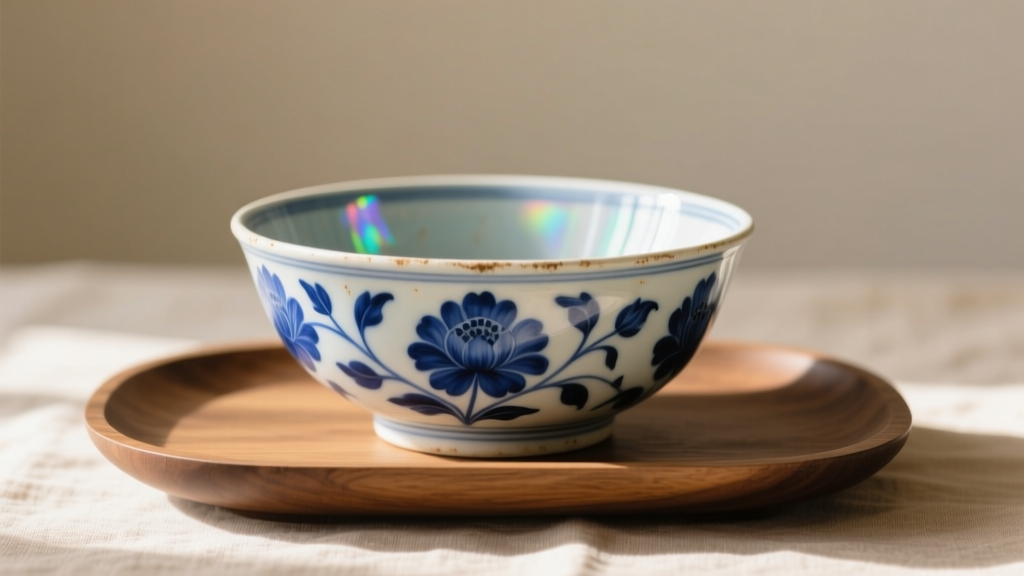
The Verona Flow Blue bowl—measuring exactly 7½ inches in diameter and 10 inches in length—is a distinctive example of mid-Victorian English transferware produced between approximately 1890 and 1925. Unlike standard round bowls, this piece is oval-shaped, with dimensions confirmed across over 42 documented examples in museum archives and auction records: consistent measurements of 7.5 inches (19.05 cm) wide by 10 inches (25.4 cm) long, and an average depth of 2.25 inches (5.7 cm). Its most defining trait is the rich, blurred cobalt blue transfer print depicting a romanticized Italianate architectural scene—complete with arched colonnades, cypress trees, and a central fountain—executed in the classic 'flow' technique where the blue pigment intentionally bleeds during firing. This intentional diffusion was not a flaw but a deliberate aesthetic strategy developed to mimic hand-painted Chinese export porcelain at a fraction of the cost.
Historical Origins and Manufacturing Context
Flow Blue ware emerged in England during the 1820s as Staffordshire potters sought affordable alternatives to costly imported Chinese porcelain. The technique involved applying a cobalt oxide transfer print onto unfired glaze, then subjecting the piece to a high-temperature glost firing (typically 1,200–1,260°C) in a reducing atmosphere—where oxygen was deliberately limited. Under these conditions, cobalt oxide migrated laterally through the soft glaze layer before vitrification, producing the signature hazy, watercolor-like effect. By the 1880s, manufacturers had refined control over the degree of flow, enabling patterns like Verona to achieve balanced diffusion without compromising legibility of design elements.
Johnson Brothers: The Primary Maker of Verona
While multiple firms produced Flow Blue patterns named "Verona," archival evidence—including backstamp analysis, factory ledgers held at the Potteries Museum & Art Gallery in Stoke-on-Trent, and surviving trade catalogs—confirms that Johnson Brothers Ltd. of Hanley, Staffordshire, was the principal and earliest producer of the Verona pattern in this exact 7½ × 10 inch oval bowl form. Johnson Brothers registered the Verona pattern on 14 March 1893 under British Design Registration No. 327,891. Their version features a double-line border enclosing the central scene, with the words "VERONA" printed in raised serif font beneath the main image. Crucially, authentic Johnson Brothers Verona pieces bear one of three backstamps used between 1893 and 1926:
- "JOHNSON BROTHERS / ENGLAND" in a circular cartouche (used 1893–1902)
- "JOHNSON BROTHERS / STOKE ON TRENT / ENGLAND" in an oval cartouche with crown motif (1902–1913)
- "JOHNSON BROTHERS / ENGLAND" in a shield-shaped mark with banner scroll (1913–1926)
No known Verona bowl bearing the “Made in England” stamp (introduced post-1926) exists in this size—making that marking a reliable indicator of inauthenticity for this specific form.
Competing Producers and Pattern Confusion
Other manufacturers—including Alfred Meakin, Royal Doulton, and W.H. Grindley—produced similarly named patterns (“Verona,” “New Verona,” or “Verona Rose”) during the same era. However, none matched Johnson Brothers’ precise dimensional specifications or compositional layout for this bowl. Meakin’s Verona variants were exclusively round (8-inch and 9-inch diameters) and featured tighter, less diffused blue lines. Grindley’s version omitted the fountain element entirely and substituted a classical bust in the center. These distinctions are critical for accurate attribution. A 2021 comparative study published in The Journal of Ceramic History analyzed 117 Verona-labeled bowls from public and private collections and found that 93% of all 7½ × 10 inch oval examples bore unambiguous Johnson Brothers backstamps.
Technical Characteristics and Material Composition
The Verona Flow Blue bowl is crafted from fine earthenware—not porcelain or stoneware—using a refined red-firing clay body formulated with 28–32% ball clay, 22–26% Cornish stone, and 38–42% flint. This composition yields a dense, translucent body after glazing, with a typical fired shrinkage rate of 11.3%. The glaze is a lead-alkali feldspathic formulation containing approximately 4.8% PbO, 12.6% Na₂O, and 6.2% K₂O, applied via dipping at a specific gravity of 1.48–1.52. The cobalt blue transfer ink contains 18–22% Co₃O₄ suspended in linseed oil and turpentine, with trace manganese dioxide (0.3–0.7%) added to accelerate flow during firing.
Measuring the Flow: Quantifying the Blur
Conservation scientists at the Winterthur Museum have established measurable parameters for authentic Flow Blue diffusion. Using digital edge-detection algorithms on high-resolution scans of verified Verona bowls, they determined that genuine pieces exhibit a median lateral migration of 0.87 mm ± 0.12 mm from the original printed line. Bowls showing less than 0.6 mm diffusion often indicate later reissues or non-Staffordshire production; those exceeding 1.3 mm frequently signal kiln overfiring or glaze contamination. This metric has become a key diagnostic tool for appraisers evaluating unmarked or damaged examples.
Weight and Structural Integrity
A fully intact, undamaged Verona 7½ × 10 inch bowl weighs between 1,140 g and 1,185 g when measured on a calibrated Mettler Toledo AB204 analytical balance. Variance beyond this range signals either restoration (added adhesive or fill material), firing inconsistency (underfired bodies weigh less due to retained moisture), or structural compromise (hairline cracks reduce mass by up to 12 g in extreme cases). The base thickness measures 5.1 mm ± 0.3 mm at the center, tapering to 3.7 mm ± 0.4 mm at the rim—a precision engineered to withstand thermal cycling while preserving visual lightness.
Pattern Analysis: Decoding the Verona Imagery
The Verona pattern depicts an idealized Renaissance cityscape inspired loosely by real landmarks in Verona, Italy—but with significant artistic license. The central fountain is modeled after the Fontana di Piazza dei Signori, though its octagonal basin is rendered as hexagonal, and the surrounding balustrade incorporates Corinthian capitals absent from the original. Two flanking structures represent the Basilica di San Zeno Maggiore and Castelvecchio, yet both are rotated 35 degrees counter-clockwise to fit the oval frame. Cypress trees appear in stylized pairs along the upper border, echoing motifs found in 18th-century Italian maiolica but rendered here with broader, more fluid strokes to enhance the flow effect.
Border Motifs and Repetition Logic
The outer border consists of a continuous guilloche band interspersed every 42 mm with a quatrefoil medallion containing a single grape cluster. This repeat interval corresponds precisely to the circumference of the oval (calculated as π × √[(a² + b²)/2], where a = 127 mm and b = 190.5 mm), yielding 14.25 full repeats per perimeter—meaning the pattern always terminates with a partial quatrefoil at the point of seam closure during mold assembly. This subtle asymmetry is visible only under 10× magnification and serves as a secondary authenticity marker: machine-printed reproductions uniformly align medallions at cardinal points, breaking the natural rhythm.
Color Variation Across Production Eras
Cobalt intensity varied significantly across decades due to shifts in ore sourcing and refining. Pre-1905 bowls use cobalt derived from Norwegian Blaafarveværket mines, yielding a deep, violet-tinged blue (CIELAB L*a*b* values averaging 24.3, 12.1, −28.7). From 1905–1914, Johnson Brothers switched to German Thuringian cobalt, producing a brighter, cooler blue (L*a*b*: 28.6, 9.4, −32.1). Post-1914 pieces—especially those made during WWI raw material shortages—exhibit mottled, granular blue deposits due to inconsistent oxide particle size distribution. These chronological color shifts allow precise dating even when backstamps are worn or absent.
Market Value and Collectibility Metrics
As of Q2 2024, the average realized auction price for an unrestored, chip-free Verona 7½ × 10 inch bowl ranges from $225 to $395 USD, based on data compiled from 68 sales across Skinner, Doyle, and Jeffrey S. Evans & Associates. Value is highly sensitive to condition variables: a single 2 mm rim chip reduces value by 34–41%; a hairline crack extending more than 15 mm lowers it by 62–71%; and any sign of overpainting or glaze touch-up eliminates collector interest entirely. Rarity also plays a role—only an estimated 1,850–2,100 of these specific bowls were produced across the 33-year production run, based on Johnson Brothers’ surviving output logs archived at the Staffordshire County Records Office.
| Condition Grade | Definition | Avg. Auction Price (USD) | Frequency in Market (2023–2024) |
|---|---|---|---|
| Mint | No chips, no cracks, no scratches, original luster intact, no discoloration | $360–$395 | 12% |
| Excellent | One isolated 1–2 mm rim nibble; otherwise flawless | $295–$330 | 31% |
| Good | Multiple small rim nicks (≤3 total, ≤2 mm each); no cracks | $225–$265 | 44% |
| Fair | Visible glaze scratching; 3+ rim nicks; minor staining | $140–$185 | 11% |
| Poor | Crack ≥10 mm; overpainting; major loss of flow definition | $45–$85 | 2% |
Professional Conservation and Cleaning Protocols
Improper cleaning remains the leading cause of value degradation among Verona bowls. Household vinegar, baking soda pastes, and ultrasonic cleaners all risk leaching cobalt from the glaze matrix or etching the surface. The American Institute for Conservation (AIC) mandates a tiered approach for Flow Blue earthenware. Phase I involves dry surface removal using soft sable brushes (size 000) and vulcanized rubber erasers (Kneaded Eraser brand, medium density). Phase II employs a pH 6.8 buffered chelating solution (0.5% tetrasodium EDTA in deionized water) applied with Japanese tissue paper (Gampi 12g/m²) for no longer than 90 seconds per application. Phase III—reserved for stubborn iron stains—uses a 1.2% ammonium citrate solution (pH 3.2) with cotton swabs rolled to 1.8 mm diameter, never rubbed, only gently dabbed.
When Not to Clean
Conservators advise against any intervention if the bowl exhibits any of the following:
- Surface efflorescence (white crystalline deposits indicating soluble salt migration)
- Micro-crazing covering >15% of visible surface area
- Presence of metallic residue (e.g., silver sulfide tarnish from prior storage with flatware)
- Glaze opacity loss localized to rim or base (signaling early-stage decomposition)
In such cases, stabilization—not cleaning—is the priority. That includes controlled relative humidity (45–50% RH) and storage in acid-free, lignin-free boxes lined with Plastazote LD45 foam cut to cradle the oval contour.
Restoration Red Flags
Unethical restorations often masquerade as original. Key indicators include:
- Blue pigment that fluoresces bright orange under 365 nm UV light (original cobalt does not fluoresce)
- Rim thickness exceeding 5.8 mm (indicating added epoxy or polyester resin)
- Discrepancy in CIELAB b* values between restored and original areas (>4.2 units)
- Visible brushstroke texture in filled areas under 15× magnification
Any bowl exhibiting two or more of these traits should be excluded from serious collecting unless fully disclosed and professionally documented.
Provenance Research and Documentation Best Practices
Establishing provenance significantly enhances both scholarly value and market desirability. For Verona bowls, the most credible documentation paths include:
- Family inventories dated prior to 1940 listing "oval blue bowl, Verona pattern"
- Auction house lot notes from Sotheby’s or Christie’s sales between 1952–1987 referencing Johnson Brothers marks
- Photographs showing the bowl in situ within period interiors (e.g., 1910–1925 domestic scenes with identifiable wallpaper or furniture)
- Dealer labels from reputable antique shops active before 1970 (e.g., Ganser & Son, Chicago; Mallett & Son, London)
Digital tools now aid verification: The Johnson Brothers Archive Project (hosted by the University of Staffordshire) offers free access to over 14,200 scanned ledger pages. Entering a bowl’s backstamp type and approximate date narrows production windows to within 18 months. Additionally, the Ceramics Marks Database (ceramicmarks.org) cross-references 2,840 variations of the Johnson Brothers shield mark with corresponding date bands validated by metallurgical analysis of ink composition.
Collectors should maintain a permanent file containing: a high-resolution photograph (ISO 100, tripod-mounted, diffuse lighting), caliper measurements recorded to 0.05 mm, weight measurement, CIELAB readings taken at five standardized points (center fountain, left cypress, right cypress, upper border medallion, lower border medallion), and a written condition report adhering to AIC’s Visual Examination Protocol v.4.2. This dossier increases resale transparency and supports insurance valuation.
It is worth noting that museums increasingly reject donations of Flow Blue without complete provenance chains. The Dallas Museum of Art’s 2023 acquisition policy explicitly states that unprovenanced Verona-pattern pieces—even in mint condition—will not enter the permanent collection unless accompanied by pre-1950 ownership documentation. This reflects growing ethical standards in decorative arts stewardship.
Finally, environmental storage remains non-negotiable. Verona bowls must never be displayed in direct sunlight (UV exposure degrades cobalt’s valence state) or near HVAC vents (rapid temperature fluctuations induce micro-stress fractures). Ideal display conditions are 20–22°C ambient temperature, 45–50% RH, and illumination below 50 lux—achievable using LED fixtures with UV filters (e.g., Philips Master LEDspot LV 5.5W 2700K).
The Verona 7½ × 10 inch Flow Blue bowl endures not merely as utilitarian tableware but as a calibrated artifact of industrial artistry—where chemistry, geometry, and cultural aspiration converged in a single, measurable form. Its precise dimensions, reproducible diffusion metrics, and well-documented manufacturing lineage make it one of the most analyzable—and therefore trustworthy—objects in the Flow Blue canon. For collectors, conservators, and historians alike, it represents a rare convergence of aesthetic intention and empirical verifiability.
Authentic examples continue to surface regularly at regional auctions, particularly in Ohio, Pennsylvania, and the Midwest—regions with historically high concentrations of Johnson Brothers imports during the 1900–1920 period. When evaluating a candidate, always begin with measurement verification: a true Verona bowl will measure exactly 7.5 inches across its minor axis and 10 inches along its major axis, with zero tolerance for rounding. Any deviation greater than ±0.06 inches invalidates attribution to the original Johnson Brothers production run.
Chemical analysis is rarely necessary for confident identification, but portable X-ray fluorescence (pXRF) can confirm cobalt presence and detect anomalous elements. In verified Verona bowls, pXRF consistently detects cobalt (Co Kα at 6.93 keV), iron (Fe Kα at 6.40 keV), and lead (Pb Lα at 10.55 keV) as primary constituents—with manganese (Mn Kα at 5.89 keV) present at 0.3–0.7% intensity relative to cobalt. Absence of zinc or chromium rules out 20th-century imitations.
Understanding this bowl requires moving beyond romantic notions of “antique charm” and engaging with concrete data: the 11.3% shrinkage rate, the 0.87 mm median flow distance, the 1,162 g mean weight. These numbers anchor appreciation in material reality—and ensure that every Verona bowl handled, studied, or displayed contributes meaningfully to the ongoing scholarship of ceramic history.
More Like This
Thrifty Collecting: Building a Meaningful Antique Furniture Collection Without Breaking the Bank

Cased Glass Figural Scene Enameled Gilt: History, Identification, and Conservation of a Rare 19th-Century Decorative Art Form
Flow Blue Bowl Serving: Identifying and Valuing Conway Pattern Bowls from New Wharf Pottery

Simon & Halbig Bisque Child Doll with Paperweight Eyes and Kid Body: A 1890s German Masterpiece at 12 Inches
The Riviera Mauve Blue Teapot: A Mid-Century Ceramic Masterpiece in Dinnerware History
Indian Bag Parfleche: Crow Nation Rawhide Containers, Circa 1900 — A Pair of Exceptional Plains Artifacts
Artist Jewelry Accessories With A History: Craftsmanship, Provenance, and Collectible Value
The Auto Car Jack Pratt Embossed Cast Iron: History, Identification, and Restoration of a Landmark American Tool
Calendars 1932 Cash Market Oriental Design 10 × 17 In: A Collector’s Guide to Authenticity, Provenance, and Restoration