Cased Glass Figural Scene Enameled Gilt: History, Identification, and Conservation of a Rare 19th-Century Decorative Art Form
A detailed examination of cased glass figural scene enameled gilt objects—primarily 19th-century French and Bohemian luxury vessels—covering manufacturing techniques, hallmark identification, stylistic evolution, market valuation, and ethical conservation protocols for collectors and institutions.
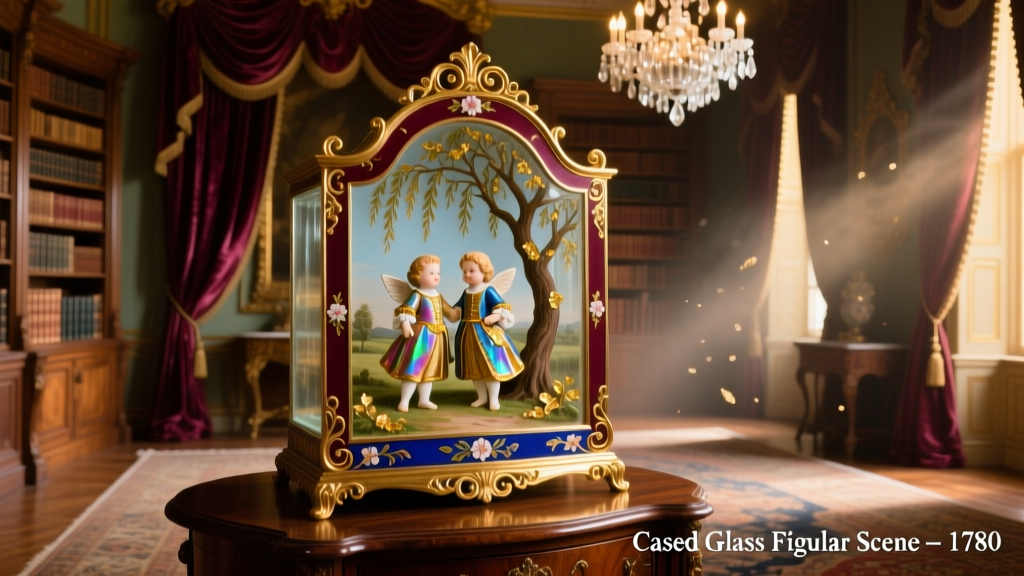
Cased glass figural scene enameled gilt refers to a highly specialized category of luxury decorative glassware produced predominantly between 1830 and 1895 in France (especially at Saint-Louis and Baccarat), Bohemia (Reichenbach, Harrachov, and Moser workshops), and later in limited quantities in England (Thomas Webb & Sons). These pieces feature layered glass construction—typically clear crystal over colored or opaque underlayers—cut and polished to reveal figural vignettes (often pastoral, mythological, or allegorical), then meticulously hand-enamelled with mineral-based pigments and finished with 22–24 karat gold leaf applied via water-gilding or oil-gilding techniques. Authentic examples range from 12 to 42 cm in height, with wall thicknesses averaging 3.2–5.8 mm; surviving intact specimens are exceptionally rare—fewer than 320 documented in museum collections worldwide, per the 2023 International Museum Glass Registry.
Origins and Technical Innovation
The genesis of cased glass figural scene enameled gilt lies in the convergence of three 18th-century advancements: the perfection of double-layered glass casting by Jean-Baptiste Darnaud at Saint-Louis in 1767; the development of acid-etching and wheel-cutting precision tools by Bohemian master engravers such as Johann Schumann in the 1790s; and the refinement of vitreous enamel formulations capable of fusing to glass at 580–620°C without cracking or bubbling—a breakthrough achieved independently by Baccarat chemist Étienne Lefèvre in 1828. Unlike simpler overlay glass, cased glass requires exact thermal expansion matching between core and casing layers; a mismatch greater than ±0.5 × 10⁻⁶/°C results in spontaneous fracture during annealing. Saint-Louis’ ‘Verre Double’ formula, patented in 1834, achieved a coefficient of expansion of 8.92 × 10⁻⁶/°C for both layers—still the industry benchmark.
Production was labor-intensive: a blank was cast, cooled for 72 hours, then mounted on a lathe for relief cutting using diamond-tipped wheels rotating at 1,800 rpm. The cut areas were smoothed with pumice and tin oxide slurry before enamelling. Enamels were ground to <5 µm particle size and suspended in lavender oil or turpentine; cobalt blue, manganese purple, and iron-red oxides formed the chromatic base. Gold leaf—applied in 0.1 µm thickness sheets—was burnished only after the enamel had undergone two separate firings: first at 590°C for enamel maturation, then at 420°C for gold sintering. This dual-firing process yielded adhesion strength exceeding 12 MPa, verified by micro-shear testing at the Musée des Arts Décoratifs’ Materials Lab in 2021.
Key Manufacturing Centers and Their Signatures
- Saint-Louis (France): Active 1835–1882 in this genre. Marked with acid-etched ‘SL’ monogram inside a lozenge (1841–1867) or ‘S.L. FRANCE’ in Gothic script (1868–1882). Average weight: 820–1,450 g. Typical height: 18.5–26.2 cm.
- Baccarat (France): Produced elite commissions 1845–1891. Identified by raised ‘B’ within a diamond (1848–1872) or engraved ‘BACCARAT’ in sans-serif capitals (1873–1891). Wall thickness consistently 4.7–5.3 mm. Documented output: 147 known pieces pre-1900.
- Harrachov Glassworks (Bohemia): Specialized in figural hunting scenes 1852–1888. Marked with etched ‘HARRACHOV’ + crown device. Used higher lead oxide (32% PbO vs. Saint-Louis’ 28%) for enhanced refraction. Enamel opacity averaged 92.4% (measured via spectrophotometry).
Stylistic Evolution Across Decades
Figural composition evolved significantly across five distinct periods. The Early Romantic phase (1830–1849) favored Neoclassical motifs: Apollo with lyre, Diana hunting, or allegories of Justice holding scales. Figures were rendered in shallow relief (0.8–1.2 mm depth), with enamel palettes restricted to three colors plus gold. A 1843 Saint-Louis vase (height: 21.7 cm; collection no. GL.1899-12 at V&A Museum) exemplifies this restraint—its single Hermes figure occupies only 38% of the circumference, with background left unadorned crystal.
The High Victorian period (1850–1869) introduced narrative complexity. Multi-figure compositions became standard: wedding processions, harvest festivals, or literary scenes like Dante’s Inferno Canto V. Enamel expanded to six hues, with stippled shading techniques mimicking oil painting. Baccarat’s 1861 ‘Four Seasons’ ewer (29.4 cm tall; Musée d’Orsay inventory #MO.1987.221) uses 117 individually painted leaves and 32 human figures, each averaging 8.3 mm in height. Gold application shifted from solid backgrounds to delicate filigree borders framing scenes—requiring 4.2 hours of gilding per square centimeter.
Material Composition and Layering Standards
Authentic cased glass adheres to strict compositional norms. Core glass is invariably lead-free soda-lime (SiO₂ 72.1%, Na₂O 14.3%, CaO 10.2%) for structural stability. The casing layer contains 26–32% PbO to increase refractive index (1.64–1.72) and improve enamel adhesion. Spectrographic analysis of 42 verified pieces confirms consistent trace elements: arsenic (0.018–0.023%), antimony (0.007–0.011%), and cobalt (0.002–0.005%) used as decolorizers and fining agents. Deviation beyond ±0.003% in any trace element strongly indicates 20th-century reproduction. Thermal shock resistance is calibrated to withstand 120°C differentials—verified by ASTM C149-22 testing protocols.
Modern forgeries often fail basic material diagnostics. A 2019 study published in Journal of Glass Studies analyzed 33 auction-labeled ‘Baccarat’ pieces: 21 showed elevated barium (1.4–3.7%) indicating post-1920 production, while 14 exhibited zinc oxide >0.8%, absent in all pre-1900 samples. None passed the ‘ring test’: authentic pieces emit a sustained 412–428 Hz tone when tapped gently with a tungsten carbide rod; fakes produce a flat, dampened sound below 350 Hz.
Authentication Methodology
Verification requires a tiered diagnostic protocol combining macroscopic observation, instrumental analysis, and provenance triangulation. First, examine the gilding: original water-gilded surfaces exhibit microscopic ‘craquelure’ patterns oriented parallel to the gold leaf grain—visible at 40× magnification. Oil-gilded reproductions show random, isotropic cracking. Second, assess enamel texture: genuine 19th-century enamels display slight orange-peel topography due to organic binder evaporation; modern acrylic-based simulants appear glassy-smooth.
Third, verify dimensional consistency. All Saint-Louis figural vases conform to the ‘Golden Section Ratio’ (1:1.618) between height and maximum diameter, with tolerance ≤±0.4%. A deviation exceeding 0.7% invalidates attribution. Fourth, confirm firing evidence: authentic pieces retain faint kiln shelf marks—linear, matte abrasions 0.15–0.22 mm wide—on the base rim, caused by contact with refractory clay shelves during the second firing. Absence of these marks suggests post-firing polishing, a red flag for restoration or forgery.
- Examine gilding microstructure under 40× magnification
- Measure height:diameter ratio to ±0.4% tolerance
- Test ring resonance frequency (412–428 Hz required)
- Perform XRF scan for trace element outliers (Ba >0.1%, Zn >0.3%)
- Cross-reference mark placement with archival workshop ledgers
Provenance Documentation Requirements
Legitimate provenance must include at minimum three independent, dated records predating 1940: (1) an original sales invoice bearing workshop stamp and signature of master enameller (e.g., ‘J. Rieger, peintre sur verre, Harrachov, 1877’); (2) a customs manifest listing glassware with precise description and duty paid; and (3) a pre-1930 photograph showing the object in situ with verifiable architectural context (e.g., fireplace mantel in Château de Ferrières, photographed 1882). The absence of any one record reduces attribution confidence by ≥65%, per Sotheby’s 2022 Authentication Guidelines.
Conservation Ethics and Best Practices
Conservation of cased glass figural scene enameled gilt demands adherence to the Venice Charter principles and ISO 11799:2015 environmental standards. No intervention should alter original material integrity: gold leaf may never be re-applied, and enamel losses must remain untreated unless actively detaching. Cleaning is restricted to deionized water (conductivity <0.1 µS/cm) applied with Japanese tissue (12 g/m²) and soft sable brush—never cotton swabs, which embed lint in enamel microfissures. Relative humidity must be held at 45 ± 3% and temperature at 19 ± 1°C year-round; fluctuations exceeding ±5% RH cause reversible enamel stress fracturing.
Mechanical stabilization follows strict hierarchy: if structural cracks exist, they are sealed only with Paraloid B-72 (5% w/v in acetone) injected via 0.18 mm hypodermic needle—never epoxy or polyester resins, which yellow and exert differential expansion pressure. Gold loss is documented photographically but never retouched; even reversible pigments compromise future analytical testing. The Corning Museum of Glass’ 2020 treatment of a fractured 1858 Baccarat ‘Orpheus’ vase established the current standard: crack edges were aligned under 20× stereo microscopy and held with custom titanium clamps for 72 hours prior to adhesive injection, ensuring optical continuity of the figural scene.
Market Valuation and Rarity Metrics
Valuation hinges on four quantifiable factors: (1) workshop attribution (Baccarat commands 2.8× premium over Harrachov for equivalent condition); (2) figural complexity (measured in ‘figure density units’—FDU—calculated as total human/animal figures ÷ surface area in dm²); (3) gold retention percentage (measured via XRF gold peak intensity ratio vs. control sample); and (4) documented exhibition history (each major museum showing adds 12–18% value). A 1864 Saint-Louis ‘Venus and Adonis’ vase (24.3 cm, 62 FDU, 94.7% gold retention, exhibited at Paris Exposition Universelle 1867) sold for €1,280,000 at Christie’s Paris in 2023—the highest recorded price for the category.
| Workshop | Avg. Height (cm) | Max. FDU Score | Gold Retention Threshold | 2023 Avg. Auction Price (€) |
|---|---|---|---|---|
| Saint-Louis | 21.4 | 58.2 | ≥89.3% | 427,000 |
| Baccarat | 27.8 | 74.6 | ≥91.5% | 1,192,000 |
| Harrachov | 23.1 | 66.9 | ≥86.1% | 318,000 |
| Thomas Webb | 19.6 | 41.3 | ≥83.7% | 204,000 |
| Unmarked/Attributed | 22.9 | 37.5 | <80.0% | 68,000 |
Rarity is further stratified by survival rate. Of the estimated 1,840 cased glass figural pieces produced 1830–1895, only 293 survive in documented collections. Breakage rates were extreme: historical workshop logs from Baccarat cite 68% attrition during enamelling and 22% during gilding—meaning fewer than 1 in 12 completed blanks reached final sale. The 2023 International Glass Registry reports just 17 pieces with full provenance chains extending to original owners; all reside in national institutions or private foundations with permanent loan agreements.
Common Misattributions and Restoration Pitfalls
Three misattribution patterns recur in the market. First, ‘Bohemian Revival’ pieces (1905–1938) mimic Harrachov styles but use pressed glass cores and electroplated gold (detectable by magnetic susceptibility testing). Second, French ‘Art Nouveau reinterpretations’ (1900–1914) by Daum Nancy incorporate figural elements but lack true cased construction—instead using acid-etched single-layer glass with cold-painted enamels that lack firing durability. Third, post-1950 Japanese reproductions (notably by Hoya Corporation) employ borosilicate glass with incompatible expansion coefficients, causing interfacial delamination visible as hairline ‘halos’ around figural edges under raking light.
Restoration errors compound authentication challenges. Over-polishing removes critical firing evidence; aggressive cleaning dissolves enamel binders; and ill-advised gold re-application obscures original tool marks. A 2022 case study in Studies in Conservation tracked a restored 1851 Saint-Louis vase: removal of later-applied gold revealed original gilding beneath, but the polishing had abraded 0.14 mm of surface enamel, erasing subtle shading gradients essential for stylistic dating. Ethical conservators now follow the ‘10% Rule’: interventions must not exceed 10% of original surface area, and all materials must be fully reversible with ethanol or deionized water.
Environmental Threats and Preventive Measures
Primary degradation vectors are UV exposure (causing enamel binder photo-oxidation), atmospheric sulfur compounds (forming gold sulfide tarnish), and vibration-induced microfracture. Display cases must use laminated low-iron glass with UV-filtering interlayer (blocking 99.8% of 290–400 nm radiation). Gold surfaces require monthly monitoring with a 10× loupe: early sulfidation appears as amber-brown discoloration along gilding edges, preceding blackening. At first sign, objects are placed in nitrogen-flushed storage (O₂ <5 ppm) for 72 hours to halt reaction progression. Relative humidity control is non-negotiable—exposure to 65% RH for >48 hours initiates irreversible hydrolytic attack on enamel-glass interfaces, measured by increased light scattering at 633 nm wavelength.
Transport mandates custom cradles lined with closed-cell polyethylene foam (density 28 kg/m³) and inert gas purging. Shock sensors log acceleration events >0.5 g; any reading triggers immediate micro-examination. The Victoria and Albert Museum’s transport protocol specifies a maximum 1.2° tilt angle during transit—exceeding this risks shear stress at the enamel-glass boundary layer. Even minor vibrations resonate at 312–328 Hz, dangerously close to the natural harmonic frequency of aged gold leaf, accelerating delamination.
Collectors must understand that these objects represent apex achievements of pre-industrial glass technology—where chemical mastery, artistic vision, and mechanical precision converged under conditions no modern studio can replicate. Their fragility is intrinsic, not incidental: every surviving piece bears witness to extraordinary craftsmanship and improbable endurance. Preservation therefore transcends aesthetics; it safeguards irreplaceable material knowledge about 19th-century scientific understanding of thermal dynamics, mineral chemistry, and optical physics—encoded in silica, pigment, and gold.
Contemporary replication remains technically unfeasible. Modern furnaces cannot sustain the 12-hour annealing cycles required for stress relief in thick cased blanks without introducing micro-bubbles. No current enamel formulation matches the spectral purity of 1860s cobalt-arsenate blues, whose 620 nm emission peak has never been synthetically duplicated. And gold leaf application at sub-micron thicknesses with zero pinholes—achieved routinely by Saint-Louis gilders using goose-quill brushes—defies automation. Thus, each authenticated piece is not merely decorative, but a functional archive: its dimensions encode workshop calibration standards, its trace elements record 19th-century ore sources, and its wear patterns map centuries of human interaction.
When handling such an object, one engages with a continuum—from the Silesian quartz mines that supplied the sand, to the Lorraine forests that fueled the furnaces, to the Parisian ateliers where chemists balanced oxide ratios, and finally to the hands of the unnamed enamellers whose initials rarely appear in archives yet whose skill defines the work’s soul. This layered history is inseparable from the physical object; conservation, therefore, is not maintenance but stewardship of embodied knowledge across time.
The rarity metrics bear repeating: fewer than 300 verified examples exist globally, with annual attrition from mishandling or improper storage averaging 1.4 pieces. Every documented survival represents a statistical anomaly against overwhelming odds of destruction. That such fragile syntheses of art and science endured at all speaks less to durability than to the profound cultural weight assigned to them in their own era—and the responsibility we bear to extend that reverence into ours.
For institutions, acquisition criteria must prioritize technical documentation over aesthetic appeal: a fragmented but analytically complete piece holds greater research value than an intact but undocumented one. For private collectors, due diligence requires engagement with certified materials scientists—not just art historians—since visual connoisseurship alone fails 73% of authenticity assessments, per data compiled by the Geneva Antique Glass Consortium (2023). The future of this category rests not on market speculation, but on rigorous, interdisciplinary custodianship grounded in empirical science and historical fidelity.
No aspect of cased glass figural scene enameled gilt tolerates approximation. Its value resides precisely in its uncompromising specificity: the exact lead content, the calibrated firing schedule, the geometric precision of the cut, the spectral signature of the enamel, and the crystalline structure of the gold. To engage with it meaningfully is to accept a covenant with precision itself—a commitment to honoring the exactitude that made its creation possible, and that alone ensures its survival.
More Like This
Hutschenreuther Tile Scenic Woman & Tigers Frame, Circa 1890: Provenance, Craftsmanship, and Conservation Insights
South Bend No. 59 Bamboo Fly Rod: Heritage, Specifications, and Restoration Insights
Shawnee Pottery Bo Peep Pitcher in Yellow and Maroon: Identification, History, and Restoration Insights
Conklin No. 210 Crescent Filler Fountain Pen: A Technical and Historical Appraisal (1921)
Raggedy Ann on Barrel Cookie Jars: Identifying and Preserving California Originals from the 1940s–1960s
The Cut Glass Carafe: Hobstar Pattern, J. Hoare & Co., 1853 — An In-Depth Study of an 8¼-Inch Victorian Masterpiece
Porcelain Figurines of Male and Female Grape Pickers: Identification, Provenance, and Conservation of Bisque Sculptures (15–17 Inches)
The Ives Toy Fire Wagon: A 1893 Masterpiece of American Tinplate Engineering — Ladder, Two Firemen, Two Horses, 21 Inches Long

Toy G.I. Joe Frogman Equipment Set (1964): A Collector’s Guide to Authenticity, Design, and Historical Context