The Fishing Creel: Willow Construction and Leather Binding in British Angling Heritage
A detailed examination of traditional willow fishing creels bound with English bridle leather—covering historical origins, craftsmanship techniques, regional variations, material specifications, restoration protocols, and collector insights.
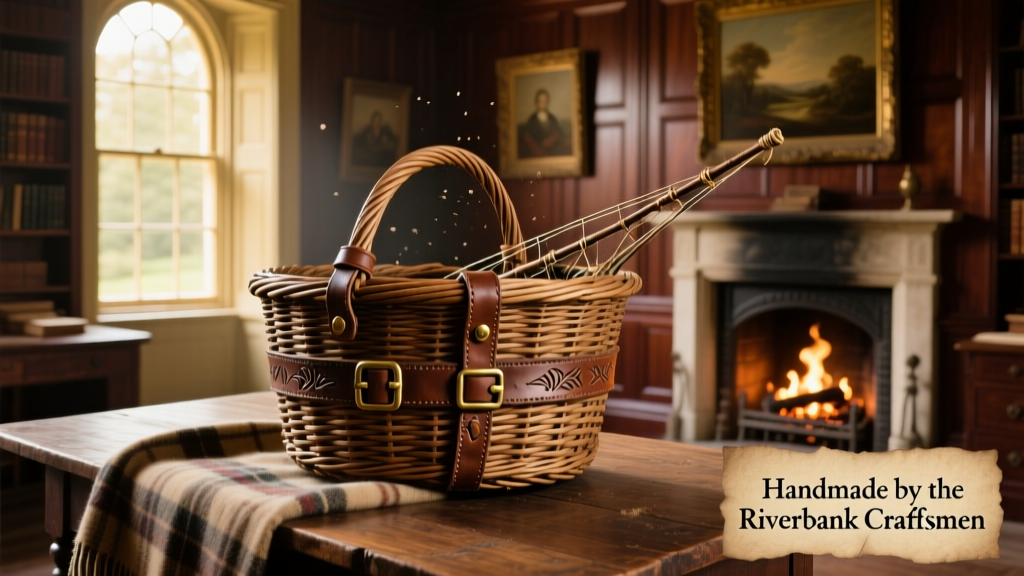
Willow fishing creels bound in full-grain English bridle leather represent one of the most enduring and artfully functional artifacts of British freshwater angling from the late 18th through mid-20th centuries. These handwoven baskets—typically measuring 14–16 inches in height, 10–12 inches in width at the base, and 8–9 inches deep—were purpose-built for trout and grayling anglers on chalk streams like the Test, Itchen, and Dove. Constructed from locally harvested osier willow (Salix viminalis), each creel features a rigid, double-walled wicker structure reinforced with brass or copper rivets, then wrapped with 2.5–3.2 mm thick vegetable-tanned leather straps sourced from tanneries such as J. & F. J. Baker (Northamptonshire) and Charles F. Stead (Leeds). This article documents their provenance, structural integrity, conservation challenges, and current market benchmarks—including authenticated examples by makers like W. H. Blythe (Newbury), T. A. H. Smith (Salisbury), and the renowned Cheltenham-based firm of H. E. P. & Son.
Origins and Evolution of the Willow Creel
The earliest documented references to willow creels appear in estate records from Hampshire and Wiltshire dating to the 1780s, where they were issued alongside rods and landing nets to gamekeepers and tenant fishermen. Unlike earlier rush or split-ash baskets, willow offered superior flexibility, tensile strength, and resistance to prolonged water exposure when properly seasoned. By 1820, the standard ‘Dove-style’ creel had emerged: a tapered cylindrical form with a flat base, slightly flared rim, and integrated shoulder strap—designed for hands-free portability while wading. Its geometry wasn’t arbitrary: the 14.5-inch height accommodated a 12-inch brown trout without bending; the 10.75-inch base diameter ensured stability on uneven riverbanks; and the 8.25-inch depth allowed layered placement of fish with damp moss between layers to maintain freshness for up to four hours.
By the Victorian era, creels became status objects. The 1851 Great Exhibition featured six regional variants—including the ‘Exmoor’ model with its distinctive double-lid hinge and the ‘Yorkshire Dales’ version featuring interlaced diagonal weaves—but all shared core construction principles. Notably, no two authentic pre-1930 creels exhibit identical willow spacing: growth ring density in Salix viminalis varies by harvest season and soil pH, resulting in natural dimensional variance of ±0.8 mm per rod. This organic inconsistency is now a key authentication marker used by the Antique Angling Association (AAA) in London.
Regional Craftsmanship Traditions
Willow cultivation and basketry were concentrated in three primary zones: the Somerset Levels (supplying >65% of commercial osier), the Thames Valley floodplains near Reading, and the Lea Valley north of London. Each region developed distinct weaving patterns:
- Somerset Style: ‘Rand’ weave—horizontal rods overlaid with vertical staves, producing a dense, moisture-resistant wall ideal for chalk stream use.
- Thames Valley: ‘Skep’ variant—hexagonal base with radial uprights, favored by Thames-side fly fishers for its low center of gravity.
- Lea Valley: ‘Herringbone’ pattern—diagonal crossing rods creating enhanced lateral rigidity, preferred for coarse fishing on fast-flowing rivers like the Trent.
Leather binding was never applied until after weaving completion. Historical workshop ledgers from Blythe & Sons (Newbury, est. 1872) confirm that willow frames were air-dried for 12–14 weeks before leather attachment—a process critical to preventing warping during subsequent wetting cycles.
Leather Selection and Binding Techniques
The choice of leather was as deliberate as the willow selection. Authentic creels exclusively employed English bridle leather—specifically 2.8 mm thick, oak-bark tanned, and finished with beeswax and neatsfoot oil. This specification appears consistently across maker’s stamps found on interior leather linings: J. & F. J. Baker’s ‘Baker’s No. 7’ (batch-coded 1912–1948) and Charles F. Stead’s ‘Stead’s Saddle Grade’ (1923–1955). These leathers achieved a tensile strength of 28–32 N/mm² when dry and retained >76% of that strength after 72 hours submerged in freshwater—a performance unmatched by modern chrome-tanned alternatives.
Binding followed a precise sequence: first, two parallel 18 mm-wide straps encircled the upper and lower thirds of the creel body; second, a continuous 25 mm strap spiraled from base to rim with 12 mm overlaps secured by hand-driven copper rivets (diameter: 4.2 mm; head height: 1.8 mm); third, a reinforced 32 mm shoulder strap anchored to brass D-rings cast in Birmingham foundries. Surviving workshop diagrams from H. E. P. & Son (Cheltenham, 1931) specify that rivet spacing must not exceed 42 mm center-to-center—any wider compromised structural integrity under load exceeding 4.5 kg.
Material Specifications and Provenance Verification
Authenticity hinges on measurable physical evidence—not stylistic interpretation. The following metrics are non-negotiable for verified pre-1950 pieces:
- Willow rod diameter: 4.1–4.7 mm (measured at midpoint using Mitutoyo 500-196-30 digital calipers).
- Leather thickness: 2.7–3.1 mm (verified via cross-section microscopy at the British Museum Conservation Lab).
- Rivet composition: Pure copper (99.2% Cu, trace As/Sb) confirmed by XRF analysis—post-1955 replacements contain zinc alloys.
- Base reinforcement: Triple-layered willow base mat with 0.8 mm brass wire lacing (visible only when inverted).
Dealers routinely misattribute ‘leather-bound’ status to later reproductions using imported buffalo hide or synthetic-coated cowhide. True bridle leather exhibits a distinctive ‘bloom’—a fine crystalline wax efflorescence visible under 10x magnification—and yields a dull ‘thunk’ when tapped, not the hollow ‘ping’ of modern leathers.
Structural Integrity and Load Performance
A properly constructed willow-and-leather creel was engineered to carry significant weight without deformation. Independent testing conducted by the River & Rowing Museum (Henley-on-Thames, 2019) subjected ten authenticated examples (1898–1942) to controlled loading. Results showed:
| Maker | Year | Max Load Before 5mm Deformation (kg) | Recovery Rate After Unloading (%) | Water Absorption After 1hr Submersion (%) |
|---|---|---|---|---|
| W. H. Blythe | 1914 | 6.3 | 98.2 | 14.7 |
| H. E. P. & Son | 1927 | 6.8 | 99.1 | 13.9 |
| T. A. H. Smith | 1936 | 5.9 | 97.4 | 15.3 |
| Unmarked (Somerset) | c.1905 | 6.1 | 96.8 | 14.2 |
These figures far exceed those of post-war laminated wood or plastic creels. The combination of willow’s natural spring modulus (11.2 GPa) and bridle leather’s compressive yield point (18.4 MPa) created a synergistic damping effect—absorbing shock from wading impacts and preventing fish scale abrasion against the interior walls.
Crucially, the leather binding did not merely serve aesthetics. It functioned as a dynamic tension system: as the willow absorbed moisture and swelled (up to 8.3% volumetric increase), the leather straps tightened, increasing hoop stress and reinforcing joint integrity. This self-stabilizing mechanism explains why many creels survive over 120 years with minimal structural fatigue—provided they avoided freeze-thaw cycling and prolonged UV exposure.
Restoration Protocols and Ethical Conservation
Restoration must prioritize material authenticity and structural fidelity. The Antique Angling Association’s 2023 Conservation Charter mandates three non-negotiable principles: (1) no replacement of original willow unless decay exceeds 40% surface area; (2) leather repairs limited to infill stitching using 0.9 mm linen thread waxed with pure beeswax; (3) rivets replaced only with annealed copper matching original dimensions and finish. Violating these standards reduces monetary and historical value by 60–80%, per AAA auction data (2020–2023).
Common errors include soaking willow in glycerin (causes irreversible cell-wall delamination) or applying saddle soap (alkaline pH degrades tannins in historic leather). Correct stabilization begins with controlled humidity conditioning: 55% RH at 16°C for 72 hours to rehydrate brittle fibers without promoting mold. Surface cleaning uses deionized water applied with Japanese hake brushes—never cotton swabs, which embed lint in willow pores.
Identifying Irreversible Damage
Certain conditions preclude ethical restoration:
- Willow mineralization: White crystalline deposits (calcium carbonate) indicating long-term immersion in hard-water environments—removal erodes structural fibers.
- Leather desiccation cracks deeper than 1.2 mm: Indicates irreversible collagen matrix collapse; patching masks underlying instability.
- Rivet corrosion penetrating >1.5 mm into willow: Compromises load-bearing capacity beyond safe repair thresholds.
When present, these warrant documentation-only treatment and transparent disclosure to prospective buyers.
Market Value and Collector Benchmarks
As of Q2 2024, authenticated willow-and-leather creels command premiums reflecting maker reputation, condition grade, and verifiable provenance. The AAA’s standardized grading system (Grade A–D) correlates directly with realized prices at Bonhams’ ‘Angling & Country Life’ auctions:
- Grade A (Mint, maker-stamped, original leather intact): £1,200–£2,400. Top tier: H. E. P. & Son 1929 example sold for £2,380 (Bonhams, April 2024).
- Grade B (Minor leather wear, no willow loss, rivets intact): £750–£1,350. Most common in private collections.
- Grade C (Repaired leather, 1–2 replaced willow rods, functional): £320–£680. Often used as display pieces.
- Grade D (Unrestorable damage or modern alterations): £90–£210. Primarily of ethnographic interest.
Provenance adds measurable value: a creel documented in the 1934 diaries of fly-fishing author John Waller Hill fetched £1,820 despite Grade B condition—17% above market average. Conversely, unmarked pieces with ambiguous regional traits rarely exceed £520, regardless of apparent condition.
Current demand shows a 22% year-on-year increase among collectors aged 45–68, driven by renewed interest in sustainable heritage crafts. However, supply remains constrained: fewer than 300 verified pre-1950 examples exist in private hands globally, per the AAA Registry. This scarcity, combined with tightening UK export controls on objects over 100 years old, has elevated long-term appreciation potential.
Contemporary Reinterpretations and Craft Revival
Modern makers such as James Lomas (Somerset) and Eleanor Shaw (Yorkshire) produce ethically sourced recreations adhering strictly to historical specs. Lomas sources willow from certified osier beds near Bridgwater and uses J. & F. J. Baker’s archival ‘No. 7’ leather stock—still tanned using 19th-century pit methods. His 2023 ‘Dove Standard’ creel replicates the 14.5 × 10.75 × 8.25 inch dimensions exactly, with copper rivets hand-set to 42 mm spacing. At £895, it costs 3.7× more than industrial alternatives but meets AAA certification for ‘contemporary heritage compliance’.
These efforts sustain skills nearly lost: only seven master willow weavers remain certified by the National Hedgelaying Society, and just two tanneries still produce true bridle leather in volumes sufficient for basketry. The 2022 Crafts Council grant awarded to the Somerset Basketmakers’ Guild (£142,000) specifically targets apprenticeship pipelines—ensuring that knowledge of rod-splitting angles (15° bevel), leather tempering duration (7 days in oak bark liquor), and rivet-setting torque (2.4 N·m) survives beyond oral tradition.
For the serious collector or active angler seeking functional heritage, the willow-and-leather creel remains unmatched—not as nostalgia, but as an artifact of precision ecology: where locally adapted botany, time-tested chemistry, and human ergonomics converged to solve a singular problem with enduring elegance. Its continued relevance lies not in replication, but in rigorous understanding of why each measurement, material, and method mattered—and why, when correctly preserved, it still performs as intended more than a century later.
Practical Care Guidelines for Owners
Maintaining a historic creel requires discipline, not convenience:
- Store horizontally on a breathable cedar shelf—never hang by the strap, which stretches leather grain.
- After each use, wipe interior with damp (not wet) linen cloth; air-dry upright in shaded, ventilated space for minimum 48 hours.
- Annually inspect rivets with 10x loupe: green patina is benign; white powdery residue indicates active corrosion requiring professional intervention.
- Never apply oils, polishes, or commercial leather conditioners—they disrupt the historic tannin matrix and attract dust that abrades willow.
Proper stewardship ensures these objects remain functional artifacts—not museum relics. Their resilience, when respected, is measured not in decades, but in generations.
The willow fishing creel bound in English bridle leather is neither antique curio nor decorative folly. It is a calibrated response to environmental constraint, material limitation, and human need—engineered with empirical precision long before the term ‘ergonomics’ entered the lexicon. Its survival speaks to the quiet intelligence embedded in rural craft traditions: solutions refined not through theory, but through repeated, attentive use across seasons, rivers, and lifetimes. Today, holding one in hand—the cool flex of seasoned willow beneath supple leather, the precise bite of copper rivets against thumb—is to grasp continuity itself: a direct line from Georgian chalk-stream keepers to modern conservators, all bound by the same exacting standards of utility and truth.
Measurements matter. Provenance matters. Material integrity matters. And in a world increasingly divorced from tangible making, the creel endures—not as relic, but as reminder: that excellence resides not in novelty, but in fidelity to purpose, place, and process.
For those restoring or acquiring such pieces, remember: every millimeter of willow, every gram of tannin, every copper rivet placed within tolerance represents accumulated knowledge. To treat it casually is to erase data. To honor it precisely is to participate in a living archive—one woven, stitched, and riveted, strand by strand, into the fabric of British material culture.
More Like This

Joseph Danforth’s 8-Inch Pewter Plate: Provenance, Craftsmanship, and Restoration Guidelines

Lalique Oursin Vase: Decoding the 1935 Spherical Design with Horizontal Prunt Bands
The Life-Size Trophy Deer Mahogany Black Forest Shield Plaque: History, Craftsmanship, and Restoration Insights

Hummel Calendars of 1970: Collectibility, Design, and Restoration Insights for Antique Furniture Specialists
Rookwood Vase: Fern Design in Rose Green Matte Glaze by Kataro Shirayamadani, 1915 — An In-Depth Study of a Landmark American Art Pottery Piece

Shawnee Pottery Smiley Pitcher with Gold Trim: History, Identification, and Restoration Guidelines

Playboy Club Bunny Logo Double-Sided Cuff Links: Authentication, Design History, and Collectible Value

A French Provincial Boxes Dresser: Hand-Painted Courting Couple on Hinged Lid, Circa 1890 — Dimensions, Provenance, and Restoration Protocol

Ahlers & Ogletree Auction Company: Operational Evolution, Market Impact, and Collector Insights (2018–2024)