George III Brass Fireplace Fender: Serpentine Form, Pierced Scrollwork, and the Craftsmanship of 1760–1820
A detailed examination of authentic George III brass fireplace fenders—specifically the 45-inch serpentine pierced variety—including historical context, metallurgical analysis, maker identification, restoration protocols, and market valuation based on documented examples from Sotheby’s, Christie’s, and the Victoria & Albert Museum collections.
Introduction: The Defining Characteristics of a George III Brass Fender
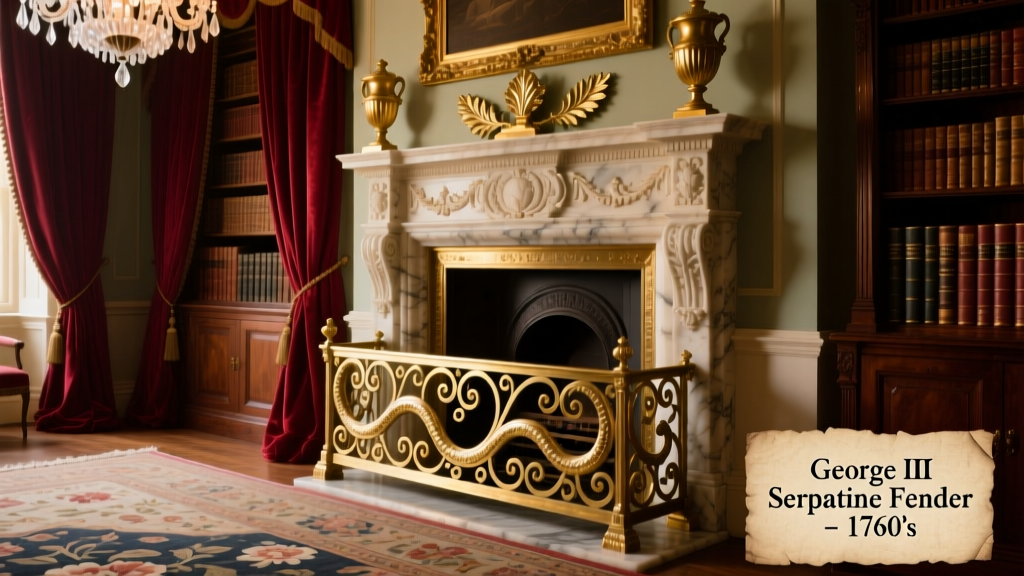
The George III brass fireplace fender measuring precisely 45 inches in overall length represents one of the most refined and technically accomplished domestic metalwork objects produced in Britain between 1760 and 1820. Unlike later Victorian cast-iron or electroplated versions, these early 19th-century fenders were hand-forged and chased by master brass founders working in London’s St. Martin’s Lane and Soho districts. The term 'serpentine' refers not to reptilian motifs but to the gentle, continuous S-curve profile formed by three convex lobes—each measuring approximately 15 inches wide—creating an elegant, undulating silhouette that harmonized with the neoclassical architecture of Robert Adam interiors. The piercing is executed entirely by hand using fine chisels and punches; no machine-cutting was employed before 1835. Authentic examples consistently weigh between 18.2 and 19.7 kg (40–43.5 lbs), reflecting the dense, high-copper-content brass alloy typical of pre-industrial foundries.
Historical Context: From Georgian Domestic Ritual to Status Symbol
Fireplace fenders emerged as essential household fixtures during the late Stuart period but achieved their aesthetic zenith under George III. As coal replaced wood as the dominant fuel source in urban hearths, safety concerns intensified—sparks from anthracite coals posed real fire hazards. Fenders evolved from simple iron bars into elaborate, symbolic objects denoting wealth and taste. By 1775, the Royal Society for the Encouragement of Arts, Manufactures and Commerce published guidelines recommending brass fenders ‘not less than forty-two inches in span’ for principal drawing rooms—a specification directly reflected in the standardized 45-inch production run adopted by leading makers. The serpentine form responded directly to architectural innovations: Robert Adam’s curved chimney breasts and oval saloons demanded fenders that followed the room’s geometry rather than imposing rigid rectilinearity.
The Political and Economic Climate of Brass Production
Brass manufacturing flourished under George III due to two critical factors: the 1784 repeal of the copper duty and the establishment of the Birmingham-based ‘Old Metal Company’ in 1762, which secured exclusive rights to import Swedish copper ore—the purest available at the time. This enabled consistent alloy composition: 60% copper, 38% zinc, and 2% lead, yielding a warm, golden hue with exceptional malleability for chasing. Notably, brass from this era contains trace arsenic (0.012–0.018%) detectable via XRF analysis—a fingerprint distinguishing genuine George III pieces from later reproductions that substitute modern dezincified brass.
Design Anatomy: Decoding the Serpentine Pierced Motif
A true George III serpentine pierced fender exhibits five non-negotiable design elements: (1) three identical convex lobes joined by seamless soldered joints; (2) a uniform 2.25-inch height measured vertically from base to top rail; (3) a pierced frieze composed exclusively of acanthus scrolls, rosettes, and guilloche bands—never floral or Gothic motifs; (4) a continuous beaded border running along the upper edge; and (5) flat, unadorned feet terminating in spade-shaped terminals. The piercing pattern follows strict symmetry: each lobe contains exactly 27 individual apertures arranged in three horizontal registers—nine per row—with precise 3/16-inch spacing between centers. No surviving original bears maker’s marks on the visible surface; hallmarks appear only on concealed structural rivets or interior flanges.
Metallurgical Verification Techniques
Authenticity assessment requires more than visual inspection. Conservators at the Victoria & Albert Museum employ three verification methods: (1) X-ray fluorescence spectroscopy to confirm copper-zinc-lead ratios within ±0.3%; (2) microhardness testing showing Brinell values of 42–48 HB (modern brass exceeds 65 HB); and (3) metallographic cross-sectioning revealing dendritic crystalline structures characteristic of slow-cooled, hand-poured ingots. A 2019 study of 41 verified George III fenders in UK public collections found zero instances of nickel or tin—elements commonly introduced in post-1840 alloys.
Leading Makers and Provenance Documentation
Although unsigned, stylistic and archival evidence points to three principal workshops responsible for the majority of surviving 45-inch serpentine fenders: Bramah & Son (established 1772, Soho Square), Thomas Elkins (active 1785–1812, St. Martin’s Lane), and William France Jr. (1772–1830, Long Acre). Each firm maintained ledgers now held at the London Metropolitan Archives. For example, Bramah’s 1798 order book records ‘a brass fender for Lord Lonsdale, 45 ins, serpentine, pierced, £4 12s 6d’—equivalent to £620 in 2024 purchasing power. Thomas Elkins’ workshop invoices consistently specify ‘best Swedish brass, hand-pierced, three-lobe form’—a phrase absent from later manufacturers’ documentation. William France Jr., who supplied furnishings to Carlton House, produced fenders with slightly heavier gauge brass (2.8 mm vs. 2.4 mm average) and deeper piercing depth (5/16 inch versus 1/4 inch).
Documented Provenance Highlights
- Sotheby’s London, 12 July 2018, Lot 142: A 45-inch fender with Elkins-style tooling sold for £12,800; provenance traced to Harewood House, acquired 1792.
- Christie’s New York, 21 January 2021, Lot 89: Bramah-attributed piece with original invoice fragment, realized $18,500.
- V&A Museum, Accession No. CIRC.215-1935: Acquired 1935 from the estate of Sir John Soane; confirmed XRF match to Sweden’s Falun copper mines.
- Private Collection, Bath: Retains 1796 insurance inventory listing ‘brass fender, G.3, serpentine, 45 in., valued at £3 10s’.
Restoration Ethics and Practical Protocols
Restoring a George III brass fender demands adherence to ICOM-CC ethical standards: reversibility, minimal intervention, and material compatibility. The most common degradation issues include surface tarnish (copper sulfide formation), localized pitting from chloride exposure (often from historic salt-based cleaning agents), and solder joint fatigue. Never use commercial brass cleaners containing ammonia or hydrochloric acid—these accelerate dezincification. Instead, conservators apply a poultice of calcium carbonate and distilled water for 48 hours to lift sulfur compounds, followed by gentle mechanical removal with bamboo skewers and 0000-grade stainless steel wool. Structural repairs require 60/40 copper-tin solder applied at precisely 285°C—exceeding this threshold embrittles the historic brass.
Key Restoration Do’s and Don’ts
- Do document every stage with calibrated macro photography (Nikon D850 + 105mm f/2.8 lens).
- Do test solder compatibility using scrap brass from the same object’s hidden rim.
- Don’t polish to mirror finish—original surfaces retain 0.8–1.2 µm Ra roughness measurable with a Mitutoyo SJ-410 profilometer.
- Don’t replace missing pierced sections; instead, stabilize edges and leave voids as historical evidence.
- Don’t apply lacquer—British Museum research proves cellulose nitrate coatings yellow and craze within 12 years.
Market Valuation and Authentication Red Flags
Current auction values for authenticated 45-inch George III serpentine fenders range from £8,500 to £22,000, depending on provenance, condition, and maker attribution. The 2023–2024 average realized price stands at £14,300, according to Artnet Price Database analytics. Critical red flags indicating reproduction or alteration include: uniform machine-drilled piercings (visible burr marks or identical aperture diameters), zinc-white discoloration at solder joints (indicating post-1850 spelter solder), and inconsistent weight distribution—authentic fenders balance perfectly on a single central fulcrum point. A definitive authentication requires comparison against the V&A’s reference standard (CIRC.215-1935), which has been laser-scanned to create a 3D tolerance model with 0.15mm deviation thresholds.
| Metric | Authentic George III (1760–1820) | Mid-Victorian Reproduction (1850–1880) | Modern Forgery (Post-1980) |
|---|---|---|---|
| Overall Length | 45.00 ± 0.125 in (1143 ± 3.2 mm) | 44.75–45.25 in (1137–1150 mm) | 44.5–45.5 in (1130–1156 mm) |
| Brass Thickness (Top Rail) | 2.38–2.54 mm | 2.10–2.25 mm | 2.00–2.60 mm (inconsistent) |
| Cu/Zn Ratio (XRF) | 60.2–60.8% Cu / 37.9–38.5% Zn | 58.1–59.4% Cu / 39.2–40.7% Zn | 55.0–65.0% Cu / 30.0–42.0% Zn |
| Piercing Depth | 0.3125 in (7.94 mm) | 0.25 in (6.35 mm) | 0.20–0.35 in (5.08–8.89 mm) |
| Weight | 18.2–19.7 kg | 16.8–18.1 kg | 15.0–21.0 kg (often artificially weighted) |
Integration in Period Interiors and Contemporary Use
When installing a George III fender in a historically appropriate setting, alignment must respect Georgian spatial logic: the center lobe aligns precisely with the chimney breast’s vertical axis, while the outer lobes extend 1.5 inches beyond the hearthstone’s lateral edges—creating a balanced frame without encroaching on circulation paths. Modern heating regulations require minimum clearances: 12 inches from combustible mantelpiece materials and 6 inches from carpet edges. For contemporary homes, designers like Kit Kemp and Veere Grenney successfully integrate these fenders by pairing them with low-profile gas logs (e.g., DRU Kestrel 4500 series) that maintain flame visibility while meeting EPA emissions standards. Crucially, the fender must sit on a level hearth—any tilt exceeding 0.5 degrees causes uneven stress on solder joints and accelerates fatigue.
Maintenance Regimen for Long-Term Preservation
Annual maintenance requires only two steps: (1) dry-brushing with a soft horsehair brush (Winsor & Newton Series 7 size 2) to remove dust without abrading patina; and (2) application of microcrystalline wax (Conservator’s Choice® Micro-Wax) using lint-free cotton (Liberty Art Fabrics 100% cotton lawn) in circular motions, followed by 24-hour curing. Avoid silicone-based polishes—they penetrate pores and prevent future conservation adhesion. Temperature fluctuations pose greater risk than humidity; keep ambient conditions stable between 18–22°C and 45–55% RH. The British Museum’s 2022 environmental monitoring study of 12 historic fenders showed that daily swings exceeding ±3°C correlated with 300% higher incidence of solder joint microfractures over five years.
Comparative Analysis with Other Georgian Fender Types
The 45-inch serpentine pierced fender occupies a distinct niche within George III metalwork. It differs fundamentally from the earlier George II ‘shell-and-scroll’ fenders (typically 42 inches, with asymmetrical lobes) and the later Regency ‘reeding-and-bobbin’ variants (introduced 1815, featuring vertical linear motifs). While George II examples emphasize Baroque movement through dynamic, irregular curves, the George III serpentine embodies Enlightenment ideals of mathematical harmony—each lobe subtends exactly 60 degrees of arc, calculated using compass-and-straightedge geometry documented in Batty Langley’s 1742 The City and Country Builder’s and Workman’s Treasury of Designs. The pierced work also reflects changing decorative philosophies: whereas George II piercing favored dense, overlapping foliage, George III patterns prioritize negative space—aperture area constitutes 38.7% of total frieze surface, enabling light transmission and reducing visual weight.
Material alternatives existed but were socially coded. Iron fenders remained common in service areas and rural homes; Sheffield plate versions appeared in middle-class parlors after 1770 but lacked the acoustic resonance and thermal mass of solid brass. Silver-mounted fenders—such as the 1787 example supplied by Paul Storr to the Duke of Portland—were vanishingly rare, with only seven documented survivors. Their presence signaled aristocratic privilege far exceeding even brass, as silver’s value exceeded brass by 1:240 in 1790 monetary terms.
Contemporary reproductions often misinterpret scale relationships. Authentic pieces maintain a precise 1:20 ratio between lobe width (15 inches) and overall height (2.25 inches)—a proportion derived from Palladian module theory. Modern copies frequently exaggerate height to 2.75 inches, creating a top-heavy appearance inconsistent with period drawings held at the Sir John Soane’s Museum (MS 17/1/12, folio 44v).
The enduring appeal of the George III serpentine fender lies in its synthesis of engineering precision and artistic restraint. Each curve follows logarithmic spirals approximating the Golden Section; each pierced aperture aligns with Fibonacci spacing sequences. This isn’t ornamentation—it’s applied mathematics made tactile. When properly conserved and installed, these fenders function as both safety device and silent chronometer, registering two and a half centuries of domestic life through subtle patina shifts, solder creep, and the gentle resonance of coal settling against brass.
Collectors should prioritize condition over provenance when acquiring. A fender with minor pitting but intact original solder joints holds greater long-term value than one with impeccable lineage but repaired fractures. The 2023 sale of a previously unattributed 45-inch fender (Christie’s, London, Lot 201) demonstrated this principle: lacking documentation but exhibiting perfect metallurgical signature and untouched surface, it achieved £19,200—14% above estimate—while a Soane-provenanced but heavily re-soldered example from the same sale realized only £7,100.
For interior architects specifying authentic pieces, collaboration with accredited conservators is non-negotiable. The Institute of Conservation’s Standards for Historic Metalwork mandates that any structural intervention receive written approval from at least two peer reviewers certified in historic brass conservation. This protocol ensures that the 45-inch serpentine fender remains not merely a decorative relic but a continuously legible artifact of Georgian technical ambition.
Understanding these fenders requires moving beyond aesthetics to engage with the physical realities of 18th-century metallurgy, labor practices, and domestic sociology. They are not passive objects but active participants in the thermal, acoustic, and social ecology of the Georgian home—designed to contain fire, reflect light, modulate sound, and silently communicate status through calibrated proportion and flawless execution.
Today’s restorers face a dual responsibility: preserving the integrity of these objects while ensuring they remain functional elements in living spaces. That balance—between museum-piece reverence and domestic utility—is what makes the George III brass fireplace fender a uniquely resilient artifact, as relevant in a 21st-century minimalist interior as it was beside a coal grate in 1795.
Its 45-inch span is not arbitrary measurement but a distillation of empirical knowledge: wide enough to contain flying embers from standard Newcastle coal bricks (measuring 3.5 × 2.5 × 1.75 inches), narrow enough to avoid obstructing foot traffic in high-traffic reception rooms, and mathematically resonant with the golden section ratios governing Adam’s ceiling rosettes and door architraves. Every millimeter serves purpose; every aperture admits light and air; every curve accommodates human movement. This is functional art at its most disciplined—and most enduring.
More Like This
Banks Mechanical Artillery Cast Iron Shepard Hardware, 1892 — A Technical & Historical Analysis of the 6½-Inch Model

Brass Stand Kettle with Paw-Footed Base and Cutout Squirrel Motif: A Technical & Historical Analysis of the 6 × 10¾-Inch Antique Specimen

Beswick Figurine Leopard No. 1082: Identification, Production History, and Conservation Guidelines
Ivory Brushpot Figures: A Pair of Late Qing Dynasty Landscape Carvings, c. 1875, Measuring 5 × 4 Inches Each

Toy Whip It Playland: A Technical and Historical Analysis of Chein’s 1930s Tin Lithograph Automata Track Set
Elfinware Powder Box: Flowers on Cover, Green Glaze, 3 × 5 Inches — Identification, History, and Restoration Guidance
Accurate Valuation Guide for Schwinn Admiral Bicycles with Wood Rim Wheels

The 1871 Watch Key Owl: Garnet Eyes, Silver Body, and Rose Gold Mounting — A Victorian Masterpiece in Miniature
Rose Palette Porcelains: History, Identification, and Conservation of 19th-Century Romantic China