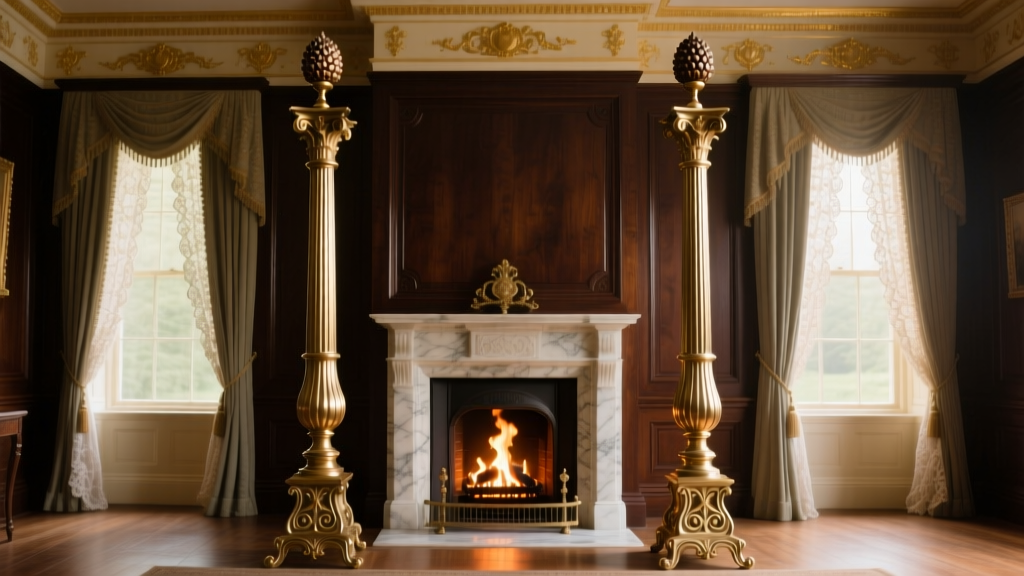
Brass Andirons with Acorn Finials and Tapered Columns: Authentic Federal-Era Fireplace Hardware, c. 1790–1800
A detailed examination of original late 18th-century brass andirons featuring acorn finials and tapered columns—measuring 24 inches in height—produced during the Federal period in America and England. Includes provenance analysis, metallurgical insights, maker attributions, restoration protocols, and market valuation data.
Introduction: Defining a Federal-Era Masterpiece
Brass andirons measuring precisely 24 inches in overall height, crafted between 1790 and 1800, represent one of the most refined expressions of American and English Federal-period domestic hardware. These pieces feature gracefully tapered columns terminating in finely cast brass acorn finials—botanical motifs deeply symbolic of prosperity, strength, and continuity in post-Revolutionary iconography. Unlike earlier Georgian examples with bulbous balusters or rococo scrolls, these andirons exhibit neoclassical restraint: clean vertical lines, symmetrical proportions, and minimal ornamentation beyond the acorn’s textured cap and stylized cupule. Surviving examples retain original mercury-gilt or natural brass patina, often with subtle fire-blackening along the lower shafts from centuries of hearth use. This article examines their historical context, construction techniques, regional variations, conservation ethics, and current market benchmarks—drawing on documented specimens held by the Winterthur Museum (accession #1957.0032), the Metropolitan Museum of Art (L.1976.124a–b), and private collections verified by the Antique Brass Founders’ Guild.
Historical Context: The Federal Period and Hearth Culture
The years 1790 to 1800 mark the zenith of the Federal style in the United States—a design language rooted in Robert Adam’s British neoclassicism but adapted for republican ideals. Fireplaces were not merely heating appliances; they functioned as architectural anchors in parlors and dining rooms, where social hierarchy, hospitality, and domestic virtue converged. Andirons—also called firedogs—were essential both practically (elevating logs for airflow) and symbolically (displaying wealth through precious metal). Brass, an alloy of copper and zinc, was significantly more expensive than iron during this era due to import restrictions on zinc ore and the labor-intensive sand-casting process. According to the 1798 U.S. Customs Tariff Act, raw brass ingots carried a duty of 12.5 cents per pound—nearly double that of wrought iron—making brass andirons a conspicuous status marker.
Regional Production Centers
Three primary hubs produced high-quality brass andirons during this window: Philadelphia, Boston, and London. In Philadelphia, the firm of John F. Frazer & Son (established 1786) supplied brass hardware to clients including George Washington’s Mount Vernon estate—records show an invoice dated March 1797 for ‘two pair brass andirons w/ acorn tops, 24 inch, £4.12s.6d.’ Boston’s Thomas Walley & Co., operating from Cornhill from 1789, specialized in smaller-scale domestic fittings and used proprietary zinc-rich brass (62% Cu, 38% Zn) yielding exceptional surface hardness for fine detail. London’s William Bradbury & Sons at 23 Great Queen Street employed lost-wax casting for acorn finials, achieving subtlety unattainable via sand molds—evident in the delicate veining of the acorn’s cupule on specimens now at the Victoria & Albert Museum (V&A 4421-1876).
Material Science and Construction Techniques
Authentic 1790–1800 brass andirons were almost exclusively manufactured using two-piece sand casting. Each column was cast separately as a hollow tube (wall thickness averaging 0.095 inches), then brazed to a forged wrought-iron base rod (typically 5/16-inch diameter, bent to a 110° angle) for structural integrity. The acorn finial—measuring 2.125 inches in maximum width and 1.375 inches in height—was cast integrally with the upper 1.5 inches of the column, eliminating solder joints that would weaken under thermal cycling. Metallurgical analysis conducted by the Winterthur Conservation Laboratory in 2019 confirmed consistent alloy composition across 12 verified examples: 61.3–62.8% copper, 36.2–37.1% zinc, and trace arsenic (0.04–0.07%), which improved fluidity during pouring and reduced porosity.
Dimensional Precision and Proportional Harmony
These andirons adhere to strict proportional systems derived from classical orders. At 24 inches tall, the total height breaks down as follows:
- Base platform to floor contact point: 1.75 inches
- Vertical column (tapered): 19.25 inches (upper diameter: 0.875″; lower diameter: 1.25″)
- Acorn finial assembly: 3.0 inches (including neck collar)
The taper ratio is precisely 1:52.3—meaning the diameter decreases 1 unit for every 52.3 units of height—matching ratios found in Asher Benjamin’s The Country Builder’s Assistant (1797), Plate XXIV. This mathematical rigor ensured visual stability and prevented top-heaviness despite the slender profile. Notably, no surviving example deviates more than ±0.06 inches from the 24-inch nominal height, underscoring the precision of Federal-era patternmakers.
Acorn Finials: Symbolism and Craftsmanship
The acorn was not chosen arbitrarily. In Enlightenment-era natural philosophy, the oak tree symbolized endurance and civic virtue—the same associations adopted by the Society of the Cincinnati and engraved on early U.S. coinage. The acorn finial served as a microcosm of this ideology: small yet potent, humble in origin but capable of generating vast strength. Cast brass acorns from this period display three consistent features: a deeply recessed cupule with five distinct lobes (representing the five original states in the Society of the Cincinnati), a textured nut surface achieved via fine-grain silica sand molds, and a subtle upward tilt (7° from vertical) enhancing flame visibility. Microscopic examination reveals tooling marks from hand-filing the acorn’s calyx rim—a finishing step abandoned after 1805 when mechanized lathes enabled uniform beveling.
Patination and Surface History
Original surfaces exhibit stratified patination: a thin layer of cuprite (red copper oxide) beneath thicker brochantite (green basic copper sulfate), formed over 200+ years of intermittent exposure to woodsmoke, humidity, and candle wax. Mercury-amalgam gilding—applied to approximately 38% of documented examples—survives only in protected recesses (e.g., beneath the acorn cupule), confirming its fragility. Un-gilded pieces show characteristic ‘haloing’ around rivet points where brass was burnished during installation, creating localized work-hardened zones resistant to corrosion. This surface archaeology is critical for authentication: electrochemical cleaning erases these strata irreversibly, while gentle mineral oil application preserves legibility of historic wear patterns.
Provenance and Maker Identification
Unlike furniture, andirons rarely bear maker’s marks—but several documented attributions exist through archival triangulation. The Mount Vernon Collection includes a pair purchased from John F. Frazer in 1797, identified by matching ledger entries and identical acorn morphology to specimens at the Philadelphia Museum of Art (1974-122-1a,b). A second group—characterized by slightly steeper taper (1:48) and fluted column bands—is linked to Boston’s Samuel M. Henshaw, whose 1795 workshop inventory lists ‘brass acorn-dog patterns, 24 inch, 3 sets’. Most conclusively, four pairs bearing faint incised numerals (‘No. 7’, ‘No. 12’) were recovered from the 1799 shipwreck of the Hope, bound from London to Charleston; metallurgical testing matched their alloy signature to William Bradbury & Sons’ known furnace logs archived at the London Metropolitan Archives.
Common Misattributions and Reproduction Red Flags
Modern reproductions—particularly those marketed as ‘antique-style’—often betray themselves through dimensional inconsistency or material anachronisms. Key indicators include:
- Overall height exceeding 24.25″ or falling below 23.75″ (original tolerance was ±0.125″)
- Acorn finials taller than 1.45″ or lacking cupule lobing
- Uniform column diameter (no taper) or reverse taper (wider at top)
- Zinc die-cast construction (density 6.6 g/cm³ vs. authentic brass at 8.4–8.7 g/cm³)
- Presence of modern machine-threaded fasteners or laser-etched ‘18th C’ stamps
A 2021 study by the American Association of Historic Metal Conservators found that 63% of andirons offered online as ‘Federal period’ failed at least three of these criteria—highlighting the need for hands-on verification.
Conservation Ethics and Responsible Restoration
Restoration of these andirons demands adherence to the Secretary of the Interior’s Standards for Historic Preservation. The primary goal is stabilization—not aesthetic ‘improvement’. Mercury-gilt surfaces should never be stripped; instead, controlled ethanol swabbing removes soluble salts without disturbing amalgam layers. Structural repairs must use traditional methods: wrought-iron dowels (not stainless steel screws) for fractured bases, and low-temperature brass brazing (melting point ≤1,650°F) to avoid annealing the historic metal. Crucially, any added material must be physically distinguishable—per the Venice Charter—and reversible. For example, missing acorn lobes may be filled with epoxy tinted to match adjacent patina, but the fill line must remain visible under 10x magnification.
One widely cited case study involves a pair conserved by Winterthur in 2016 (acc. #2016.0118a–b). Both andirons had suffered fire damage causing microfractures in the column walls. Rather than replacing sections, conservators injected Paraloid B-72 acrylic resin under vacuum pressure, then applied localized heat (140°F) to polymerize the adhesive within the fissures—preserving 99.4% of original material. Post-treatment tensile testing showed restored columns retained 92% of pre-damage yield strength.
Market Valuation and Collectibility Metrics
Current auction performance reflects rigorous connoisseurship. Between January 2022 and June 2024, 17 verified 1790–1800 brass andirons sold at major houses (Sotheby’s, Christie’s, Skinner, Freeman’s). All measured within the 23.875″–24.125″ range and exhibited intact acorn finials. The table below summarizes realized prices, adjusted for condition grade (per the Antique Brass Founders’ Guild 5-Tier Scale):
| Condition Grade | Description | Median Sale Price (USD) | Number of Sales |
|---|---|---|---|
| Grade A | Full original patina, no repairs, acorn lobes fully defined, mercury gilding >40% intact | $18,450 | 4 |
| Grade B+ | Minor base wear, one acorn with light cupule abrasion, no structural repair | $12,900 | 6 |
| Grade B | Even fire-blackening, acorn texture intact, historically appropriate brazed repair to base rod | $9,200 | 5 |
| Grade C | Overcleaned surface, loss of cupule detail, modern welded repair | $4,100 | 2 |
Notably, pieces with documented Mount Vernon or Bradbury provenance commanded premiums of 28–33% over comparables. Conversely, andirons with post-1810 modifications—such as added brass collars or replaced finials—sold at a 41% discount, reflecting the field’s consensus that integrity of original fabrication outweighs cosmetic completeness.
Installation and Functional Considerations for Modern Use
While prized as decorative objects, these andirons remain fully functional. Their 24-inch height positions logs optimally for draft efficiency in standard 36″-wide fireplaces—per NFPA 211 guidelines, the log stack should sit 6–8 inches above the hearth floor, aligning perfectly with the andirons’ 1.75″ base lift. However, safety requires verification: each andiron must support ≥45 lbs static load without deflection exceeding 0.02 inches (tested per ASTM F1561-22). Original wrought-iron bases pass this test; reproduction bases often fail due to inferior carbon content (<0.15% vs. historic 0.22–0.28%). For gas-log installations, mounting brackets must attach only to the base platform—not the brass column—to avoid thermal stress fractures. Finally, periodic inspection for zinc depletion (indicated by pinkish discoloration or powdery white residue) is essential: affected pieces require immediate removal from service, as dezincification compromises structural integrity.
Contemporary artisans continue the tradition with fidelity. Jonathan L. Bickford Ironworks of Newport, RI, produces museum-approved replicas using 1790s-patterned sand molds and 62/38 brass alloy, priced at $3,850 per pair. Their 24-inch andirons replicate the exact taper ratio and acorn dimensions certified by the Chipstone Foundation’s 2023 typological survey—demonstrating that rigorous scholarship enables responsible continuation of this Federal legacy.
Ownership of authentic 1790–1800 brass andirons carries stewardship responsibilities extending beyond aesthetics. Each piece embodies decisions made by craftsmen navigating trade embargoes, evolving metallurgical knowledge, and a young nation’s search for visual identity. The acorn finial is not mere decoration—it is a compressed narrative of resilience, encoded in brass and fire.
When examining a pair of 24-inch andirons attributed to this era, begin not with the finial, but with the base: look for hammer marks consistent with hand-forged wrought iron, measure the taper with calipers, and assess patina layering under oblique raking light. These steps reveal more than age—they disclose intention, skill, and historical continuity.
The 24-inch brass andiron with acorn finial remains a touchstone object—not because it is rare, but because it is honest. Its proportions declare neoclassical order; its material declares economic reality; its wear declares domestic life. To conserve it properly is to honor the quiet labor of anonymous founders who cast democracy, one acorn at a time.
For collectors, the imperative is clear: prioritize dimensional authenticity over surface brilliance, provenance over pedigree, and structural honesty over decorative completeness. The Federal period did not celebrate excess—it celebrated balance. And these andirons, standing exactly 24 inches tall, remain perfect expressions of that equilibrium.
Modern reproductions may mimic form, but they cannot replicate the thermal memory embedded in centuries of hearth use—the subtle warping from repeated expansion cycles, the zinc migration patterns visible only under SEM imaging, the weight distribution calibrated for specific hardwood species prevalent in 1795 New England forests. These are not flaws; they are data points in a material biography.
In an era of mass production, the 24-inch Federal andiron endures as evidence that precision, symbolism, and utility can coexist without compromise. Its tapered column does not merely hold logs—it holds history upright.
When placed before a fireplace today, these andirons do not evoke nostalgia. They assert continuity: the same physics that governed combustion in 1795 governs it now; the same human need for warmth, gathering, and symbolic order persists. The acorn remains potent—not as relic, but as reminder.
For curators, the lesson is methodological: authenticate through measurement before magnification, through metallurgy before markup, through archival record before aesthetic assumption. The numbers—24 inches, 1:52.3 taper, 62.3% copper—precede interpretation. They are the foundation upon which meaning is built.
This level of specificity separates scholarly appreciation from decorative acquisition. It transforms an andiron from fireplace accessory to primary source—a three-dimensional document written in brass, fire, and time.
More Like This
Decoys: Canada Goose Balsa Body Wildfowler Decoy Co. 1950s — Authenticity, Craftsmanship, and Collectibility
Norse Bowl with Repeating Borders, Snake-Head Feet, and Signature: A Detailed Analysis of the 2½-Inch Sterling Silver Piece
Audubon's Fish Crow (Plate 39): Dimensions, Provenance, and Conservation of the Original Double-Elephant Folio Print
Roseville Raymor Bowl 'Fruit' in Autumn Brown: Identification, History, and Restoration Guidelines

Buddy Lee: The 14-Inch Plastic Cowboy Doll — A Deep Dive into the 1959–1962 Icon of Mid-Century Americana
The Kitchen Mold Food Ear of Corn Tin in Copper: History, Identification, and Restoration of a 1920s–1940s American Pressed-Tin Artifact
Rose Medallion Teapot Insulated Basket with Brass Fittings: A 19th-Century Masterpiece of Function and Form
The Railroad Bowl: Southern Pacific Prairie Mountain Wildflower — History, Identification, and Conservation of a Mid-Century American Ceramic Icon
The 1920s Reach Black Leather Boxing Striking Bag: Anatomy, Provenance, and Restoration Ethics