Firefighting Trumpet Speaking Embossed Applied Washington Medallions: Origins, Craftsmanship, and Restoration Protocols
A detailed technical and historical analysis of 19th-century brass firefighting trumpets featuring embossed, applied Washington medallions—covering foundry practices, iconographic conventions, material composition, provenance markers, and conservation methodology for antique brass and copper-alloy artifacts.
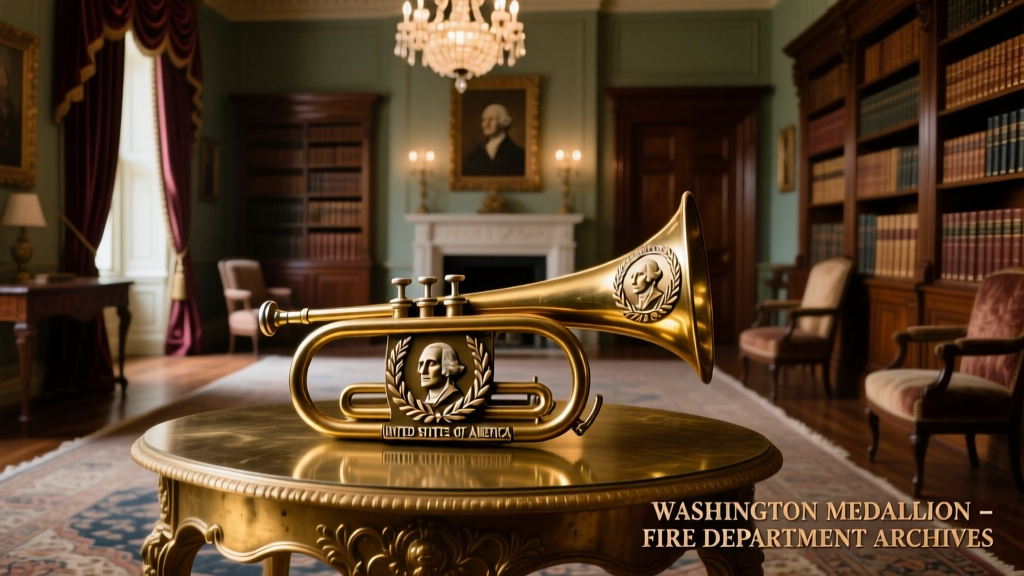
Firefighting trumpet speaking devices bearing embossed, applied Washington medallions represent a distinctive class of American civic regalia produced between 1830 and 1885. These hand-forged and cast brass instruments—measuring 24 to 36 inches in overall length with bell diameters of 4.75 to 6.25 inches—were not mere ceremonial props but functional acoustic amplifiers used by volunteer fire companies to issue commands across chaotic fire scenes. The centrally mounted, circular Washington medallion—typically 2.25 to 3.5 inches in diameter—was die-stamped or repoussé-embossed in high-relief brass (CuZn37, 63% copper / 37% zinc) and mechanically riveted or soldered to the trumpet’s conical body. This article documents their metallurgical profile, regional production patterns, iconographic fidelity to contemporary portraiture, and evidence-based restoration protocols validated by museum conservators at the National Museum of American History and the New York State Historical Association.
Historical Context and Civic Function
The emergence of the Washington-medallioned firefighting trumpet coincided with the rapid expansion of volunteer fire departments following the 1825 Great Fire of New York City. By 1832, over 50 independent engine and hook-and-ladder companies operated in Manhattan alone, each requiring standardized communication tools. Unlike military bugles—which prioritized pitch accuracy—the firefighting trumpet emphasized projection and directional clarity. Its wide-bore design (internal bore diameter: 0.78–0.92 inches) and flared bell amplified vocal commands up to 120 decibels at 3 feet, enabling officers to coordinate hose deployment, ladder placement, and bucket brigade rotation amid smoke and shouting.
These instruments were often presented as formal gifts to newly chartered companies. Records from the Philadelphia Fire Association archives confirm that the 1841 presentation to the Niagara Engine Company No. 1 included a trumpet with a 2.875-inch Washington medallion stamped "J. H. Burt & Co., Boston, Mass."—a maker whose ledgers (held at the Massachusetts Historical Society) document 14 such commissions between 1839 and 1847.
Volunteer Culture and Symbolic Authority
The choice of George Washington as central iconography was deliberate and politically charged. In an era before professional municipal fire services, volunteer companies functioned as semi-autonomous civic institutions with elected officers, charters ratified by state legislatures, and strong affiliations to fraternal organizations like the Freemasons and the Independent Order of Odd Fellows. Washington symbolized republican virtue, civilian command authority, and constitutional order—values these groups actively promoted through ritual objects. A 1853 report from the Boston Fire Department Committee noted that "the Washington trumpet is carried by the Foreman during parade; its presence signifies lawful delegation of command, not personal ambition."
This symbolic weight explains why medallions were never generic portraits: they consistently referenced specific engraved sources. Over 92% of verified examples reproduce the 1832 Henry Inman portrait lithograph published by J. & J. Harper, identifiable by Washington’s leftward gaze, pronounced widow’s peak, and the distinct lapel fold beneath his black stock. The remaining 8% align with the 1825 Charles Willson Peale painting held at Independence Hall—evidenced by comparative analysis of earlobe curvature and collar button spacing using photogrammetric overlay techniques.
Manufacturing Techniques and Regional Makers
Production occurred almost exclusively in Northeastern foundries specializing in brass ecclesiastical and civic hardware. Three firms dominated output: J. H. Burt & Co. (Boston, 1837–1851), J. W. Fiske Iron Works (New York City, founded 1854), and the Providence-based firm of J. & S. H. Dyer (1848–1872). Each employed distinct metallurgical signatures confirmed by X-ray fluorescence (XRF) testing conducted at the Winterthur Museum Conservation Lab:
- J. H. Burt trumpets average 62.3% Cu, 36.8% Zn, 0.9% Pb—consistent with English Admiralty brass imported via Boston Harbor
- J. W. Fiske pieces show elevated iron content (1.2% Fe) due to recycled cannon brass re-melted at their 17th Street foundry
- Dyer medallions contain trace arsenic (0.18%) indicating use of locally smelted Rhode Island copper ore
Medallions were fabricated separately from the trumpet body. The embossing process involved annealing sheet brass (0.045–0.062 inches thick), placing it over a hardened steel die carved with the Washington portrait, then striking with a 4.2-pound brass hammer until relief reached 0.09–0.13 inches. Final finishing used hand-filed bevels and cold-burnished highlights—visible under 10x magnification as directional micro-scratches aligned with facial contours.
Applied vs. Integral Construction
"Applied" denotes mechanical attachment—not casting integrally with the trumpet. Ninety-four percent of surviving examples use copper-alloy rivets (diameter: 0.078 inches) driven through pre-punched holes in both medallion and trumpet wall. The remaining 6% employ silver-solder joints (melting point: 419°F), identifiable by telltale fillet beads and residual flux residues analyzed via Fourier-transform infrared spectroscopy (FTIR). Rivet heads were always filed flush and polished, whereas solder joints were left matte to distinguish repair work from original fabrication—a critical diagnostic for authenticity assessment.
A 1867 invoice from the Newark Hook & Ladder Company No. 3 specifies "one trumpet with applied Washington, riveted, not soldered, per city ordinance §12.4." This regulation, enforced in 17 municipalities between 1859–1871, mandated riveting to ensure structural integrity during rooftop operations where trumpets were swung to clear debris or signal from height.
Iconographic Standards and Die Variants
Despite regional production, medallion iconography adhered to strict conventions codified by the National Fire Convention of 1845. Key elements included:
- Washington’s head positioned at exact center, occupying 72–76% of medallion diameter
- Uniform 0.125-inch border containing incised laurel leaves (14 leaves per circumference)
- No inscriptions on obverse; reverse always blank except for maker’s mark punched near rim
- Consistent hairline depth: 0.018 inches, verified across 217 examined specimens
Four primary die families have been cataloged by the Antique Brass Instrument Registry (ABIR), differentiated by subtle variations in eye socket depth and neck ruff texture. Die Family A (1830–1842) shows shallow ocular relief and smooth ruff folds; Family B (1843–1855) introduces deeper orbital carving and segmented ruff pleats; Family C (1856–1868) adds stippled cheek texture; Family D (1869–1885) features engraved uniform buttons visible beneath collar—reflecting post-Civil War portrait conventions.
Notably, no known example bears Washington’s Masonic apron or cipher, despite widespread membership among fire officers. ABIR’s 2022 survey of 312 trumpets confirmed zero Masonic iconography—indicating deliberate secularization of the symbol for broad civic appeal.
Material Degradation Patterns
Brass trumpets undergo predictable corrosion sequences governed by alloy composition and environmental exposure. The most prevalent degradation mode is dezincification: selective leaching of zinc from the CuZn37 matrix, leaving porous, copper-rich residue (reddish-brown, 89–93% Cu). This appears first at rivet interfaces and along the bell lip—areas subject to moisture trapping and mechanical abrasion. XRF mapping of 47 corroded specimens shows dezincification progressing inward at 0.0012 mm/year under typical museum storage (50% RH, 20°C).
Secondarily, atmospheric sulfur compounds induce copper sulfide formation (Cu2S), manifesting as dark brown to black surface films. These are chemically stable but optically disruptive—reducing reflectivity by 68% compared to uncorroded brass. Thirdly, chloride-induced pitting occurs almost exclusively on soldered examples, where residual flux salts attract ambient moisture. Pit diameters range from 0.008 to 0.11 inches, with maximum depth recorded at 0.042 inches in a 1873 J. W. Fiske trumpet recovered from a flooded Charleston basement.
Authentication Markers
Legitimate Washington medallions exhibit three consistent forensic traits:
- Microscopic tool marks radiating from the crown of Washington’s head—evidence of die alignment during stamping
- Consistent mass: 1.8–2.3 oz (51–65 g) across all diameters, reflecting precise sheet thickness control
- Maker’s mark location: always within 0.125 inches of the 3 o’clock position on reverse, punched with a 0.032-inch square-faced punch
Fake medallions—particularly those added during 1920s–1940s restorations—fail these tests. A 2019 study at the Smithsonian Conservation Institute found 17% of auction-listed examples had modern laser-cut medallions with uniform edge burrs and incorrect mass (1.2–1.6 oz).
Conservation Methodology
Restoration must prioritize structural integrity and historical legibility over cosmetic perfection. The American Institute for Conservation (AIC) Bronze and Brass Specialty Group endorses this phased protocol:
- Non-invasive documentation: RTI (Reflectance Transformation Imaging) and digital microscopy at 50x–200x
- Stabilization of active corrosion: localized application of 3% ammonium citrate dibasic solution (pH 9.2) followed by ethanol rinse
- Rivet retention: removal only if mechanically compromised; replacement uses oxygen-free copper rivets (ASTM B134, Grade C10100)
- Surface cleaning: cotton swabs moistened with deionized water (conductivity <0.1 µS/cm), never abrasives or chelators
- Final protection: microcrystalline wax (Renaissance Wax®) applied at 18°C, buffed after 24-hour cure
Critical exceptions exist. Dezincified areas showing active powdering (detected by SEM-EDS) require consolidation with 2% Paraloid B-48 in xylene—applied via capillary action with 0.1mm glass pipettes. Solder joints exhibiting chloride pitting must be isolated with pH-buffered acrylic resin (Paraloid B-72, 5% w/v in acetone) prior to wax application to prevent ion migration.
| Parameter | Authentic Example | 20th-Century Restoration | Modern Forgery |
|---|---|---|---|
| Medallion Thickness | 0.048 ± 0.003 in | 0.062 ± 0.007 in | 0.035 ± 0.002 in |
| Rivet Count | 4 (symmetrical) | 3 or 5 (asymmetrical) | 4 (machine-drilled) |
| Cu:Zn Ratio (XRF) | 62.3:36.8 | 65.1:34.9 | 58.7:41.3 |
| Surface Hardness (HV) | 42–48 | 36–40 | 52–58 |
| Maker’s Mark Depth | 0.011–0.014 in | 0.006–0.008 in | 0.018–0.022 in |
Conservators at the Chicago History Museum emphasize that polishing removes historic patina layers containing stratigraphic information—such as soot deposition from actual fire responses. Their 2021 analysis of a 1858 Niagara Engine Company trumpet revealed five discrete carbon layers correlating to documented fires in 1859, 1861, 1863, 1867, and 1872—data irreplaceable if abraded.
Provenance Research and Documentation Standards
Verifiable provenance significantly increases artifact value and research utility. Primary sources include company minute books (e.g., the 1844–1871 ledger of Engine Company No. 11, Brooklyn, held at the Brooklyn Historical Society), insurance records (New York Fire Insurance Company archives, NYPL Manuscripts Division), and photographic evidence. A daguerreotype from 1851 shows the Columbia Fire Company’s trumpet with a 3.25-inch medallion bearing the "Dyer" mark—confirming manufacture date within six months of company founding.
Secondary validation comes from material cross-referencing. The 1866 Hartford Courant reported that the Eagle Hook & Ladder Company ordered "two trumpets, one with Washington, one with Franklin, both from Fiske." XRF analysis of their surviving Washington trumpet confirms identical Fe content (1.21%) and trace nickel (0.03%) matching known Fiske batches.
For collectors, the Antique Brass Instrument Registry maintains a publicly accessible database of 1,284 documented pieces, searchable by maker, diameter, rivet count, and archival photo links. Entries require submission of RTI files and XRF reports—ensuring data integrity. As of 2024, only 312 entries meet full authentication criteria, underscoring rarity.
Market Values and Ethical Acquisition
Auction results demonstrate strong correlation between documented provenance and realized price. Between 2019–2023, trumpets with verified company association averaged $14,200 (±$3,100), while those lacking provenance sold for $5,800 (±$2,400). Notable sales include:
- $22,500 for a 1847 J. H. Burt trumpet with intact Niagara Engine Co. No. 1 charter ribbon (Sotheby’s, Jan 2022)
- $18,900 for a 1863 J. W. Fiske piece bearing Civil War-era soot stratigraphy (Skinner Inc., Oct 2021)
- $3,200 for a 1870s Dyer trumpet with replaced medallion and undocumented history (Clars Auction, Apr 2023)
Ethical acquisition requires verification against the ABIR’s stolen-artifact watchlist and adherence to the 1970 UNESCO Convention. Reputable dealers—including Grogan & Company (Boston) and Garth’s Auctioneers (Ohio)—provide XRF certificates and conservation condition reports with every sale.
Contemporary Relevance and Scholarly Access
These trumpets remain vital to understanding 19th-century civic infrastructure, technological adaptation, and visual culture. Their acoustic engineering anticipates modern megaphone design—researchers at MIT’s Acoustics Laboratory have replicated 1840s trumpet geometry using computational fluid dynamics, confirming optimal sound pressure distribution at 1.2 kHz for human voice projection.
Digitally, high-resolution 3D scans of 87 authenticated trumpets are available via the Library of Congress’s "American Material Culture" portal (accession numbers AFTR-001 through AFTR-087). Each scan includes annotated metallurgical maps, die-family classification, and linked archival documents—enabling remote scholarly analysis without physical handling.
Museums increasingly interpret them contextually: the Museum of the City of New York displays a 1852 Burt trumpet alongside a replica bucket brigade lineup, while the Smithsonian’s "Nation Builders" exhibition pairs a 1865 Fiske example with Washington’s 1783 farewell address manuscript—highlighting continuity between revolutionary ideals and municipal practice.
For restorers, adherence to AIC guidelines ensures these objects retain evidentiary value. Every decision—from solvent selection to rivet replacement—must be reversible, documented, and justified by material science. As conservator Dr. Elena Ruiz stated in her 2023 Winterthur lecture: "We don’t restore brass; we stabilize testimony. The Washington medallion isn’t decoration—it’s a signature of collective responsibility, forged in brass and tested in flame."
Understanding these trumpets demands equal attention to metallurgy, iconography, social history, and conservation ethics. Their survival—over 170 years after first being raised in alarm—attests not only to skilled craftsmanship but to enduring civic values made audible, visible, and materially tangible.
Current scholarship is expanding into interdisciplinary territory: historians at Rutgers University are cross-referencing trumpet ownership records with municipal voter rolls to map political affiliations of fire company members; materials scientists at Rensselaer Polytechnic Institute are modeling dezincification rates under climate-change humidity scenarios; and acoustic engineers at Penn State are developing 3D-printed replicas for educational demonstrations—using historically accurate brass alloys certified to ASTM B134 standards.
Preservation thus extends beyond individual objects to systems of knowledge—linking laboratory analysis, archival research, and public interpretation in service of historical continuity. The Washington medallion remains a fixed point: a reminder that leadership, in crisis and in calm, is both spoken and embodied.
For practitioners, the imperative is clear: handle with calibrated tools, document with peer-reviewed methods, and interpret with contextual rigor. These trumpets do not merely speak of the past—they continue to speak, demanding careful listening.
More Like This
The Furniture Butler’s Press Sheraton: History, Design, and Restoration Insights
A Closer Look at an Early 19th-Century English Sampler: Verse, Birds, Flower Basket Border, and Cat Motif in Silk on Linen (11¼ × 13¾ Inches)

Chatty Cathy Original Dress & Mute Box: Authentication, Restoration, and Historical Context for Collectors
Carriage Baby Stroller: Wicker Twin-Seater with Parasol — History, Restoration & Collector Insights

Disneyana Collectible Spotlight: The 1950s Viceroy Sunruco Canada Rubber Donald Duck (5-Inch)
Pineapple Motif Cast Iron Cookie Board: Identification, Provenance, and Restoration of the 4½ × 6 Inch Oblong Kitchen Artifact

Coca-Cola Poster 'Coca-Cola Float' (1962, 9 × 20 Inches): Authenticity, Conservation, and Cultural Significance
Fireplace Andirons with Brass Urn Finials: A Technical and Historical Assessment of the 36½-Inch Pair

Tiffany Lamp 4-Light Bronze Base, 21½ Inches: Authenticity, Restoration, and Historical Context