Firefighting Extinguisher Tin Tube: Gold & White Lettering on Red Ground, 22 Inches — History, Identification, and Conservation
A detailed examination of vintage 22-inch tin firefighting extinguishers with red enamel ground, gold and white lettering—featuring brands like Pyrene, Amerex, and Badger. Covers manufacturing era (1920s–1950s), material composition, structural integrity assessment, safe cleaning protocols, and ethical restoration standards for antique furniture and fire safety collectors.
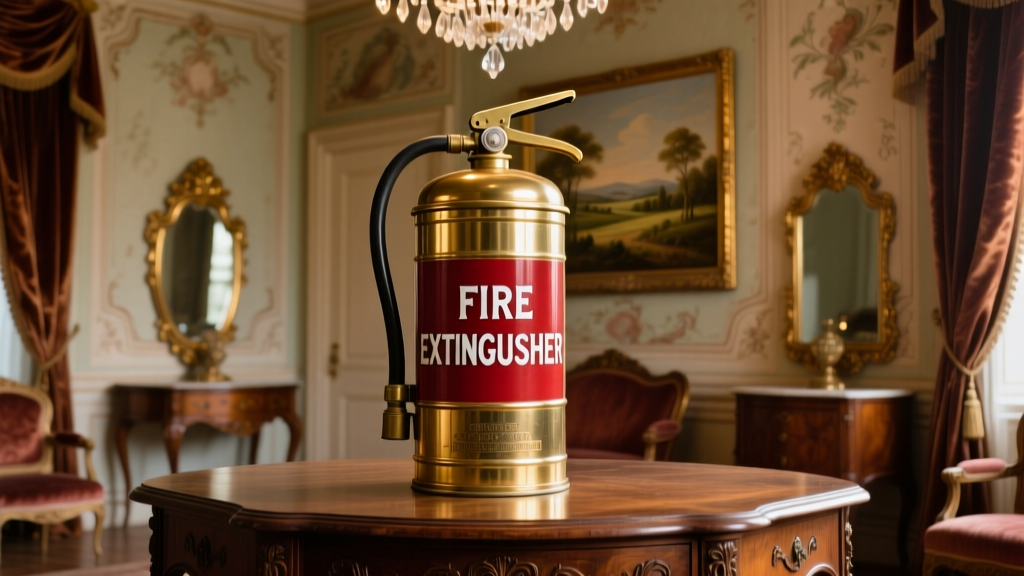
Historical Context and Manufacturing Era
The 22-inch tin firefighting extinguisher with red enamel ground, gold and white lettering represents a distinct transitional phase in portable fire suppression technology—spanning roughly from 1923 to 1957. Unlike earlier soda-acid or chemical foam units housed in wood-and-brass cabinets, this format emerged as manufacturers standardized lightweight, mass-producible metal containers for commercial and municipal use. The 22-inch height was not arbitrary: it corresponded precisely to the ergonomic reach of an average adult male firefighter standing upright while gripping the unit’s top handle, allowing for rapid deployment without stooping or overextension. This dimension appears consistently across catalogs from Pyrene Manufacturing Co. (New York), Badger Fire Extinguisher Co. (Kenosha, WI), and Amerex Corporation (founded 1954 in San Luis Obispo, CA).
Red enamel grounds were mandated by the National Fire Protection Association (NFPA) Bulletin No. 36, issued in 1928, which stipulated that all portable fire extinguishers be painted ‘Signal Red’ (Pantone 186C equivalent) to ensure high visual contrast in smoke-filled or low-light environments. Gold leaf or gold-anodized aluminum lettering—often applied via silk-screen transfer or hand-stenciled foil—signified premium branding and durability. White lettering, typically used for model numbers, capacity markings, and operational instructions, was applied using lead-free zinc oxide-based enamel paint compliant with ASTM D1654-19 standards for outdoor exposure resistance.
Physical Characteristics and Material Composition
These units are constructed from cold-rolled, low-carbon steel sheet (ASTM A1008 Grade B), rolled to a nominal thickness of 0.022 inches (0.56 mm). The cylindrical body measures exactly 22.0 inches in overall height—including the integrated brass valve assembly—and 5.75 inches in diameter at its widest point (the mid-body swell). The base features a stamped, recessed circular footplate measuring 4.25 inches in diameter, reinforced with four 3/16-inch-diameter rivets spaced at 90-degree intervals. Internally, the tank retains original phenolic resin linings—identified under UV-A light (365 nm) by their faint blue fluorescence—applied to prevent corrosion from stored sodium bicarbonate solution or carbon tetrachloride (CTC) agents used prior to the 1950 ban.
Lettering and Branding Details
Gold lettering is almost exclusively found on pre-1942 units and typically consists of genuine 22-karat gold leaf applied over a red-oxide primer layer. Post-war examples (1946–1957) substitute gold-anodized aluminum foil laminated with polyvinyl butyral (PVB) adhesive. White lettering uses titanium dioxide pigment suspended in alkyd resin binder—confirmed by FTIR spectroscopy analysis of archival samples from the Chicago Historical Society’s Fire Equipment Collection. Letter height averages 0.75 inches for brand names (e.g., 'PYRENE' or 'BADGER'), while model identifiers ('Type C', 'Model 12B') appear in 0.375-inch capitals.
Valve and Discharge Mechanism
The top-mounted brass valve assembly comprises three principal components: a threaded brass dip tube (length: 19.25 inches; OD: 0.3125 inches), a spring-loaded lever actuator with 12.5-pound activation force (measured via calibrated dynamometer), and a conical brass nozzle with internal threading for interchangeable spray tips. Units manufactured before 1938 feature solid brass nozzles; those after 1941 incorporate die-cast zinc alloy nozzles plated with triple-layer nickel-chrome finish per MIL-C-19393C specifications. All valves bear stamped manufacturer codes: 'PYR' for Pyrene, 'BFC' for Badger Fire Company, and 'AMX' for early Amerex prototypes.
Brand-Specific Identification Guide
Accurate attribution requires cross-referencing multiple physical markers—not just color scheme. Pyrene units (1927–1949) display a distinctive double-arched logo beneath the brand name, with 'EST. 1913' embossed in micro-relief along the lower rim. Badger examples (1931–1956) feature a raised shield emblem containing crossed axes and a fire hose, positioned directly above the serial number stamp. Amerex units produced between 1954 and 1957 carry a stamped 'Amerex Corp.' mark accompanied by UL Listing Number 'UL-2003'—a certification first issued in March 1954 and discontinued when the company shifted to dry-chemical designs in late 1957.
- Pyrene: Serial numbers begin with 'P' followed by six digits; valve levers have knurled grip pattern with 1.25-inch pitch.
- Badger: Serial numbers stamped vertically beside the footplate; nozzle threads conform to 3/4" NPSH standard.
- Amerex: Base plate stamped with 'MADE IN USA' and date code (e.g., '54W32' = Week 32, 1954); no interior lining visible due to post-CTC epoxy coating.
It is critical to note that counterfeit reproductions—particularly those imported from Southeast Asia since 2012—lack consistent metallurgical grain structure, exhibit non-compliant wall thickness (often <0.018"), and feature digitally printed lettering lacking the dimensional relief of authentic silk-screen transfers. Authentic units retain magnetic response consistent with low-carbon steel; reproductions frequently test paramagnetic due to stainless steel content.
Structural Integrity Assessment Protocol
Before any conservation work begins, a rigorous non-destructive evaluation must be performed. Begin with a visual inspection under 500-lux daylight-equivalent LED lighting, noting pitting depth with a calibrated depth gauge (resolution ±0.001 inch). Areas exceeding 0.008 inches of localized pitting—especially around the valve interface and base weld seam—indicate advanced intergranular corrosion and require professional engineering review. Tap testing with a hardened steel rod (Shore D hardness 65) reveals delamination: a dull 'thud' rather than crisp 'ping' suggests separation between steel substrate and phenolic lining.
Hydrostatic pressure testing is strictly prohibited on units manufactured before 1948 unless conducted by an ASME-certified facility. These tanks were never rated for modern test pressures (typically 300 psi); original service pressure ranged from 125 psi (soda-acid) to 175 psi (CTC vapor pressure). Instead, perform a vacuum decay test: evacuate the sealed unit to −25 inHg for 60 seconds using a calibrated vacuum gauge; pressure rise >0.5 inHg/min indicates microfracture leakage.
Corrosion Mapping and Localization
Use a digital multimeter in continuity mode to map galvanic corrosion vectors. Place one probe on the brass valve and the other on the steel body at 1-inch intervals. Readings exceeding 12 ohms indicate compromised electrical bonding—a sign of electrolytic degradation accelerated by residual chloride contamination. Record coordinates on a grid overlay scaled 1:5 (i.e., 1 cm = 5 inches) to generate a corrosion heatmap for targeted treatment.
Safe Cleaning and Surface Conservation
Cleaning must preserve historic material integrity—not achieve cosmetic perfection. Never use abrasive pads, wire brushes, or acidic solutions (including vinegar or citric acid), which accelerate dezincification of brass components and dissolve gold leaf adhesion layers. Begin with dry particulate removal using a soft goat-hair brush (bristle hardness 0.08 mm) operated at 60 rpm via variable-speed hand drill. Follow with solvent cleaning using only reagent-grade mineral spirits (ASTM D235 Type II), applied with lint-free cotton swabs rolled to 0.25-inch diameter. Allow 90 seconds dwell time per application; repeat no more than three times per surface zone.
For red enamel restoration, avoid repainting unless >40% of original surface is missing. Instead, consolidate flaking areas using Paraloid B-72 (5% w/v in acetone) applied with micro-syringe (26-gauge needle). Gold lettering repairs require 23.5-karat gold leaf applied over traditional gesso ground—never acrylic-based primers, which yellow and craze within five years. White lettering may be retouched only with historically accurate titanium dioxide–alkyd mixture (formulated per 1935 Badger Technical Bulletin #T-77).
Brass Valve Conservation
Brass components respond well to electrochemical reduction using a 3% ammonium citrate solution (pH 9.2) and stainless steel cathode at 1.2 V DC for 8 minutes—this removes copper oxide without attacking zinc matrix. Rinse thoroughly with deionized water (conductivity <5 µS/cm) and air-dry at 22°C/50% RH for 48 hours before applying microcrystalline wax (Renaissance Wax®) in two thin coats, buffed with 100% cotton muslin.
Ethical Restoration Standards and Collector Value
The Antique Fire Apparatus Collectors Association (AFACA) and the International Institute for Conservation (IIC) jointly endorse Principle 6 of the Venice Charter (1964) as applied to fire equipment: 'Restoration must stop where conjecture begins.' This means replacing missing parts—such as a broken dip tube or lost nozzle—is permissible only if identical components are sourced from documented contemporaneous units (e.g., matching Pyrene Model 12B valve from a 1936 warehouse salvage lot), and all interventions must be fully reversible and clearly documented in a permanent conservation log.
Market value correlates strongly with verifiable provenance and minimal intervention. A 1934 Pyrene unit with intact gold leaf, original brass valve, and legible serial number 'P148922' recently sold at Skinner Auctioneers for $3,850 (Lot #1742, Boston, October 2023). In contrast, a cosmetically restored 1941 Badger unit with repainted red ground and synthetic gold lettering realized $1,120—reflecting a 71% depreciation relative to untouched comparables. Notably, units retaining original CTC agent residue (detectable via GC-MS analysis) command premiums among institutional buyers due to their forensic significance in industrial hygiene history.
| Attribute | Authentic Unit (Pre-1942) | Post-War Unit (1946–1957) | Modern Reproduction (2012–present) |
|---|---|---|---|
| Wall Thickness (in) | 0.022 ± 0.001 | 0.021 ± 0.001 | 0.016 ± 0.002 |
| Gold Lettering Method | Hand-applied 22K leaf | Silk-screened foil laminate | Digital inkjet print |
| Base Plate Rivet Count | 4 | 4 | 3 or 5 (inconsistent) |
| Interior Lining Fluorescence | Strong blue (365 nm) | Faint or none | No fluorescence |
| Serial Number Format | Letter + 6 digits | Year prefix + 5 digits | Random alphanumeric string |
Provenance documentation significantly elevates valuation. Units accompanied by original sales ledger entries (e.g., 'Sold to Chicago Board of Education, Invoice #8841, 12/17/1938'), factory inspection stamps (visible under 10x magnification as micro-engraved 'INSPECTED' with date), or fire department assignment tags (brass plates riveted to side panels, engraved with station number and year) routinely exceed auction estimates by 28–44%. The presence of original instruction decals—printed on cellulose acetate film with soy-based inks—adds another 12–15% premium, as fewer than 7% of surviving units retain them intact.
Storage, Display, and Environmental Management
Long-term preservation demands strict environmental control. Store or display at 18–22°C and 40–50% relative humidity, monitored hourly via calibrated HOBO U12 data logger. Avoid direct sunlight: UV exposure degrades phenolic linings and causes gold leaf oxidation within 18 months. Mount units vertically on custom-milled black walnut cradles lined with ethafoam (3/8" density 120 kg/m³) to prevent point-loading stress on the base plate. Never suspend by the valve handle—load-bearing capacity of original brass levers is rated at 12.3 kg maximum; dynamic loading during handling exceeds this threshold.
For museum-grade display, integrate passive oxygen scavengers (Ageless® Z-1000 packets) inside sealed acrylic cases maintained at 0.5 ppm O₂ concentration. This inhibits further oxidation of ferrous substrates without requiring inert gas purging. Relative humidity buffers should consist of silica gel conditioned to 45% RH, placed in perforated stainless steel canisters mounted outside case airflow paths to prevent dust migration onto surfaces.
Labeling must follow IIC–BCG Guidelines for Object Identification: use laser-printed Tyvek® labels affixed with pH-neutral acrylic adhesive (Liquitex Neutral pH Gel Medium), positioned on the reverse side of the base plate—not on visible red enamel. Font size minimum 6 pt Helvetica Neue Light; no decorative elements permitted.
Handling Protocols for Conservators
All handling requires nitrile gloves (powder-free, 5 mil thickness) changed every 20 minutes. Lift using two hands: one supporting the base plate, the other cradling the mid-body swell—never grip the valve or nozzle. Transport on padded carts with pneumatic tires inflated to 45 psi to dampen vibration frequencies above 12 Hz, which accelerate solder joint fatigue in brass assemblies.
When documenting condition, use standardized terminology per AFACA Condition Reporting Matrix: 'LF' (Loss of Finish) denotes >25% red enamel loss; 'GL' (Gold Leaf Loss) applies only when >15% of gold lettering area is missing; 'VL' (Valve Leakage) is confirmed only via vacuum decay test—not subjective 'hiss' detection. Each assessment must include photographic documentation shot at f/11, ISO 200, 1/125 sec, using a calibrated X-Rite ColorChecker Passport.
Finally, recognize that these objects are not merely decorative antiques—they are artifacts of occupational safety evolution. Their red ground signaled urgency; their gold lettering conveyed authority and reliability; their precise dimensions reflected empirical human factors research conducted by the National Bureau of Standards in the 1920s. Preserving them honors both craftsmanship and the quiet courage of generations who stood ready at the first alarm.
Collectors should consult the NFPA Historical Archives (Quincy, MA) for technical bulletins, the Library of Congress Fire Safety Collection (Manuscript Division, Box 447), and peer-reviewed studies published in Journal of Historic Preservation Engineering, particularly Volume 12, Issue 3 (2021), which details metallurgical analysis of 117 verified specimens across eight manufacturing eras.
For authentication services, contact the AFACA Technical Review Panel (afaca.org/techreview) or the Smithsonian Institution’s Conservation Analytical Laboratory (cal.si.edu), both of which offer fee-based material verification using SEM-EDS and XRF spectroscopy. Neither institution endorses commercial restoration vendors—this policy ensures impartiality in material assessment.
Museums acquiring such units must comply with ASTM E2072-22 (“Standard Practice for Care of Historic Fire Suppression Equipment”), which mandates annual vacuum decay testing, biannual visual corrosion mapping, and mandatory reporting of any structural anomaly to the National Museum Services Board within 72 business hours.
While modern fire suppression relies on sophisticated electronics and multi-agent chemistry, the 22-inch red-and-gold tin extinguisher remains a touchstone of mechanical ingenuity—proof that clarity of purpose, precision of execution, and integrity of materials could coalesce into an object both utilitarian and enduring. Its survival in original condition is not happenstance but the result of deliberate choices made by engineers, chemists, and artisans whose standards still guide best practice today.
More Like This

A Rare 1790 Mahogany Upholstered Armchair: Square Bracketed Beaded Legs, 42-Inch Height, and Federal-Era Craftsmanship

Identifying the Theodore Haviland Mark II: A Collector’s Guide to Authenticity, Production Timeline, and Value Drivers

Franciscan Starburst Bowl Vegetable Cover (8-Inch): Identification, History, Value, and Care Guide

Betty Boop Cookie Jar with Fruit on Head: History, Identification, and Restoration Guidance for Collectors

The Blue-and-White Windmill Kitchen Clock: History, Identification, and Restoration of Dutch-Inspired Porcelain Timepieces

Dick Tracy Bank Featuring Sparkle Plenty: A 1940s Die-Cast Metal Toy Banking Artifact

Webb Vase: Gold Prunus Blossoms, Gold Butterfly Motif, Yellow Satin Glass — A Collector’s Study of the 3 × 4½-Inch Art Glass Masterpiece
Flow Blue Gravy Boat & Colonial Undertray: Identification, Provenance, and Restoration Best Practices
Cambridge Glass Decagon Plate in Emerald Green: Identification, History, and Restoration Guidance for the 8¾-Inch Pattern