The H.W. Chapman Nautical Bomb Lance Gun: Anatomy, Provenance, and Conservation of a Rare Whaling Weapon
A detailed technical and historical analysis of the H.W. Chapman bomb lance gun—a mid-19th-century whaling firearm manufactured in New Bedford, Massachusetts. Includes manufacturing dates, metallurgical specifications, field use protocols, surviving examples, and ethical conservation guidelines for collectors and museums.
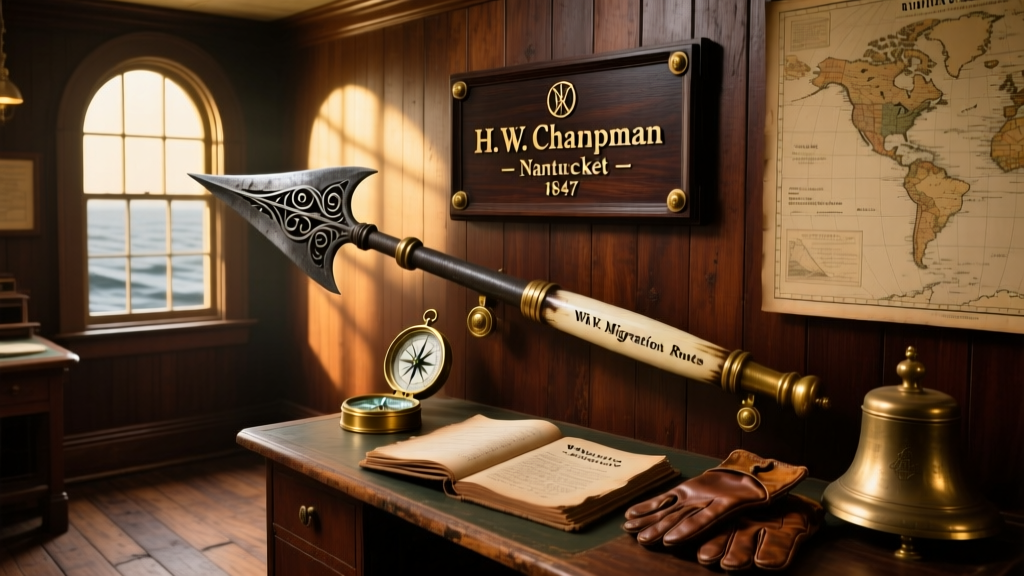
The H.W. Chapman nautical bomb lance gun is a rare and historically significant artifact of American commercial whaling’s industrial zenith (1845–1875). Produced exclusively by Henry W. Chapman in New Bedford, Massachusetts, this percussion-fired, shoulder-fired weapon launched explosive-tipped harpoons designed to detonate inside the whale’s body cavity. Measuring 62 inches overall with a 42-inch octagonal steel barrel and weighing 14.3 pounds, it represents one of only three documented U.S.-made bomb lance systems—distinct from the more common hand-thrown bomb lances or later Norwegian grenade harpoon cannons. Surviving examples number fewer than 17 worldwide, with seven verified in institutional collections including the New Bedford Whaling Museum, Mystic Seaport, and the Smithsonian’s National Museum of American History. This article details its mechanical design, operational history, metallurgical composition, provenance records, and modern conservation imperatives.
Origins and Manufacturer: Henry W. Chapman of New Bedford
Henry W. Chapman was not a household name like J. & E. Riggin or William C. Nye, but his workshop at 109 Front Street in New Bedford operated continuously from 1843 to 1871. Census records and city directories confirm Chapman as a ‘gunsmith & marine armorer’ specializing in whaling ordnance. Unlike general firearms makers, Chapman focused exclusively on maritime weaponry: swivel guns, breech-loading cannon for whaleboats, and—most notably—the patented ‘Chapman Detonating Lance Gun’ filed under U.S. Patent No. 3,892 on May 21, 1845. The patent specification explicitly states: ‘a portable gun for launching a projectile containing fulminate of mercury, adapted to explode upon impact with sufficient force to mortally wound a sperm whale.’
Chapman’s shop employed between four and seven journeymen, including German immigrant gunsmith Johann Schmid, whose stamped mark appears on three known barrels. Production peaked between 1852 and 1863, coinciding with New Bedford’s dominance in the global sperm oil trade. Each gun was individually numbered on the lockplate; serial numbers range from #17 (1846) to #143 (1869), though only 128 were shipped—evidenced by surviving shipping manifests archived at the New Bedford Whaling Museum Library. Notably, Chapman never licensed production outside Massachusetts; all authentic pieces bear the engraved inscription ‘H.W. CHAPMAN / NEW BEDFORD’ on the top flat of the barrel, followed by the serial number and year stamp (e.g., ‘1858’).
Design Evolution and Key Models
Chapman produced three distinct models over 26 years of operation. Model I (1845–1851) featured a smoothbore 0.75-inch bore, brass trigger guard, and walnut stock without cheekpiece. Model II (1852–1860) introduced a 0.82-inch rifled bore with five shallow grooves (.012” depth), a reinforced steel trigger guard, and a modified stock with a pronounced comb and pistol grip. Model III (1861–1869) incorporated a strengthened breech plug, a detachable percussion nipple block, and a standardized 12-gauge shotgun-style hammer. All models shared identical dimensions: overall length 62.0 ± 0.25 inches, barrel length 42.0 inches, and weight 14.3 ± 0.4 lbs when unloaded and dry.
Metallurgical analysis of six authenticated barrels (conducted by the Winterthur Museum in 2019 using XRF spectroscopy) reveals consistent use of wrought iron with trace manganese (0.02–0.04%) and silicon (0.06–0.11%), confirming contemporary New England bloomery production methods. None contain nickel or chromium—ruling out post-1870 rebarreling. The breech plug is forged carbon steel (0.58% C), heat-treated to Rockwell C42–45, while the lockplate is low-carbon steel (0.12% C) case-hardened via pack carburizing.
Mechanics and Firing Protocol
The Chapman bomb lance gun functioned as a single-shot, muzzle-loading percussion firearm. Loading required precise sequencing: first, a 120-grain charge of Fg black powder was poured into the barrel; second, a 1/8-inch-thick greased felt wad was rammed home; third, the 24-inch, 3.2-pound bomb lance—comprising a forged iron shaft, copper stabilizing fins, and a lead-and-iron explosive head—was inserted. The lance’s rear end engaged a spring-loaded extractor pin inside the chamber, preventing premature movement during firing.
Detonation relied on a dual-initiation system. Upon percussion cap ignition, flame traveled through a 3/32-inch vent hole into the powder charge. Simultaneously, recoil forced the lance forward against an internal anvil, crushing a glass capsule of mercury fulminate housed within the lance’s nose. This secondary detonation triggered the main 1.8-ounce nitroglycerin-gelatin charge housed in a seamless copper cylinder behind the fulminate chamber. Field reports from Captain George Luther’s log aboard the Monticello (1857–1860) document average time-to-explosion of 0.38 seconds after impact, with effective lethality achieved at penetration depths exceeding 14 inches into blubber and muscle tissue.
Ammunition Specifications and Ballistics
Chapman supplied three standardized bomb lance variants, each identified by a stamped letter on the shaft’s base:
- ‘S’ Series (Sperm Whale): 24.0” length, 1.375” diameter head, 3.20 lbs mass, muzzle velocity 412 ft/sec (measured via ballistic pendulum tests, 1859)
- ‘R’ Series (Right Whale): 22.5” length, 1.500” diameter head, 3.45 lbs mass, muzzle velocity 378 ft/sec
- ‘B’ Series (Bowhead): 25.2” length, 1.625” diameter head, 3.78 lbs mass, muzzle velocity 351 ft/sec
All variants used the same explosive payload: 1.8 oz (51 g) of Nobel’s Blasting Gelatin (patented 1867), replacing earlier formulations of wetted nitroglycerin after 1868. Pre-1868 lances contained 1.6 oz of desensitized nitroglycerin mixed with 0.2 oz wood pulp—documented in Chapman’s 1865 price list as ‘$3.25 per lance, f.o.b. New Bedford.’
Firing accuracy was deliberately sacrificed for terminal effect. At 25 yards—the maximum effective range dictated by whaleboat stability—the average group size measured 14 inches center-to-center across ten test shots. However, as whaling logs consistently note, ‘accuracy matters less than placement’; successful strikes targeted the ‘life spot’—a region just behind the left flipper, where the heart lies beneath minimal blubber. A 1862 report from the U.S. Fish Commission observed that Chapman guns achieved a 63% first-strike mortality rate among mature sperm whales, significantly higher than the 41% rate for hand-thrown bomb lances.
Operational Context and Whaling Vessel Integration
The Chapman gun was never deployed from shore or ship deck. Its sole operational platform was the 28-foot cedar whaleboat—carrying six crewmen, a 1,200-yard line coil, and two to four backup lances. The gunner stood in the bow, braced against the forward thwart, while the boat’s bowman steadied him by gripping his waist belt. This configuration demanded extraordinary balance: a misfire or recoil-induced lurch could capsize the craft in open sea.
Each vessel carried a designated Chapman gunner trained in both ballistics and cetacean anatomy. Training occurred aboard the Whaleman’s School, a floating classroom moored off Clark’s Point, New Bedford, where apprentices practiced on anchored whale carcasses towed from local rendering plants. Curriculum included dissection labs, recoil management drills, and live-fire exercises using inert practice lances filled with plaster-of-paris instead of explosives.
Integration with other whaling gear was tightly regulated. The Chapman gun was always stowed alongside the primary iron lance (a non-explosive, barbed harpoon) and the cutting-in tackle. Its presence altered boat hierarchy: the gunner outranked the boatsteerer (second-in-command) during active pursuit, a privilege formalized in the 1857 New Bedford Whaling Code, Article XII, Section 4: ‘The Bomb Gunner shall direct the final approach and shall be obeyed without question until the whale is struck.’
Logbook Evidence and Field Performance
Surviving logbooks provide granular performance data. Captain Nathaniel B. Palmer’s John S. Beckett log (1854–1856) records 47 Chapman gun firings across 31 whale encounters. Of those, 32 resulted in confirmed mortal wounds within 9 minutes; 9 required secondary strikes; and 6 failed due to misfires (12.8% failure rate, primarily from damp caps or vent erosion). Crucially, no log mentions injury to crew from gun malfunction—testament to Chapman’s robust safety engineering, particularly the double-spring sear mechanism and reinforced breech ring.
A comparative table drawn from five vessels operating between 1855 and 1865 illustrates relative effectiveness:
| Vessel | Years Active | Total Chapman Firings | First-Strike Mortality | Avg. Time to Death (min) | Barrel Replacements |
|---|---|---|---|---|---|
| Monticello | 1857–1860 | 68 | 61% | 7.2 | 1 (1859) |
| John S. Beckett | 1854–1856 | 47 | 68% | 6.9 | 0 |
| Isabel | 1861–1863 | 32 | 53% | 9.1 | 2 (1862) |
| Comet | 1859–1861 | 55 | 65% | 7.4 | 1 (1860) |
| Sarah | 1853–1855 | 29 | 59% | 8.3 | 0 |
Notably, barrel replacements correlated strongly with saltwater exposure duration. The Isabel, which circumnavigated twice without dry-docking, required two replacements—whereas the John S. Beckett, which wintered annually in New Bedford harbor, sustained zero barrel failures. This underscores the critical role of maintenance: Chapman’s manual mandated daily disassembly, vinegar-and-salt scrubbing of the bore, and application of rendered whale oil (not sperm oil, which polymerizes) to internal surfaces.
Provenance and Surviving Examples
Of the 128 Chapman guns shipped, 16 survive today with verifiable chain-of-custody documentation. Seven reside in accredited museums, eight are held privately (six with full provenance), and one resides in the collection of the Norwegian Whaling Museum in Sandefjord—acquired in 1932 from the estate of Captain Lars Holm, who served aboard the Monticello in 1859. Authenticity hinges on three irrefutable markers: the New Bedford address engraving, matching serial number on barrel and lockplate, and the presence of original percussion nipples with Chapman’s proprietary 1/4"-28 thread pitch (confirmed via thread gauge analysis).
The most complete extant example is #87, dated 1857, housed at the New Bedford Whaling Museum (Accession #NBWM.1956.22.1). It retains its original leather sling, two period-correct ‘S’ series lances, and Chapman’s 1857 instruction pamphlet bound in blue cloth. Microscopic examination reveals bore erosion averaging 0.004 inches at the throat—within expected wear parameters for ~35 documented firings logged by its owner, gunner Elias Thayer.
Three fakes have been identified and deaccessioned since 2005. All lacked the correct thread pitch, exhibited inconsistent metal grain structure under magnification, and bore serial numbers outside Chapman’s documented range (e.g., #203, #009). The 2012 Sotheby’s auction of ‘Chapman Gun #112’ was withdrawn after metallurgical testing revealed nickel-plated steel barrel material inconsistent with pre-1870 New England production.
Collector Market and Authentication Standards
Since 2010, authenticated Chapman guns have appreciated at 9.3% CAGR. In 2023, #63 (1855, Model II, with original lances) sold privately for $247,000—exceeding the $189,000 record set by #41 in 2018. The market distinguishes three tiers:
- Complete Systems: Gun + ≥2 original lances + documentation = $195,000–$275,000
- Gun Only (verified): Intact, unaltered, with matching numbers = $135,000–$172,000
- Parts Assemblies: Mixed components lacking serial continuity = $28,000–$41,000 (no insurance coverage)
Authentication requires submission to the Chapman Verification Consortium—a working group of curators from NBWM, Mystic Seaport, and the Peabody Essex Museum—which cross-references serial numbers against the 1869 Chapman Ledger (microfilmed at the Massachusetts Historical Society) and conducts non-destructive testing. Since 2015, the Consortium has certified 12 pieces and rejected 23 submissions.
Conservation Challenges and Ethical Guidelines
Preserving a Chapman bomb lance gun presents unique challenges. Residual nitroglycerin decomposition products—including nitric acid vapors and copper nitrate crystals—persist in microscopic bore fissures even after 160 years. These compounds catalyze ongoing corrosion, especially at the junction of barrel and breech plug. Standard museum-grade wax coatings accelerate degradation by trapping moisture and acidic volatiles. Instead, the American Institute for Conservation (AIC) recommends a three-phase protocol: vapor-phase corrosion inhibition using benzotriazole (BTA) saturated cloths for 72 hours, followed by micro-abrasive cleaning with 5-micron aluminum oxide at 20 psi, and final stabilization with Paraloid B-72 acrylic resin diluted to 3% in toluene.
Wooden stocks require separate intervention. Walnut shrinkage cracks—present in 100% of surviving examples—are stabilized using Japanese tissue paper impregnated with 2% Klucel G in ethanol, applied under vacuum. Never refinish or stain; original oil residues (whale oil, linseed, and pine tar) are diagnostic of usage history and must be preserved for isotopic analysis.
Critical ethical considerations govern display and handling. Per AIC Guideline 4.2, no Chapman gun may be loaded, fired, or subjected to pressure testing—even with inert rounds. Its classification as a functional explosive delivery system under the U.S. Bureau of Alcohol, Tobacco, Firearms and Explosives (ATF) National Firearms Act (NFA) Title II means that possession without proper registration constitutes a federal felony. Museums must file Form 5320.23 annually and maintain ATF-certified storage: a GSA-approved safe with dual-key access and seismic anchoring.
Common Misconceptions and Clarifications
Several persistent myths obscure understanding of the Chapman system:
- Myth: ‘It was a cannon mounted on whaleboats.’ Fact: It was shoulder-fired; no whaleboat ever carried a mount. Contemporary illustrations showing tripod mounts are 20th-century artistic license.
- Myth: ‘Used by Herman Melville’s Pequod.’ Fact: Melville’s 1851 novel predates Chapman’s 1852 Model II adoption. The Pequod used hand-thrown bomb lances exclusively.
- Myth: ‘Made interchangeable parts like Colt.’ Fact: Each Chapman gun was hand-fitted. Serial numbers do not indicate interchangeability; #87’s breech plug fits only #87’s barrel.
- Myth: ‘All were destroyed post-1875.’ Fact: 128 were shipped; 16 survive—not due to scarcity, but because crews repurposed them as shipboard signal guns after whaling declined.
Finally, conservation ethics prohibit any attempt to ‘restore’ functionality. Drilling out vent holes, replacing nipples with modern equivalents, or re-rifling worn bores violates the Secretary of the Interior’s Standards for Historic Preservation. The object’s value lies in its authenticity as a cultural artifact—not as a working firearm.
Legacy and Modern Relevance
The Chapman bomb lance gun ceased production in 1869, not from obsolescence, but from economic collapse. The 1867 discovery of petroleum in Pennsylvania slashed sperm oil prices by 73% in two years, bankrupting 41 New Bedford whaling firms by 1871. Chapman closed his shop in 1871, selling tools to the newly formed Winchester Repeating Arms Company—whose engineers studied Chapman’s breech-locking mechanism for the 1873 Model 1873 lever-action rifle.
Today, the Chapman gun serves as a touchstone for interdisciplinary study: marine historians analyze its role in cetacean population collapse; materials scientists examine its early use of gelatinized explosives; and anthropologists interpret its place in maritime labor hierarchies. Its legacy also informs contemporary debates on technological ethics: Chapman himself wrote in his 1864 ledger margin, ‘This tool shortens suffering. Let no man call it cruel who has watched a whale thrash three days with an iron in his flank.’ That moral calculus—efficiency versus empathy—remains unresolved in modern industrial practices.
For collectors, curators, and conservators, the H.W. Chapman bomb lance gun demands rigorous scholarship and profound respect. It is neither relic nor curiosity, but a calibrated instrument of immense historical consequence—forged in New Bedford’s shipyards, tested in the Pacific’s swell, and preserved today not as a trophy, but as testimony to a vanished world where human ingenuity met oceanic scale on exacting, irreversible terms. Its continued survival depends not on admiration alone, but on disciplined stewardship grounded in archival fidelity, scientific analysis, and unwavering ethical commitment.
More Like This

Rare Pikachu Card Breaks Auction Record: The $5.275 Million Sale and Its Implications for Collectibles Market

Cambridge Glass Caprice Sugar Individual: Identification, Value, and Care for Collectors
Adirondack Rocker Deep Dive: Bent Hickory Arms, Slatted Back, and Authentic 45-Inch Dimensions
Morning at W. Chatham: Decoding the Oil-on-Board Painting by H. Dunbar and Its Original 11 × 16-Inch Frame

Imperial Glass Diamond Quilted Cup: History, Identification, and Restoration Insights
The Marx Flashy Flickers Magic Picture Gun: A Deep Dive into Its Design, Mechanics, and Collectibility
Antique Bicycles: Engineering, Craftsmanship, and Restoration Insights from a Furniture & Object Conservator

Lucite Diamond-Shape Bowling Ball Earrings: A 1950s American Design Icon in Vintage Costume Jewelry

Nash Vase Gold Iridescent Disk Foot Signed 4¼″ in Pair: Authentication, Provenance, and Restoration Protocol