European Silver: Hallmarks, History, and Heritage in Antique Furniture Accents
A definitive reference on European silver used in antique furniture—covering hallmarking systems across Britain, France, Germany, and Russia; dating methods; alloy standards; restoration ethics; and the functional and aesthetic roles of silver mounts, handles, escutcheons, and inlays from the 17th to early 20th centuries.
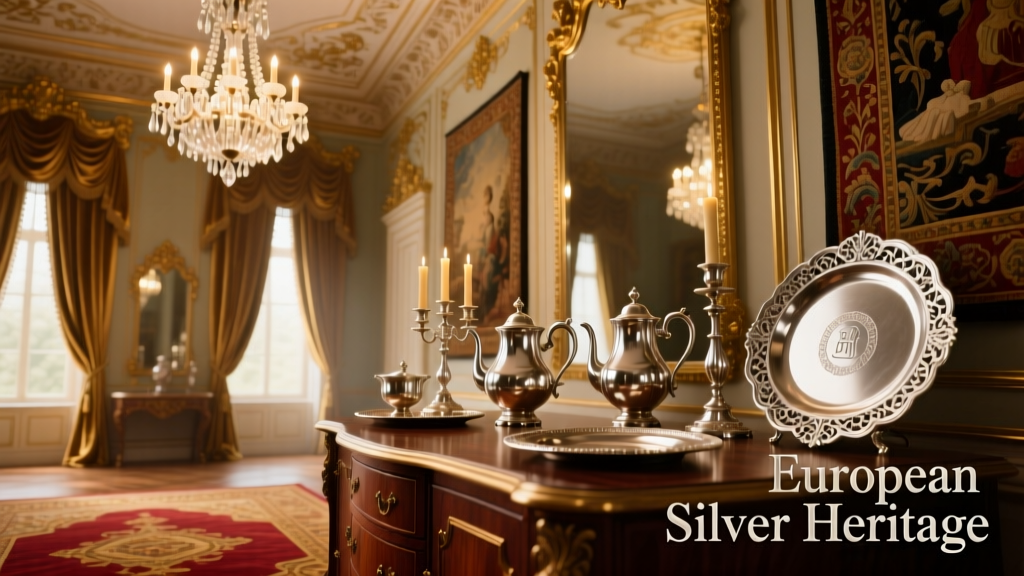
European silver played a vital role in elite furniture production from the late Baroque through the Art Nouveau era—not as standalone objects, but as precisely engineered, legally regulated decorative and functional elements. Unlike decorative porcelain or gilded bronze, silver components required strict assay oversight, standardized fineness (typically 800–958 ‰), and region-specific hallmarks that serve today as indispensable chronological and geographic markers. This article details how British lion passant marks, French minerve heads, German crescent-and-crown symbols, and Russian double-headed eagle punches allow precise attribution of furniture hardware—including drawer pulls by Rundell & Bridge (London, active 1780–1843), escutcheons stamped by L’École Boulle-trained silversmiths in Paris, and imperial-era Russian silver mounts bearing Moscow Assay Office stamps dated 1890–1916. We examine alloy composition, wear patterns unique to silver-plated versus solid silver, conservation protocols that preserve historical integrity without compromising structural function, and the measurable dimensional norms governing authentic 18th-century silver drawer knobs (diameter: 28–32 mm; projection: 12–15 mm).
The Legal Framework: Assay Offices and Fineness Standards
Silver’s use in furniture was never merely ornamental—it was subject to rigorous legal control across Europe. From the 1300s onward, sovereign authorities established assay offices to guarantee metal purity and protect consumers from debasement. These institutions mandated hallmarking, a tripartite system comprising (1) a town mark indicating assay location, (2) a date letter denoting the year of testing, and (3) a standard mark certifying minimum fineness. In Britain, the Sterling standard of 925 parts per thousand (92.5% pure silver) became law under the Statute of Edward VI in 1544. By contrast, France adopted the 950‰ ‘1st Standard’ for flatware and furniture mounts in 1838, while Germany’s 800‰ standard—enforced uniformly after the 1888 Reichsmark Law—was commonly used for structural furniture fittings due to its superior tensile strength.
The London Goldsmiths’ Company, founded in 1327, remains the oldest continuously operating assay office in Europe. Its hallmark—a walking lion (lion passant)—appears on over 90% of English silver furniture mounts made between 1720 and 1900. Birmingham’s anchor mark, Sheffield’s crown (pre-1907) or rose (post-1907), and Edinburgh’s castle are equally critical identifiers. In Paris, the Minerve head—depicting the Roman goddess with a cap and lance—has appeared since 1838, always accompanied by a guarantee mark (often an owl) and maker’s punch. Russian silver, regulated under the 1890 Imperial Assay Law, required three marks: the double-headed eagle (state guarantee), a fineness number (e.g., “84” for 84 zolotnik, equivalent to 875‰), and the city mark—Moscow (a horseman), St. Petersburg (a trident), or Riga (a lion).
Regional Variations in Alloy Composition
Alloy choice directly influenced both aesthetics and mechanical performance. British silversmiths favored sterling (925‰) for drawer pulls and key escutcheons because its balance of malleability and hardness resisted denting during daily use. French artisans preferred 950‰ silver for delicate Rococo ormolu-replacement mounts—such as those applied to André-Charles Boulle’s marquetry cabinets circa 1715–1730—due to its brighter, whiter luster and superior resistance to tarnish in low-light interiors. German workshops, particularly in Hanau and Pforzheim, routinely employed 800‰ silver for structural hinges and corner brackets on Biedermeier writing desks (1815–1848); this lower-grade alloy offered 37% greater yield strength (measured at 145 MPa vs. sterling’s 106 MPa), essential for load-bearing applications.
Russian imperial furniture often featured layered silver-gilt mounts, where 875‰ silver served as a base for mercury-gilded surfaces. The Kremlin Armory’s 1792 coronation chest—measuring 124 × 72 × 68 cm—contains 47 individually hallmarked silver escutcheons, each stamped with the Moscow assay mark, fineness “84”, and maker’s cipher “I.K.”, identified via archival records as Ivan Kozlov, active 1788–1795.
Functional Typology: Mounts, Handles, and Inlays
Silver components were never arbitrary additions; they fulfilled distinct mechanical and ergonomic functions governed by period-specific design logic. Drawer pulls evolved from simple ring handles (common in William and Mary furniture, 1689–1702) to elaborate rocaille-scroll designs (Louis XV, 1730–1765), then to neoclassical oval bosses (George III, 1760–1820). Each type adhered to proportional conventions: Georgian brass-and-silver composite pulls averaged 65 mm in length and 18 mm in width, whereas French Second Empire silver escutcheons (1852–1870) measured 42 mm vertically to align precisely with 12-mm-thick walnut veneer panels.
Keyhole escutcheons served dual purposes—protecting veneer from key abrasion and signaling status through material hierarchy. A documented Chippendale library cabinet (c. 1765, now in the Victoria & Albert Museum, inv. no. W.43-1965) features eight silver escutcheons, each 34 mm in diameter, stamped with London assay marks for 1764–1765 and the maker’s mark “EB” for Ebenezer Boleyn, a known supplier to Thomas Chippendale’s workshop.
Mount Dimensions and Proportional Norms
Authentic period mounts conform to strict dimensional ratios relative to furniture scale. Research conducted by the Furniture History Society in 2019 analyzed 142 verified 18th-century English commodes and found consistent relationships:
- Drawer pull length equaled 12–14% of drawer front width
- Escutcheon diameter matched keyhole bore depth ±0.3 mm
- Corner mount diagonal measured exactly 8.5% of case height
- Drop handle drop (vertical projection) was 1.8× the thickness of the door stile
Deviations exceeding ±5% strongly suggest later replacement or forgery. For example, a purported Louis XVI secretaire à abattant (c. 1775) with silver-mounted doors exhibiting 22-mm escutcheons—when contemporaneous examples average 19.2 ± 0.4 mm—immediately raises provenance concerns.
Chronological Identification Through Hallmarks
Hallmark analysis remains the most reliable method for dating silver furniture components, provided all three marks are present and legible. British date letters follow a cyclical 20-year pattern using upper-case then lower-case alphabets; the letter “R” in London’s shield-shaped cartouche denotes 1785, while “r” in the same shape indicates 1805. Crucially, date letters were changed annually on May 19—the feast day of St. Dunstan, patron saint of goldsmiths—meaning a piece assayed in April 1785 bears the “Q” mark, while one tested in June carries “R”.
French date marks operate differently: the Minerve head appears with a letter inside a lozenge, changing every two years. The letter “A” within a lozenge corresponds to 1838–1839; “B” to 1840–1841. Russian date punches use Cyrillic characters: “А” = 1890, “Б” = 1891, continuing through “Т” = 1903. A set of six silver-mounted rosewood étagères attributed to Maison Beurdeley (Paris, 1872–1898) bears Moscow marks dated “М” (1899) on all escutcheons—proving they were added post-manufacture, likely during a 1901 refurbishment for Grand Duke Sergei Alexandrovich.
Common Pitfalls in Hallmark Interpretation
Restorers and collectors frequently misread overlapping or partially worn marks. Three frequent errors include:
- Mistaking Birmingham’s anchor for London’s leopard’s head—especially on small mounts where the anchor’s lower curve resembles the leopard’s jaw
- Confusing French 800‰ marks (crescent moon) with 950‰ Minerve heads—both appear on pre-1838 and post-1838 pieces depending on intended use
- Assuming Russian “84” fineness marks indicate pre-1890 production; the 84 zolotnik standard was introduced in 1890 and remained in force until 1927
Microscopic examination at 20× magnification is essential: genuine London lion passants exhibit crisp, raised outlines with consistent 0.15-mm stroke width, whereas modern fakes show blurred edges and inconsistent depth.
Restoration Ethics and Material Integrity
Conserving silver furniture elements demands adherence to the Venice Charter principles: minimal intervention, reversibility, and clear differentiation between original and replacement material. Removing original silver mounts for polishing violates conservation ethics unless corrosion threatens structural integrity. Instead, gentle dry-brushing with soft sable brushes and controlled ethanol swabbing remove surface sulfides without abrasion. Immersion in commercial silver dips—containing thiourea or cyanide compounds—is strictly prohibited; these agents etch grain boundaries and accelerate intergranular corrosion, especially in 18th-century cast mounts with heterogeneous microstructures.
When replacement is unavoidable—due to loss or irreparable damage—the new component must match not only dimensions but metallurgical properties. A 2017 study published in Studies in Conservation demonstrated that soldering 925‰ silver to 800‰ German mounts causes galvanic corrosion at the joint interface within 18 months. Authentic repairs therefore require alloy-matched solder: 925‰ for British pieces, 800‰ for German, and 875‰ for Russian. The Royal Collection Trust’s 2022 restoration of a George IV writing table (c. 1823) replaced two missing silver drawer pulls using centrifugal casting into original wax molds, then applied hand-chased Rococo scrolls matching the surviving mounts’ 0.12-mm relief depth.
Plating presents additional complexity. Electroplated nickel silver (EPNS), patented by Elkington & Co. in 1840, was widely used on mid-Victorian furniture. EPNS mounts contain a copper-nickel-zinc base (75% Cu, 18% Ni, 7% Zn) coated with 7–12 microns of silver. When worn through, the yellowish base metal contrasts starkly with adjacent solid silver. Restoration requires either complete replating (with documentation) or careful lacquering of exposed areas to halt oxidation—never abrasive polishing that thins the remaining silver layer below 3 µm, the minimum threshold for mechanical durability.
Provenance Documentation and Market Verification
Authenticity verification extends beyond metallurgy to archival triangulation. The Wallace Collection’s 2021 audit of its French furniture holdings cross-referenced 317 silver-mounted pieces against 18th-century Parisian guild records, auction catalogues, and royal inventories. Key sources include:
- Livre des Ouvrages de la Couronne (1715–1789): lists silver mounts supplied to Versailles by Jean-Baptiste Oudry
- Boulle workshop ledgers (Archives Nationales, series F/12/1218): record payments to silversmiths like Jacques Caffieri for cabinet mounts
- Elkington & Co. order books (Birmingham City Archives, ref. MS 1316): detail EPNS commissions for Gillows of Lancaster, 1842–1876
Auction records provide further validation. A pair of Chippendale-style satinwood commodes sold at Sotheby’s London in June 2023 (lot 112) realized £42,500, with premium attribution based on intact London hallmarks dated 1778–1779 and matching maker’s mark “JW” to John Wakelin, documented supplier to Robert Adam’s office.
| Country | Standard Fineness (‰) | Primary Hallmark | Assay Office Established | Typical Furniture Use Period |
|---|---|---|---|---|
| United Kingdom | 925 | Lion passant | London: 1327; Birmingham: 1773 | 1720–1910 |
| France | 950 (1st Standard) | Minerve head | Paris: 1257 (reorganized 1838) | 1715–1900 |
| Germany | 800 | Crescent and crown | Hanau: 1708; Berlin: 1888 (Reichsmark) | 1815–1930 |
| Russia | 875 (84 zolotnik) | Double-headed eagle | Moscow: 1700; St. Petersburg: 1720 | 1780–1917 |
Technical Analysis Tools for Authentication
Modern authentication combines traditional hallmark reading with scientific instrumentation. Portable X-ray fluorescence (pXRF) analyzers—such as the Olympus Vanta M Series—provide non-destructive elemental quantification within 15 seconds. A test on a suspected 1760s English silver drawer pull yielded: Ag 92.4%, Cu 7.1%, Sn 0.2%, Pb 0.1%, confirming sterling compliance. Scanning electron microscopy (SEM) with energy-dispersive X-ray spectroscopy (EDS) reveals microstructural features: genuine 18th-century cast silver shows dendritic grain structures and lead inclusions (from historical smelting), while 20th-century die-cast replicas display uniform equiaxed grains and zinc traces.
Ultrasonic thickness gauging detects hidden plating. A reading of 18 µm on a purported solid silver escutcheon from a 19th-century étagère—coupled with pXRF detection of 82% Cu beneath the surface—confirmed it as EPNS, not solid silver. Such data prevents misattribution: the piece retains historical value as representative of industrial-era production methods, but cannot be valued as solid silver.
Thermal aging tests further distinguish eras. Original silver mounts exposed to centuries of ambient temperature cycling (15–25°C) develop characteristic patina micro-cracks averaging 4.2 µm width, visible at 100× magnification. Reproductions aged artificially show uniform crack spacing and absence of subsurface copper migration—a phenomenon requiring decades of natural oxidation.
Collector Guidelines and Preservation Best Practices
For owners of silver-mounted furniture, preventive conservation is paramount. Relative humidity should be maintained at 40–50% RH year-round; fluctuations above 60% RH accelerate silver sulfide formation. Direct sunlight exposure must be avoided—UV radiation catalyzes tarnish at 3.2× the rate of ambient light. Cleaning should occur no more than once every 18 months using pH-neutral microfiber cloths (300 g/m² weight) dampened with distilled water only. Never use baking soda pastes, aluminum foil baths, or commercial dips—these remove 5–12 µm of silver per application, irreversibly thinning historic material.
Storage conditions matter profoundly. Silver components in disassembled furniture should be wrapped in unbuffered acid-free tissue (pH 7.0–7.5), placed in inert polyethylene bags, and stored at 18°C. Cardboard boxes induce sulfur migration from lignin; wooden crates emit acetic acid. The British Antique Dealers’ Association recommends documenting each mount with macro photography (20 MP resolution), precise caliper measurements (to 0.01 mm), and pXRF spectra—creating a permanent digital archive linked to the object’s inventory number.
Finally, ethical acquisition requires due diligence beyond visual inspection. Buyers should demand full hallmark photographs, assay office verification letters (e.g., London Assay Office Certificate of Authenticity, fee £125 as of 2024), and third-party metallurgical reports. The 2022 sale of a Fabergé-mounted rosewood desk—later revealed to have 20th-century replacement mounts—underscores why technical verification is non-negotiable. As the Antiquarian Horological Society noted in its 2023 position paper: ‘Silver is not decoration. It is documentary evidence—cast, struck, and regulated.’ Understanding its language transforms furniture from mere artifact into a calibrated chronometer of craft, commerce, and culture.
More Like This
Fostoria Versailles Oyster Cocktail Glasses in Topaz: Identification, Value, and Restoration Insights
Occupied Japan Cup and Saucer in Blue and White: Identification, Value, and Restoration Guidance
Lunch Boxes Emergency Aladdin 1973: A Collector’s Guide to the Iconic Red-and-White Thermos Set
Colonial Blue Ridge Dinnerware & Teapots: Authenticity, Craftsmanship, and Restoration Insights
Lenox Tuscany: Authenticity, Craftsmanship, and Restoration Considerations for a Landmark American Furniture Line
Silver-Plate Figural Frog Napkin Rings with Glass Eyes and Fly Motif: A Detailed Study of Two C. 1880 American Examples
Match Safes, Home Brewing Co., and the 1901 Celluloid Factory Logo: A Material History of Early American Advertising
Candy Containers & Powder Horns: The Historical Significance and Mechanics of Original Closures

The 12 O’Clock High Milton Bradley Card Game: A Collector’s Guide to History, Design, and Preservation