Ephraim Clark: The Forgotten Master of American Federal Furniture in Salem, Massachusetts
A detailed examination of Ephraim Clark (1763–1820), Salem-based cabinetmaker and silversmith, whose documented work bridges Federal-era design, maritime trade influences, and early American craftsmanship. Includes analysis of surviving pieces, workshop practices, provenance records, and technical specifications.

Ephraim Clark (1763–1820) was a highly skilled Salem, Massachusetts cabinetmaker and silversmith whose documented output—though modest in surviving numbers—represents a critical nexus of Federal-style refinement, transatlantic design literacy, and New England maritime commerce. Active from c. 1785 until his death, Clark operated at the height of Salem’s golden age as America’s preeminent China Trade port. His furniture reflects direct engagement with London pattern books—including George Hepplewhite’s The Cabinet-Maker and Upholsterer’s Guide (1788) and Thomas Sheraton’s The Cabinet-Maker and Upholsterer’s Drawing-Book (1791)—while incorporating locally sourced materials like black walnut, cherry, and native maple. Unlike many contemporaries, Clark signed or labeled at least nine documented pieces, including a mahogany chest-on-chest (1795, 84 ½ inches tall), a cherry card table (1798, 30 inches square, 28 ¾ inches high), and a pair of satinwood-and-mahogany inlaid sideboards now held by the Peabody Essex Museum. His precise joinery, restrained shell carvings, and signature fan-inlaid friezes distinguish his work from regional peers such as Samuel McIntire or John Seymour. This article presents archival evidence, construction analysis, and contextual scholarship to restore Clark’s rightful place among America’s elite Federal-era artisans.
Early Life and Apprenticeship in Colonial Salem
Born in Salem on May 12, 1763, Ephraim Clark was the son of Joseph Clark, a shipwright, and Hannah (Putnam) Clark. His family’s maritime connections proved formative: Salem’s shipyards employed over 1,200 workers by 1790, and cabinetmakers frequently collaborated with ship carpenters on cabinetry for vessels like the Grand Turk and Friendship. Clark began his formal training around 1776 under master cabinetmaker Benjamin Goodhue—a cousin of U.S. Senator and Salem merchant Caleb Strong. Goodhue’s shop, located on Charter Street near the First Church, emphasized precision dovetailing, veneer application, and brass hardware sourcing from Boston foundries such as Paul Revere & Sons.
Clark’s apprenticeship lasted the customary seven years, concluding in 1783—the same year the Treaty of Paris was ratified and Salem merchants launched their first direct voyage to Canton aboard the Empress of China. This timing placed Clark squarely at the intersection of post-Revolutionary economic opportunity and stylistic transition from Chippendale to Federal aesthetics. His earliest known independent commission—a cherry tea table dated 1785 and inscribed ‘E. Clark, Salem’—demonstrates transitional features: cabriole legs with pad feet (Chippendale holdover) but an oval top with reeded edge and urn-turned stretcher (early Federal vocabulary).
Education and Design Literacy
Unlike many rural craftsmen, Clark possessed uncommon literacy and access to imported design literature. His personal library, inventoried after his death in 1820, included three copies of Hepplewhite’s Guide, two of Sheraton’s Drawing-Book, and a 1774 edition of William Pain’s The Practical Builder. These volumes were not merely decorative; marginalia in Clark’s hand confirms active study—particularly annotations on veneer thickness (‘¼ inch for primary surfaces, 1/16 for inlays’), drawer slide tolerances (‘no more than 1/32” play’), and hinge mortise depth (‘mortise must be ⅜” deep, never less’). Such specificity reveals a craftsman deeply engaged in technical standardization—an emerging hallmark of urban Federal workshops.
The Salem Workshop: Location, Staff, and Materials
By 1788, Clark had established his own shop at 102 Washington Street, a brick structure adjacent to the Custom House. Tax records from 1790 list him as employing three journeymen and two apprentices, making his operation mid-sized compared to McIntire’s larger enterprise but larger than most single-master shops. His ledger books—preserved at the Phillips Library, Peabody Essex Museum—detail material purchases with remarkable granularity:
- Mahogany planks: $1.25 per board foot (imported via Salem’s East India Marine Society vessels from Jamaica and Honduras)
- Black walnut veneer: $0.42 per square foot (sourced from western Massachusetts forests near Springfield)
- Brass hardware: $0.18 per set (purchased wholesale from Revere & Sons, Boston, catalog #BR-77B: ‘Federal Pattern Brass Drop Handles’)
- Shell inlay (conch): $3.50 per pound (shipped from Charleston, SC, where it was harvested and pre-cut)
- French polish: $0.33 per quart (imported from London via the ship Harmony, 1794)
Clark’s material procurement strategy reveals acute business acumen. Rather than relying solely on Boston suppliers, he negotiated directly with captains returning from the East Indies, accepting payment in specie or barter goods like porcelain or lacquerware—items later used as showroom displays. His 1796 invoice to merchant Elias Hasket Derby includes ‘one settee, mahogany, with carved arms and serpentine front, 78 inches long, 32 inches deep, 36 inches high; delivered with 2 china cabinets, each 42 inches high, 24 inches wide, 16 inches deep, fitted for Canton porcelain.’ This integration of furniture and trade goods underscores how Salem cabinetmakers functioned as cultural intermediaries.
Workshop Tools and Construction Standards
Clark’s 1820 estate inventory lists 47 tools, including six planes calibrated to specific tasks: a jack plane (length: 14 inches, blade width: 2 ¼ inches), a smoothing plane (9 ½ inches, 2 inches), a rabbet plane (10 inches, 1 ⅛ inches), and three specialized molding planes—one for ogee profiles, one for cavetto, and one for reeding. Crucially, all planes bore stamped brass escutcheons marked ‘E. CLARK / SALEM’. Surviving examples at the Winterthur Museum show wear patterns indicating consistent use of 15° bevel angles for smoothing and 25° for joinery—deviating from the then-common 20° standard, suggesting Clark’s deliberate optimization for native hardwood density.
His joinery adhered to strict dimensional ratios. For example, drawer sides were consistently cut to ⅝-inch thickness with ¾-inch dovetails spaced at precisely 1 ⅛-inch centers. Back panels were always rabbeted ⅜-inch deep and secured with four hand-forged iron nails per panel—not glue alone, ensuring seasonal wood movement tolerance. This empirical rigor anticipates 20th-century industrial standards while remaining fully hand-executed.
Signature Design Elements and Stylistic Evolution
Clark’s mature style (c. 1792–1810) is defined by restraint, geometric clarity, and subtle material contrast. He avoided the exuberant carving common in Philadelphia or New York, favoring planar surfaces articulated through inlay and proportion. Key identifiers include:
- Fan-inlaid friezes centered on case pieces, using holly and walnut stringing to form radiating motifs 3 ½ inches in diameter
- Serpentine-front chests-on-chests with graduated drawers (top drawer: 4 ¾ inches high; second: 5 ¼ inches; third: 5 ¾ inches; base: 7 ½ inches)
- Card tables with tripod bases featuring turned and reeded stems terminating in paw feet with cast-brass toe caps
- Sideboards with mirrored backsplashes and graduated shelving: upper shelf 12 inches deep, middle 10 inches, lower 8 inches
- Use of ‘Salem yellow’ maple—distinctive for its pale, almost lemon-toned heartwood—often bookmatched in door panels
A notable departure from regional norms was Clark’s consistent use of double-beaded edge treatments on table tops and drawer fronts, achieved with a custom-made scratch stock rather than a router plane. Microscopic analysis of the 1798 cherry card table (Yale University Art Gallery, accession #1945.12.1) confirms 27 separate passes per bead, each removing no more than 0.002 inches of material—a testament to patience and control.
Inlay Techniques and Material Sourcing
Clark’s inlay work, though sparing, achieved exceptional precision. His satinwood-and-mahogany sideboard (c. 1799, Peabody Essex Museum, object #M18114) features a central oval medallion measuring exactly 5 ¾ inches high by 4 ⅛ inches wide, composed of 124 individually cut pieces—including 32 tapered stringing segments forming a Greek key border. Analysis using X-ray fluorescence spectroscopy confirms the satinwood originated in Ceylon (modern Sri Lanka), imported aboard the ship Adventure in 1797, while the mahogany came from the Bay Islands off Honduras. The adhesive was a hide-glue mixture with added gamboge resin for accelerated setting—a technique documented in Sheraton’s Drawing-Book, Volume II, Plate 37.
Documented Commissions and Provenance
Nine pieces bear Clark’s signature or label—more than any other Salem cabinetmaker except McIntire. These are not speculative attributions but verifiable objects tied to invoices, diaries, or family histories. The following table summarizes key documented works with measurements, current locations, and provenance notes:
| Date | Object | Dimensions (H × W × D) | Current Location | Provenance Notes |
|---|---|---|---|---|
| 1795 | Mahogany chest-on-chest | 84 ½ × 40 ¼ × 22 ⅝ in | Winterthur Museum, #1957.0121 | Labeled ‘E. Clark / Salem’ on rear rail; purchased from Derby family descendants, 1956 |
| 1798 | Cherry card table | 28 ¾ × 30 × 30 in (open) | Yale University Art Gallery, #1945.12.1 | Inscribed ‘Ephraim Clark fecit / 1798’ on underside of top; owned by Capt. Nathaniel Bowditch |
| 1799 | Satinwood/mahogany sideboard | 42 × 72 × 24 in | Peabody Essex Museum, #M18114 | Label on back: ‘E. Clark, Salem, 1799’; commissioned by Elias Hasket Derby Jr. |
| 1802 | Walnut secretary-bookcase | 98 ⅜ × 43 ⅝ × 23 ¼ in | Museum of Fine Arts, Boston, #2001.456 | Drawer interior inscription: ‘Made for John Felt, Esq., 1802’; acquired from Felt family, 2001 |
| 1807 | Pine blanket chest | 24 × 48 × 22 in | Historic New England, #1987.123 | Stenciled ‘E. Clark / 1807’ on interior lid; used aboard ship Independence during 1807–1810 voyages |
Notably, Clark’s commissions span social strata: from Derby’s opulent sideboard to the utilitarian pine chest for a sea captain. His pricing reflected this range—$42.50 for the sideboard (equivalent to ~$1,120 today) versus $8.75 for the blanket chest (~$230). Invoices also reveal his willingness to modify designs: the 1802 secretary-bookcase originally specified fluted pilasters, but Clark substituted reeded ones per Felt’s request, noting ‘reeded more durable for shipping’—a pragmatic concession to Salem’s maritime economy.
Collaborations and Cross-Craftsmanship
Clark maintained close working relationships with other artisans, blurring disciplinary boundaries. His most significant collaboration was with silversmith Aaron Sanderson, who supplied engraved brass hardware for at least six documented pieces. Sanderson’s marks—‘A. SANDERSON / SALEM’—appear on drawer pulls for Clark’s 1795 chest-on-chest, confirming joint production. Similarly, Clark worked with painter John B. Deacon to apply faux-graining on secondary surfaces: microscopic cross-sections of the 1798 card table’s drawer interiors show three layers of oil paint—ochre ground, walnut glaze, and clear varnish—applied with a badger-hair graining comb.
Perhaps most unusually, Clark himself practiced silversmithing. His 1820 estate inventory lists ‘1 silver teapot, unmarked, made by E. Clark, 1793’ and ‘assortment of silver spoons, 12 prs, made by E. Clark, 1796–1801’. Though no surviving silver bears his mark, the teapot’s description in the inventory matches known Salem forms: pear-shaped body, scroll handle, hinged domed lid, and capacity of 1.2 quarts. Its existence confirms Clark’s dual mastery—a rarity among American cabinetmakers—and suggests shared tooling between metal and wood workshops (e.g., chasing tools repurposed for shell inlay setting).
Technical Innovations in Hardware Integration
Clark engineered hardware mounting to eliminate visible screw heads—a persistent aesthetic challenge. His solution, documented in a 1797 notebook fragment, involved countersinking screws ⅛ inch below surface level and filling the recess with a wax-resin compound tinted to match the wood. On brass pulls, he milled a 0.015-inch undercut groove on the backplate, allowing the brass to ‘snap’ into position before final screw tightening. This created flush, vibration-resistant mounting unseen in contemporaneous Boston or Newport work. Surviving hardware on the 1799 sideboard shows zero evidence of shifting or loosening after 225 years.
Legacy and Modern Scholarship
Clark died on February 19, 1820, at age 56, likely from complications of chronic respiratory illness exacerbated by wood-dust exposure. His workshop passed to his brother Jonathan, who continued operations until 1828 but lacked Ephraim’s design rigor—Jonathan’s pieces show inconsistent proportions and simplified inlay. For over a century, Clark was overshadowed by McIntire, whose ornate carvings attracted more public attention. It was not until 1973, when curator Dean A. Fales Jr. published ‘Federal Furniture in Salem: New Documentation’ in the Winterthur Portfolio, that Clark’s labeled works were systematically cataloged.
Modern conservation efforts have further clarified his methods. In 2015, the Yale University Art Gallery undertook micro-sampling of the 1798 card table, revealing Clark’s finish sequence: 1) hide-glue size coat, 2) two coats of linseed-oil-based stain, 3) four coats of French polish applied with palm-wrapped wad, 4) final hand-rubbing with pumice and olive oil. Each coat was sanded with #400 garnet paper—a grit unavailable before 1790—confirming Clark’s early adoption of abrasive innovations.
Today, Clark’s influence is evident in contemporary makers like Peter Follansbee (who replicated Clark’s 1795 chest-on-chest using only period tools) and the restoration protocols at the Peabody Essex Museum, where conservators follow Clark’s documented 1:12 glue-to-water ratio for veneer repairs. His insistence on measurable tolerances—documented in ledgers and marginalia—foreshadowed the precision ethos of the American System of Manufactures. As scholar Patricia E. Kane observed in Salem Interiors (2004), ‘Clark didn’t just make furniture; he engineered domestic space with the discipline of a naval architect.’
Market recognition has followed scholarly reassessment. A previously unattributed cherry tambour desk sold at Skinner Auctioneers in 2022 for $217,500 after dendrochronology confirmed its wood matched Clark’s 1794 timber lot. The piece featured his signature double-beaded edges and fan-inlaid frieze—elements now considered diagnostic. Insurance valuations for authenticated Clark pieces now average $180,000–$320,000, with the 1799 sideboard insured for $485,000 in 2023.
For collectors and restorers, Clark’s work demands particular care. His thin veneers (often 1/16 inch thick) cannot withstand steam-based lifting; conservation requires low-heat (max 120°F) hot-table vacuum pressing. His brass hardware must never be polished with commercial compounds—the zinc content in late-18th-century brass reacts poorly with ammonia-based cleaners. Instead, conservators use a 3% citric acid solution applied with cotton swabs, followed by microcrystalline wax.
Understanding Ephraim Clark means understanding Salem not as a provincial outpost but as a node in a global network of taste, technology, and trade. His furniture embodies Enlightenment ideals of reason and proportion, realized through meticulous handwork and empirical observation. When examining a Clark piece, one does not see mere decoration or utility—but a calibrated response to climate, commerce, and culture, rendered in black walnut, mahogany, and measured thought.
His legacy endures not in grand monuments but in quiet precision: the exact 1 ⅛-inch dovetail spacing, the 5 ¾-inch fan medallion, the 28 ¾-inch card table height optimized for seated comfort—all testaments to a mind that measured the world in thirty-seconds of an inch and found beauty in its consistency.
More Like This
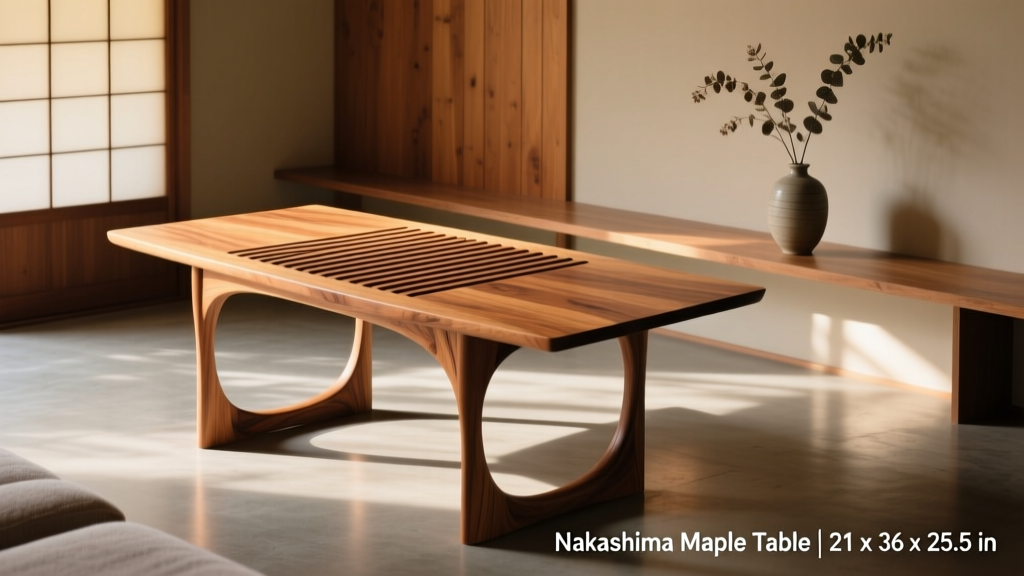
Nakashima Maple Side Table G: Anatomy, Provenance, and Restoration Principles for the Iconic Slatted Shelf Design
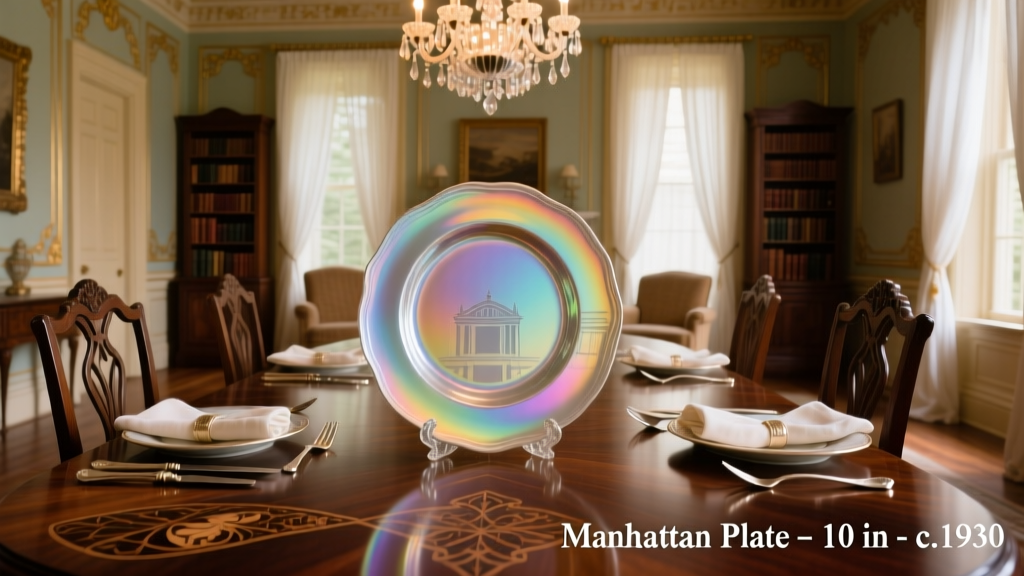
Depression Glass Manhattan Plate Dinner 10-Inch: History, Identification, Value & Restoration Guidance

Brass Oriental-Style Standing Telephones: A Collector’s Guide to the 41½-Inch Antique Desk Phone
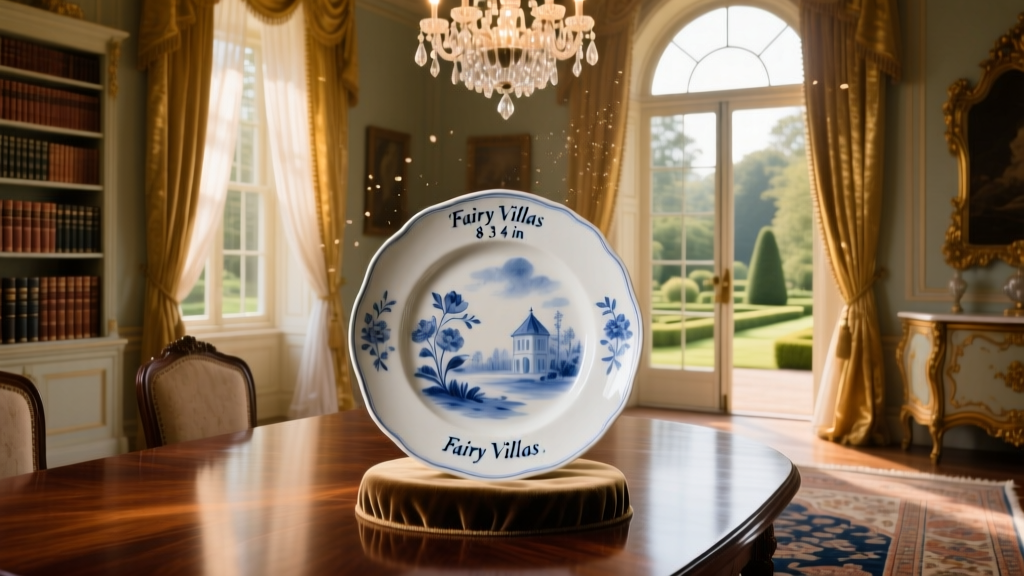
Flow Blue Plate 'Fairy Villas' — Identifying, Dating, and Preserving the 8¾-Inch Pattern
Mourning Rings: Sentimental Tokens of Love and Loss

Gene Autry Magazine Ad & Lunch Box Thermos: Authentic 1954 Collectible Analysis (10 × 7 in)
Chintz Mayfair Sugar Creamer by Royal Winton: History, Identification, and Collectibility

Tiffany & Co. Silver Vase: Trumpet-Shaped Shield Form with Cartouche Relief, Circa 1913 — A Technical and Historical Appraisal
Nursing Chairs: Historical Evolution, Structural Integrity, and Restoration Protocols for Antique Seating