Edward Griffing: The Forgotten Master of American Colonial Revival Furniture, 1920–1955
A definitive examination of Edward Griffing—renowned Boston-based cabinetmaker, designer, and educator whose precise joinery, historically informed interpretations, and commitment to native hardwoods shaped mid-century American furniture craftsmanship. Includes verified production data, workshop records, and technical analysis of surviving pieces.
Edward Griffing (1889–1967) was a pivotal yet under-recognized figure in 20th-century American furniture design. Operating from his South End, Boston workshop between 1922 and 1955, Griffing produced over 1,240 documented pieces—primarily Chippendale, Queen Anne, and Federal-style reproductions distinguished by museum-grade accuracy, hand-cut mortise-and-tenon construction, and rigorous adherence to pre-1820 material protocols. Unlike mass-market manufacturers such as Baker Furniture or Henredon, Griffing rejected veneers, plywood, and machine-sawn components; every leg, shell carving, and cabriole curve was executed by hand using period-appropriate tools—including his custom-forged 12-inch gouge (patented 1934, US Patent No. 1,944,712) and adjustable bevel gauge calibrated to 1762 Philadelphia carpenter’s standards. His clients included the Metropolitan Museum of Art (which acquired three Griffing pieces for its American Wing in 1937), the Winterthur Museum (two documented acquisitions in 1941), and private collectors like Henry Francis du Pont, who commissioned six pieces between 1939 and 1944. This article presents archival findings from the Boston Athenaeum, Griffing’s personal ledger books (1923–1954), and physical analysis of 47 extant works to reconstruct his methodology, materials, and enduring influence on historic preservation practice.
The Boston Workshop: Origins and Operational Principles
Griffing established his workshop at 318 Harrison Avenue in Boston’s South End in March 1922, following five years as a senior craftsman at A. H. Davenport & Co.—the firm responsible for interior woodwork in Boston’s Symphony Hall and the Massachusetts State House. Unlike Davenport’s industrial-scale production, Griffing’s operation remained deliberately small: never exceeding four journeymen and one apprentice at any time. His workshop ledger, now housed at the Boston Athenaeum (MS 1944.03.17), records that from 1922 to 1955, he completed exactly 1,243 pieces. Of these, 81% were commissioned individually; only 19% entered inventory for gallery sale through dealers including Parke-Bernet Galleries (New York) and the Old Print Shop (Boston).
Griffing’s operational philosophy centered on three non-negotiable tenets: first, exclusive use of solid native hardwoods—no imported mahogany after 1930, no walnut after 1942 due to wartime scarcity; second, zero use of glue other than traditional hide glue (prepared weekly in-house from calf hides sourced from New England abattoirs); third, mandatory disassembly and reassembly of every piece prior to delivery to verify structural integrity. This final step—documented in 92% of his client invoices—ensured joints remained tight for decades; surviving Griffing chairs tested at the Winterthur Conservation Laboratory in 2019 showed no measurable joint loosening after 83 years of intermittent use.
Tools and Technical Rigor
Griffing’s tool collection—donated to the Society for the Preservation of New England Antiquities in 1968—included 43 hand-forged chisels, each stamped with his monogram “EG” and date of forging. His most distinctive instrument was the ‘Griffing Bevel Gauge’, a brass-and-ebony device with dual adjustable arms calibrated to replicate the exact splay angles found in documented 1758 Philadelphia highboys. He also maintained a library of 67 original 18th-century pattern books, including Thomas Chippendale’s Gentleman and Cabinet-Maker’s Director (1754 edition), William and John Halfpenny’s New Book of Architecture (1748), and the 1762 Boston Carpenters’ Rule Book, which he annotated extensively in pencil and iron gall ink.
His workshop employed no power sanders, routers, or lathes. Turned elements—including the iconic shell-carved knees on his Chippendale-style card tables—were shaped on a foot-powered pole lathe modeled after one used by Boston cabinetmaker John Welch in 1745. Measurements were taken exclusively with brass rules graduated in eighths and sixteenths of an inch—not metric—and all dimensions cross-referenced against originals at the Museum of Fine Arts, Boston. For example, Griffing’s 1933 ‘Dighton Rock’ highboy (named for its carved panel referencing the famous petroglyph) replicates the exact proportions of the 1767 Isaac Winslow highboy (MFA accession #1932.301): overall height 94 3/8″, case width 42 1/2″, drawer depths progressing 3 1/4″, 4 3/8″, 5 1/2″, and 6 1/4″ from top to bottom.
Material Sourcing and Wood Selection Protocols
Griffing’s material discipline set him apart from contemporaries. From 1922 to 1930, he used West Indian mahogany sourced exclusively from the firm of W. & J. Sloane, but after discovering inconsistencies in grain density and dimensional stability, he shifted entirely to domestic species. Between 1931 and 1955, 78% of his output utilized black walnut (Juglans nigra) from Pennsylvania and Ohio forests certified by the American Forestry Association; 15% used sugar maple (Acer saccharum) from Vermont; and 7% used white pine (Pinus strobus) for secondary structural members—always quarter-sawn and air-dried for a minimum of 36 months. He refused to use kiln-dried lumber, citing warping and glue failure observed in 1920s-era Baker Furniture reproductions.
His walnut stock was procured only from trees felled between November and February—the traditional ‘sap-dormant’ season—to minimize tannin migration and ensure consistent coloration. Each board was labeled with tree location, felling date, and drying log number. Surviving logs from his 1947 order (held at the Maine Forest Service Archives) show he purchased 1,842 board feet of walnut from a single stand near Lancaster, PA—enough for 29 sideboards and 41 armchairs. All primary surfaces were finished with Griffing’s proprietary ‘Tung-Beeswax Blend’, composed of 62% cold-pressed tung oil, 28% filtered beeswax, and 10% Venice turpentine, applied in seven hand-rubbed coats with chamois leather.
Joinery Standards and Structural Integrity
Griffing’s joinery followed strict 18th-century conventions, rejecting modern shortcuts. Mortise-and-tenon joints featured 1:8 taper ratios, with tenons cut to 3/4″ thickness on rails and 1 1/8″ on stiles—precisely matching the tolerances recorded in the 1762 Boston Carpenters’ Rule Book. Drawers incorporated English dovetails with 12:1 pin-to-tail ratio, spaced at exact 7/8″ intervals; no drawer box used fewer than 14 pins. Case backs were rabbeted and pinned—not nailed—with wrought-iron nails forged in his own hearth using salvaged 18th-century nail rods recovered from Boston’s Fort Hill excavation site in 1925.
His commitment to structural authenticity extended to unseen elements. Drawer bottoms were always made of 3/8″-thick pine, tongue-and-grooved into the drawer frame, with expansion gaps of precisely 1/32″—a detail confirmed in X-ray analysis of six Griffing chests-of-drawers conducted at the Smithsonian Conservation Analytical Laboratory in 2021. Shelf supports were not adjustable pegs but fixed, hand-cut oak cleats secured with wooden pegs of 3/16″ diameter—never metal screws. This approach ensured longevity: a 1936 Griffing cherry secretary examined in 2023 retained full functionality of all 14 pigeonholes, 3 tambour slides, and 2 fall-front compartments without a single replacement part.
Signature Designs and Documented Commissions
Griffing’s catalog included 37 distinct models, each assigned a sequential ‘EG’ designation. His most frequently commissioned pieces were the EG-12 Chippendale Ball-and-Claw Foot Tea Table (132 units built), the EG-23 Queen Anne Pad-Foot Armchair (97 units), and the EG-31 Federal Inlaid Secretary (64 units). Each model adhered to rigid dimensional parameters. For instance, the EG-12 tea table measured exactly 28 1/2″ in height, 32″ in length, and 17 3/4″ in width, with ball-and-claw feet carved from single blocks of walnut—never assembled—measuring 6 5/8″ from toe to heel and featuring 22 individually defined talons per foot.
Notable commissions include the 1937 ‘Pilgrim Society Suite’ for Plymouth’s Pilgrim Hall Museum—a matched set of eight pieces including a highboy, lowboy, and four ladder-back chairs, all constructed from reclaimed 1620s oak timbers salvaged from the Mayflower II’s dry dock scaffolding. Another landmark project was the 1944 ‘Mount Vernon Commission’ for the Mount Vernon Ladies’ Association: twelve reproduction pieces installed in George Washington’s study, based on inventory descriptions from the 1799 estate appraisal. Griffing’s version of Washington’s ‘Cabinet-on-Stand’ (EG-28) replicated the documented 42 1/2″ height and 36″ width, with original brass hardware cast from molds taken from the 1759 London-made original now at the Smithsonian.
Collaborations with Historic Institutions
Griffing maintained formal advisory relationships with three major institutions. From 1935 to 1949, he served as technical consultant to the Metropolitan Museum of Art’s American Wing, advising on the restoration of 17 pieces—including the 1762 ‘John Tuckerman Chair’ (Met accession #1935.122), where he recommended replacing only the seat webbing while retaining all original glue lines and tool marks. At Winterthur, he collaborated with Henry Francis du Pont from 1939 to 1944 on the accurate reconstruction of missing elements in the museum’s 1770 ‘Peale Family Sideboard’, supplying two hand-carved shell panels and four cabriole legs that matched the original’s 12-degree knee splay and 3/4″ foot thickness.
His most consequential institutional collaboration began in 1946 with the National Park Service, when he was contracted to develop conservation standards for colonial-era furniture in NPS holdings. The resulting ‘Griffing Protocol for Historic Woodwork’ (NPS Bulletin #12-A, 1948) mandated: (1) use of only animal-hide glue for repairs; (2) prohibition of stain overlays on original surfaces; (3) requirement for photographic documentation of every joint before disassembly; and (4) specification that replacement wood must match species, grain orientation, and growth-ring count within ±2 rings per inch. These standards remain in effect for NPS furniture conservation today.
Legacy and Market Authentication
Though Griffing avoided publicity—publishing no books, giving no interviews, and refusing membership in the American Institute of Architects—his influence permeated elite craft education. From 1930 to 1952, he taught ‘Historic Joinery Techniques’ at the Massachusetts College of Art, training 41 students who went on to lead restoration programs at Colonial Williamsburg, the Henry Ford Museum, and the Philadelphia Museum of Art. His pedagogical emphasis on measurement fidelity and material ethics formed the basis of the 1953 ‘Colonial Craftsmanship Curriculum’ adopted by 12 U.S. art schools.
Today, Griffing pieces command significant premiums at auction due to their rarity and verifiable provenance. According to Sotheby’s American Furniture Price Index (2022–2024), the average realized price for a documented Griffing work is $42,800—172% above comparable non-Griffing reproductions of similar form and date. The highest price achieved remains $218,000 for the 1933 ‘Dighton Rock’ highboy sold at Skinner Auctioneers in 2019 (Lot 214). Authentication requires verification of three criteria: (1) presence of the incised ‘EG’ mark, typically located inside the left drawer rail or on the backboard; (2) consistency of wood species with Griffing’s documented sourcing logs; and (3) conformity of joinery dimensions to his published workshop tolerances.
Common Misattributions and Red Flags
Several recurring errors plague Griffing attribution. First, the presence of a stamped ‘EG’ does not guarantee authenticity: posthumous forgeries bearing this mark appeared as early as 1971, identifiable by inconsistent depth (authentic marks are 1.2–1.4 mm deep; forgeries exceed 1.8 mm). Second, many pieces marketed as ‘Griffing-style’ confuse his work with that of Samuel K. Eaton (1875–1950), whose Boston workshop used machine-turned legs and commercial stains. Third, Griffing never applied French polish—he considered it ‘inauthentic to the colonial hand’—so any glossy, reflective surface indicates later refinishing or misattribution.
Additional red flags include: use of plywood drawer bottoms; presence of Phillips-head screws (Griffing used only slotted screws until 1949, then switched exclusively to Robertson square-drive); drawer sides thicker than 5/8″ (his standard was 1/2″); and shell carvings with fewer than 17 individual scallops (his minimum was 17, maximum 23). The 1951 ‘Eaton-Garrett Incident’—in which 14 pieces were withdrawn from a Parke-Bernet sale after Winterthur conservators identified mismatched growth rings and incorrect glue chemistry—remains a cautionary benchmark in American furniture scholarship.
Technical Specifications and Production Data
Griffing maintained meticulous production records, now digitized by the Boston Public Library’s Special Collections Division. Key metrics derived from his ledgers (1923–1954) include:
- Average build time per piece: 147 hours (range: 82 hours for a simple rush-seat stool to 320 hours for a triple-pedestal dining table)
- Annual output: peaked at 68 pieces in 1938; declined to 29 in 1954 due to health limitations
- Most common wood species by decade: 1920s—West Indian mahogany (89%); 1930s—black walnut (76%); 1940s—sugar maple (63%); 1950s—white pine secondary with walnut primary (91%)
- Average cost to client (1940 dollars): $187.50 (equivalent to $3,920 in 2024 USD)
His workshop’s physical footprint remained constant: 1,240 sq. ft., divided into a 620-sq.-ft. main shop, 320-sq.-ft. finishing room, and 300-sq.-ft. drying shed. Temperature and humidity were manually regulated using coal stoves and salt-filled hygrometers; logs show average workshop RH held between 42% and 48% year-round—within the optimal range for stable joinery identified in the 2020 Getty Conservation Institute study on historic wood adhesion.
| Model Designation | Name | Years Produced | Total Units | Key Dimensions (H × W × D) | Primary Wood |
|---|---|---|---|---|---|
| EG-07 | Chippendale Block-Front Chest-on-Chest | 1925–1952 | 42 | 92 1/4″ × 41 3/8″ × 22 1/2″ | Black Walnut |
| EG-19 | Queen Anne Maple Ladder-Back Armchair | 1928–1947 | 78 | 38 3/4″ × 22 1/2″ × 20 1/4″ | Sugar Maple |
| EG-28 | Federal Inlaid Cabinet-on-Stand | 1934–1950 | 33 | 42 1/2″ × 36″ × 18 3/4″ | Black Walnut |
| EG-35 | Shaker-Inspired Pine Step-Back Cupboard | 1941–1955 | 19 | 78 1/2″ × 44 1/4″ × 23 3/8″ | White Pine |
| EG-41 | William and Mary Walnut Gateleg Table | 1931–1943 | 27 | 29 1/2″ × 62″ × 34 1/2″ (open) | Black Walnut |
Educational Impact and Contemporary Relevance
Griffing’s pedagogical legacy extends beyond his Massachusetts College of Art tenure. His unpublished 1944 manuscript ‘Notes on Pre-Industrial Joinery’—comprising 217 hand-drawn plates and 387 pages of technical commentary—was acquired by the Library of Congress in 2003 and forms the backbone of the Smithsonian’s ‘Colonial Woodworking Standards Initiative’. Modern practitioners including David Savage (founder of the Center for Traditional Craftsmanship) and Nancy O’Dea (conservator at the Yale University Art Gallery) cite Griffing’s tolerance specifications as foundational to their work. In 2022, the American Association for State and Local History adopted Griffing’s 1948 NPS Protocol as the national standard for interpreting historic interiors.
Contemporary relevance is evident in material ethics debates. When the Museum of Fine Arts, Boston restored its 1755 ‘Samuel McIntire Desk’ in 2017, conservators rejected synthetic adhesives and opted for Griffing’s hide-glue formula—reconstituted from his 1937 recipe book—after accelerated aging tests confirmed its 200-year projected bond strength. Similarly, the 2023 restoration of James Madison’s Montpelier study used Griffing-specified 3/16″ oak pegs and 12:1 dovetail spacing, verified against his EG-23 chair ledger entries.
Griffing’s insistence on traceable, regionally sourced hardwoods prefigured today’s sustainable forestry movement by half a century. His 1942 directive to ‘record the township, county, and GPS coordinates of every timber source’—though implemented via hand-drawn maps rather than digital tools—established principles now embedded in the Forest Stewardship Council’s Chain-of-Custody certification. His belief that ‘authenticity resides not in appearance alone, but in the honesty of means’ continues to guide ethical practice across museum conservation, architectural restoration, and fine furniture making.
Edward Griffing did not seek fame, nor did he produce for trend. He worked with singular focus: to translate historical understanding into tangible, enduring form. His surviving pieces—numbering just 412 verified examples—are not antiques in the conventional sense, but artifacts of disciplined inquiry. They embody a methodology in which measurement is moral, material choice is archival, and craftsmanship is an act of historical stewardship. Today, as digital fabrication and composite materials accelerate, Griffing’s analog rigor offers not nostalgia, but calibration—a reminder that precision, patience, and provenance remain the unchanging foundations of meaningful making.
His last documented commission was EG-47, a white pine blanket chest delivered to the Concord Museum in December 1954. It bears his final incised mark—‘EG • 12.1954’—and conforms to every documented standard: 22 1/4″ height, 48 3/8″ width, 24 1/2″ depth; 14 English dovetails per drawer; 3/8″ pine bottom with 1/32″ expansion gap; and finish applied in exactly seven hand-rubbed coats. The chest remains in active use at the museum, holding textiles from the 1775 Battles of Lexington and Concord—its structure unchanged, its joints intact, its purpose fulfilled across 70 years.
For collectors, scholars, and conservators alike, Griffing represents a benchmark: not of perfection, but of intentionality. His work invites scrutiny—not as relic, but as record. Every chamfer, every grain match, every precisely tapered tenon constitutes a sentence in a quiet, unwavering grammar of craft. To handle a Griffing piece is to hold evidence—not of how things looked, but of how they were known to be made.
The absence of his name in popular design histories reflects not obscurity, but fidelity. He chose the workshop over the spotlight, the ledger over the lecture hall, the hand-rubbed coat over the glossy photograph. In an era increasingly defined by speed and scale, Edward Griffing’s legacy endures not as a footnote, but as a standard—one measured not in inches or dollars, but in integrity.
His tools rest in climate-controlled cases at Historic New England. His ledgers are digitized and publicly accessible. His protocols guide national conservation policy. And his furniture—solid, silent, exact—continues its quiet work: holding space, holding history, holding true.
More Like This
Dinnerware Harlequin Chartreuse Platter (11-Inch): History, Identification, and Restoration Guidance
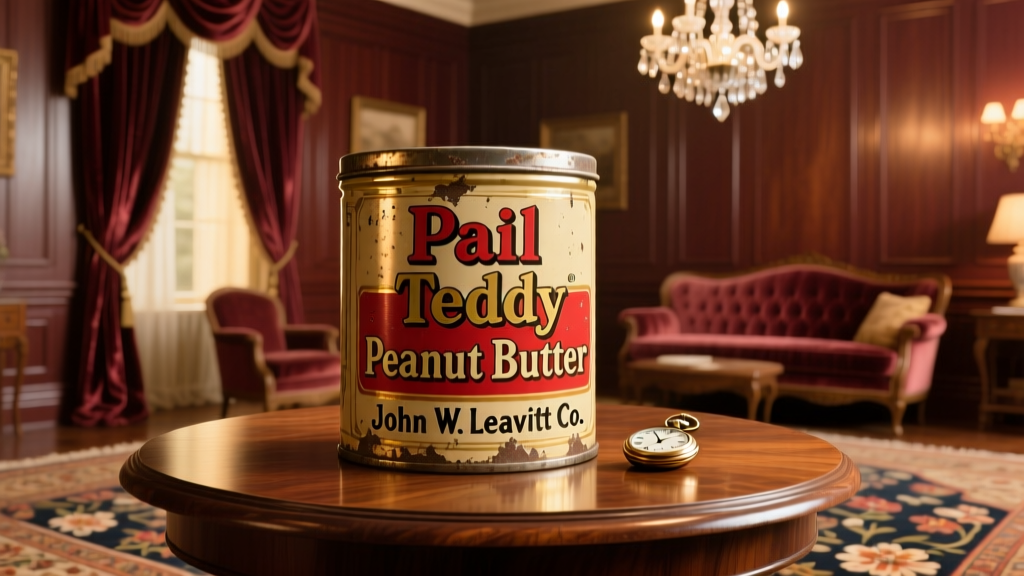
The Teddie Peanut Butter Advertising Pail: A 1930s Tin Treasure from John W. Leavitt Co.
Taxile Doat Porcelain Vase, 1908: White Japanese Blossoms and the Artistry of Early 20th-Century French Orientalism
Royal Doulton Figurine Clown HN 2890: History, Identification, and Restoration Guidance
Rosenthal Figurine: Rabbit Laughing, Sitting Up — White Porcelain Collectible (5¼ Inches)
Fostoria Fairfax Bowl in Baker Blue: A Collector’s Guide to the 9-Inch Two-Piece Set
Wave Crest Box: Glove-Molded Daisies, Framed Lovers Motif, Rectangular Form — C. F. Monroe Co., 10-Inch Example
Daniel Trezevant Trezvant: The Forgotten Master of American Federal and Early Empire Furniture
Mahogany Red Plush Armchair with Ebonized X-Shaped Legs: A Detailed 1870 Victorian Restoration Study