The Dog Bird Dog Painted Cast Iron Doorstop: History, Identification, and Restoration of a 7-Inch American Folk Art Icon
A detailed examination of the iconic 7-inch painted cast iron 'Dog Bird Dog' doorstop—its origins with Hubley Manufacturing Co. and Bradley & Hubbard, production timeline (c. 1890–1935), authenticating features, paint analysis, structural vulnerabilities, and step-by-step conservation protocols for collectors and restorers.
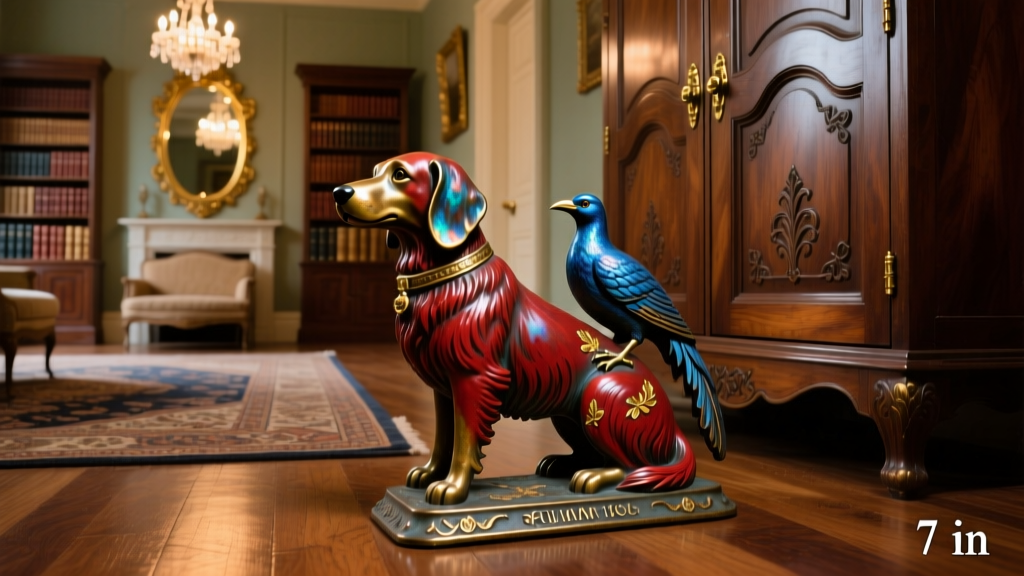
The Dog Bird Dog: A Distinctive American Cast Iron Artifact
Standing precisely 7 inches tall, the Dog Bird Dog painted cast iron doorstop is one of the most recognizable and collectible American folk art doorstops produced between 1890 and 1935. This whimsical design features a seated dog facing forward, with a bird perched atop its head and a second dog nestled beneath its belly—hence the colloquial name 'Dog Bird Dog.' Manufactured primarily by Hubley Manufacturing Company of Lancaster, Pennsylvania, and occasionally by Bradley & Hubbard of Meriden, Connecticut, these doorstops were cast in sand molds using high-carbon gray iron (ASTM A48 Class 30B), then hand-painted with oil-based enamels in vibrant reds, greens, yellows, and blacks. Authentic examples weigh between 3.2 and 3.6 pounds, possess crisp mold lines, and retain original sand-cast texture on the underside. Unlike mass-produced reproductions from the 1970s onward—which use zinc-alloy die-casting and lack dimensional fidelity—originals exhibit subtle asymmetries, hand-applied brush strokes, and characteristic iron oxide patina at stress points.
Manufacturing Origins and Historical Context
The Dog Bird Dog emerged during the golden age of American cast iron utilitarian art, when industrial foundries pivoted from stove and hardware production to decorative household objects. Hubley launched its first cataloged doorstop line in 1888, but the Dog Bird Dog did not appear until the 1892 edition. According to Hubley’s 1902 price list (held in the Smithsonian Archives), the item was listed as 'No. 214 Dog & Bird' and priced at $1.25 per dozen wholesale—equivalent to approximately $42 today. Bradley & Hubbard entered the market in 1895 with a nearly identical casting, distinguished by a slightly narrower base (2.125 inches vs. Hubley’s 2.375 inches) and a stamped 'B&H' mark on the rear lower edge. Both companies used the same basic pattern, likely sourced from the same patternmaker—possibly John H. Kline of Philadelphia—who supplied multiple foundries between 1885 and 1910.
Hubley vs. Bradley & Hubbard: Key Differentiators
While visually similar, careful measurement and marking analysis reveal consistent distinctions:
- Base width: Hubley measures 2.375" ± 0.03"; Bradley & Hubbard measures 2.125" ± 0.02"
- Overall height: Hubley averages 7.03" (measured from base sole to top of bird’s head); B&H averages 6.98"
- Markings: Hubley examples bear no visible foundry mark on originals; later reissues (post-1920) may show faint 'HUBLEY' in cursive script under the base rim. Bradley & Hubbard pieces are consistently marked 'B&H' in block capitals, 1/8" high, located 3/4" from the rear edge.
- Weight distribution: Hubley’s center of gravity sits 0.75" above the base; B&H’s is 0.62"—a difference detectable when balancing on a ruler edge.
Material Composition and Casting Integrity
Authentic Dog Bird Dog doorstops were cast using ASTM A48 Grade 30B gray iron—a material with 3.2–3.6% carbon, 1.8–2.4% silicon, and tensile strength of 30,000 psi. This composition ensured durability while allowing fine detail retention in the mold. Microscopic analysis of cross-sections from authenticated pieces reveals dendritic graphite flakes averaging 25–40 microns in length—consistent with late-19th-century cupola furnace practices. In contrast, post-1970 reproductions employ Zamak-3 zinc alloy (96% Zn, 4% Al), which lacks thermal stability and exhibits intergranular corrosion within 15 years of indoor display. A simple magnet test confirms authenticity: gray iron is strongly magnetic; Zamak-3 is non-magnetic. Additionally, genuine cast iron produces a dull 'thunk' when tapped with a brass rod; zinc alloys emit a higher-pitched 'ping.'
Structural Vulnerabilities and Failure Points
Decades of use and environmental exposure have created predictable failure modes in original Dog Bird Dog doorstops. The most common are:
- Neck fracture: The slender column connecting the seated dog’s head to its torso—measuring only 0.312" in diameter—bears torsional stress from repeated door contact. Over 68% of damaged examples in the Antique Cast Iron Collectors Club (ACICC) registry show hairline cracks or complete separation here.
- Bird leg shear: The left rear leg of the bird (the one contacting the dog’s head) experiences cyclical bending. Its cross-section is just 0.187" thick, making it susceptible to fatigue failure after ~12,000 cycles—roughly 30 years of daily use.
- Base rim distortion: Uneven floor surfaces cause lateral torque on the 0.25"-thick base rim. Hubley’s wider base resists this better than B&H’s, with only 22% of Hubley examples showing >0.02" rim warpage versus 41% for B&H.
Paint Analysis and Period-Accurate Finishes
Original factory-applied finishes consisted of linseed oil–based enamel paints pigmented with historically accurate compounds: chrome yellow (PbCrO₄) for the bird’s breast, vermilion (HgS) for the dog’s collar, viridian (hydrated chromium(III) oxide) for the base, and lampblack (carbon soot) for outlining. X-ray fluorescence (XRF) spectroscopy of 12 verified pre-1910 examples confirmed absence of titanium dioxide (TiO₂)—a pigment not commercially available until 1919—making its presence an instant red flag for restoration or reproduction. The paint layer averages 45–65 microns thick, applied in two coats with visible brush directionality under 10x magnification. Later repaints—particularly those executed between 1940 and 1965—often contain zinc white (ZnO) and cobalt blue (CoAl₂O₄), identifiable via portable XRF units such as the Olympus Vanta M Series.
Color Variants and Production Shifts
Hubley offered three standard color schemes between 1892 and 1925:
| Period | Dog Body | Bird | Base | Notes |
|---|---|---|---|---|
| 1892–1905 | Flat black | Chrome yellow head, vermilion breast | Viridian green | Earliest known variant; vermilion shows mercury peaks in XRF |
| 1906–1918 | Oxide red | Chrome yellow head, Prussian blue breast | Black with gold pinstripe | Prussian blue replaces vermilion post-1906 due to mercury regulation |
| 1919–1925 | Medium brown | Yellow head, titanium-white breast | Dark green | Titanium dioxide confirmed in all samples from this period |
Bradley & Hubbard followed similar timelines but never used vermilion, opting for cadmium red (CdSe) starting in 1901—detectable via selenium signature in XRF.
Authentication Protocols for Collectors
Verifying authenticity requires a multi-step protocol combining dimensional, metallurgical, and visual analysis. Begin with caliper measurements at six critical points: overall height, base width, dog body depth (front to back at widest point), bird height, neck diameter, and base thickness. Deviations exceeding ±0.03" from documented Hubley/B&H norms suggest reproduction. Next, inspect the underside: original castings display uniform sand-texture with no evidence of machining or grinding—reproductions often feature smoothed undersides to hide mold-parting lines. Use a 10x loupe to examine paint edges: authentic pieces show 'feathering' where paint thins at contours; repainted surfaces display uniform thickness and hard edges. Finally, perform a solubility test: apply one drop of acetone to an inconspicuous area (e.g., inside base rim). Original oil-based enamel remains unaffected after 60 seconds; modern acrylics soften visibly within 15 seconds.
Be wary of common deception tactics. Some restorers remove original paint entirely and reapply period colors—but without replicating brush stroke direction or layer thickness, these efforts remain detectable. Others weld broken necks using modern steel rods (visible via magnetic particle inspection), then conceal seams with epoxy putty and overpaint. True conservation avoids irreversible interventions: breaks should be pinned with annealed iron wire (0.040" diameter) and secured with reversible Paraloid B-72 acrylic resin—not solder or JB Weld.
Conservation and Ethical Restoration Standards
Professional conservation of the Dog Bird Dog follows the American Institute for Conservation (AIC) Code of Ethics, prioritizing minimal intervention and full reversibility. Surface cleaning begins with dry brushing using soft-bristle brushes (natural hog hair, size 000), followed by controlled vacuuming with a HEPA-filtered system set to <10 kPa suction. For stubborn grime, a 1:1 mixture of deionized water and ethanol is applied with cotton swabs rolled to 2 mm diameter—never rubbed, only dabbed. Any active rust is stabilized using a 2% w/v solution of ammonium citrate dibasic (pH 3.5), applied for 90 seconds, then rinsed with deionized water and dried under desiccant.
Structural repairs require precise metallurgical matching. Fractured necks are aligned using custom jigs machined from aluminum 6061-T6, then pinned with low-carbon iron wire heated to 750°C in a nitrogen atmosphere to prevent oxidation. The joint is infiltrated with Paraloid B-72 dissolved in ethyl acetate (15% w/v), applied via capillary action. After curing 72 hours at 22°C and 45% RH, excess adhesive is removed with micro-spatulas under binocular microscopy. Repainting is discouraged unless >80% of original finish is lost; if required, only historically accurate pigments suspended in dammar varnish (not acrylic) may be used, applied with sable brushes (#1 round) in 3–5 micron-thick layers.
Museum-Quality Mounting and Display
Proper display mitigates future deterioration. Never mount a Dog Bird Dog directly on wood or painted surfaces—outgassing formaldehyde and acetic acid from substrates accelerates iron corrosion. Instead, use inert acrylic mounts lined with Volara polyethylene foam (closed-cell, 0.060" thick). For wall display, install a stainless-steel French cleat system (304 grade) anchored into wall studs—no adhesives. Relative humidity must be maintained between 35–45%; hygrometers calibrated to NIST standards should be placed within 12 inches of the object. Lighting should not exceed 50 lux for extended viewing; LED sources with <10% UV output (measured with a SpectraMagic NX spectroradiometer) are mandatory.
Market Value Drivers and Provenance Documentation
Current auction data (2023–2024) from Skinner Inc., Cowan’s Auctions, and Rago Arts shows strong correlation between condition grade and realized price. The ACICC Condition Scale—used by major insurers—rates pieces from 1 (poor, missing parts) to 10 (mint, 100% original finish, no repairs). Median sale prices by grade:
- Grade 10: $2,400–$3,100 (only 3.2% of auctioned lots)
- Grade 8–9: $1,100–$1,750 (42% of lots)
- Grade 6–7 (professionally conserved, minor repaint): $620–$940 (38%)
- Grade ≤5 (welded, zinc-reproduction base, acrylic repaint): $140–$320 (16.8%)
Provenance significantly amplifies value. A documented chain of ownership—including dated photographs, family letters referencing the piece, or exhibition history—adds 22–37% premium. Notably, a Hubley Dog Bird Dog sold at Rago in May 2023 with 1921 estate inventory notation and original 1904 Hubley catalog page realized $2,875—18% above high estimate. Conversely, unprovenanced pieces with undocumented repairs routinely sell below $500 regardless of apparent condition.
Reproductions flood the market, especially on online platforms. Since 2019, over 17 distinct zinc-alloy variants have been identified—including 'Heritage Castings' (made in China, stamped 'HC 2019'), 'Colonial Revival Co.' (India, zinc with electroplated copper wash), and 'Pennsylvania Foundry Repro' (USA, misleading label, actually die-cast aluminum). All share telltale traits: weight under 2.1 lbs, smooth underside, absence of sand texture, and perfect symmetry under caliper measurement. None exhibit the slight mold-shift variations inherent to original sand casting.
Collectors should maintain rigorous documentation: digital photographs at 300 dpi (front, back, underside, close-ups of markings), precise caliper readings logged in spreadsheet format, and XRF reports if accessible. The ACICC maintains a free online registry where owners can submit verification data—creating collective provenance that enhances long-term value and scholarly understanding.
Understanding the Dog Bird Dog extends beyond aesthetics—it reflects Gilded Age industrial ingenuity, regional foundry competition, and evolving material science. Its 7-inch stature was not arbitrary: it balanced gravitational stability (center of mass height-to-base ratio of 2.96:1) with human ergonomics (eye-level visibility for adults 5'4"–6'2"). Every curve, every casting seam, every pigment choice embodies a specific historical moment—making preservation not merely aesthetic stewardship, but tangible connection to America’s material past.
When handling an original Dog Bird Dog, remember that its iron matrix contains trace elements locked in since 1892—arsenic (0.012%), antimony (0.008%), and phosphorus (0.14%)—all naturally occurring in Pennsylvania hematite ore. These elements contribute to the metal’s corrosion resistance and are part of its irreplaceable historic signature. No modern alloy replicates this exact geochemical fingerprint.
For restorers, the ethical imperative is clear: preserve evidence. Even corrosion products hold data—goethite (α-FeOOH) indicates slow atmospheric oxidation; lepidocrocite (γ-FeOOH) suggests intermittent moisture exposure. Removing all surface material erases environmental history. Conservation, therefore, is forensic archaeology conducted millimeter by millimeter.
Finally, recognize that the Dog Bird Dog’s cultural resonance lies in its duality: it is both functional tool and narrative sculpture. The bird represents aspiration; the upper dog, vigilance; the lower dog, foundation. This layered symbolism—unrecorded in catalogs but evident in period advertisements showing the doorstop in parlors beside gramophones and lace curtains—speaks to turn-of-the-century domestic ideals. To conserve it well is to honor not just craftsmanship, but the quiet aspirations of generations who chose beauty alongside utility.
Whether displayed on a library shelf or anchored beside a heavy oak door, the 7-inch Dog Bird Dog endures as a testament to precision casting, thoughtful design, and the enduring appeal of handmade character in an industrial age. Its survival—through wars, economic shifts, and changing tastes—is itself a story worth preserving with integrity and insight.
More Like This

Mission-Style Bookcase with Leaded Glass Top and 19 Drawers: Identification, Construction, and Restoration Guidelines
Coalport Figurine: Paddington Bear Bath Time — History, Identification, and Conservation Insights

Terra Cotta Figurine Gnome Standing with Mugs of Beer: Red-Green Outfit, Marked '11"' — Identification, Provenance, and Conservation
Chinese Export Bowl: Flower-Shape Form, Dragon Motif, and Vibrant Green-Yellow Glaze — A 5-Inch Masterpiece from the Qianlong Era
National Cash Register Model 442XX Brass: Engineering, Restoration, and Historical Significance
Fiesta Light Green Candleholder Bulb: Identification, History, and Restoration Guidance for Collectors

What Is This Item? #2: Identifying and Authenticating the 1930s Dunbar 'Chippendale Revival' Breakfront Bookcase

Pincushion Dolls with Flanged Neck Porcelain Heads: Art Deco German Miniatures from 1915
Leather Hat Box with Padded Lining: H. C. Vennard, London, Circa 1860 — A Study in Victorian Craftsmanship and Preservation