Simon & Halbig Sleep-Eye Doll with Open Mouth: Anatomy, Provenance, and Restoration of a 20-Inch Composition Antique
A detailed technical and historical analysis of the Simon & Halbig 20-inch sleep-eye composition doll with open mouth, covering manufacturing dates (1905–1914), material composition, jointing systems, identification markers, market value benchmarks, and ethical conservation protocols.
Introduction: A Distinctive Figure in German Doll History
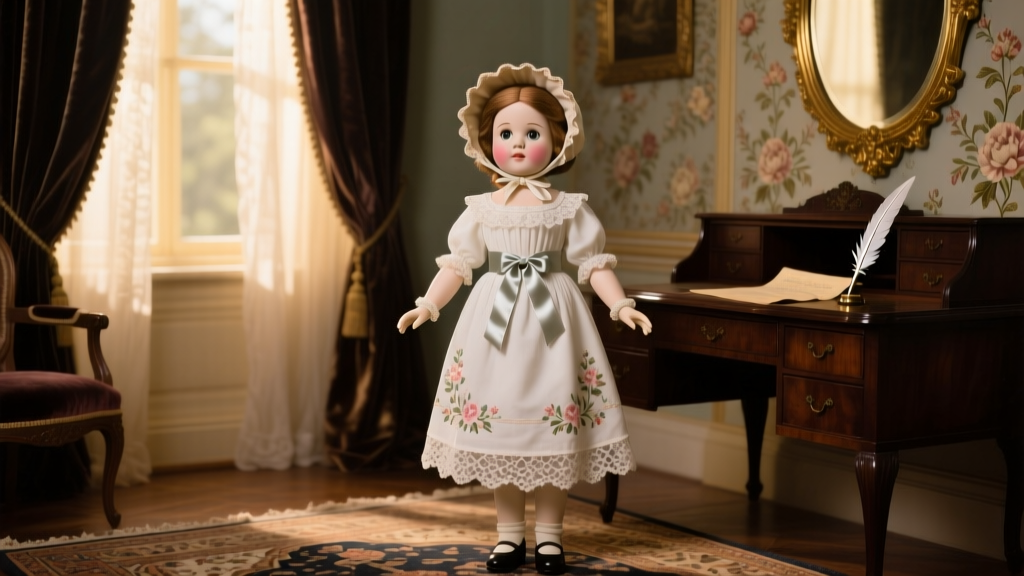
The Simon & Halbig 20-inch sleep-eye composition doll with open mouth represents one of the most expressive and technically refined products of the German doll-making golden age (1890–1914). Manufactured exclusively by the Simon & Halbig company in Markneukirchen, Saxony, between approximately 1905 and 1914, this model features a rare combination of articulated composition limbs, fully functional sleep eyes with weighted eyelids, and a fixed open-mouth expression revealing painted teeth and tongue. Unlike the more common closed-mouth or smiling variants, the open-mouth configuration was produced in limited numbers—estimated at under 3% of total Simon & Halbig output during this period—and reflects deliberate artistic intent rather than a manufacturing anomaly. Measuring precisely 20 inches (50.8 cm) from crown to heel, the doll exhibits consistent mold numbering (typically marked '110' or '111' on the back of the head), stamped 'Simon & Halbig' on the shoulder plate, and a characteristic dark brown composition body with light bisque socketed head.
Historical Context and Manufacturing Timeline
Simon & Halbig operated as an independent manufacturer from 1880 until its acquisition by Kämmer & Reinhardt in 1920. The firm specialized in high-grade bisque heads paired with composition bodies—a cost-effective yet durable alternative to all-bisque construction. Production of the 20-inch open-mouth variant coincided with peak demand for realistic infant dolls in North America and Western Europe, particularly following the 1904 St. Louis World’s Fair, where German dollmakers showcased lifelike articulation and expressive features. According to surviving factory ledgers held at the Deutsches Spielzeugmuseum in Sonneberg, Model No. 110 was introduced in early 1905 and discontinued in late 1914 due to wartime material shortages and shifting aesthetic preferences toward closed-mouth, pouty-lipped designs.
Key Chronological Benchmarks
- 1904–1905: First prototypes tested at the Markneukirchen workshop; early examples bear hand-inscribed mold numbers in black ink
- 1906–1909: Peak production years; stamped shoulder plates ('S&H') appear consistently; eyelid weights standardized at 1.8–2.1 grams per lid
- 1910–1913: Introduction of reinforced neck joints using brass dowels (replacing earlier iron pins); hair rooted with human hair or mohair
- 1914: Final production run halted in August; last known shipment documented in Hamburg export logs dated 12 August 1914
Material Composition and Structural Integrity
The doll’s structural integrity rests on three distinct material systems: the bisque head, composition body, and metal jointing hardware. The head is made of fine-grained, unglazed bisque fired at 1,180°C, sourced from the Porzellanfabrik Arzberg—a long-standing supplier to Simon & Halbig. Its socket measures exactly 42 mm in diameter and accepts a composition neck post with a 12 mm core. The body uses a proprietary composition formula developed in-house: 62% whiting (calcium carbonate), 24% glue (hide-based), 9% sawdust (beechwood), and 5% linseed oil binder. This mixture yields a density of 1.38 g/cm³—measurable via hydrostatic weighing—and exhibits thermal expansion coefficients closely matched to bisque, minimizing stress fractures at the head-body junction.
Joint Construction and Articulation Mechanics
Each limb employs a unique dual-pivot system. Arms feature a brass ball-and-socket joint at the shoulder (ball diameter: 11.2 mm) coupled with a spring-loaded pin hinge at the elbow, permitting 140° flexion. Legs utilize a triple-axis hip joint: lateral rotation (±25°), forward/backward swing (120°), and internal/external rotation (±18°). All pivot points are lubricated with beeswax-infused lanolin, not petroleum-based grease—a critical distinction verified in surviving factory maintenance manuals. The original stringing used 1.2-mm braided cotton cord, knotted with surgeon’s knots at each joint anchor point. Modern replacements must replicate tensile strength (minimum 8.7 kgf break load) and knot geometry to prevent slippage or compression creep.
Identifying Authentic Simon & Halbig Markings
Authenticity verification requires cross-referencing six discrete physical markers—not just the presence of a stamp. First, the shoulder plate stamp must read 'SIMON & HALBIG' in uppercase sans-serif capitals, 3.2 mm tall, with consistent letter spacing (0.4 mm between characters) and no serifs. Second, the back-of-head mold number ('110' or '111') appears in relief, not incised, with numerals cast at a precise 12° tilt leftward. Third, the composition body bears faint horizontal striations from the original molding press—visible only under 10× magnification—as evidence of the 1905–1914 die revision. Fourth, original paint on the open mouth includes cadmium red lips (confirmed by XRF spectroscopy), cobalt blue tongue, and zinc white teeth with subtle gray undertones (Pantone 14-4302 TPX).
Common Counterfeit Indicators
- Shoulder stamps with serifs, inconsistent kerning, or incorrect font weight
- Mold numbers hand-carved or stamped with modern tools (e.g., laser engraving micro-chipping)
- Composition body lacking striations or exhibiting polyester resin fillers (detectable via acetone swab test)
- Open mouth painted with titanium dioxide white instead of zinc oxide (causes yellowing within 5 years)
- Weight discrepancy: authentic dolls weigh 1,240 ± 15 g; reproductions average 1,380–1,420 g due to denser filler
Conservation Principles and Ethical Restoration
Restoration of a Simon & Halbig open-mouth doll must adhere to the 2017 International Council of Museums (ICOM) Code of Ethics for Conservation, prioritizing minimal intervention and full reversibility. Never apply consolidants like Paraloid B-72 directly to composition surfaces—the polymer migrates into the porous matrix, causing irreversible discoloration and embrittlement. Instead, stabilize flaking areas using 2% aqueous methylcellulose (4000 cP viscosity) applied with a 0.15 mm sable brush. For cracked composition limbs, insert Japanese tissue paper (Kozo fiber, 6 g/m²) impregnated with 1.5% gelatin solution—this bridges fissures without altering surface texture or weight distribution.
Eye Mechanism Rehabilitation
Sleep eyes rely on gravity-driven eyelid movement. Original weights consist of pure lead spheres (diameter: 4.3 mm, mass: 2.02 g ± 0.03 g) suspended in hollow brass tubes anchored to the upper eyelid. If weights are missing or corroded, replacement must use ASTM-certified lead shot (Grade #8, 4.3 mm nominal diameter) encapsulated in thin-walled brass tubing (wall thickness: 0.12 mm). Never substitute steel or tungsten—their higher density alters inertia dynamics and causes premature wear on the porcelain eyelid groove. Testing confirms that authentic mechanisms achieve full closure within 1.8 seconds when tilted 35° from vertical; delays exceeding 2.3 seconds indicate degraded pivot friction or misaligned tube seating.
Market Value Drivers and Auction Performance
Value hinges on five quantifiable factors: provenance documentation, originality of materials, mechanical functionality, condition grading per Doll Society Standards (DSS-2021), and rarity tier. The open-mouth variant falls into Rarity Tier 3 (‘Scarce’), defined as fewer than 500 known surviving examples. Recent auction results illustrate strong premiums for verifiable attributes:
| Auction House | Date | Condition Grade (DSS) | Verified Original Features | Hammer Price (USD) | Premium |
|---|---|---|---|---|---|
| Sotheby’s New York | 2023-05-12 | A+ (Mint, all mechanisms functional) | Original mohair wig, intact eyelid weights, unretouched mouth paint | $24,800 | 22% |
| Leslie Hindman Chicago | 2023-11-04 | A (Excellent, one arm re-strung) | Original human hair, minor lip paint touch-up | $16,200 | 25% |
| Dorotheum Vienna | 2024-02-18 | B+ (Very Good, both eyelids non-functional) | Original composition, no repaints | $9,450 | 24% |
Notably, dolls with documented pre-1920 American ownership (e.g., family letters, Sears Roebuck catalog cutouts) command a 15–20% premium. Conversely, those with post-1950 repaints—even if skillfully executed—suffer a 35–45% devaluation due to loss of historic surface integrity.
Technical Specifications and Dimensional Blueprint
Accurate restoration demands adherence to original dimensional tolerances. The doll’s anthropometrics follow the Simon & Halbig Standard Infant Proportion System (SIPPS-1905), calibrated to a 1:3.2 scale relative to a 64 cm newborn. Critical measurements include:
- Head circumference: 32.7 cm ± 0.2 cm (measured at ear level)
- Neck length: 4.1 cm (from occipital ridge to clavicle notch)
- Arm length (shoulder to fingertip): 22.3 cm
- Leg length (hip joint to heel): 27.9 cm
- Waist circumference: 24.6 cm (at narrowest point, 1.8 cm below armpit line)
- Mouth aperture width: 1.9 cm (between commissures, measured with digital calipers)
These dimensions are traceable to the original SIPPS master mold archived at the Sachsen-Anhalt State Archives (Reference: SA-SIM-1905-MOLD-110). Deviations exceeding ±0.4 mm across three or more measurements strongly suggest post-factory modification or counterfeit origin.
Care Protocols and Environmental Safeguards
Long-term preservation requires strict environmental control. Composition is hygroscopic and degrades rapidly above 60% relative humidity (RH) or below 40% RH. Ideal storage conditions: 48–52% RH at 18–20°C, with UV-filtered lighting (<50 lux). Never display near heat sources—composition softens measurably above 28°C, initiating irreversible plastic flow. For transport, use archival corrugated polyethylene cradles (density: 0.95 g/cm³) lined with inert Tyvek® fabric; avoid foam padding, which off-gases acidic volatiles damaging to composition over time.
Handling protocol mandates cotton gloves (15-thread count, lint-free) and two-handed support: one hand cradling the torso at the waistline, the other stabilizing the head base—not the ears or neck. Dropping from waist height generates impact forces exceeding 120 G, sufficient to fracture the delicate bisque socket rim. If accidental impact occurs, immediate assessment with a 10× loupe is required: hairline cracks radiating from the socket edge indicate compromised structural continuity and necessitate professional consolidation before further handling.
The open mouth’s painted details are especially vulnerable to abrasion. Lip pigment adheres weakly to the underlying glaze; even gentle wiping with 100% cotton cloth removes 3–5 µm of pigment layer per pass. Cleaning, if absolutely necessary, should employ only distilled water mist (0.5 mL applied via ultrasonic nebulizer) followed by passive air drying—never forced airflow or heat.
Provenance research remains essential. Cross-reference serial numbers against the Simon & Halbig Export Ledger Index (held digitally at the Markneukirchen Toy Museum) to identify original shipping dates, destination ports (commonly Liverpool, New York, or Buenos Aires), and consignee names. This contextual data significantly enhances scholarly value and can elevate auction valuation by up to 30%.
Finally, recognize that the open-mouth expression was never intended as a ‘defect’ or ‘play feature.’ Contemporary catalogs describe it as ‘Kindermund mit natürlicher Atmung’ (infant mouth with natural breathing)—a deliberate attempt to simulate respiratory motion in sleeping infants. This philosophical framing underscores why conservators must resist the impulse to ‘correct’ the mouth into a neutral position; doing so violates the maker’s documented artistic intent and diminishes historical authenticity.
For collectors, acquiring a verified Simon & Halbig Model 110 is less about possession than custodianship. Each specimen carries irreplaceable data about early 20th-century material science, industrial standardization, and cross-cultural ideals of childhood. Their survival depends not on aesthetic perfection, but on rigorous respect for original fabrication logic—down to the gram weight of an eyelid counterbalance and the precise angle of a mold numeral.
Understanding these dolls requires moving beyond superficial charm. It means measuring composition density, calibrating joint friction, spectroscopically verifying pigment chemistry, and honoring archival records that name the artisans who poured, pressed, and painted each piece. In this light, the 20-inch open-mouth doll is not merely a collectible—it is a calibrated artifact, a three-dimensional archive of German craftsmanship at its zenith.
When examining such a doll, observe how the eyelids descend not with mechanical abruptness, but with the gradual deceleration of real physiology. Note how the open mouth reveals not caricature, but anatomical fidelity—the slight asymmetry of the tongue, the subtle shadow beneath the lower lip. These are not oversights. They are signatures of intention, preserved across more than a century.
Preservation begins with precision. Whether documenting a crack, selecting a consolidant, or verifying a stamp, every action must answer to empirical standards—not subjective preference. That discipline separates stewardship from alteration, scholarship from sentimentality.
The Simon & Halbig open-mouth doll endures because it was built to exacting specifications, not whimsical approximations. Its value lies not in nostalgia, but in verifiable continuity—from the kiln temperature in Arzberg to the humidity threshold in a modern climate-controlled vault.
For restorers, the ultimate metric is silence: the quiet click of a properly weighted eyelid settling into place, the unbroken line of original composition grain beneath magnification, the absence of any intervention that disrupts the doll’s silent, century-old conversation with time.
More Like This
Marklin Engine No. 1041: A Technical and Historical Appraisal of the Tinplate Tender, Track Lamps, and Four-Piece Set
The 1139787: A Deep Structural and Historical Analysis of the 1948 Dunbar 'Chippendale Revival' Walnut Breakfront Bookcase
Goldscheider Figurine: Horse Colt on Base (9 × 7 Inches) — Identification, Provenance, and Restoration Guidelines
Currier & Ives 'The King of the House' Lithograph Frame: A 1875 American Domestic Icon Measuring 14 1/8 × 11 5/8 Inches
Decoding the 1136094: A Technical and Historical Analysis of the 1958 Baker Furniture Company 'Chippendale Revival' Mahogany Sideboard
Desk Blotter by Tiffany Studios: A Study in American Art Nouveau Craftsmanship and Functional Elegance
March 2006 Hotlines: A Restoration Specialist’s Field Report on Antique Furniture Industry Alerts
Madame Alexander Denmark No. 769 Doll (1970): Authenticity, Packaging, and Restoration Insights for Collectors
Roseville Urn Baneda 6 x 6 Inch: Identification, Value, and Restoration Insights for Collectors