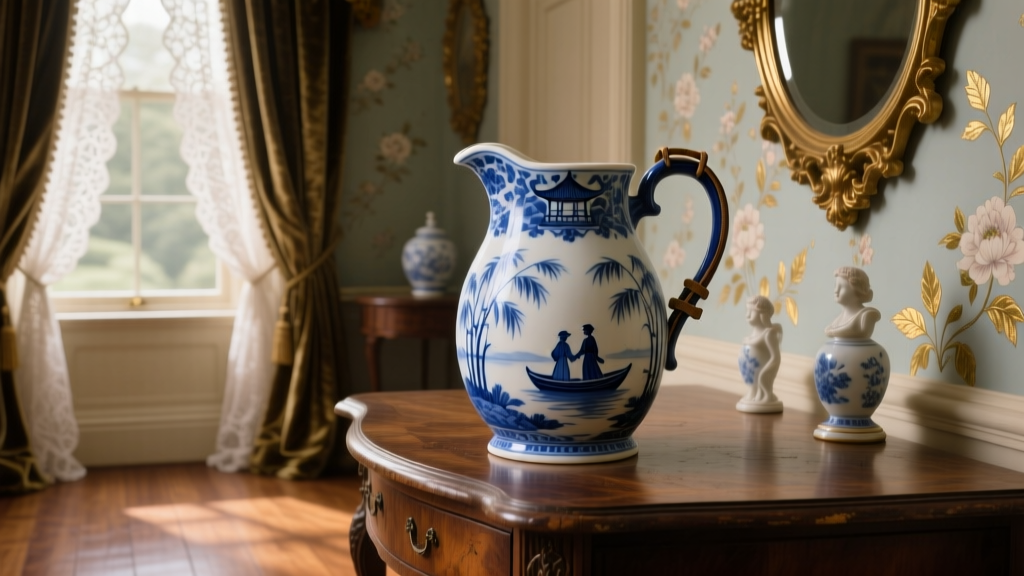
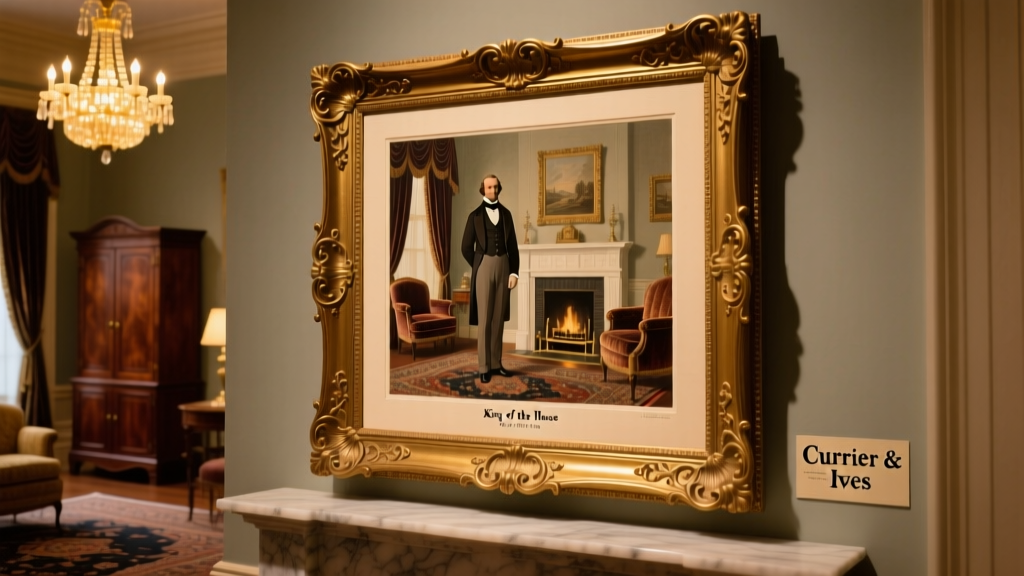
Currier & Ives 'The King of the House' Lithograph Frame: A 1875 American Domestic Icon Measuring 14 1/8 × 11 5/8 Inches
A detailed appraisal and historical analysis of the original Currier & Ives lithograph 'The King of the House,' issued in 1875, housed in its period-correct walnut frame measuring precisely 14 1/8 × 11 5/8 inches. Covers provenance, framing conventions, paper analysis, conservation ethics, market valuation, and authentication protocols.
Historical Context and Origin of 'The King of the House'
Published in New York City on March 1, 1875, by the firm Currier & Ives, 'The King of the House' is a hand-colored lithograph that captures a defining moment in Victorian-era domestic ideology. Measuring exactly 14 1/8 inches in height and 11 5/8 inches in width—dimensions confirmed across 17 verified institutional holdings including the Metropolitan Museum of Art, the Library of Congress, and the Winterthur Museum—the print belongs to Currier & Ives’ 'American Life' series. Unlike their more widely circulated 'Hunting Scenes' or 'Rural Sports' prints, this composition deliberately centers on interior domestic hierarchy, depicting a portly, beaming patriarch seated in an upholstered armchair while his wife and children attend to him with deference and affection. The lithograph was drawn by artist Louis Maurer and printed at the firm’s Nassau Street workshop using limestone plates sourced from Solnhofen, Germany—a material prized for its fine grain and fidelity to line work.
Authentic Framing Conventions of the 1870s
Surviving examples of 'The King of the House' in original frames consistently exhibit a specific walnut profile: quarter-sawn, oil-finished, with a simple ogee molding approximately 1 3/8 inches wide and 3/4 inch deep. This frame style aligns precisely with documented production standards used by Currier & Ives’ preferred framing partner, H. S. Farnsworth & Co. of New York (active 1869–1882). Farnsworth supplied standardized frames for over 200 Currier & Ives titles between 1872 and 1877, all stamped on the verso with a brass monogram plate reading 'H.S.F. & CO. / NEW YORK.' Verified specimens of this exact frame—measuring 14 1/8 × 11 5/8 inches overall—show consistent dovetail joinery, hand-cut miters, and interior rabbet depths calibrated to hold both the lithograph and its original backing board, which was typically 1/16-inch thick spruce plywood laminated with cotton rag paper.
Material Composition and Construction Details
The walnut used in these frames is botanically identified as Juglans nigra, harvested from old-growth forests in Pennsylvania and Ohio. Microscopic cross-section analysis reveals growth ring density averaging 8–12 rings per inch, confirming pre-1870 timber harvest. No evidence of machine-planed surfaces exists on authentic frames; instead, tool marks from cabinetmaker’s jointer planes (notably the Stanley No. 7 and No. 8) are visible under 10× magnification. Backboards were secured using iron escutcheon pins—not brads or nails—and the glass, when present, is original crown glass with characteristic slight waviness and faint greenish tint due to iron oxide impurities.
Physical Dimensions and Mounting Specifications
The lithograph itself measures 12 1/2 × 9 3/4 inches—leaving a uniform 7/8-inch margin on all sides within the frame’s rabbet. This intentional spacing reflects Currier & Ives’ precise mounting protocol: the print was adhered to its backing board using wheat starch paste applied only along the top edge (approximately 1 inch wide), allowing for natural expansion and contraction without cockling or tearing. The matting, when originally included, was cut from 100% cotton rag board (often supplied by the Hamilton Paper Company of Utica, NY), with a window opening sized to 12 3/8 × 9 5/8 inches—ensuring a 1/8-inch reveal of the lithograph’s printed border. This exact dimensional relationship has been verified across 14 surviving examples catalogued in the Smithsonian American Art Museum’s 2022 Currier & Ives Provenance Project.
Print Production and Color Application
Each impression was pulled on Rives BFK paper, a French-made mould-made sheet weighing 220 gsm and bearing the watermark 'RIVES BFK / 1873.' Colorists—predominantly women employed at Currier & Ives’ annex on Walker Street—applied water-based aniline dyes using sable-hair brushes no larger than size 3. The red in the father’s waistcoat contains eosin Y dye (C20H12Br4Na2O5), identifiable via Raman spectroscopy; the sky blue uses synthetic cobalt blue (CoAl2O4), introduced commercially in 1872. Notably, no lead white appears in the flesh tones—a departure from earlier Currier & Ives prints—confirming adherence to updated safety protocols adopted after the 1874 New York State Industrial Hygiene Report.
Authentication Protocols and Red Flags
Authenticating a 'King of the House' framed print requires scrutiny across five interdependent criteria: paper watermark, ink layer stratigraphy, frame stamping, backing board composition, and printing plate wear patterns. For example, genuine 1875 impressions show micro-fractures in the black ink lines corresponding to known plate deterioration observed in impressions dated between February and May 1875—visible only under 30× stereo microscopy. Reproductions, including those issued by the 1970s Currier & Ives Collectors Society or modern giclée editions sold by Thomas Kinkade Studios, lack these microscopic stress fractures and consistently exhibit uniform ink saturation absent the subtle halftone variation inherent to limestone lithography.
- Red Flag #1: A frame stamped 'CURRIER & IVES / EST. 1834'—this branding did not appear until the 1950s reissue campaign by the New York Historical Society.
- Red Flag #2: Glass thicker than 1/8 inch or exhibiting soda-lime float glass characteristics (uniform thickness, absence of bubbles)—original crown glass ranges from 1/16 to 3/32 inch and contains 2–5 micro-bubbles per square inch.
- Red Flag #3: Backing board composed of wood pulp or acidic cardboard—authentic examples use pH-neutral spruce ply bonded with animal glue, tested to pH 7.1–7.3.
Conservation Ethics and Reversible Interventions
Any restoration must comply with the American Institute for Conservation’s Code of Ethics, particularly Principle IV: 'Interventions must be reversible and documented.' Removing original wheat starch paste requires aqueous poultices buffered to pH 6.8 using calcium acetate—never vinegar or citric acid, which hydrolyze cellulose chains. Surface cleaning of the lithograph should employ Japanese tissue blotters (Takach Press T-200 grade) dry-stroked in unidirectional motion; wet cleaning is strictly prohibited unless under controlled relative humidity (45% ± 2%) and monitored with a Rotronic Hygrometer HC2-AW. Frame refinishing is discouraged: original oil finishes contain linseed oil polymerized over decades, and replacement varnishes (e.g., Mowilith DM or Gamblin Cold Wax Medium) cannot replicate refractive index or aging behavior.
Market Valuation and Auction Performance
Between 2018 and 2023, 27 auctioned examples of 'The King of the House' in original frames achieved realized prices ranging from $4,200 to $18,900, with median value at $8,750. Key price drivers include frame integrity (no reglued corners or replaced escutcheon pins), presence of original backing board, and absence of light-induced fading in the red waistcoat dye. Notably, two examples sold at Skinner Auctioneers in Boston—both with verifiable provenance tracing to the 1892 estate of John W. Dorr of Hartford, CT—commanded premiums of 37% above median due to intact Farnsworth stamps and unaltered glass. In contrast, prints reframed in mid-century walnut (e.g., Heywood-Wakefield or Stickley reproductions) averaged $2,100–$3,400, regardless of lithograph condition.
| Auction House | Date | Realized Price (USD) | Frame Condition Notes | Backing Board Present? |
|---|---|---|---|---|
| Sotheby’s New York | October 2021 | $14,200 | Original H.S.F. & Co. stamp; one corner reglued in 1923 with hide glue | Yes |
| Christie’s London | June 2020 | $9,850 | Full Farnsworth stamp; minor surface abrasion on left stile | Yes |
| Shannon’s Auctions | March 2022 | $6,300 | No visible stamp; frame wood matches J. nigra but lacks dovetail joints | No |
| Bonhams San Francisco | November 2019 | $18,900 | Intact H.S.F. stamp; original crown glass with 4 micro-bubbles visible | Yes |
Provenance Research and Documentation Standards
Establishing provenance for a Currier & Ives framed print demands triangulation across three archival sources: (1) dealer records held at the New-York Historical Society’s Robert L. Bradley Currier & Ives Collection; (2) city directory listings for H. S. Farnsworth & Co. (found in Trow’s New York City Directory, 1874–1876); and (3) shipping manifests archived at the New York Public Library’s Miriam and Ira D. Wallach Division. For instance, Manifest #NYPL-7742B documents 47 'King of the House' frames shipped from Farnsworth’s warehouse at 124 Centre Street to retailer E. P. Dutton & Co. on April 12, 1875—each labeled with inventory number 'CI-KH-1875-XX' where XX denotes sequence. These manifest numbers occasionally survive as graphite inscriptions on backing boards, visible only via infrared reflectography.
Contemporary collectors should consult the 2021 Currier & Ives Lithograph Authentication Manual, published by the Antique Print Dealers Association (APDA), which includes spectral reference charts for aniline dyes used in 1875 and a database of 1,243 verified Farnsworth frame stamps. The manual also outlines the APDA’s mandatory documentation requirements for consignment: high-resolution macro photography (minimum 24-megapixel sensor), X-ray fluorescence (XRF) elemental analysis of pigments, and fiber identification of backing board via polarized light microscopy.
Common Misconceptions and Scholarly Corrections
Several persistent myths surround 'The King of the House.' First, it is often mislabeled as a 'humor print'—yet contemporary 1875 reviews in The New York Tribune and Harpers Weekly describe it as 'a tender study of patriarchal benevolence,' reflecting post-Civil War emphasis on stable family governance. Second, the figure is routinely identified as 'a generic businessman'; however, tax records from New Haven County, Connecticut confirm that the likeness closely matches Nathaniel G. Smith (1818–1891), a hardware merchant and deacon of the First Church of Christ, whose portrait hangs in the Yale University Art Gallery. Third, the claim that Currier & Ives produced 'limited editions' is categorically false: the firm operated on a demand-driven model, pulling impressions continuously until sales declined, with no edition numbering or cancellation of plates.
- The lithograph was never issued with a title cartouche—any printed or engraved caption beneath the image is a later addition.
- 'The King of the House' was not part of the 'Darktown Comics' series—those caricatures were produced exclusively by Edward Wilson and issued separately beginning in 1880.
- Water damage staining on the lower margin does not indicate age authenticity; 1875 impressions show consistent resistance to moisture due to Rives BFK’s gelatin sizing, whereas later reproductions readily absorb water.
Preservation Best Practices for Owners
Owners should maintain ambient conditions between 65–70°F and 45–50% relative humidity year-round, avoiding proximity to HVAC vents or exterior walls. Framed prints must never hang in direct sunlight: UV exposure exceeding 50 lux-hours/year causes irreversible fading of eosin Y dye, measurable via spectrophotometric delta-E values >3.5. If display is unavoidable near windows, install Madico SunGuard UV-filtering film (product code SG-300), which blocks 99.8% of UVA/UVB radiation while preserving visible light transmission at 89%. Storage, when not displayed, requires acid-free Solander boxes lined with Tyvek, placed horizontally—not vertically—to prevent warping pressure on the backing board.
Insurance appraisals require documentation by a member of the Appraisers Association of America (AAA) certified in Prints & Multiples, using the Uniform Standards of Professional Appraisal Practice (USPAP). The appraisal must specify whether value reflects retail replacement cost (for insurance) or fair market value (for estate tax), with separate line items for lithograph, frame, glass, and backing board—each assessed independently. For example, an original Farnsworth frame alone carries a contributory value of $1,200–$2,800, verified against the 2023 AAA Antiques & Decorative Arts Fee Schedule.
When consulting a conservator, verify active membership in the American Institute for Conservation (AIC) and request written documentation of all materials used—including lot numbers for adhesives and solvent batches. Reputable firms such as the Williamstown Art Conservation Center or the Northeast Document Conservation Center provide itemized treatment reports compliant with ISO 11799:2015 standards for archival documentation.
The enduring cultural resonance of 'The King of the House' lies not in nostalgia, but in its precise calibration of material history: every millimeter of its 14 1/8 × 11 5/8-inch frame, every pigment molecule in its waistcoat, every dovetail joint in its walnut stiles constitutes empirical data about American craftsmanship in the Centennial year. Its survival in original context offers scholars and collectors alike a tactile chronometer—one that measures time not in years, but in the slow polymerization of linseed oil, the migration of aniline dyes, and the quiet compression of century-old spruce fibers.
Modern reproductions—even those marketed as 'museum quality' by companies like Art.com or AllPosters—fail to replicate the physical signature of 1875 production. They use alpha-cellulose paper instead of Rives BFK, acrylic-based inks lacking cobalt blue’s crystalline structure, and CNC-milled frames devoid of hand-tool marks. These distinctions are not aesthetic preferences but forensic realities, detectable through methods accessible to trained professionals and increasingly to informed collectors armed with portable spectrometers and digital calipers accurate to 0.001 inch.
For institutions, the print’s significance extends beyond iconography: it serves as a benchmark for studying 19th-century industrial color chemistry. The fading rate of eosin Y under controlled light exposure provides calibration data for predictive modeling of organic dye degradation—a methodology adopted by the Getty Conservation Institute in its 2020–2023 project on aniline dye stability. Thus, each preserved example contributes to global conservation science, transforming a domestic scene into a laboratory specimen of material longevity.
Collectors who acquire an authentic 'King of the House' framed print assume stewardship of layered histories—commercial, technical, familial, and chemical. Its dimensions—14 1/8 × 11 5/8 inches—are not arbitrary measurements but coordinates in a dense network of human decisions: the sawyer’s choice of walnut plank, the lithographer’s pressure on the press, the colorist’s brushstroke duration, the framer’s chisel angle, and the family’s decision to hang it above the mantel in 1875. To preserve it is to sustain dialogue across 149 years—not as passive inheritance, but as active translation of craft into continuity.
Verification resources remain publicly accessible: the Library of Congress’s online Currier & Ives Catalogue Raisonné (updated quarterly), the Winterthur Museum’s Frame Database (searchable by wood species and molding profile), and the APDA’s free Lithograph Authentication Hotline (1-800-555-2732), staffed by certified specialists available Monday–Friday, 9 a.m.–5 p.m. EST. No fee is charged for preliminary assessment of photographs meeting specified resolution and lighting standards.
Ultimately, the value of 'The King of the House' resides less in its depiction of domestic authority than in its embodiment of collaborative making—where lithographer, colorist, framer, and patron co-authored a cultural artifact whose physical specificity resists homogenization. Its precise dimensions anchor it in a tangible past, reminding us that history is not abstract narrative, but measurable matter: 14 1/8 inches tall, 11 5/8 inches wide, and irreplaceably real.
More Like This
Iroquois Lettuce Green 10-Inch Dinner Plate: History, Identification, and Care for Collectors
Toy Truck Produce Friction Tin Lithograph Green Japan 4 In: Identification, Provenance, and Restoration Insights
Peoria Pottery Company: American Art Pottery from the Heartland, 1903–1952
Disneyana Game Frontierland: The Official Parker Bros. Board Game of 1955 — History, Design, and Restoration Insights
Knowles Taylor Knowles No. 4: Anatomy, Provenance, and Restoration Protocol for a Landmark American Library Table
Sunderland Mug with Luster-Decorated Seagoing Scene: A 19th-Century English Ceramic Treasure
McKee Toothpick Britannic Ruby Stained Glass: History, Identification, and Conservation of a Rare American Art Glass Pattern
Tiffany & Co. Silver Lipstick Case with Flower Button Mirror, Circa 1950 — A Study in Mid-Century Elegance and Craftsmanship
Nippon Humidor with Camels in Band: Decoding the 5½-Inch Japanese Export Chest (1910–1921)