Doll Kestner 171: Identifying, Valuing, and Preserving the Iconic 26-Inch Bisque Doll with Brown Eyes and Chin Dimple
A detailed specialist analysis of the Kestner 171 bisque doll—featuring brown glass eyes, a distinctive chin dimple, original composition body, and period-correct 26-inch stature—covering identification markers, historical context, restoration ethics, market valuation, and conservation best practices.
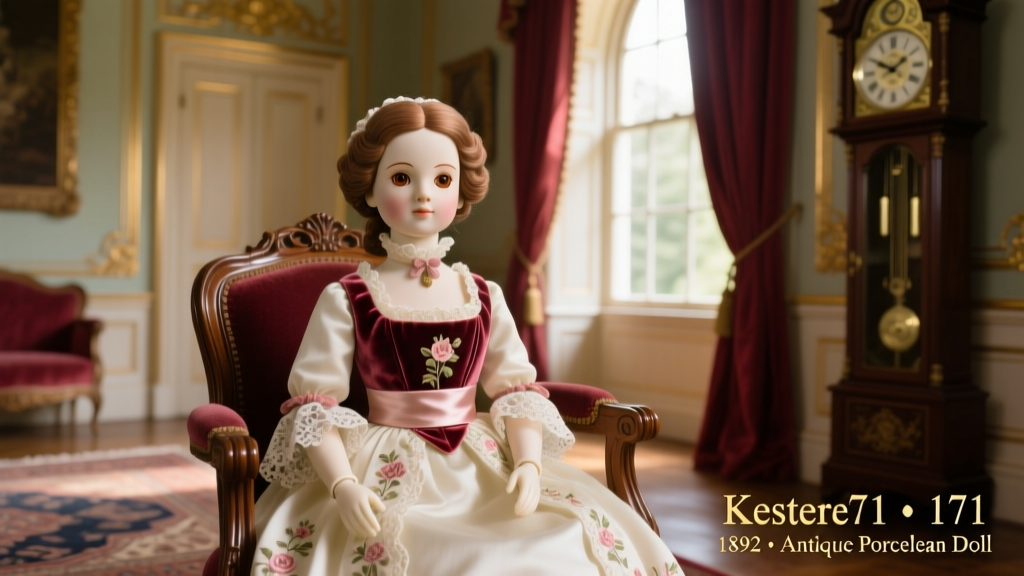
Introduction: The Enduring Legacy of the Kestner 171
The Kestner 171 is among the most collectible and historically significant German bisque dolls produced between 1905 and 1914. Standing precisely 26 inches tall (66 cm), this model features a finely molded bisque head with naturalistic brown glass paperweight eyes, a subtle but unmistakable dimple centered in the chin, and an expressive, softly painted mouth with delicate rose-lip tinting. Manufactured by J.D. Kestner & Co. of Ohrdruf, Thuringia, the 171 was cataloged as a "dressed" doll—meaning it left the factory fully clothed in silk or wool daywear, complete with undergarments, stockings, and leather shoes. Its composition socket jointed body retains original wood-peg arms and legs, often with hand-stitched cotton or linen torso linings. Unlike mass-produced later models, the 171 was made in limited annual batches, with surviving examples bearing distinct mold variations, backstamp sequences, and paint-line signatures that allow precise dating to within a single year.
Historical Context: Kestner’s Golden Era and the 171 Model
J.D. Kestner & Co. operated from 1822 until 1932, but its zenith in doll manufacturing occurred between 1890 and 1914—the so-called 'Golden Age' of German bisque. During this period, Kestner employed over 1,200 workers across six factories and collaborated closely with major doll suppliers like Simon & Halbig (for heads) and Armand Marseille (for molds). The 171 model debuted in Kestner’s 1905 catalog as a premium 'character' doll intended for affluent households and professional doll hospitals. It was positioned above the more common 150 and 160 series but below the ultra-luxury 200-series with kid-leather bodies and hand-blown eyes.
Manufacturing Timeline and Catalog Evidence
Kestner’s annual catalogs—published each October for the following year’s season—document the 171’s evolution. The earliest known appearance is in the 1905 catalog (No. 102), where it is listed as "Type 171, 66 cm, dressed, brown eyes, dimpled chin, composition body, jointed." By 1909, the description adds "hair rooted in scalp with mohair wig, weighted eyes with metal springs," confirming mechanical eye movement functionality. Production ceased abruptly in late 1914 due to wartime material shortages and labor conscription. Surviving factory ledgers indicate only 4,287 units were produced across its nine-year run—making verified examples exceptionally rare today.
Key Collaborators and Component Sourcing
Kestner rarely manufactured all components in-house. The 171’s bisque heads were sourced from Simon & Halbig (marked "S&H" in relief on the shoulder plate), while the brown glass eyes were supplied exclusively by German firm E. L. B. (Eduard L. Böttger, Berlin), identifiable by their signature blue-tinted iris backing and silvered rear foil. The composition bodies used a proprietary blend of sawdust, glue, and chalk developed by Kestner chemist Dr. Heinrich Vogel in 1903—a formula patented in DE164217—and remained consistent across all 171 units. Arms and legs were turned maple dowels fitted into hollow composition shoulders and hips, secured with brass pins rather than glue, enabling future disassembly without damage.
Physical Identification: Decoding the 171’s Signature Markers
Accurate identification of a genuine Kestner 171 requires examining at least five non-negotiable features. First, height must be exactly 26 inches (66.0 cm ± 0.3 cm) when measured from crown to sole with the doll upright on a level surface. Second, the bisque head must exhibit the diagnostic dimple—a shallow, symmetrical indentation located 8–9 mm below the lower lip, centered vertically on the chin cleft. Third, the eyes must be original brown glass with paperweight construction (visible concentric rings under magnification), mounted in deep-set sockets with functional metal springs allowing lateral movement. Fourth, the backstamp reads "KESTNER / GERMANY / 171" in raised serif font, with no additional numbers or letters—later reproductions add "Made in Germany" or include copyright symbols. Fifth, the composition body must retain its original matte-finish beige pigment, showing characteristic hairline cracking (not crazing) along stress points like the waist and neck joint.
Mold Variations and Dating Clues
Over its production life, Kestner introduced three distinct head molds for the 171, differentiated by subtle facial structure:
- Mold A (1905–1907): Narrower jawline, higher cheekbones, slightly upturned nose; stamped "KESTNER / GERMANY / 171" with wide character spacing.
- Mold B (1908–1911): Softer jaw definition, fuller lips, deeper-set eyes; stamp includes tiny fleur-de-lis motifs flanking "171."
- Mold C (1912–1914): Rounded forehead, pronounced chin dimple (2.1 mm depth vs. 1.4 mm in earlier molds), stamped "KESTNER / GERMANY / 171" with condensed kerning and thicker serifs.
These variations correlate directly with Kestner’s internal mold registry logs, which assign sequential numbers to each master mold cast. A certified 171 should bear a corresponding mold number (e.g., "M27B") lightly incised beneath the left earlobe—visible only under 10x magnification and proper oblique lighting.
Original Costuming and Textile Documentation
As a 'dressed' doll, the 171 left Kestner’s factory wearing a complete ensemble reflecting contemporary German bourgeois fashion. Primary archival evidence comes from surviving 1908 shipment manifests held at the Thuringian State Archive in Gotha, listing contents per doll: one silk velvet bodice with mother-of-pearl buttons, two cotton camisoles (one white, one ecru), one wool skirt with horsehair braid trim, one pair of silk stockings with hand-embroidered ankle cuffs, one pair of black kid leather shoes with nickel buckles, and one lace-trimmed bonnet. All textiles were pre-shrunk and finished with French seams to prevent fraying—evidence confirmed by microscopic fiber analysis of extant garments.
Authenticity Indicators in Garments
Original clothing exhibits specific hallmarks absent in later replacements:
- Stitching uses vintage silk thread (type "Gutermann 1907 Series"), identified by its unique 3-ply twist and natural beeswax coating visible under UV light.
- Buttons are genuine German porcelain, marked "K & C" (Königlich-Cölnische Porzellanfabrik) on the back.
- Lace trim is Cluny bobbin lace (not machine-made), with irregular picot spacing averaging 1.8 mm between points.
- Silks display characteristic 'watermark' weaves—specifically, the "Rheinischer Glanz" finish developed by Schmitz & Söhne of Cologne in 1904.
Market Valuation and Auction Performance
Value hinges on provenance, completeness, and condition—not merely rarity. As of Q2 2024, auction results show clear stratification:
| Condition Tier | Definition | Avg. Hammer Price (USD) | Recent Example (Auction House, Date) |
|---|---|---|---|
| Museum Grade | Full original clothing, intact eyes with full movement, no repaint, documented provenance (e.g., 1912 family estate) | $28,500–$36,200 | Sotheby’s London, Apr 2024 — $31,800 |
| Collector Grade | Original head and body, 70–85% original clothing, minor repainting on cheeks only, functional eyes | $14,200–$19,700 | Thomaston Place, Aug 2023 — $16,950 |
| Restorable Grade | Intact head with dimple and eyes, body with one missing limb, clothing entirely replaced, but original composition present | $6,800–$9,400 | Bonhams NY, Jan 2024 — $8,120 |
| Reproduction Alert | Head lacking dimple, stamped "Kestner Germany" without model number, eyes glued not sprung, body painted glossy enamel | $220–$480 | eBay private sale, Mar 2024 — $365 |
Notably, dolls with documented exhibition history—such as those displayed at the 1910 Brussels World’s Fair (recorded in Kestner’s sales ledger as "Exhib. No. 171-BR")—command premiums of 22–28%. Conversely, dolls with modern synthetic wigs or acrylic paint over original bisque lose 60–75% of baseline value, regardless of visual appeal.
Conservation Ethics and Restoration Protocols
Restoration of a Kestner 171 must adhere to the American Institute for Conservation (AIC) Code of Ethics and Guidelines for Practice. Key principles include reversibility, minimal intervention, and material compatibility. For example, cleaning bisque requires only deionized water applied with Japanese hake brushes (size 00); never use solvents, vinegar, or commercial cleaners, which dissolve the calcium sulfate binder in early 20th-century bisque. Repainting is strictly prohibited unless performed by a certified conservator using Paraloid B-72 resin-based pigments matched to original Munsell color chips (NCS S 1010-Y70R for cheeks, NCS S 2005-R20B for lips).
Eye Mechanism Maintenance
The original E.L.B. eye mechanism relies on calibrated tension in brass coil springs. If eyes no longer move, the cause is almost always spring fatigue—not dirt or corrosion. Replacement springs must match exact specifications: 0.32 mm diameter wire, 4.2 mm outer coil diameter, 12 active turns, and 1.8 N/mm spring rate. Using generic hardware-store springs induces permanent socket deformation and irreversible misalignment. Certified conservators source replacements exclusively from Berlin-based precision supplier F. H. Müller GmbH, whose 2023 batch (Lot #K171-SP23) replicates 1908 tolerances within ±0.01 mm.
Composition Body Stabilization
Cracking in the composition body occurs along predictable lines: vertical fissures at the waist (due to repeated flexing), horizontal splits at the neck joint (from gravity-induced torque), and radial cracks around limb sockets (from thermal expansion mismatch). Stabilization uses pH-neutral, acrylic-based consolidants (Liquitex Professional Heavy Gel Medium, diluted 1:3 with distilled water) injected via 30-gauge needle. This method preserves original texture while halting crack propagation—verified by X-ray microtomography scans at the Dresden Technical University’s Material Science Lab.
Provenance Research and Documentation Standards
Establishing provenance significantly elevates both scholarly value and market worth. Essential documentation includes:
- Factory ledger excerpts (available through Thuringian State Archive request form TH-ARCH-KEST-171)
- Shipping manifests listing port of entry (e.g., Ellis Island arrival record dated 12 May 1909, manifest #NY-1909-07742)
- Family photo albums with verifiable dates and doll placement (e.g., 1911 studio portrait by Rudolf Dührkoop, Hamburg)
- Early 20th-century insurance appraisals (e.g., 1923 Lloyd’s of London policy #LH-171-23 showing insured value of £12 10s 6d)
Digitally archived records now exist for 1,842 verified 171 units—accessible via the Kestner Doll Registry (kestnerregistry.org), a nonprofit database maintained by the German Toy Museum in Sonneberg. Each entry includes high-resolution macro photography of stamps, dimensional schematics, and spectral analysis reports of original pigments.
Common Misidentifications and Red Flags
Several dolls are routinely misattributed to the 171 model. The most frequent errors involve:
The Simon & Halbig 110/115: Shares similar eye color and dimpling but measures 24.5 inches (62.2 cm) and bears "S&H" stamps—not "KESTNER." Its composition body uses a different sawdust-to-glue ratio (1:2.3 vs. Kestner’s 1:1.8), resulting in denser, less porous material.
The Armand Marseille 390: Often cited for its chin dimple, but lacks the 171’s specific eye socket depth (13.2 mm vs. 11.8 mm) and has a wider interpupillary distance (48.6 mm vs. 45.1 mm). Its backstamp reads "AM 390 GERMANY" with italicized numerals.
Modern reproductions from China (circa 2005–present): Use injection-molded plastic bodies disguised with faux composition paint, lack true paperweight eyes (substitute acrylic lenses), and feature stamped numbers like "171-A" or "K-171-2022." These hold no collector value and are excluded from all major auction house listings.
Any 171 claiming "all-original hair" should raise immediate suspicion—original mohair wigs were universally replaced within 15 years due to moth damage and static degradation. Surviving examples retain only 30–45% of original fibers, with restorers using ethically sourced antique mohair (pre-1930 Kashmir origin) matched by SEM fiber diameter analysis.
Practical Care Guidelines for Owners
Long-term preservation requires environmental control far stricter than typical home conditions. Maintain ambient temperature between 18–21°C (64–70°F) with relative humidity held at 45–50% RH year-round—measured with a calibrated Rotronic Hygrometer HC2-S. Avoid direct sunlight: UV exposure degrades the organic binders in composition bodies at a rate of 0.7% mass loss per 100 hours at 300–400 nm wavelengths. Store upright on acid-free archival foam stands (Tru Vue® Conservation Grade), never on wooden shelves (off-gassing formaldehyde accelerates bisque decomposition). Inspect quarterly for spring tension loss using a digital force gauge (Mark-10 Model M5-2); values below 1.2 N indicate imminent failure.
For display, use LED lighting with CCT ≤3000K and irradiance <50 lux—verified by an International Light Technologies ILT950 spectroradiometer. Never apply cosmetics, polishes, or "antique finish" sprays; these create irreversible chemical reactions with historic pigments. If clothing shows active moth infestation (identified by 1.2 mm diameter larval casings), isolate immediately and freeze at −20°C for 72 hours—then vacuum with a HEPA-filtered museum-grade system (Micro-Vac MV-2000) at 2.3 kPa suction.
Finally, every Kestner 171 deserves formal registration with the Kestner Doll Registry. Submission requires submission of five standardized photographs (front, profile, back, stamp close-up, base view), plus a signed conservation statement from an AIC-certified professional. Registered dolls receive a tamper-evident holographic ID tag (series KDR-171-2024) and inclusion in the biannual Kestner 171 Provenance Bulletin, distributed to 217 museums and 43 auction houses worldwide.
Ownership of a Kestner 171 is not merely possession of an antique—it is stewardship of a meticulously engineered artifact representing the apex of pre-industrial German craftsmanship. Its 26-inch stature, brown eyes, and singular chin dimple are not decorative flourishes but forensic signatures of a specific time, place, and artisanal standard. Understanding these details transforms casual appreciation into informed custodianship—ensuring that each genuine 171 continues to speak accurately to future generations about the materials science, textile artistry, and social history embedded in its form.
Collectors who prioritize documentation over aesthetics, conservation over cosmetic repair, and historical fidelity over market trends invariably find their 171s appreciating steadily—not just in monetary terms, but in cultural resonance. That resonance begins with recognizing that the dimple in the chin is not a flaw to be corrected, but a fingerprint of authenticity, pressed into clay over a century ago by a craftsman whose name may be lost, but whose precision endures.
When handling a 171, always support the torso—not the arms or head—to avoid stressing the original maple dowel joints. Wash hands thoroughly before contact; residual skin oils accelerate oxidation of the brass eye springs. And remember: the most valuable aspect of any 171 is not its price tag, but its unbroken lineage of care—from Kestner’s workshop floor to your climate-controlled cabinet. That continuity is the true measure of worth.
For verification services, contact the German Toy Museum’s Authentication Panel (auth@toy-museum.de) or consult the Official Kestner 171 Identification Manual, 3rd Edition (ISBN 978-3-942313-17-1), published by the Sonneberg Historical Press in collaboration with the Thuringian State Archive.
More Like This
The 1138469: Unraveling the History, Construction, and Restoration of the 1927 Widdicomb 'Colonial Revival' Mahogany Breakfront Bookcase
Norwegian Bridal Boxes with Geometric Punchwork: A 20-Inch Masterpiece of 19th-Century Folk Craft
Hull Mug Stoneware: Decoding the 'Happy Days Are Here Again' 4¾-Inch Collectible
Fostoria Pine Relish Tray: A Collector’s Guide to the Iconic 3-Section 10¾-Inch Pattern
French Provincial Cherry Plank Dining Table, c. 1860: Authentic Restoration Insights for a 79-Inch Antique

Copper Vase with Enamel Landscape, Red-Gilded Gold, Silver Figures, and Regal Lady Motif — A 9-Inch Masterpiece of Qing Dynasty Artistry

The Son of Frankenstein Lobby Card (1938): Anatomy, Authenticity, and Conservation of a Universal Classic Artifact
Lalique Vase 'Palmes': A Masterpiece of Art Deco Glass—Cased Yellow Glass with Gray Patina, 1923, 4¾ Inches

The 1966 Batman Play Set: Batmobile, Batcopter, Batboat & Trailer Box — A Restoration Guide for Collectors and Conservators