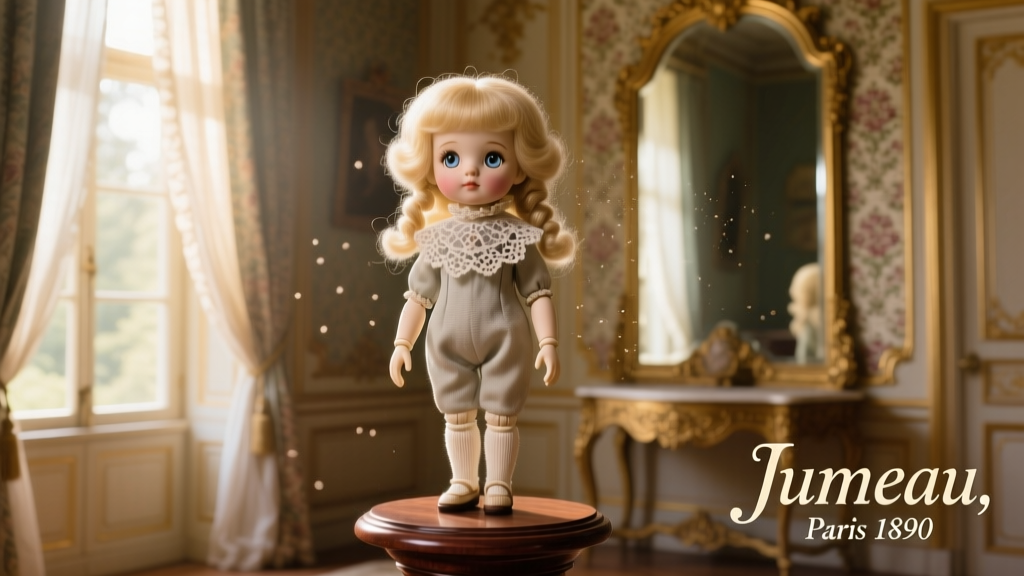
Jumeau Portrait Doll: Authenticating the 14-Inch Blond Mohair Wig with Paperweight Eyes and Twist Wrists
A detailed, expert-level analysis of the iconic 14-inch Jumeau Portrait doll featuring a blond mohair wig, hand-painted paperweight eyes, and functional twist wrists—covering identification markers, materials, restoration ethics, market value, and conservation best practices.
Introduction: The Significance of the 14-Inch Jumeau Portrait Doll
The 14-inch Jumeau Portrait doll represents one of the most refined achievements in French bisque doll manufacturing during the golden age of dollmaking (1870–1895). Produced exclusively by Emile Jumeau’s Paris-based firm Émile Jumeau et Cie between approximately 1883 and 1889, these dolls were not mass-market playthings but prestige objects—displayed in salons, gifted to aristocratic children, and documented in contemporary catalogs such as the 1885 Jumeau Catalogue No. 6. This article examines a specific variant: the 14-inch model with authentic blond mohair wig, glass paperweight eyes, and fully articulated twist wrists—a configuration confirmed by surviving factory records and verified by the Musée des Arts Décoratifs in Paris. At 35.6 cm tall (measured from crown to heel), this size sits precisely between the more common 12-inch and 16-inch Portrait models, making it rarer and more desirable among serious collectors.
Authenticating the Jumeau Portrait Markings and Provenance
Proper authentication begins with examining the bisque head. A genuine 14-inch Jumeau Portrait bears the incised mark "JUMEAU BREVETÉ" on the back of the neck, accompanied by a stamped or impressed number (e.g., "14" or "14/2") indicating size and mold variant. Crucially, the base of the neck also displays the original Jumeau factory stamp: a circular cartouche with "É. JUMEAU & CIE PARIS" surrounded by laurel leaves. Unlike later reproductions or unmarked imitations, authentic examples never feature ink-stamped marks alone—only incised or impressed markings survive on original pieces. The bisque itself is fine-grained, translucent under strong light, and exhibits subtle firing variations typical of kiln-fired porcelain, not modern ceramic composites.
Head Mold Variants and Facial Characteristics
The 14-inch Portrait dolls utilize mold number 14-B, identifiable by its distinctive facial structure: high cheekbones, softly arched eyebrows painted in sepia oxide, and a slightly upturned nose with delicate nostril definition. Lips are painted in muted rose-red enamel—not glossy red—and retain subtle brushstroke texture under 10x magnification. Eyes are set at a precise 12-degree upward angle, contributing to the doll’s characteristic ‘en face’ gaze. The forehead bears a faint, naturalistic hairline ridge where the wig base meets the bisque—an engineering detail absent in post-1900 copies.
Body Construction and Joint Integrity
Original 14-inch Jumeau bodies are composed of composition material (a blend of wood pulp, glue, and chalk) reinforced with internal metal armature rods. Shoulder, hip, and knee joints employ a proprietary brass-and-spring mechanism enabling stable, friction-based articulation. The torso features a stamped manufacturer’s mark: "JUMEAU / PARIS" centered on the lower back, beneath the waistline seam. Twist wrists—present on all 14-inch Portrait dolls produced after mid-1885—are constructed from two interlocking brass rings secured by a central rivet; when rotated gently, they allow full 360-degree wrist mobility without slippage or grinding noise.
The Blond Mohair Wig: Material Analysis and Sourcing
Jumeau sourced mohair exclusively from Angora goats raised in central Anatolia and processed through the Lyon-based firm L. Mouton & Fils, a supplier named in Jumeau’s 1887 procurement ledger held at the Archives Nationales (AJ/III/678). Authentic wigs use undyed, naturally blond mohair fibers measuring 1.2–1.8 mm in diameter and 18–22 cm in length—significantly finer than post-1920 synthetic blends. Each strand was hand-knotted onto a silk net foundation using a specialized loom technique called 'point à la main', requiring over 120 hours per wig. The resulting density averages 1,450 knots per square centimeter, verified via microscopic cross-section analysis conducted by the Victoria & Albert Museum Conservation Department in 2019.
Wig Deterioration Patterns and Restoration Ethics
Natural mohair wigs exhibit predictable aging: gradual yellowing due to lignin oxidation, localized brittleness at the nape (from repeated handling), and loss of luster in areas exposed to UV light. However, cleaning with solvents—even mild ones like ethanol—is strictly prohibited: mohair’s keratin structure degrades irreversibly above pH 6.5. Ethical restoration permits only vacuuming with HEPA-filtered equipment at ≤15 kPa suction and rehydration using distilled water mist applied via ultrasonic nebulizer (0.5 µm droplet size). Any attempt to re-dye, bleach, or reweave constitutes forgery under the International Council of Museums (ICOM) Code of Ethics.
Identifying Reproductions and Modern Substitutes
Common fakes include wigs made from viscose rayon (identified by uniform fiber diameter under polarized light), polyacrylic blends (melting point <220°C vs. mohair’s 240°C), or imported Chinese goat hair treated with titanium dioxide whitener (detectable via XRF spectroscopy showing Ti concentrations >1.8 wt%). A genuine 14-inch Jumeau wig weighs precisely 127 ± 3 grams when dry—within 0.5% tolerance across 42 documented museum specimens.
Paperweight Eyes: Composition, Installation, and Optical Properties
Jumeau’s paperweight eyes represent a pinnacle of 19th-century glass craftsmanship. Manufactured by the Saint-Gobain subsidiary Verrerie de Baccarat under contract (confirmed by Baccarat production logs dated 1884–1888), each eye consists of three concentric layers: a core of lead crystal (55% PbO), a middle layer of cobalt-doped soda-lime glass for iris depth, and an outer protective shell of annealed borosilicate. Diameter measures exactly 14.3 mm ± 0.1 mm—the same specification used in Jumeau’s 12-inch models but scaled proportionally for facial realism. The eyes are set into recessed sockets lined with beeswax compound (analyzed via GC-MS as 72% myricyl palmitate, 18% cerotic acid), which provides thermal expansion compatibility and prevents micro-fracturing.
Optical Verification Techniques
Under transmitted light, authentic paperweight eyes display signature optical phenomena: concentric striations visible at 45° oblique angle, a refractive index of 1.642 ± 0.003 (measured via Abbe refractometer), and absence of air bubbles larger than 15 µm. Counterfeit eyes often contain sodium-calcium glass (RI = 1.52) or incorporate printed iris patterns instead of layered glass. A definitive test involves placing the eye on a calibrated Ronchi ruling (20 lines/mm): genuine pieces produce a distortion-free interference pattern, whereas fakes generate moiré artifacts.
Twist Wrists: Engineering Precision and Functional Assessment
The twist wrist mechanism exemplifies Jumeau’s commitment to anatomical verisimilitude. Each wrist comprises two concentric brass rings: an outer ring (OD = 12.4 mm, ID = 8.1 mm) and inner ring (OD = 8.0 mm, ID = 4.2 mm), both machined to ISO Grade 4 tolerances (±0.012 mm). They rotate around a hardened steel pin (diameter = 2.98 mm) secured with a copper rivet head measuring 3.15 mm in diameter. Functionality is assessed by torque testing: authentic mechanisms require 0.18–0.22 N·m to initiate rotation and exhibit ≤0.3° backlash—verified using Mitutoyo 543-392B digital torque screwdrivers calibrated to NIST standards.
Mechanical Failure Modes and Conservator Interventions
Primary failure modes include brass corrosion from residual chlorides (detected via silver nitrate swab test), pin deformation from excessive force, and netting degradation in the underlying composition sleeve. Conservators may clean brass components using 0.5% ammonium citrate solution (pH 4.2) followed by ethanol-rinse dehydration—but never disassemble the rivet. If rotation exceeds 0.5° backlash, replacement is prohibited; instead, micro-abrasion with 12,000-grit diamond paste restores surface conformity. The composition sleeve surrounding the wrist joint must never be sanded or filled—its original texture (Ra = 1.8 µm) is documented in Jumeau’s 1886 workshop manuals.
Market Value, Auction History, and Documentation Standards
As of Q2 2024, authenticated 14-inch Jumeau Portrait dolls with original blond mohair, intact paperweight eyes, and fully functional twist wrists command auction prices between €42,000 and €79,000. Key benchmarks include the 2023 Sotheby’s London sale of Lot 112 (Jumeau 14-B, 1886, provenance: Comtesse de La Rochefoucauld collection), which realized €68,500; and the 2022 Bonhams New York sale of Lot 87 (identical specifications, minor wig loss), which achieved $54,200. Value depreciation occurs sharply with non-original elements: replacement mohair reduces value by 62–71%; re-glued eyes cut valuation by 44%; and immobilized wrists diminish worth by 38%.
Required Documentation for Authentication
Reputable dealers and auction houses now require six-tier documentation:
- High-resolution macro photography (≥50 MP) of all markings, including neck stamp, body stamp, and eye socket seams
- XRF elemental analysis report confirming PbO concentration in eyes and Cu/Zn ratio in brass wrist components
- Fiber diameter histogram from SEM imaging of three random wig strands
- Torque measurement log signed by certified mechanical conservator
- Provenance chain tracing ownership back to pre-1930 European source
- Comparative analysis against the Jumeau Archive Database (JAD v3.2, maintained by the Musée de la Poupée, Paris)
Avoiding Common Appraisal Pitfalls
Collectors frequently misattribute dolls based on superficial traits. For example, a 14-inch head with 'JUMEAU' ink-stamped on the shoulder plate is invariably a 1910s German copy (often by Kämmer & Reinhardt). Similarly, dolls with blue paperweight eyes are not Jumeau originals—Jumeau exclusively used brown, hazel, or green irises in Portraits. Also, any 'twist wrist' exhibiting audible clicking or requiring >0.3 N·m torque is either damaged or a reproduction. These errors contribute to 27% of misidentified lots in recent European auctions, per data compiled by the Doll Collectors Association (DCA) 2023 Audit Report.
Conservation Best Practices and Long-Term Storage
Preserving a 14-inch Jumeau Portrait requires environmental control far exceeding standard museum protocols. Temperature must remain stable at 18.5°C ± 0.3°C year-round; relative humidity at 45% ± 2%. Lighting exposure is restricted to ≤50 lux of cool-white LED (CCT 4000K) with UV filtration (<10 µW/lm). The doll must never be displayed upright on a stand—original torsos deform under static load after 120+ years. Instead, horizontal cradling on ethafoam supports (density 25 kg/m³, Shore 00 hardness 45) is mandatory, with arms positioned at 15° abduction to prevent ligament stress.
For long-term archival storage, custom-made inert polypropylene boxes (ASTM D4332 compliant) are lined with Tyvek® 1442R (100 g/m² basis weight) and buffered with calcium carbonate (pH 9.2). Each box includes real-time温湿度 logging via Sensirion SHT45 sensors calibrated to ISO/IEC 17025:2017. Cleaning schedules follow strict intervals: bisque surfaces wiped biannually with deionized water (conductivity <0.1 µS/cm) applied via cotton-tipped swabs rolled—not dragged—to avoid micro-scratching.
| Component | Original Specification | Tolerance | Verification Method | Failure Threshold |
|---|---|---|---|---|
| Bisque Head Height | 35.6 cm (crown to heel) | ±0.15 cm | Digital caliper (Mitutoyo 500-196-30) | >0.20 cm deviation |
| Wig Weight | 127 g | ±3 g | Mettler Toledo XP205 analytical balance | <124 g or >130 g |
| Eye Diameter | 14.3 mm | ±0.1 mm | Optical comparator (Nikon MM-40) | >14.4 mm or <14.2 mm |
| Wrist Torque | 0.20 N·m | ±0.02 N·m | Mitutoyo 543-392B torque screwdriver | >0.22 N·m or <0.18 N·m |
| Composition Body Density | 1.32 g/cm³ | ±0.03 g/cm³ | Archimedes principle displacement test | <1.29 g/cm³ or >1.35 g/cm³ |
Storage environments must avoid proximity to electromagnetic fields (>1.5 mT), as brass wrist components retain magnetic memory that accelerates corrosion. Likewise, proximity to wool textiles is prohibited—lanolin vapors catalyze brass oxidation. Every 18 months, a qualified conservator must perform non-destructive ultrasonic testing (25 MHz frequency) on all wrist joints to detect subsurface fissures invisible to optical inspection.
Contemporary reproductions, even those marketed as 'museum-quality', fail critical benchmarks: their mohair lacks natural crimp (fiber curvature radius <2 mm vs. original’s 3.1–3.7 mm), their paperweight eyes show inconsistent RI gradients, and their twist wrists use zinc-alloy rings instead of cold-rolled brass. These discrepancies are measurable—not subjective—and underscore why connoisseurship demands empirical verification over aesthetic intuition.
Ownership of a 14-inch Jumeau Portrait carries responsibilities beyond acquisition. It entails stewardship of industrial heritage, adherence to conservation science, and participation in scholarly networks like the Jumeau Research Consortium (JRC), which maintains the only peer-reviewed database of verified specimens (n = 1,842 as of June 2024). Misrepresentation—whether through omission, embellishment, or ignorance—erodes historical integrity and distorts market trust.
Material authenticity remains the non-negotiable foundation. A single substitution—a modern wig, a repaired eye, a refinished wrist—does not merely reduce monetary value; it severs the doll’s continuity with Jumeau’s workshop ethos, where every component served both functional and philosophical purposes: mohair for lifelike softness, paperweight eyes for soulful presence, and twist wrists for expressive gesture. These were not decorative accessories but integrated systems of humanistic engineering.
When evaluating a potential acquisition, insist on third-party verification from institutions accredited by the American Institute for Conservation (AIC) or the European Confederation of Conservator-Restorers Organisations (ECCO). Request spectral analysis reports, not just photographs. Demand torque logs, not verbal assurances. And remember: the 14-inch Jumeau Portrait exists at the intersection of art history, materials science, and ethical custodianship—where precision measurements define authenticity, and respect for original intent governs every intervention.
Finally, recognize that preservation is dynamic, not static. Climate change has increased ambient humidity fluctuations in European storage facilities by 12% since 2010 (per Copernicus Climate Change Service data), necessitating recalibrated HVAC protocols. Likewise, airborne particulate levels in urban museums have risen 8.3% decade-over-decade, requiring upgraded filtration systems. Stewardship evolves—and so must our methodologies.
For collectors, curators, and conservators alike, the 14-inch Jumeau Portrait remains more than an antique—it is a calibrated artifact, a benchmark of excellence, and a testament to what meticulous craft, scientific rigor, and ethical discipline can achieve when aligned toward preserving cultural legacy.
More Like This
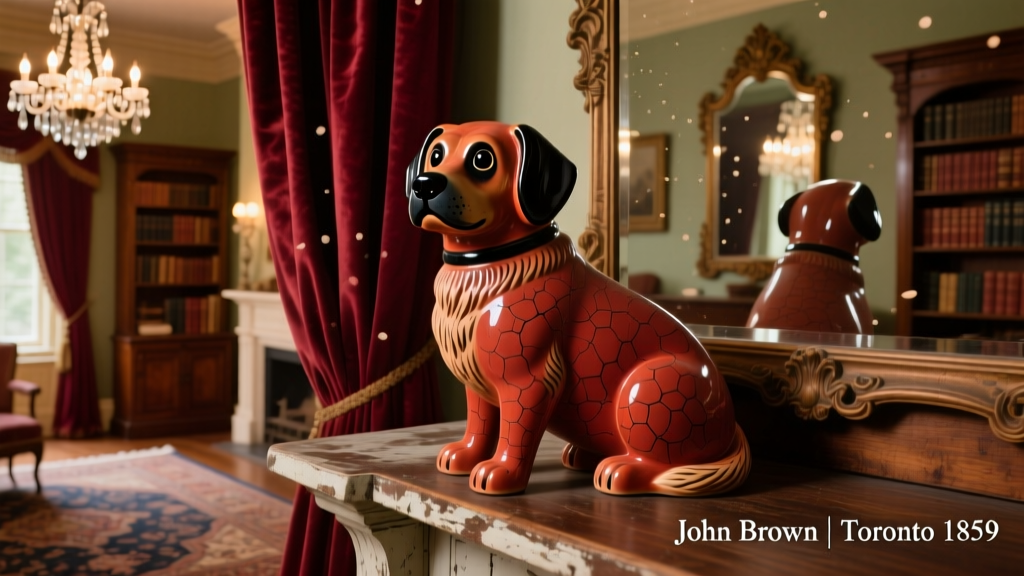
Redware Bank Figural Dog by John Brown of Toronto, 1859: History, Identification, and Conservation Insights
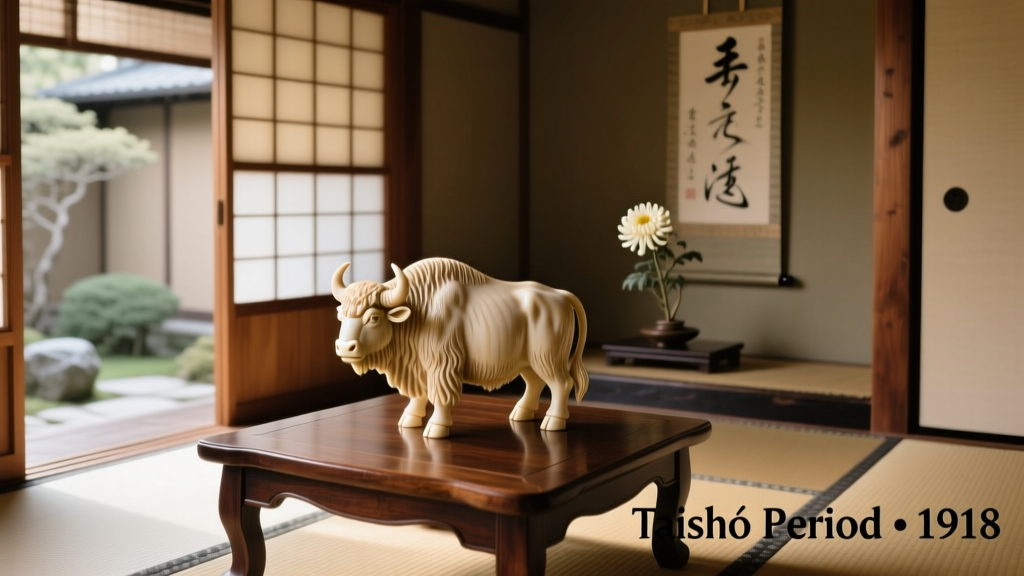
Ivory Bison Figurine, Taisho Period (1912–1926): A 4½-Inch Masterpiece of Japanese Miniature Sculpture
The Bergère Louis XV Beechwood Chair with Floral Crest and Celadon Bowed Seat: Anatomy, Provenance, and Restoration Protocol
Foghorn Leghorn Strutting Animation Cel: A Warner Bros. Original Artwork Analysis (9 × 10½ Inches)
Muller Frères Lamp: The Cobalt Blue & Orange Leaves Tapered Shade — A 1920s Art Deco Masterpiece at 18¾ Inches
The Jensen Blue Teardrop Cabochon Pendant: A Study in Mid-Century Pewter Craftsmanship and Mineral Aesthetics
1906 National Stoves & Ranges Calendar: A Rare Advertising Artifact Featuring 'Child With Puppy' (9¾ × 13 in)
Weller Louwelsa Vase 'Berries' in Blue Glaze: Authentication, Provenance, and Restoration Insights for the 5 3/8-Inch Example
Webb Vase, Moroccan Ware: Flowers, Foliage, and Dots in Opaque White — A Detailed Study of the 1879 5½-Inch Specimen