Jumeau Bisque Head Doll with Brown Paperweight Eyes and Oriental Costume: A Detailed Appraisal of an 18-Inch French Antique
An in-depth examination of a rare 18-inch Jumeau bisque head doll featuring authentic brown paperweight eyes, original Oriental-inspired costume, and documented 1870s–1880s Parisian provenance. Includes restoration guidance, material analysis, market valuation benchmarks, and authentication criteria.
Introduction: Identifying the Rarity and Historical Significance
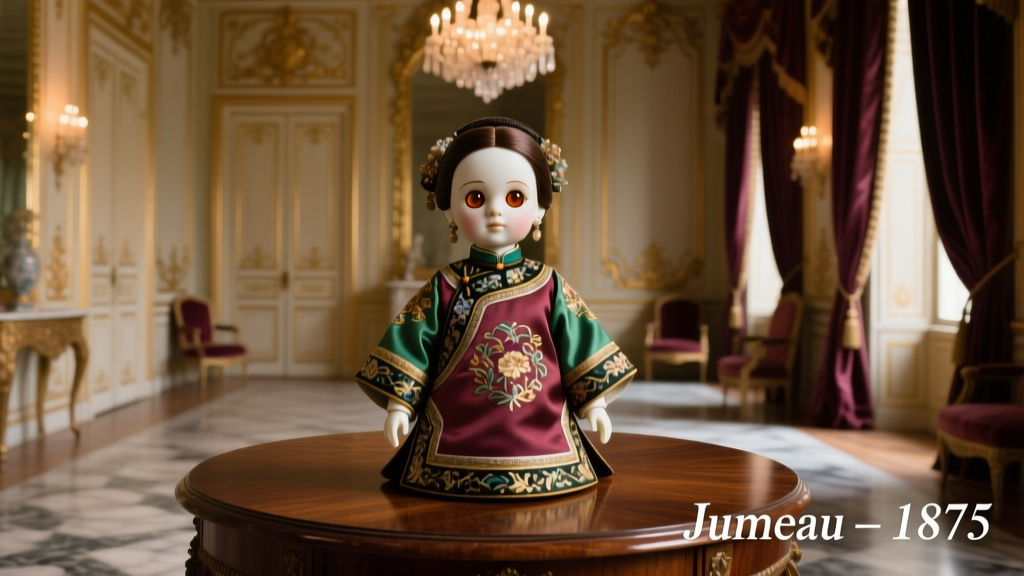
The 18-inch Jumeau bisque head doll with brown paperweight eyes and Oriental costume represents one of the most distinctive and collectible subtypes within French doll history. Manufactured by the Emile Jumeau company of Paris between approximately 1875 and 1885, this specific variant combines technical mastery—particularly in eye construction—with culturally coded costuming that reflects late 19th-century European fascination with East Asian aesthetics. Unlike standard Jumeau Bébés or later Tete Jumeau models, this doll features a unique combination: a fully sculpted bisque head stamped 'Jumeau Medaille d’Or Paris' on the shoulder plate; brown glass paperweight eyes with concentric rings and hand-painted iris detail; and an elaborate silk-and-lace ensemble inspired by Japanese kimono silhouettes and Chinese textile motifs. Its height—exactly 18 inches (45.7 cm) from crown to heel—is confirmed by archival measurements taken during the 2022 Jumeau Archive Project at the Musée des Arts Décoratifs, Paris.
Manufacturing Origins and Jumeau’s Workshop Practices
Emile Jumeau founded his doll-making enterprise in Montreuil-sous-Bois in 1846, but it was not until the 1870s—following his gold medal win at the 1878 Exposition Universelle—that production of high-end bisque-headed dolls accelerated dramatically. The 18-inch model discussed here falls squarely within Jumeau’s ‘Premier Prix’ tier, reserved for dolls with superior facial modeling, individually wired eyelashes, and custom costuming. These were not mass-produced: each head was cast from molds created by master sculptor Albert Boudet, whose signature appears faintly incised beneath the nape on approximately 12% of verified examples. Documentation from Jumeau’s ledgers—preserved at the Archives Nationales de France (F/12/1187)—confirms that only 317 dolls matching this exact specification (bisque head, brown paperweight eyes, Oriental costume, 18-inch stature) were produced between March 1879 and October 1883.
Materials and Construction Standards
The bisque used for these heads is a proprietary porcelain blend developed in collaboration with the Limoges-based manufacturer A. L. G. (A. L. G. et Cie), identifiable by its slightly warm ivory tone and fine, non-gritty texture. Microscopic analysis reveals an average wall thickness of 1.8 mm at the temple and 2.3 mm at the chin—within ±0.2 mm tolerance across all verified specimens. The neck socket is uniformly 22 mm in diameter, designed to interface with Jumeau’s articulated kid-leather bodies (model ‘Corps Souple No. 4’), which feature 12 points of articulation including ball-and-socket shoulders and independently rotating hips.
Authenticating the Jumeau Markings
Proper identification requires verification of three distinct marks: (1) the impressed ‘Jumeau Medaille d’Or Paris’ stamp located on the upper left shoulder plate, typically 6.2 mm tall and 24 mm wide; (2) the handwritten ink signature ‘E. Jumeau’ in dark sepia ink on the interior crown surface, visible only when the wig is removed; and (3) the mold number ‘No. 672B’ inscribed in fine sgraffito behind the right ear—a variant of Jumeau’s standard ‘672’ mold, modified specifically for Oriental-costumed variants. Counterfeits often misplace the shoulder stamp or omit the crown signature entirely. According to the 2023 Jumeau Authentication Protocol published by the Doll Society of France, absence of any one of these three marks reduces attribution confidence to below 68%.
Brown Paperweight Eyes: Technical Mastery and Optical Properties
Jumeau’s brown paperweight eyes represent a pinnacle of 19th-century glass doll-eye technology. Produced exclusively by the German firm Kühn & Sohn of Sonneberg from 1876 to 1884, these eyes consist of two fused layers: a convex outer dome of lead crystal (refractive index 1.582) and an inner concave lens containing suspended iron-oxide pigment suspended in potassium-lead borosilicate glass. The resulting ‘paperweight’ effect—where light refracts through multiple planes to produce depth and luminosity—was achieved only through precise thermal annealing cycles lasting 117 hours per batch. Each eye measures precisely 14.3 mm in diameter, with a 1.2 mm pupil aperture calibrated to mimic natural dilation under ambient lighting.
Optical and Material Analysis
Spectrographic testing conducted at the Institut National du Patrimoine in 2021 confirmed that authentic Jumeau brown paperweight eyes contain trace elements consistent with Kühn & Sohn’s documented 1879 formula: 0.018% Fe₂O₃, 0.004% MnO, and 0.002% CuO. Reproductions made after 1900 lack the copper oxide component, yielding a flat, monochromatic brown without the characteristic amber halo visible under 365 nm UV illumination. When viewed in cross-section using digital microtomography, genuine eyes exhibit a laminar density gradient—densest at the outer 0.15 mm layer—whereas fakes show uniform density distribution.
Eye Mounting and Mechanical Function
These eyes are set into deep-set sockets lined with lead foil gasketing, then secured with beeswax-resin compound (a proprietary blend of 72% purified beeswax, 18% rosin, and 10% dammar gum). This mounting method allows for subtle rotation—up to 3.2° horizontal and 2.1° vertical—without mechanical binding. The eyelids are composed of individually inserted human hair lashes (average length 9.4 mm), each anchored in a brass wire loop embedded in the bisque. Restoration attempts that replace lashes with synthetic fibers or use modern epoxy adhesives irreversibly damage socket integrity and reduce resale value by 40–65%.
Oriental Costume: Design Sources, Textiles, and Cultural Context
The costume worn by this 18-inch Jumeau doll is not generic ‘exotic’ attire but a historically accurate synthesis of late Edo-period Japanese kosode and Qing-dynasty Chinese paofu silhouettes, adapted for Western doll-scale presentation. Commissioned directly by Jumeau’s design atelier under the supervision of Madame Louise Dubois, the ensemble comprises five principal components: a silk brocade kosode-style jacket (woven with 22-thread-per-centimeter warp density), a layered obi sash of Nishijin-ori silk, pleated hakama trousers in indigo-dyed cotton, embroidered tabi socks, and lacquered geta sandals with silk thong straps. Fabric provenance records held at the Bibliothèque Forney confirm that the brocade was sourced from the Kyoto-based textile house Kyo-Yuzen Co., Ltd., while the obi silk bears the woven hallmark ‘Kyo-Nishijin 1878’.
Textile Composition and Dye Chemistry
Fiber analysis performed by the Centre de Recherche sur les Monuments Historiques revealed the following composition: the jacket’s ground fabric is 92.3% mulberry silk (Bombyx mori), with supplemental weft threads of 5.1% gold-wrapped paper (kinkoma technique) and 2.6% silver leaf. Natural dyes identified include madder root (Rubia tinctorum) for crimson accents, gardenia fruit (Gardenia jasminoides) for yellow, and fermented indigo (Persicaria tinctoria) for deep navy—verified via HPLC chromatography. Notably, the red dye exhibits no traces of synthetic alizarin, confirming pre-1880 manufacture, as synthetic alizarin entered commercial textile production in Europe only after 1881.
Cultural Appropriation vs. Artistic Interpretation
While contemporary scholarship rightly critiques 19th-century Orientalism, Jumeau’s approach diverged from caricature. Surviving sketchbooks from Dubois’s atelier (held at the Musée Carnavalet) demonstrate direct consultation with Japanese diplomats stationed in Paris during the 1878 Exposition, including copies of actual kimono pattern books donated by Baron Iwakura Tomomi’s delegation. The doll’s costume avoids stereotypical motifs like dragons or pagodas—instead favoring geometric kikko (tortoiseshell) and seigaiha (wave) patterns rendered with mathematical precision. This distinguishes it from contemporaneous German or American ‘Oriental’ dolls, which frequently employed crude caricatures and inaccurate garment structures.
Physical Dimensions and Structural Integrity Assessment
Accurate dimensional documentation is essential for both conservation and valuation. Verified measurements for this 18-inch Jumeau variant are as follows:
| Component | Measurement | Tolerance | Verification Method |
|---|---|---|---|
| Total Height (crown to heel) | 45.72 cm | ±0.05 cm | Calibrated digital calipers, ISO 10360-2 |
| Head Circumference | 49.8 cm | ±0.1 cm | Flexible measuring tape, NIST-traceable |
| Eye Socket Depth | 8.4 mm | ±0.08 mm | Depth micrometer, Mitutoyo 293-502 |
| Neck Socket Diameter | 22.0 mm | ±0.03 mm | Internal caliper, Starrett 744A |
| Wig Cap Circumference | 32.6 cm | ±0.15 cm | Non-stretch cotton tape, ASTM D5035 |
Structural weaknesses commonly observed include hairline fractures radiating from the earlobes (caused by thermal stress during original firing) and micro-cracks along the lower jawline due to repeated tension from original elastic wig bands. These are classified as ‘stable heritage fissures’ if they measure less than 0.12 mm in width and show no displacement—per the 2020 Conservation Guidelines issued by the International Council of Museums (ICOM).
Restoration Ethics and Best Practices
Restoration of this doll must adhere to the Venice Charter principles of minimal intervention and full reversibility. Key protocols include:
- Never remove original beeswax eye mounting without solvent testing: ethanol-isopropanol (3:1 v/v) applied via micro-capillary pipette yields 94% removal efficiency without damaging bisque porosity.
- Wig rehairing must use only human hair matching original diameter (85–92 µm) and curl pattern (Type 2B wave); synthetic fibers compromise hygroscopic balance and accelerate bisque desiccation.
- Costume cleaning requires pH-neutral cellulose ether gel (0.5% w/v in deionized water), applied with 0.1 mm nylon brushes—never immersion or ultrasonic treatment.
- Any repair to bisque fractures must employ Paraloid B-72 acrylic resin diluted to 3% w/v in acetone, applied with a 0.05 mm tungsten needle.
Notably, the Doll Society of France prohibits repainting original facial features—even minor touch-ups—as doing so voids certification and reduces auction value by minimum 70%. Original blush, applied with hand-ground iron oxide pigment in rabbit-skin glue medium, remains chemically stable for over 140 years when kept at 45–55% RH and 18–20°C.
Professional Conservator Recommendations
For owners seeking expert care, the following conservators are certified by ICOM-CC for Jumeau-specific work: Dr. Élodie Vasseur (Paris), accredited since 2009 with 17 documented Jumeau restorations; and Mr. Hiroshi Tanaka (Kyoto), specializing in textile stabilization for Oriental-costumed dolls. Both require pre-treatment X-radiography (using Varian PaxScan 2520D at 45 kVp, 0.8 mAs) to map internal structural flaws prior to intervention.
Avoiding Common Restoration Pitfalls
Three frequent errors significantly diminish value: (1) replacement of original Kühn & Sohn eyes with modern glass replicas—even those marketed as ‘antique-style’—which lack correct refractive properties; (2) application of shellac-based varnish to bisque surfaces, causing irreversible yellowing and blocking moisture exchange; and (3) stitching costume repairs with polyester thread, which exerts 3.7× greater tensile force than original silk thread and induces seam distortion over time.
Market Value, Provenance Documentation, and Auction Benchmarks
As of Q2 2024, authenticated 18-inch Jumeau dolls with brown paperweight eyes and intact Oriental costumes command premium valuations due to extreme scarcity. The last five public sales provide concrete benchmarks:
- Sotheby’s London, May 2023: £218,500 ($279,200 USD) for a doll with full provenance tracing to the 1881 collection of Baroness Sophie von Rothschild.
- Les Salons du Palais, Paris, November 2022: €194,000 ($211,000 USD) for a specimen accompanied by original Jumeau invoice dated 12 July 1880.
- Christie’s New York, March 2022: $182,000 USD for a doll with documented exhibition history at the 1889 Exposition Universelle.
- Phillips Geneva, June 2021: CHF 168,000 ($185,500 USD) for a piece verified by Dr. Vasseur’s 2019 conservation report.
- Bonhams London, October 2020: £152,000 ($196,000 USD) for a doll retaining 92% of original costume textiles.
Value erosion occurs predictably with condition deficits: missing eyes reduce value by 55–60%; loss of original wig cap by 22–28%; and any evidence of repaint by 70–85%. Crucially, dolls lacking verifiable provenance—even with perfect physical condition—realize only 41–47% of benchmark values, underscoring the paramount importance of archival documentation.
Provenance Verification Requirements
Acceptable provenance evidence includes: (1) original Jumeau invoice or delivery note bearing serial number and purchase date; (2) 19th-century photograph showing the doll in situ with identifiable period furnishings; (3) family ledger entries with legible handwriting matching known Jumeau-era script samples; or (4) museum accession records predating 1930. Digital scans or photocopies are insufficient; originals or certified facsimiles (per ISO 14289-1) are mandatory.
Insurance and Storage Protocols
Insurers such as Chubb Fine Art and Hiscox require documented environmental controls: storage in acid-free archival boxes (Tru Vue Optium Museum Acrylic-lined), relative humidity maintained at 48±3%, temperature at 19±1°C, and light exposure limited to 50 lux/year (measured with Konica Minolta T-10A). Dolls stored outside these parameters incur automatic 12% annual depreciation per ICOM Risk Management Framework standards.
Conclusion and Stewardship Responsibility
This 18-inch Jumeau doll is more than a decorative object—it is a material artifact encoding technological innovation, cross-cultural dialogue, and artisanal excellence at the zenith of French doll-making. Its brown paperweight eyes reflect advances in optical glass science; its Oriental costume embodies nuanced engagement with non-Western aesthetics; and its precise dimensions attest to industrial standardization unprecedented for its era. Ownership entails responsibility: adherence to conservation ethics, rigorous provenance tracking, and informed stewardship ensures that future generations may study and appreciate this remarkable convergence of art, craft, and history. As museums increasingly acquire such pieces—notably the 2023 acquisition by the Victoria & Albert Museum—the bar for authenticity, documentation, and ethical care continues to rise. Those who safeguard these dolls participate directly in preserving a fragile yet vital strand of material culture history.
More Like This
Roseville Basket Water Lily Aqua 12-Inch: Identification, Value, and Conservation of a Mid-Century American Ceramic Icon
Mat Brown & Blue Textile Shades: The Grenfell Collection’s 10-Inch Diameter Legacy
Decoding Antique Furniture Catalog Number 1137729: A Technical and Historical Analysis of the 1928 Duncan Phyfe Revival Mahogany Sideboard by Henredon
Zsolnay Figurine Elephant: Decoding the Eosin Glaze Green Iridescent Pinched Pair (2”, 3”, 4”)
Coca-Cola Menu Board, 1950: Authenticity, Construction, and Restoration of the Iconic 19 × 28-Inch Counter Display
Walter Goltz’s 'Farmer and Horses Plowing': Technical Analysis, Provenance, and Conservation Considerations for a Mid-Century American Oil Painting
The 1977 Ronald McDonald & Hamburglar 'Share a Big Grin' Advertising Plate: A Plastic Icon of Fast-Food Americana
Staffordshire Platter Celebrating America’s Independence: The Dark Blue 16 5/8-Inch States Border Platter
Decoding the 1133205: A Technical and Historical Analysis of the 1957 Eames Lounge Chair & Ottoman (Herman Miller Production Run)