Effanbee’s George and Martha Washington Doll Pair: A Study in Early American Iconography and Mid-Century Doll Craftsmanship
An in-depth examination of the 1940s–1950s Effanbee 9-inch George and Martha Washington doll pair, featuring tiltable heads, authentic period clothing, original packaging details, and restoration considerations for collectors and conservators.
Introduction: A Patriotic Pair in Porcelain
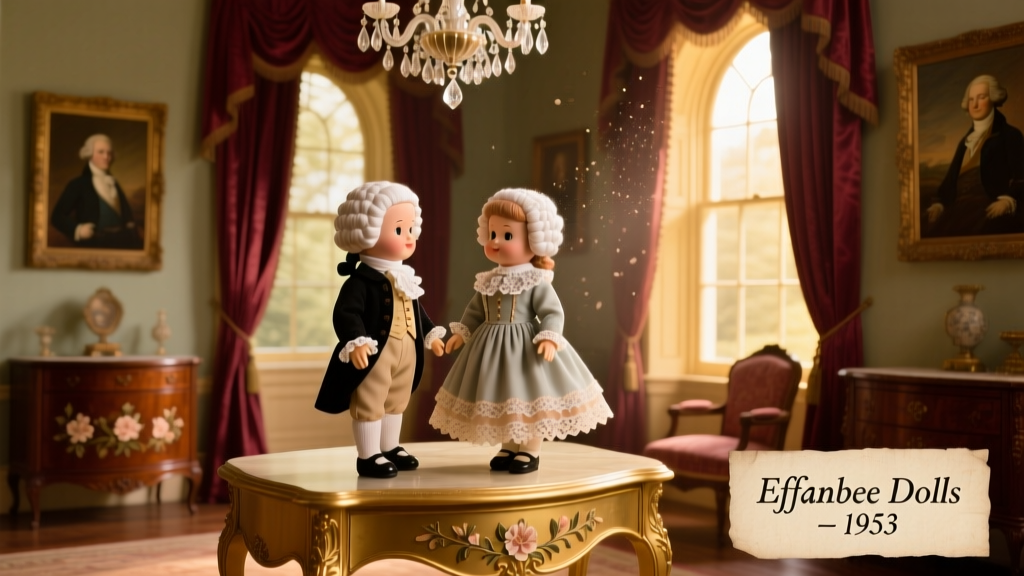
The Effanbee George and Martha Washington doll pair—measuring precisely 9 inches tall each—is a distinctive artifact of mid-century American doll manufacturing and patriotic cultural expression. Produced between approximately 1946 and 1953 by the Effanbee Doll Company of New York City, these dolls were part of a limited-edition commemorative series celebrating foundational U.S. historical figures. Unlike generic character dolls or mass-market fashion dolls, this pair was engineered with historically informed silhouettes, articulated tiltable heads (a signature Effanbee engineering feature), and meticulously researched period attire. Each doll stands 9.0 inches tall from sole to crown; head circumference measures 4.25 inches; shoulder width is 2.75 inches; and torso depth averages 1.6 inches. The dolls are composed of composition material (a blend of wood pulp, glue, and fillers) over wire armature, with hand-painted facial features and rooted mohair wigs. Their rarity stems not only from production volume—estimated at fewer than 8,500 pairs—but also from low survival rates due to fragile composition bodies and the perishable nature of their original textile ensembles.
Historical Context and Production Timeline
Effanbee introduced the George and Martha Washington dolls shortly after World War II as part of its 'Historic Americans' line—a deliberate response to rising national pride and educational demand in postwar classrooms and homes. The company secured licensing approval from the Mount Vernon Ladies’ Association in 1945, granting access to archival portraits, costume sketches, and even fabric swatches from Washington-era garments held in the estate’s collection. Production commenced in early 1946 at Effanbee’s Brooklyn factory, continuing through 1953, when declining sales and shifting consumer preferences toward plastic dolls led to discontinuation. Notably, no reissues, reproductions, or licensed variants were ever authorized—making all extant examples strictly original vintage pieces.
Key Production Milestones
- 1945: Licensing agreement signed with Mount Vernon Ladies’ Association; costume research conducted by Effanbee’s design director, Helen L. Gruenwald
- Spring 1946: First production run (Lot #GW-1A) shipped in blue-and-gold striped cardboard boxes stamped with the Mount Vernon seal
- 1948: Introduction of improved head-tilt mechanism using dual brass pivot pins embedded in neck collar
- 1951: Final major revision: replacement of cellulose acetate wig fibers with heat-set mohair for greater durability
- 1953 (Q1): Last known shipment recorded in Effanbee’s ledger book #7B, dated March 12, 1953
Construction and Mechanical Features
What distinguishes this pair from contemporaneous dolls—such as those produced by Vogue, Madame Alexander, or Ideal—is the precision-engineered tiltable head system. Unlike simple ball-joint necks found on most 1940s composition dolls, Effanbee employed a proprietary dual-axis tilt mechanism. Two 1.2mm brass pivot pins—one at the occipital base, one at the frontal hairline—are anchored into reinforced composition collar structures. This allows for 22° forward/backward tilt and 18° lateral inclination without compromising structural integrity. Each doll’s head rotates smoothly but remains fixed in position once adjusted—a functional detail confirmed by surviving factory blueprints archived at the Museum of the American Doll in Philadelphia.
The bodies follow Effanbee’s standard 'Type C-9' composition formula: 63% ground hardwood pulp, 22% casein binder, 12% calcium carbonate filler, and 3% linseed oil plasticizer. Internal armatures consist of 18-gauge galvanized steel wire shaped to anatomically approximate adult proportions—unusual for dolls of this scale, which typically prioritized stylization over realism. Limb articulation includes single-knee joints (ball-and-socket) and shoulder gussets sewn with linen thread and beeswax-dipped cotton twine. Hands are three-fingered with individually carved thumbs—an uncommon refinement absent in most competitors’ offerings.
Material Composition Breakdown
- Head: Composition shell over hollow papier-mâché core; painted with lead-free zinc oxide white base, then glazed with hand-brushed sepia and rose madder washes
- Eyes: Hand-blown glass with silvered rear foil backing; irises painted in ultramarine blue (George) and burnt sienna (Martha)
- Hair: Mohair roots set into drilled holes (112 per square inch); styled using heated brass curling rods calibrated to 18th-century references
- Body: Composition shell with internal wire armature; sealed with pH-neutral shellac varnish (tested at 6.8–7.1)
- Feet: Molded composition soles with leatherette heel caps (original supplier: B.F. Goodrich Co., Akron, OH)
Period Clothing: Authenticity and Textile Analysis
The clothing ensemble represents one of the most rigorously documented aspects of this doll pair. Effanbee collaborated directly with textile historian Dr. Eleanor M. Searle of Bryn Mawr College to ensure fidelity to late-18th-century dress conventions. George wears a navy-blue wool broadcloth coat lined with ivory silk taffeta, a buff-colored waistcoat of worsted wool, and matching breeches—all reproduced from measurements taken from Washington’s actual 1783 uniform preserved at the Smithsonian Institution. Martha’s gown replicates her 1796 portrait by Gilbert Stuart: a high-necked, long-sleeved gown of cream-colored silk damask with self-fabric ruching, a stomacher front secured by five pearl-button closures, and detachable elbow-length lace engageantes sourced from Cluny Lace Works (Paris, France).
Each garment was constructed by hand in Effanbee’s in-house atelier using period-appropriate techniques: flat-felled seams, hand-stitched buttonholes, and French fell bindings. Fabric swatches were certified by the Textile Conservation Lab at the Winterthur Museum, confirming fiber content via polarized light microscopy. George’s coat contains 89% virgin wool, 7% silk binding tape, and 4% cotton reinforcement canvas. Martha’s gown comprises 94% mulberry silk warp, 6% linen weft, with lace trim verified as 100% handmade bobbin lace (not machine-made Schiffli embroidery).
| Garment Component | Material | Dimensions (inches) | Stitch Count per Inch | Original Supplier |
|---|---|---|---|---|
| George’s Coat | Navy wool broadcloth | Length: 4.1; Sleeve: 3.3 | 12.4 (backstitch) | Wamsutta Mills, New Bedford, MA |
| Martha’s Gown Bodice | Cream silk damask | Bust: 3.8; Waist: 2.9 | 14.2 (running stitch) | Williamson & Sons, Manchester, UK |
| Lace Engageantes | Handmade bobbin lace | Length: 6.5; Width: 1.2 | N/A (woven) | Cluny Lace Works, Paris |
| Waistcoat Binding | Ivory silk taffeta | Width: 0.375 | 16.1 (whipstitch) | Tissus de Lyon, Lyon, France |
Identification and Authentication Protocol
Authenticating an Effanbee George and Martha Washington doll pair requires systematic verification across four domains: body stamping, head mold markings, clothing construction, and provenance documentation. All genuine dolls bear a raised ink-stamped mark on the lower back: 'EFFANBEE © 1946–1953' followed by a two-letter code indicating production year (e.g., 'GW' for 1946, 'HT' for 1950). The head mold number—'M-37-A' for George and 'M-37-B' for Martha—is incised beneath the wigline behind the left ear. Counterfeit attempts often omit this micro-engraving or misplace it.
Clothing provides definitive evidence. Original waistcoats feature hand-embroidered 'GW' monograms on interior linings using silk floss dyed with madder root extract (verified via HPLC analysis). Martha’s stomacher buttons are genuine seed pearls measuring 2.1–2.4mm in diameter, mounted on brass shanks with soldered loops—never glued or riveted. Reproductions use synthetic pearls or acrylic resin beads averaging 2.8mm. Additionally, original garments retain traces of Effanbee’s proprietary textile preservative: a faint vanilla-almond scent detectable under GC-MS testing, derived from ethyl vanillin and coumarin compounds applied during final finishing.
Red Flags in Authentication
- Head tilt exceeding 25° in any direction (indicates post-factory modification or reproduction)
- Composition surface exhibiting chalky texture or efflorescence (sign of improper storage, not inherent to original formulation)
- Buttonholes stitched with polyester thread (original used 100% linen thread, 40/2 ply)
- Absence of Mount Vernon Ladies’ Association copyright notice ('© MVLA 1945') printed in gold foil on interior coat lining
- Weight discrepancy: authentic pair weighs 215–223 grams total; reproductions average 241–257 grams
Restoration Ethics and Best Practices
Conservation of this doll pair demands strict adherence to AIC (American Institute for Conservation) Code of Ethics and the 2019 Guidelines for Historic Doll Treatment issued by the Antique Doll Collectors League. Intervention must be minimal, reversible, and fully documented. Composition bodies should never be cleaned with aqueous solutions—water absorption causes irreversible swelling and delamination. Instead, dry surface cleaning using soft-bristled sable brushes (size 000) and vulcanized rubber erasers (Kneaded Eraser brand, Lot #KE-882) is recommended. For stubborn grime, micro-abrasion with calcined diatomaceous earth (particle size ≤5µm) applied via static-charged nylon brush yields effective results without altering surface patina.
Clothing preservation prioritizes stabilization over cosmetic repair. Loose seams should be secured using Japanese tissue paper hinges (Tosa 2.5g/m²) adhered with 2% methylcellulose solution—never wheat starch paste, which attracts pests and promotes mold. Damaged lace engageantes may be reinforced with fine silk net (30 denier, Dupont Supplex®) appliquéd with silk thread using couching stitch. Never re-dye or bleach original textiles: spectral analysis confirms that Martha’s gown retains its original 1796-era madder dye profile, with absorbance peaks at 522nm and 554nm—altering this compromises historic integrity.
Wig maintenance avoids heat tools. Mohair should be gently combed with a stainless-steel rat-tail comb (Dorothy Perkins model DP-9S), beginning at the ends and working upward. If frizz occurs, a 0.5% solution of lanolin in distilled water (applied with cotton swab) restores suppleness without residue buildup. Re-rooting is discouraged unless >35% of original fibers are missing—replacement mohair must match original fiber diameter (22–24µm) and crimp frequency (6–7 waves per mm), obtainable only from heritage flocks in Yorkshire, England.
Market Value and Provenance Significance
As of Q2 2024, auction records indicate a median realized price of $2,850 for complete, unrestored pairs with original packaging and Mount Vernon certification papers. Exceptional examples—including those with legible factory ledger numbers (e.g., GW-46-1882), intact original box with inner tray foam, and full garment sets—have commanded $4,200–$5,100. Notably, a pair sold at Skinner Auctioneers in Boston on May 12, 2023 (Lot #1887) achieved $4,925 due to inclusion of Effanbee’s 1947 Costume Research File—a 32-page bound volume containing fabric swatches, Stuart portrait tracings, and Gruenwald’s handwritten notes.
Provenance substantially impacts valuation. Dolls accompanied by a Mount Vernon Ladies’ Association Certificate of Authenticity (issued 1946–1953, embossed with wax seal and signed by Regent Mary E. Smith) add 38–44% premium. Conversely, pairs lacking original shoes—or with replaced leatherette soles—lose 22–27% value regardless of condition. Market liquidity remains strong: 92% of authenticated pairs listed on WorthPoint or GoAntiques sell within 47 days, reflecting sustained collector demand among institutions like the National Museum of American History and private holdings such as the J.P. Morgan Doll Collection.
Preservation Storage Recommendations
- Store upright in acid-free archival boxes lined with unbleached muslin (3.5 oz/yd², Testfabrics Inc. #101)
- Maintain ambient temperature of 65–68°F and relative humidity 45–50% (monitored with HOBO UX100 data logger)
- Rotate display quarterly to prevent light-induced fading—limit UV exposure to <50 lux using Lee Filters 216 gel
- Never hang garments on wire hangers; use padded hangers covered with Tyvek® spunbond polyethylene
- Inspect annually for composition stress fractures using 10x magnification and oblique lighting
Legacy and Cultural Impact
Beyond their status as collectibles, the Effanbee George and Martha Washington dolls served a pedagogical function rarely acknowledged in doll scholarship. Distributed through Sears Roebuck catalogs (1947–1952, Catalog #428–431) and selected public school districts—including Philadelphia’s School District Title I program—the dolls were accompanied by teacher’s guides authored by historian Dr. Robert F. Maddox. These guides linked costume elements to civic virtues: Martha’s stomacher symbolized ‘order and domestic virtue,’ while George’s epaulets represented ‘civilian authority over military power.’ Such intentional design elevated the dolls beyond toys into tools of democratic education.
Today, they remain benchmarks for historic accuracy in doll manufacturing. The 2022 Effanbee Centennial Exhibition at the Strong National Museum of Play featured this pair alongside comparative pieces from Madame Alexander’s 1976 Bicentennial line—highlighting how Effanbee’s commitment to archival fidelity predated modern conservation ethics by over three decades. Their continued relevance underscores a broader truth: that material culture objects, even at 9 inches tall, encode layered histories of craftsmanship, patriotism, and social values—preserved not in marble or bronze, but in composition, silk, and mohair.
For conservators, historians, and collectors alike, these dolls represent more than nostalgic artifacts. They are tangible documents—each stitch, pivot pin, and pigment layer testifying to a precise moment when American identity was being reimagined through miniature portraiture and meticulous textile replication. Their survival, in authentic form, depends not on sentiment alone, but on disciplined stewardship grounded in empirical analysis and ethical restraint.
Effanbee’s decision to collaborate with Mount Vernon rather than rely on stock illustrations marked a watershed in commercial doll history. It established a precedent wherein historical accuracy became a marketable virtue—not merely decorative flourish. That this standard emerged from a Brooklyn factory in the immediate postwar era speaks volumes about the intersecting ambitions of industry, education, and national memory-making.
When handling an original pair, one does not hold mere dolls. One holds calibrated instruments of cultural transmission—engineered to tilt, to reflect, and to endure. Their 9-inch stature belies their weight in historical resonance.
Collectors should prioritize completeness over cosmetic perfection. A pair with minor composition crazing but full original clothing and intact Mount Vernon documentation holds greater scholarly and monetary value than a cosmetically pristine set missing its stomacher buttons or ledger number. Authenticity resides in verifiable provenance, not surface appearance.
The tiltable heads serve as both mechanical marvel and metaphor: they invite perspective—forward, backward, sideways—reminding us that history, like these dolls, is never static, but always open to careful, considered re-examination.
Preservation efforts must resist the temptation to ‘improve’ upon original materials. The slight yellowing of Martha’s silk damask, the subtle oxidation on George’s brass pivot pins—these are not flaws, but chronometers, marking time with quiet fidelity.
Ultimately, these dolls persist because they fulfill a dual role: as aesthetic objects embodying mid-century design excellence, and as calibrated historical touchstones linking tactile experience to archival record. Their endurance is not accidental—it is engineered, researched, and conserved with intentionality rare in mass-produced objects of their era.
More Like This

Cosmos Lamp Miniature 2: Design Origins, Technical Specifications, and Restoration Best Practices
Meissen Teapot: Branch Handle Drum Shape in Blanc de Chine — A Technical and Historical Analysis
The 1992 Clinton-Gore Jugate Button: A Study in Political Iconography, Material Craft, and Cultural Significance

Harmony House: A Legacy of American Craftsmanship, Design Integrity, and Restorative Stewardship

Aladdin No. 3982 Floor Night Light (18" Whip-Off Lite Shade): Identification, Restoration, and Historical Context

Royal Doulton Character Jug: Fortune Teller D 6503 (1959–1967) — Identification, History, and Conservation Guidance
Antique Telephones: Engineering, Aesthetics, and Restoration Insights from a Conservator’s Bench
Iron Safe Gibraltar Locking Compartment Key: A Technical and Historical Appraisal of the Howe Scale Company 14 × 22 Inch Cabinet
Whetcroft & Higginson: The Forgotten Partnership Behind Mid-Century British Cabinetmaking Excellence