Antique Telephones: Engineering, Aesthetics, and Restoration Insights from a Conservator’s Bench
A detailed exploration of antique telephones—from the 1876 Edison-Bell era through the 1940s rotary dial models—covering mechanical evolution, iconic manufacturers like Western Electric, Kellogg, Stromberg-Carlson, and GPO, material composition, common failure modes, and ethical restoration practices grounded in decades of hands-on conservation work.
The Birth of Voice Across Wires: From Bell’s Lab to Living Rooms
Antique telephones are far more than nostalgic decor—they represent pivotal milestones in industrial design, materials science, and communication history. The first commercially viable telephone, patented by Alexander Graham Bell in March 1876, was followed within months by Thomas Edison’s carbon transmitter (1877), which dramatically improved volume and intelligibility. By 1880, over 50,000 telephones were in service across the United States. Early instruments were rudimentary: wooden wall-mounted boxes with separate mouthpiece and earpiece, requiring users to shout into one and hold the other to their ear. The transition to the integrated ‘candlestick’ design around 1892—featuring a vertical brass or nickel-plated shaft supporting a transmitter and a separate receiver on a flexible cord—marked the first major leap in ergonomics and domestic integration. These devices were not mass-produced consumer goods but bespoke, locally serviced instruments maintained by telephone companies that owned and leased them to subscribers. Understanding this context is essential for authentic appraisal and conservation.
Iconic Designs and Their Technical Signatures
The Candlestick Era (1892–1920)
The Western Electric 20B candlestick, introduced in 1905, became the industry standard for over a decade. Measuring 10.5 inches tall with a 4.25-inch base diameter, its cast-iron or brass body housed a carbon-button transmitter and an electromagnetic receiver. Its distinctive ‘bent-tube’ mouthpiece featured a mica diaphragm measuring precisely 1.125 inches in diameter. Most units bore a stamped manufacturer’s mark—often ‘WE CO.’ or ‘W.E. CO.’—and a serial number etched on the underside of the base. Counterfeit reproductions from the 1970s frequently lack these markings or display inconsistent casting grain. Original finishes include black japan enamel (a shellac-based lacquer), nickel plating (typically 0.0002–0.0005 inch thick), or, rarely, solid brass with hand-rubbed linseed oil patina. Corrosion in original nickel plating appears as fine, spiderweb-like fissures—not the uniform pitting seen in electroplated fakes.
The Desk Stand Revolution (1920–1935)
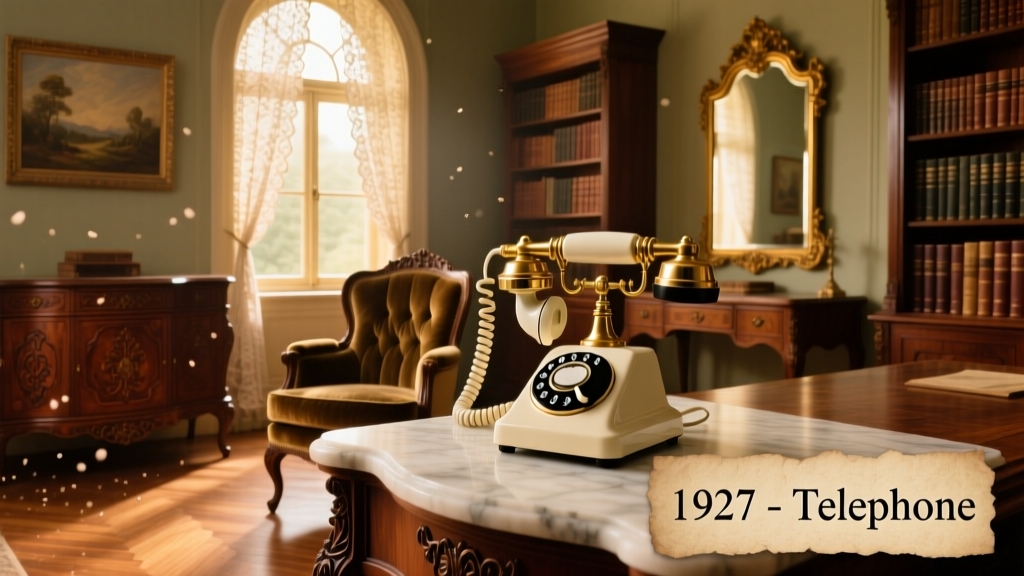
The 1920s brought radical redesign. Western Electric’s Model 102 (1927) replaced the candlestick with a compact, all-in-one desktop unit featuring a Bakelite housing, a cradle-mounted handset, and an integrated ringer. Its dimensions—6.75 inches wide × 4.25 inches deep × 5.5 inches high—reflected new priorities: stability, noise reduction, and operator convenience. Crucially, the Model 102 introduced the anti-sidetone circuit, which electronically attenuated the user’s own voice in the receiver—a feature absent in earlier sets and critical for usability. The Bakelite used was phenol-formaldehyde resin, molded at 150°C under 1,000 psi pressure; original specimens exhibit a consistent density of 1.28–1.32 g/cm³ and show no surface bloom (a whitish haze caused by plasticizer migration in later imitations). British General Post Office (GPO) telephones, such as the Type 150 (1929), used ebonite instead of Bakelite and featured a distinctive ‘bell-and-crown’ logo stamped into the metal nameplate.
The Rotary Dial Ascendancy (1930–1955)
The Western Electric 302, launched in 1937, defined mid-century telephony. With its streamlined aluminum alloy housing (3003-H14 temper, tensile strength 17,000 psi), chrome-plated steel dial plate, and integrated network coil, it combined durability with elegant minimalism. Its rotary dial required exactly 100 ± 5 gram-force to rotate—a precise calibration necessary for reliable pulse generation. The dial’s gear ratio was fixed at 10:1, meaning ten full rotations of the finger wheel produced one electrical pulse per digit. This mechanical fidelity meant that worn bushings or dried lubricants directly impacted dial return speed and pulse timing. The 302 measured 8.25 inches wide × 6.5 inches deep × 5.75 inches high and weighed 5.2 pounds. Over 12 million units were manufactured between 1937 and 1955, making it the most widely deployed telephone model in North America before the advent of touch-tone.
Key Manufacturers and Regional Variations
Western Electric, wholly owned by AT&T, dominated U.S. production, supplying over 90% of telephones installed on the Bell System network until 1984. Its manufacturing plants in Chicago (Hawthorne Works), Kearny (NJ), and Baltimore enforced strict tolerances: transmitter carbon granules were graded to 0.15–0.25 mm diameter; receiver electromagnets used 3,200 turns of #38 AWG enameled copper wire wound at 120 rpm under 2.5 grams tension. Competitors included Automatic Electric Company (founded 1901), whose 1930s ‘Model K’ featured a unique ‘clickless’ dial mechanism using a centrifugal brake, and Kellogg Switchboard & Supply Co., known for robust, field-serviceable designs like the 1925 ‘Kellogg 21B’ with its exposed terminal block and modular coil assembly. In Britain, the GPO exercised a legal monopoly, mandating rental-only models and rigorous testing—every Type 232 (1939) underwent a 48-hour continuous ring test before dispatch. Canadian production centered on Northern Electric (later Nortel), which adapted Western Electric schematics but substituted local hardwoods like sugar maple for cabinet bases to meet tariff requirements.
Stromberg-Carlson, based in Rochester, NY, carved a niche with premium residential sets like the 1940 ‘Model 400’, distinguished by its polished walnut cabinet (Janka hardness 1,450 lbf), ivory-colored cellulose acetate handset, and dual-bell ringer calibrated to 72 dB(A) at 1 meter. Unlike Western Electric’s integrated networks, Stromberg-Carlson used discrete components mounted on a removable phenolic board—facilitating field repairs but complicating conservation due to inconsistent replacement parts.
Materials Science and Degradation Pathways
Understanding material behavior is foundational to ethical restoration. Bakelite, while durable, undergoes hydrolytic degradation when exposed to humidity above 60% RH over extended periods. This causes microcracking along stress lines and embrittlement—especially problematic in thin-walled components like dial plates. Original celluloid handsets (used pre-1925) present serious hazards: cellulose nitrate decomposes exothermically, releasing nitrogen oxides that accelerate corrosion in adjacent brass components and pose fire risk. No original celluloid telephone should be powered or stored near heat sources.
Brass alloys require particular attention. Most antique telephones use C26000 ‘cartridge brass’ (70% Cu, 30% Zn), valued for machinability and acoustic properties. However, dezincification—a selective leaching of zinc in moist, chloride-rich environments—leaves a porous, copper-rich residue that crumbles under light pressure. This manifests as pinkish discoloration near screw threads or base edges. Nickel plating over brass, common on candlesticks, fails via galvanic corrosion when the plating is scratched and exposed to airborne sulfur compounds, forming black copper sulfide nodules.
Wiring insulation presents another challenge. Early cloth-covered rubber (1880–1915) contains sulfur accelerators that migrate into copper conductors, causing intergranular cracking. Later varnished cambric (1920–1940) degrades into brittle, flaking layers that expose bare wire. Modern PVC replacements are chemically incompatible: their plasticizers leach into Bakelite, causing irreversible swelling. Conservation best practice mandates retention of original insulation wherever mechanically sound, with targeted repair using period-correct silk-wrapped cotton (available from specialty suppliers such as Antique Telephone Supply Co. in Columbus, OH).
Authentic Restoration: Principles and Pitfalls
Restoration must prioritize historical integrity over cosmetic perfection. The American Institute for Conservation’s Code of Ethics explicitly prohibits irreversible alterations that obscure original manufacture. This means: never sanding original nickel plating to ‘brighten’ it (removes 0.0001 inch of historic metal); never replacing an original carbon transmitter unless electrically nonfunctional (modern ceramic transmitters alter frequency response and sidetone balance); and never refinishing Bakelite with automotive clear coat (causes hazing and yellowing within 5 years).
Proper cleaning begins with dry methods: soft-bristled brushes (size 0000 sable), microfiber cloths, and filtered air at <30 PSI. For stubborn grime on metal, a 1:1 mixture of deionized water and ethanol—applied with cotton swabs rolled to match contour radii—is acceptable. Never use ammonia, vinegar, or commercial brass cleaners: they attack patinas and accelerate dezincification. Bakelite responds well to mineral spirits applied sparingly with a lint-free cloth; aggressive rubbing removes surface polymer chains, dulling gloss permanently.
Electrical safety is non-negotiable. All antique telephones connected to live telephone lines must have capacitors rated for 600 VAC and inductors tested to UL 1459 standards. The original 1930s Western Electric capacitor (part #110A201) used oiled paper dielectric and is no longer safe for line voltage. Replacement must be a Class X2 certified film capacitor (e.g., Panasonic ECQ-U2A104ML) with identical capacitance (0.1 µF) and physical footprint. Never bypass or omit the capacitor—it protects users from shock during lightning-induced surges.
Functional Testing and Calibration Protocols
A restored telephone must perform as intended—not merely look correct. Testing requires calibrated equipment: a Fluke 87V multimeter for DC resistance (transmitter should read 35–55 ohms; receiver 120–180 ohms), a Tektronix TDS2002 oscilloscope for dial pulse analysis, and a Goldline GL-200 line simulator to verify ring voltage (90 VAC RMS at 20 Hz) and loop current (23–60 mA).
Dial calibration is especially critical. Using the oscilloscope, capture pulses generated by digits 1 through 0. Each digit must produce pulses matching these specifications:
- Digit 1: 1 pulse, 60–70 ms duration, 400–500 ms inter-pulse interval
- Digit 5: 5 pulses, each 60–70 ms, 400–500 ms apart
- Digit 0: 10 pulses, same timing parameters
- Maximum allowable variation: ±15 ms per parameter
Failure indicates worn governor springs, hardened lubricants in the flywheel assembly, or misaligned cam followers. Disassembly requires torque-controlled tools: the 302’s dial mounting screws demand exactly 4.5 in-lb—overtightening strips the aluminum housing threads.
Acoustic testing follows ANSI/TIA-920.140 standards. A calibrated microphone (Brüel & Kjær 4134) placed 2 inches from the transmitter measures output level at 1 kHz. Original 302s produce 52–56 dB SPL; readings below 48 dB indicate degraded carbon granules or diaphragm fatigue. Receiver sensitivity is tested at 800 Hz: original units deliver 47–51 dB SPL. Consistent deviation across frequencies points to magnet demagnetization—a condition corrected only by professional remagnetization using a Helmholtz coil at 12,000 Oersteds.
Preservation Guidelines for Collectors and Institutions
Long-term preservation hinges on environmental control. Ideal storage conditions: 18–20°C (64–68°F), 40–45% relative humidity, and complete darkness. UV exposure accelerates Bakelite oxidation and fades dyed cellulose acetate. Display cases must use acrylic (not glass) with UV-absorbing additives (e.g., Cyrocast UF-3), and internal lighting limited to LED sources emitting <50 lux at the object surface.
For institutions, documentation is paramount. Every telephone should be photographed with scale bars (metric and imperial), assigned a unique accession number, and entered into a database recording: manufacturer, model, serial number, date of manufacture (if stamped), materials inventory, prior conservation interventions, and electrical test results. The Smithsonian’s National Museum of American History uses a standardized form (NMAH-TEL-2022) capturing 47 discrete data points per instrument—including weight to the nearest 0.1 gram and dial plate thickness measured via digital micrometer at three locations.
Private collectors benefit from joining the Antique Telephone Collectors Association (ATCA), founded in 1962. With over 1,200 members across 14 countries, ATCA maintains the definitive reference library, including factory service manuals for 147 models, and hosts annual technical symposia where conservators share findings—such as the 2023 discovery that original Western Electric carbon granules contain trace manganese (0.012%) acting as a natural stabilizer against compaction.
| Model | Manufacturer | Production Years | Weight (lbs) | Key Material | Transmitter Type | Dial Pulse Range (ms) |
|---|---|---|---|---|---|---|
| 20B Candlestick | Western Electric | 1905–1915 | 3.8 | Cast iron / nickel | Carbon button | N/A (manual switchboard) |
| 102 Desk Set | Western Electric | 1927–1932 | 4.1 | Bakelite | Carbon button | N/A (manual/early automatic) |
| 302 Standard | Western Electric | 1937–1955 | 5.2 | Aluminum alloy 3003 | Carbon granule | 60–70 |
| Type 232 | GPO (UK) | 1939–1950 | 4.9 | Ebonite | Carbon granule | 65–75 |
| Model 400 | Stromberg-Carlson | 1940–1948 | 6.4 | Walnut / cellulose acetate | Carbon granule | 62–68 |
Finally, provenance matters. A Western Electric 302 with documented service history from the 1941 Pearl Harbor Naval Communications Center carries irreplaceable historical weight—even if its finish is worn. Conversely, a ‘mint’ 1950s reproduction with flawless chrome and perfect dial action holds negligible archival value. Authenticity resides not in surface perfection, but in verifiable lineage, intact original components, and adherence to period manufacturing standards.
One often-overlooked detail is the bell gong. Original Western Electric gongs are made from phosphor bronze (C51000), tuned to 320 Hz ±2 Hz. Reproductions use stainless steel or aluminum, producing a harsh, flat tone lacking harmonic richness. A simple tap test with a brass tuning fork reveals the difference: genuine gongs sustain resonance for 3.5–4.2 seconds; fakes decay in under 2 seconds.
Another subtle marker is screw thread specification. Pre-1930 U.S. telephones used Unified Thread Standard (UTS) 6-32 UNC screws; post-1935 models switched to 6-40 UNF for finer adjustment. British GPO sets used Whitworth threads (BSW), identifiable by 55° thread angle versus UTS’s 60°. Mis-matched screws introduce torsional stress and strip threads during routine maintenance.
Capacitor dating provides precise chronological anchors. Western Electric used distinct capacitor can colors by era: gray (1937–1941), blue (1942–1945), red (1946–1950), and green (1951–1955). The presence of a blue capacitor in a supposedly 1939 302 indicates wartime refurbishment—a valuable detail for historians studying industrial adaptation during WWII.
Ultimately, antique telephones are functional artifacts that bridge engineering history and social practice. Their preservation demands equal parts metallurgical knowledge, electrical competence, and historical literacy. When handled with respect for original intent and materials, they continue to speak—not just across wires, but across time.
Resources for Further Study and Sourcing
For technical depth, consult Western Electric Engineering Department Bulletin No. 127 (1938), which details dial timing tolerances and network impedance calculations. The GPO’s Telephone Apparatus Maintenance Manual, Issue 7 (1947) remains the definitive guide for British models. Digitized copies are available through the ATCA Digital Archive and the BT Archives in London.
Reputable suppliers include: Antique Telephone Supply Co. (Columbus, OH) for period-correct carbon granules and silk-wrapped wire; Bakelite Resource Group (Newark, NJ) for authenticated vintage phenolic resins; and Precision Electroplating Inc. (Rochester, NY), which offers nickel plating to original 1920s thickness specifications using sulfamate baths.
Museums with significant holdings include the Telephone Pioneers Museum (Denver, CO), the New England Wireless and Steam Museum (East Greenwich, RI), and the Science Museum Group (London, UK). Each permits supervised access to their conservation labs for qualified researchers—a vital opportunity to examine tool marks, casting seams, and solder joint morphology firsthand.
More Like This
Jennings Monte Carlo Console: A Deep Restoration and Historical Analysis of the 25-Cent Coin-Operated Arcade Cabinet
Advertising Tin: Axle Grease Stenciled on Cover with Bail Handle — A 4 × 5½-Inch Artifact of Early Automotive Lubrication History
Decoding the 1138806: A Technical and Historical Analysis of the 1954 Baker Furniture Company 'Chippendale Revival' Mahogany Breakfront Bookcase

Netsuke Spotlight: Ivory Boat Netsuke Signed 'Shin' with Cinnabar Seal — A 2¼-Inch Masterpiece of Edo Period Narrative Carving
Spic the Coon Drummer: A Critical Examination of Marx’s 1925 Tin Lithograph Wind-Up Toy and Its Historical Context
The Sinclair Oil Attendant Hat: A Study in Mid-Century Automotive Branding and Textile Craftsmanship
Fleischmann’s 1917 Cookbook: The Woman With Bread, Domestic Authority, and the Rise of Brand-Driven Home Baking
Stoneware Jug with Birch Leaf Motif: Identifying, Valuing, and Preserving a 4-Gallon American Folk Art Masterpiece
Identifying This Parian Pitcher: A Specialist’s Guide to Authenticity, Maker Marks, and Historical Context